21 June 2020

Holy Martyr Ioulianos of Tarsos

Saint Ioulianos of Tarsos
القديس يوليانوس الطرسوسي

The twenty-first of June in the Holy Orthodox Church is the feast-day of Saint Ioulianos of Tarsos, who suffered for Christ under the late third-century persecutions of Diocletian. Ioulianos was a native of Cilicia in Asia Minor, but his cultus is widespread throughout the East and even in the Latin Church – and especially in Antioch, where his relics came to rest.

Saint Ioulianos [Gk. Ιουλιανός, L. Julian, Ar. Yûliyyânûs يوليانوس] was born in the year 271 or 272 in the Roman province of Cilicia, in the city of Anazarbos (today ‘Ayn Zarba in Turkey). His father, a Roman senator, was a pagan. His mother, however, was a secret Christian – and she was the one responsible for having him raised in the Christian faith, albeit in secret. After Ioulianos’s father died, his mother moved to the city of Tarsos. She gave him a high-quality education, and he grew up firm in the precepts of the Christian faith, and in the love of the Lord.

In the year 290, Diocletian began a terrible persecution of Christian believers in Rome, believing them to be subversives. Ioulianos, then a youth of eighteen years, was caught up in the first wave of these persecutions, and was brought before the court of the proconsul Markianos, who was stationed in Tarsos. Markianos was known as a brutal torturer of Christians, and in the young man’s case he was no exception. The beautiful youth stirred in the governor cruel and unnatural passions, and every day for a year after his capture Markianos had Ioulianos brought to him. At times he would flatter and caress the saint, promising him wealth and luxury and fame and honour if he would submit to sacrifice to the pagan gods. At other times he would threaten Ioulianos with a thousand tortures, each more agonising than the one before. But none of these swayed the young man, who remained steadfast in his confession of Christ and adamant in his refusal to honour idols.

The governor, hoping to shame and confuse the youth into obedience, each day had him stripped and trussed behind a camel, and dragged through the streets of Tarsos to the jeers of the crowds. But this procession had the opposite effect of what he intended, for Ioulianos took the opportunity to hold his head high and offer words of encouragement to the other Christians of the city. When he was led within the præcinct he was subjected to every manner of torture. The executioners tore his flesh and gouged deep gashes in his sides. They lay his bones bare and even exposed his internal organs to view. They used the lash and the scourge upon him. They used fire and brands. They used blades and hooks – and all to the utmost cruelty; yet for an entire year the youth spoke nothing different than what he had done. At the end of the year of these torments he was brought to the city of Ægeæ on the Cilician coast for execution.

The Orthodox tradition has it that when they reached Ægeæ the governor found his mother and brought him before her son, hoping that when she saw him brought so low she would encourage him to reconcile with the state and offer incense to the idols. Markianos did not know that the mother of Ioulianos was Christian. Instead, however, she gave him words of encouragement, and urged him to run the course of martyrdom to the end. When word of this reached the governor, he ordered the woman to be seized and beheaded.

Markianos’s pride had been broken against this youth whose resolve was as unshakeable as a rock. He devised for Ioulianos an execution which was reserved for the very worst of crime under Roman law – that of parricide. He had the martyr tied in a sack that was half-filled with sand along with venomous vipers and scorpions, and then cast into the sea. In this manner Saint Ioulianos attained the victory, and was crowned with the laurel of martyrdom and welcomed into the company of saints in heaven. The sea bore the body of the martyr lightly, and cast him up on the shores of Alexandria in Ægypt, where local Christians had him borne decently into the Church and tended reverently. His relics were taken to Antioch during the time of Saint John Chrysostom, who preached a stirring and heartfelt homily in the martyr’s memory at his new shrine, on the occasion of his translation. Since that time, Saint Ioulianos has been devoutly remembered by Antiochian Christians as one of their beloved local saints, and many wonders of healing and exorcisms attended the shrine of the martyr, by the power of his prayers to Christ. Wondrous and glorious athlete Ioulianos, bold sufferer of many torments for the sake of Christ our God, beseech Him Who only loves mankind to grant us great mercy!
Apolytikion to Saint Ioulianos of Tarsos, Tone 4:

Your holy martyr Ioulianos, O Lord,
Through his suffering has received an incorruptible crown from You, our God.
For having Your strength, he laid low his adversaries,
And shattered the powerless boldness of demons.
Through his intercessions save our souls!

20 June 2020

Holy architecture in Orthodoxy and Chinese religion


The Temple of Heaven, Beijing

At present I’m reading Fr Thomas Hopko’s The Orthodox Faith: an Elementary Handbook on the Orthodox Church series, and I’m currently on the second volume, on Worship. As I was reading Fr Thomas’s exposition on the structure of Orthodox temples, I was at once struck by a fascinating similarity, both in outward appearance and in design principles, between the outlay of an Orthodox church built according to the traditional architectural schematics, and the outlay of a Chinese temple in the Rujia or Daojia traditions.

In traditional Chinese cosmology there is the principle of tian yuan di fang 天圓地方 (literally: ‘Heaven is round; Earth is square’). We should be clear that this understanding of the outlay of the cosmos is mystical and ceremonial; we might even say, by analogy, liturgical. Postclassical Chinese observers such as Zhang Heng 張衡, just like ancient Greek ones, understood perfectly well from their naturalistic observations, that the physical earth has a spherical shape and is situated in the midst of the atmosphere like the round yolk inside the white and shell of an oval egg. However, the classical view of tian yuan di fang was meant to articulate, in an intuitive spiritual sense, the orientation of the human being to both the heavens and the earth.

This classical view is set forward in a Han Dynasty text, Dai the Elder’s Book of Rites (Da Dai Liji 《大戴禮記》), which was compiled around the same time as his nephew Dai the Younger compiled the canonical pre-Qin Ru classic, the Book of Rites. Dai the Elder’s name was affixed to the former text in later commentaries in order to distinguish the two. In any event, here Dai the Elder recounts a conversation between the disciple of Confucius Zengzi 曾子 and one of his students, Dan Juli 單居離, on the subject of the orientation of the human being to earth and heaven. This saying, which Zengzi contributes to Confucius himself, forms the basis of the principle tian yuan di fang. One can see from this that the ‘squareness’ of the earth and the ‘roundness’ of heaven are to be taken in a symbolic way rather than a naturalistic one. Note the mystical language and its relation to yin-yang cosmology and the classical elements, or wu xing:
「且來!吾語汝。參嘗聞之夫子曰:『天道曰圓,地道曰方,方曰幽而圓曰明;明者吐氣者也,是故外景;幽者含氣者也,是故內景,故火日外景,而金水內景,吐氣者施而含氣者化,是以陽施而陰化也。陽之精氣曰神,陰之精氣曰靈;神靈者,品物之本也,而禮樂仁義之祖也,而善否治亂所由興作也。』」

Come! I’ll explain it to you. I’ll refer to the discourse of the Master [Confucius]: ‘The Way of Heaven is round; the Way of earth is square. Squareness is called “deep” and roundness is called “bright”. Bright things give off energy [or breath], and throw shadows on the exterior. Deep things conceal energy, and they make shadows inside. Fire and sun[light] throw external shadows; metal and water make internal shadows. That which gives off energy generates, and that which conceals energy receives – in the same way that yang generates and yin receives. Yang’s essential breath is called “spirit”; and yin’s essential breath is called “numinousness”. Spirit and numinousness: these are the foundations of things; they beget rites and music, benevolence and justice; they tell us if good or evil, [social] order or chaos, are being produced.’
A quick note: the translations of ‘spirit’ for shen 神 and ‘numinousness’ for ling 靈 are not mine; these are suggested by Mark Csikszentmihalyi in his compilation of Readings in Han Chinese Thought. In modern Chinese, shen refers to any god – including the God of the Abrahamic religions – while ling refers to the human soul. It is perhaps a bit fanciful to relate these three terms qi, shen and ling to the Greek philosophical terms πνεῦμα, λόγος and νοῦς, respectively. However, one can see from the suggestion of this text – with shen referring an active-generative capacity and ling having a sensate-receptive one, and the breath being both an inward and an outward spiration – that the general contours of these analogical correspondences could be considered valid. For the classical Chinese mind, as well, the human being is literally a microcosm. In traditional Chinese medicine, human beings are intimately connected with their surroundings, and the internal workings of the human body are a functional mirror of the cosmic order.

But now we’re getting way into the weeds, and perilously so, particularly if we consider the following tale from the Daoist classic Zhuangzi. The tian yuan di fang principle is also referred to – albeit in a playfully pejorative way – in one of this text’s memorable vignettes. In this case, when talking with Duke Ai of Lu, the philosopher Zhuang Zhou makes reference to the ‘round caps’ and the ‘square shoes’ of the Ru literati, who in dressing this way signal that they try to follow the ways of heaven and earth:
莊子見魯哀公。哀公曰:「魯多儒士,少為先生方者。」莊子曰:「魯少儒。」哀公曰:「舉魯國而儒服,何謂少乎?」莊子曰:「周聞之:儒者冠圜冠者,知天時;履句屨者,知地形;緩佩玦者,事至而斷。君子有其道者,未必為其服也;為其服者,未必知其道也。公固以為不然,何不號於國中曰『無此道而為此服者,其罪死』?」於是哀公號之五日,而魯國無敢儒服者。獨有一丈夫儒服而立乎公門,公即召而問以國事,千轉萬變而不窮。莊子曰:「以魯國而儒者一人耳,可謂多乎?」

At an interview of Zhuangzi with Duke Ai of Lu, the duke said, ‘There are many of the Learned class in Lu; but few of them can be compared with you, Sir.’

Zhuangzi replied, ‘There are few Learned men in Lu.’

‘Everywhere in Lu,’ rejoined the duke, ‘you see men wearing the dress of the Learned - how can you say that they are few?’

‘I have heard,’ said Zhuangzi, ‘that those of them who wear round caps know the times of heaven; that those who wear square shoes know the contour of the ground; and that those who saunter about with semicircular stones at their girdle-pendants settle matters in dispute as they come before them. But superior men who are possessed of such knowledge will not be found wearing the dress, and it does not follow that those who wear the dress possess the knowledge. If Your Grace think otherwise, why not issue a notification through the state, that it shall be a capital offence to wear the dress without possessing the knowledge?’

At this the duke issued such a notification, and in five days, throughout all Lu, there was no one who dared to wear the dress of the Learned. There was only one old man who came and stood in it at the duke’s gate. The duke instantly called him in, and questioned him about the affairs of the state, when he talked about a thousand points and ten thousand divergences from them. Zhuangzi said, ‘When the state of Lu can thus produce but one man of the Learned class, can he be said to be many?’
The architectural idea of tian yuan di fang in Chinese traditional buildings, and particularly those consecrated to holy purposes, determines how a traditional Chinese temple is archetypically laid out. Despite Zhuangzi’s dismissive attitude towards the principle, which he associated with the learned (ru 儒) followers of Confucius, the Daoists themselves also adopted tian yuan di fang in laying out and constructing their temples, when Daojia became an organised religion during the transitional period between the Han and Sui Dynasties. Daoist temples, or daoguan, were traditionally constructed on the southern slopes of mountains, making it easy to reflect the relation of heaven to earth. To the left is the stylised floor plan of a daoguan, from the Judge Dee mystery The Haunted Monastery by Dutch sinologist RH van Gulik.

The traditional Chinese temple is usually situated in the centre of an oval ground with its foci and long axis oriented north-south. The temple itself usually has a rectangular base structure oriented in the same way. In the northern rear of the temple, in the main altar or sanctum, the floor structure is (semi-)circular and elevated. This is meant to represent the heavens. The main altar is separated from the rest of the temple by a wall or a shrine. The southern front courtyard of the temple always has a rectangular floor plan, and is situated level with the surrounding landscape. This is meant to represent the earth. Here is a brief explanation of the way the Temple of Heaven in Beijing (which is not just one temple but in fact a whole complex of them) is laid out:
The overall planning of the Temple of Heaven met with basic ancient Chinese architectural ideas. A double ring of walls enclose the compound of temple structures. The ‘north circular’ and ‘south square’ meet with the Chinese traditional understanding of the cosmos as a ‘hemispherical dome’, situated over a ‘flat earth’. Similarly, the north wall was constructed higher than the south wall, signifying that Heaven is higher than Earth. As the temple was where the emperor would pray to the heavens, the temple’s design needed to reflect this relationship. In accordance with the theory of Hemispherical Dome, the north wall of the temple was designed to be circular, a symbol of Heaven’s shape; the south wall was to be square, representing the Earth’s appearance. The main temple buildings line up from north to south along the central axis of the compound. All the temple structures have a square or circular design, again representing the shapes of Heaven and Earth.
There is a directly analogous principle to tian yuan di fang, with regard to how the Orthodox church building is traditionally founded and built. Fr Thomas Hopko explains:
The interior of the Orthodox Church building is
particularly styled to give the experience of the unity of all things in God. It is not constructed to reproduce the upper room of the Last Supper, nor to be simply a meeting hall for men whose life exists solely within the bounds of this earth. The church building is patterned after the image of God’s Kingdom in the Book of Revelation. Before us is the altar table on which Christ is enthroned, both as the Word of God in the Gospels and as the Lamb of God in the Eucharistic sacrifice. Around the table are the angels and saints, the servants of the Word and the Lamb who glorify Him—and through Him, God the Father, in the perpetual adoration inspired by the Holy Spirit. The faithful Christians on earth who already belong to that holy assembly—‘…fellow citizens with the saints and members of the household of God…’ (Ephesians 2:19)—enter into the eternal worship of God’s Kingdom in the Church. Thus, in Orthodox practice the vestibule symbolises this world. The nave is the place of the Church understood as the assembly and people of God. The altar area, called the sanctuary or the holy place, stands for the Kingdom of God.
In an Orthodox church, the sanctuary is elevated and is set under a high dome on a semicircular floor plan: specifically to reflect heaven. This sanctuary is separated from the nave by the ikonostasis in a manner similar to the way in which the main courtyard of a Chinese temple is separated from the altar by the shrine. The vestibule represents the world while the nave (similar to the courtyard of a Chinese temple), where the people stand during the Divine Liturgy, is where the people of God are called out from the world to stand in the presence of God Who is in the altar as the elements of the Eucharist.

Unlike a traditional Chinese temple, which is built between two foci on a north-south axis with the altar on the northern side, an Orthodox church must be built between two foci on an east-west axis with the altar on the eastern side. However, here too, after a certain sense, the principle of tian yuan di fang is followed. The west, representing death, sin and the fallen state of the world, is where the vestibule is situated; the progression towards the altar in the east is a progression towards the Kingdom of Heaven, towards life and its æternal source in Christ. This is in keeping with the mindset common to the classical cultures of Ægypt, Sumer and Greece, in which one determines direction – that is, literally orients oneself – by facing the rising sun.

Even in the principles of architecture, there are obvious and natural consonances between the worldview of the righteous philosophers who lived and strove after the truth, and that Truth which was revealed in its fullness from among the people of Israel in the person of Christ. Daojia and Rujia both contain incredible profundities of wisdom and truth in their own right, which are born from the careful and methodical study of nature, the desire for harmony, the quest for loving-kindness, the exploration in stillness of the heart ‘which is deep beyond all things’, the anticipation of a perfect Sage who will rightly order the cosmos to its proper ends. Orthodox Christianity is in full agreement with all of this. Again, as Fr Thomas Hopko puts it:
At this point it must be mentioned that although God’s self-revelation in history through the chosen people of Israel--the revelation which culminates in the coming of Christ the Messiah--is of primary importance, it is also the doctrine of the [Orthodox] Christian Church that all genuine strivings of men after the truth are fulfilled in Christ. Every genuine insight into the meaning of life finds its perfection in the Christian Gospel. Thus, the holy fathers of the Church taught that the yearnings of the pagan religions and the wisdom of many philosophers are also capable of serving to prepare men for the doctrines of Jesus and are indeed valid and genuine ways to the one Truth of God.

Saint Sophia Cathedral, Harbin

18 June 2020

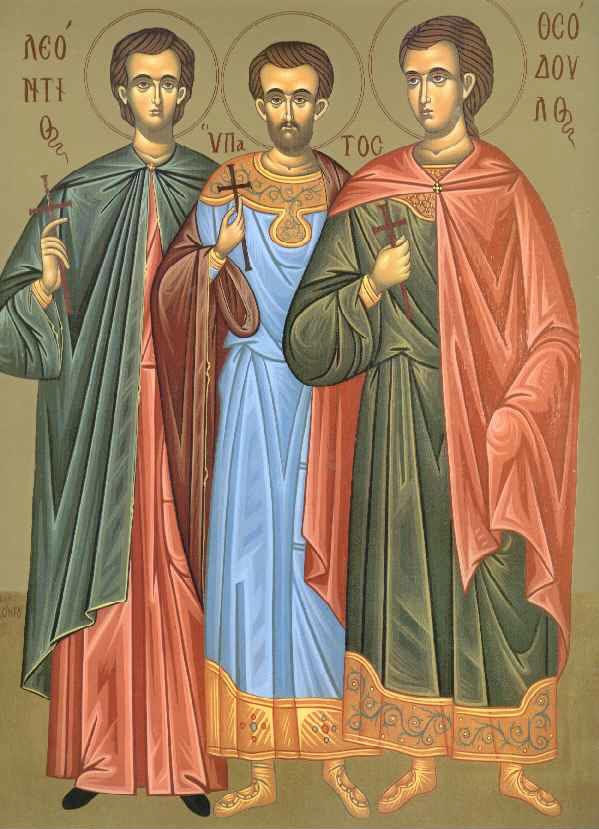
Martyrs Leontios, Hypatios and Theodoulos of Tripoli in Syria


Saints Leontios, Hypatios and Theodoulos of Tripoli

Today in the Orthodox Church we recognise and celebrate three first-century holy martyrs of the Antiochian Church. Saints Leontios, Hypatios and Theodoulos were Roman military officers stationed in Tripoli in Phœnicia – what is now Ṭarâbulus in Lebanon. They suffered for the Christian faith under the persecutions of the pagan Roman Emperor Vespasian, sometime between the years 70 and 79.

Leontios [Gk. Λεóντιος, L. Leontius] was a Peloponnesian Greek by origin. He was handsome and of a tall, muscular build – which made him eminently suitable for service in the Imperial Army. He reached the rank of centurion, or commander. When he began his service, he distinguished himself by his profound natural virtues. He was courageous, as he had many victorious engagements to his name. But he was also possessed of a calm, deliberate mind and moderate habits of living, such that he was singled out by his superiors for his sound judgement. The Romans stationed at Tripoli held the young officer Leontios in high esteem.

Over the province of Syria Prima the Emperor Vespasian appointed a new military governor. This was in response to the First Jewish Revolt and the Siege of Jerusalem which resulted in the destruction of the Second Temple. Being concerned about future uprisings, this military governor, who was named Hadrian (not to be confused with the later Emperor), was given leave to operate with a heavy hand in his new province. The political loyalty of the Christians was regarded as suspect, and they were often blamed for the disasters and political unrest which occurred in the Empire at this time. The Jews, though their position after the destruction of the Temple was indeed lamentable, were consequently not the only ones to suffer the Empire’s wrath in the wake of this crackdown in the provinces of the Eastern Mediterranean.

It soon came to the attention of Hadrian that Saint Leontios was guilty of what he considered to be several infractions of Roman military discipline. Leontios had opened the military stores of grain in order to help refugees and other poor people fleeing from the destruction at Jerusalem. Moreover, Leontios refused to offer tribute to the pagan gods of Rome and had convinced several of his fellow officers to likewise refrain, which led Hadrian to suspect him of being a Christian. The man which Hadrian sent to Tripoli with a detachment of soldiers to find and detain Leontios, was a chiliarchos named Hypatios [Gk. Υπáτιος, L. Hypatius]. On the journey to Tripoli, Hypatios was taken ill with a high fever, and at one point was near death. A messenger of God came to Hypatios and told him: ‘If you wish to be healed, you and all your soldiers together must cry aloud to heaven three times: “O God of Leontios, save me!”

Hypatios demanded of the angel to know why he should pray to the God of the man he was sent to arrest, but the messenger vanished as it had come. Hypatios nevertheless told of his vision to the detachment with him, among whom was a friend of his named Theodoulos [Gk. Θεóδουλος, L. Theodulus]. And together they did what the angel had told them to do. They gathered together and cried aloud three times in unison to the God of Leontios to save their tribune. Wondrously, no sooner was this done than Hypatios’s fever broke and he began to recover. The soldiers were overjoyed at this, but among them only Theodoulos truly marvelled at this wonder. He was amazed and baffled, and ultimately overcome by a deep love for God. He encouraged Hypatios to hurry ahead of his detachment with him, that they might seek out Leontios for themselves.

Hypatios and Theodoulos arrived in Tripoli ahead of their detachment, and set about at once looking for Leontios. But they had not spent very long in the city before they were greeted by a stranger in the street, who invited them to his home and hosted the two soldiers lavishly. It did not take the tribune and his aide long to figure out that their host was indeed the same centurion Leontios whom they had been told to seek out. They fell upon their knees before him and asked him to teach them about this God of his, who had by His grace and power healed Hypatios of his fever even on the brink of death. And Leontios began to teach them about Christ – the God who became flesh, who came into the world to redeem mankind from death, and who himself died and was risen in the flesh – and Hypatios and Theodoulos believed and asked to be baptised. Leontios brought them to a priest and acted as their sponsor: at their baptism Saint Leontios pronounced over them a prayer to the Holy Trinity. A luminous cloud appeared then in the sky and began to rain upon them in a sign of grace.

The detachment of Hypatios then arrived in Tripoli, followed soon after by the governor Hadrian himself. It did not take them long to figure out that not only had Hypatios and Theodoulos not arrested Leontios, but that they had also become Christians. The governor had all three of them arrested and brought before him – and, threatening them with torture and death, commanded them to renounce Christ and to offer sacrifice to the Roman gods. All three of the martyrs adamantly refused, and confessed their faith in Christ. Saint Hypatios was placed under a column and scourged with iron claws, while Saint Theodoulos was beaten brutally with rods. Neither of them, however, renounced Christ. Seeing the steadfastness of these two martyrs, both of them were put to the sword. Saint Leontios was returned to prison, to be brought before the governor the next day.

When he was brought before Hadrian, the governor promised Saint Leontios high honours and rich rewards if he would only offer a small sacrifice of incense to the Roman gods, but Leontios refused every bit as adamantly as his fellow martyrs had done. Seeing that blandishments were getting him nowhere, the cruel governor had Leontios hung upside down from a pillar, with a heavy stone around his neck. Despite this torture, Leontios would not renounce his belief. Then Hadrian ordered his men to take rods and beat Leontios to death, which they did. They then took his body down from the pillar and flung it over the wall outside Tripoli. But the Christians of the town went out and found the relics of Saint Leontios and interred him decently in a grave on land owned by a local Christian noblewoman named Joanna, who had given money to the soldiery to take the body. The accusations against Leontios, as well as the record of his punishments and death, are recorded on tin tablets prepared by the governor’s scribe Notarios. These tablets were placed at the grave of the martyr. Holy martyrs Leontios, Hypatios and Theodoulos, confessors of Christ before the fruitless wrath of pagan Rome, pray unto Christ our God that our souls may be saved!
Apolytikion of the Martyrs Leontios, Hypatios and Theodoulos, Tone 4:

Thy Martyr, O Lord, in his courageous contest for Thee
Received the prize of the crowns of incorruption and life
From Thee, our immortal God.
For since he possessed Thy strength,
He cast down the tyrants and wholly destroyed the demons’ strengthless presumption.
O Christ God, by his prayers, save our souls, since Thou art merciful.

17 June 2020

Je suis Georges Sorel!


A Family Dinner, a French cartoon about the Dreyfus Affair

Unfortunately, quality control at The American Conservative has gotten a trifle lax these days under Arthur Bloom. They seem to be giving a platform to every corrupt careerist Reaganite, cult-apologist comprador and China-watching hack that is willing to pen a dishonest ‘populist’ screed against China. And of course it does, because Bloom has held a wet finger to the wind, and he’s now elbowing and jostling for a position of prestige among the rising-star set of barely-reconstructed neoconservatives and quasi-protectionist nouvelle-droite Republicans like Hawley, Cotton, Rubio and McCarthy. But in a welcome change of pace away from this trend, a recent op-ed by Will Collins, which compares our current cultural moment to the upheaval following France’s Dreyfus Affair, got me thinking again about Georges Sorel’s 1908 work Réflexions sur la violence. Indeed, the killing of George Floyd, the erosion of institutional trust that it highlights, and the conscription of two duelling forms of the national myth – all point to the prescient, if idiosyncratic, what might be called ‘Tory-anarchist’ interpretation of Marx that Sorel became famous for.

Sorel’s interpretation of Marx is controversial for a number of reasons. He went from being a far left-wing anarcho-syndicalist when he started writing, to a far right-wing integral nationalist aligned with Maurras, before finally recoiling in horror from that turn and ending his life as a Leninist supporter of the Bolshevik Revolution in Russia – very similar to the turn that the Coptic Orthodox Fabian Salâma Mûsâ took at the end of his life. And yet the substance of his political commitments actually didn’t change that much with all his radical swings of loyalty to movements. It is small wonder that the contemporary left, which has been sensitised by the history of WWII to any whiff of sympathy to the far-right, has largely treated the work of this seminal theorist of the general strike as radioactive and not to be touched. Even so, he offers some credible and necessary critiques of our current moment, particularly in light of Collins’s apt analogy to France’s past.

He is one of those thinkers whose political thought is ‘unclassifiable’ by conventional means, and yet it has an internal logic that – for the most part – holds up when examined on its own terms. Sorel was a perennial political ‘outsider’, and he tended to view what were then ‘normal’ political processes in France with mounting disgust. In his examinations of the state, he was quick to note the subtle turns to force and fraud. He was a caustic critic of intellectuals and political agents who joined the ‘workers’ movement’ in France, only to subtly assert their own bourgeois class interests and advocate for compromise and triangulation when they approached the parliamentary seats of power: we can justly say that Sorel, then, is an early critic within Marxist circles of what Barbara Ehrenreich called ‘PMC’ politics. At the same time, he upheld a view of personal morality which was much in line with what the Catholic Church (and, more importantly, Pierre-Joseph Proudhon) had to say on matters of sexual comportment and defence of the nuclear family.

Sorel anticipated the libertarian-right critique of socialism as primarily motivated by envy, and the Christian-right critique that it is primarily motivated by materialism – and he moved accordingly to assert a noble, militant, master-moral anarcho-socialism that is motivated by a spirit of conquering heroism and martyric sacrifice to the glorious cause. In this he conscripted not only the existentialism of Friedrich Nietzsche but also the élan vital of Henri Bergson – the theorist of durée réelle and evolutionary creativity whose thought captivated so many post-colonial theorists. For Sorel, the most important element in Bergson was his assertion of the intuition and the creative instinct, which Sorel interpreted to mean the refinement through praxis of the working class’s revolutionary consciousness. He articulated the power of myth in both revolutionary and reactionary politics, and in so doing elevated Marxist discourse out of mere analysis into something akin to a crusade. There is a utopian dimension to his thought that links his vision of the militant proletariat indelibly to Nietzsche’s overman: the forger of new values and new virtues. But most importantly: he posited a distinction between force and violence that would later become a staple of anarchist thinking about where and how violent direct action would be appropriate and justifiable.

For Sorel, force – which, along with deception, was one of the two tools of the state to enforce its will on the mass of people – means precisely that form of coercion which is institutionally justified and legitimised in the service of the élite class, and channelled through the state. Where Sorel uses the term violence, on the other hand, he uses it to mean those forms of violence that are not institutionally justified and which are the outbursts of the oppressed people. Sorel is often wrongly understood as justifying any and all violence, but this is precisely a wrong reading. For Sorel, violence is one possible tool, and possibly the most important tool, of revolutionary change – one which is to be used judiciously and in a targeted fashion to galvanise and inspire the working class to feats of heroism and self-sacrifice.

Georges Sorel would, in fact, look with an entirely understanding – but not necessarily approving – eye on the way the protests here have played themselves out. Sorel would almost challenge us to see the violence of the riots as the entirely-logical and entirely-predictable outcome of the display of brute force which the Minneapolis police used on George Floyd. At the same time, I’m sure that Sorel would condemn in no uncertain terms the directionless and leaderless aspect of much of the violence, and call on us to discern the instances of heroism from the instances of buffoonery, opportunism and provocation. It’s a foregone conclusion that he would decry and disown the opportunistic PMCs who have joined the protests, either to vent their anger at their parents or to position themselves into institutional leadership rôles and redirect the energies of a justifiably-outraged black community into the usual institutional cul-de-sacs.

And Collins’s comparison in the TAC of the current moment to the Dreyfus Affair, is also useful and illuminating. Sorel was an ardent and unapologetic Dreyfusard – a supporter of Alfred Dreyfus against the institution of the French Armed Forces. Georges Sorel, along with his younger contemporary poet and philosopher Charles Péguy, sincerely and rightly believed that Alfred Dreyfus was the wrongful victim of the bigotry of the French public, and a scapegoat who was singled out on account of his Jewishness. So why, then, did both Sorel and Péguy turn to the anti-Dreyfusards, like Maurras, after 1908? For both Sorel and Péguy, the answer lies in their visceral revulsion, not to Dreyfus himself, but to the opportunists and political hacks who leapt upon Dreyfus’s cause for reasons of image-conscious self-display: what we would now call ‘virtue signalling’.

The other dimension to Sorel’s turn away from being a Dreyfusard, involves his understanding of the importance of myth. Here we may take Collins up on the analogical terms he sets forth. The Dreyfus Affair conjured forth two rival conceptions of France, each conception reliant upon a myth of France: either as the confessional-monarchical France of 1631, or the revolutionary France of 1789. Georges Sorel was not only repulsed by the virtue signalling of Dreyfusard ‘buffoons’ like Émile Zola, but he was also repulsed by the ease with which fellow-Dreyfusards like Jean Jaurès linked Dreyfus’s cause to the glorious history of the Revolutionary Republic of 1789, and cynically used Dreyfus as a political symbol to corral the working class into giving him their political support. Collins likewise notices and remarks upon the parallel way in which George Floyd’s extrajudicial execution has conjured forth the two rival mythic conceptions of America, which are pegged to 1619 and 1776 respectively. Though I say so myself, he is entirely right to do so.

The rôles are somewhat reversed, admittedly. The Dreyfusards, in conjuring forth the spirit of 1789, were deliberately hearkening to a positive self-image of France that they felt themselves in danger of losing; while the Floydards of today in conjuring forth 1619 are hearkening to a negative self-image of America that they seek to tear down and rebuild from the ashes. But the class dynamics and the political motives are entirely the same! Are we truly to believe that the academic historians who contribute to the 1619 Project are entirely disinterested observers of American history, and that they have no stake in building their own brands and burnishing their academic credentials? Or are we truly to believe in the sincerity of the contrition of a New York Times, which has in the spirit of William Randolph Hearst supported each and every one of America’s imperial wars, colour revolutions and coups – from Yugoslavia, through Iraq and Honduras and Libya and Syria and Venezuela, most recently to Bolivia?

I have certain problems with Georges Sorel. First and foremost: I refuse to give in to anti-Semitic diatribes and canards, the way Sorel did during his intégriste days in Action française. Indeed, I have difficulties with intégrisme itself, on related but slightly different grounds. Second: I am not an anarchist and never will be one. Sorel may have certain commonalities with Christian – and specifically Roman Catholic – doctrines and values, for example in his advocacy of the stability of the family unit. But his conception of the state as thoroughly corrupt and corrupting, and his totalised denunciation of all state action, is explicitly and even deliberately anti-Christian. Indeed, though he thoroughly understands Christianity to have been a revolutionary and egalitarian movement from the beginning, he evokes the Christian response to the Roman Empire, and its ultimate takeover of the Empire under Saint Theodosius, as an example of the sort of relation to the state to avoid.

Even so, Sorel’s prescience here is valuable. It is necessary for us, as Americans, to construct counter-myths that are neither 1619 nor 1776, just as Georges Sorel articulated in the wake of the Dreyfus Affair the necessity of making new myths that are neither 1631 nor 1789. More immediately it is entirely possible – indeed, entirely necessary – to rightly honour George Floyd and seek for effective and immediate restructuring of the police. It is entirely possible to condemn, on moral grounds, the arbitrary state force which ended Floyd’s life for no good reason. At the same time, it is possible and necessary to denounce and lay bare the hypocrisies and grotesque self-interest of the hangers-on and political operatives, or the people who riot or burn or destroy just to vent. The pain and loss and devastation of black communities, the loss of life, the loss of years in incarceration, the loss of innocence – these are all real. But to cynically use this pain and loss to further careers among the commentariat, or to bolster places in think-tanks or foundations or the machine politics of the same imperialist-consumerist-carceral structure that produces it…! In this instance, I cannot help but say in response to Collins, in the context of our new Dreyfus Affair: ‘Je suis Georges Sorel!

15 June 2020

Holy New-Martyr Constantine Hagarit of Smyrna


Saint Constantine of Smyrna

The fifteenth of June in the Orthodox Church is the feast-day of a New Martyr of Mount Athos and a working-class saint of the Church, Saint Constantine of Smyrna. One of several New Martyrs to have suffered under the Ottomans, Saint Constantine is rare in that, like Saint ’Ahmad the Calligrapher, he was martyred for having converted to Orthodoxy from his native faith, rather than as part of an ethnic persecution or a religious pogrom.

Saint Constantine was born during the late eighteenth century, to a poor Turkish mother; we do not know his birth name, only his baptismal one. He had two siblings: a brother and a sister; however, he grew up without a father. As a youth he suffered from smallpox which affected his sight; a kindly local Christian woman cured him by sprinkling his face with holy water from an Orthodox shrine. They lived in Smyrna, on the coast of Asia Minor, and from a young age he had to make a living selling fresh greens in the marketplace. Sometimes, it seems, he also sold on the streets outside, because he had occasion several times to visit the house of the local Greek Orthodox Metropolitan Kallinikos of Smyrna. Because the Metropolitan was kind to him, and often bought vegetables from him, the young Turkish lad would often stay in the house, and listen as guests visited the bishop and discussed with him and read the Scriptures and the lives of the saints. In this way, the boy – who had a natural intelligence and an active curiosity as most boys his age do – began to piece together and learn the precepts of the Orthodox faith. He also made several friends among the Greek community in Smyrna in the course of his visits, and he picked up the Greek language as well.

It so happened at one time, that he had a conversion experience – something he overheard or something he was told, ‘clicked’ with him, and he began to thirst strongly to hear the Gospel, to know Christ, and to be baptised in Christ. The boy having been born to a Turkish mother and having been Muslim all his life, the local Greek priests and even the Metropolitan were reluctant to baptise him. They knew all too well the fate that the harsh Ottoman law on religious communities had in store for them, if they tried. So instead of baptising him, and instead of trying to dissuade him, they urged him to seek baptism on the Holy Mountain.

The young man set out for the Mountain, and visited four monasteries there, each in turn. However, one after the other, they refused him baptism. What – a Greek monastery, baptise a Turk? Sadly, this sort of ethnic chauvinism persists even down to our day. Our young Turk was about to give up hope of putting on the new garment of Christ, and going home in dejection, when he decided to visit one last monastery on Mount Athos: Ivērōn Monastery on the northeast side of the island, which was built in the late 900s by two Georgian monks, Iōannēs (Tornikipos) and Euthymios. He went there to venerate an icon of the Theotokos they had there, and asked her for aid. Though the Liturgy there was served in Greek and all of the monks there were at that time also Greek, upon questioning the young man they were much better-disposed to him, and the Hegumen Gregorios V agreed to personally perform the baptism and welcome him into the Church. Abbot Gregorios christened him Constantine.

Saint Constantine lived at Mount Athos for several years afterward, as a novice at the Agios Triados Skete of Kafsokalivia under the spiritual fatherhood of Elder Gabriel. After some time at the monastery, the eager young Constantine wished to go back to visit his sister, and share the Gospel with her. At that time his sister was living in Magnesia (that is, modern-day Manisa), about 40 kilometres inland from Smyrna. He sought first the blessing of his spiritual father, who told Constantine to go to the other spiritual elders of Athos. He prayed with them, and they besought God, and ultimately they gave him their permission to go back. However, Saint Constantine never made it to Manisa and never got to see his sister. When he arrived at port – probably again in Smyrna – he was recognised at once and apprehended by the Turkish gendarmes. Being handed over to the qâḍî in charge of his case, it was soon discovered that Constantine had once been a Muslim and, by his own cheerful admission, had apostasised to Christianity among the Greeks. He was ordered to be beaten and cast into prison, to await the arrival of the regional governor or Paşa, who would judge him.

When the Paşa arrived, he made promises to Saint Constantine of great wealth and high honours if he would come back to Islâm and renounce Christ. Of course, Constantine refused, and affirmed once again his commitment to Christ and to the Faith he had learned at the house of the Metropolitan. The affronted Paşa ordered that Saint Constantine be subjected to falaka: a torture technique of foot-whipping which is still used as a corporal punishment in modern Turkey. When this failed to produce any result, Saint Constantine being as adamant as before, the Paşa handed him over to a ‘specialist’ executioner for additional tortures. Despite the incredible suffering he endured, even these tortures failed to work on Saint Constantine, who remained steadfast in the Faith.

The Paşa then sent Constantine – the workings of God are ironic – to Istanbul for sentencing, and while awaiting sentence he was subjected to penal servitude, confinement, and further falaka and other tortures. A priest of the Church in Constantinople, having heard about the young Turk who was under suspicion of being a Christian, came to visit him. He told Constantine that the Christians of the city would offer ransom and pay the guards a bribe to buy his freedom. However, Saint Constantine told the priest that he did not want to place such a burden upon his brother and sister Christians in Constantinople, and besides, that he was prepared to be martyred, the Holy Mother of God having herself appeared to him and told him of his impending execution. The following day the judge in Istanbul handed down the sentence to the apostate: death by hanging. The New Martyr of the Lord was hanged on the second of June (according to the Julian Calendar) of 1819. Holy New Martyr Constantine, confessor of the faith before the Ottomans, pray unto Christ our God that our souls may be saved!
Apolytikion to the New Martyr Constantine, Tone 4:

A light-bearer has risen in the Church of Christ,
The memory of your contest has filled her with light,
Seal of the martyrs, Glorious Constantine;
Release from deceit the offspring of Hagar
And richly illumine the souls of the faithful,
Those who celebrate your memory, ever-blessed one.

13 June 2020

New wine and old wineskins


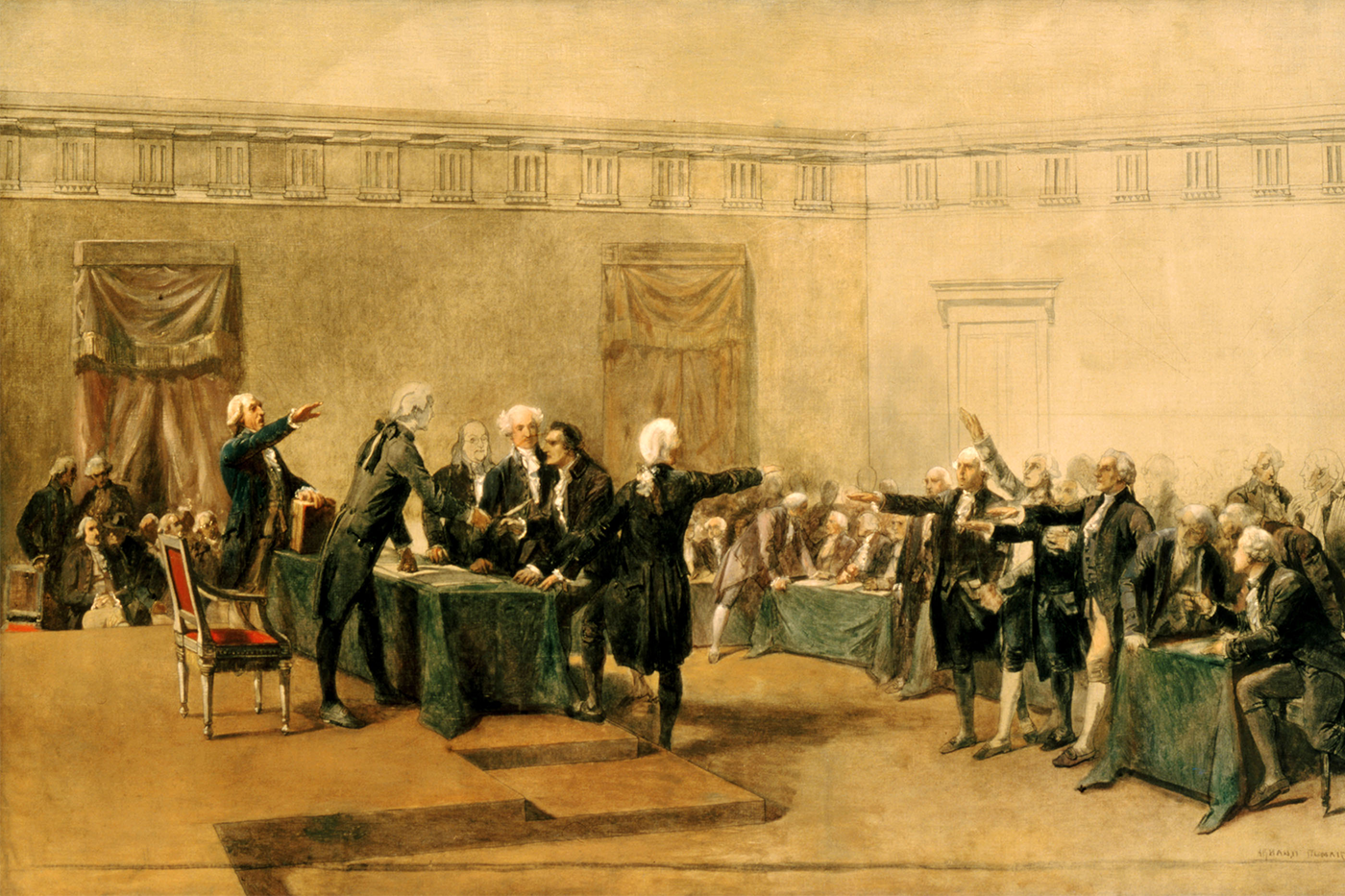
One of the frustrations that I’m having with our current cultural moment, in the wake of the protests over the death of George Floyd, is that we have essentially turned this incident into an ideological minefield between two heavily-militant versions of the American civic religion. One side is lining up and saying that we need to preserve the symbols and built culture and ideology of America going back to the Founding Fathers. The other side is going through a paroxysm of iconoclasm against these American civic symbols and ideology, and at the same time promoting an alternative civic religion. Yes, I do take a side on the issue of policing: I take the same side as Sayyidnâ ‘Atallâh (Hannâ). But, as the kids say, miss me with this pathetic little religious civil war that’s just starting to heat up.

I’m an American who loves my country, but I have next to zero patience or sympathy for our civic religion. Indeed, my conversion first to Anglo-Catholicism and subsequently to Orthodoxy – including both parts of the political side of that conversion – may in part be explained as a rebellion against the civic religion. Indeed, Berdyaev having figured heavily in that conversion, his understanding of politics as a form of religious expression sensitised me to the ways in which our civic life is configured to redirect worship away from Christ and towards symbols like the Constitution, the flag and the Fathers, or otherwise towards abstract ideas like ‘progress’, ‘democracy’ and ‘human rights’.

So we have started to see this cottage industry of articles (like this one by Leithart) trying to do shanzhai rip-offs of Berdyaev, attempting to show how the politics of the protests are starting to resemble a surrogate religion. They attempt to trace the roots of paganism in the protests, or they attempt to characterise the entirety of critical theory as a religion. And in some measure, these characterisations have merit. There certainly is an understanding of sin at play here, and there absolutely is an attempt at theodicy that the ideology of critical theory tries to address. We see this in particular in attempts at imposing grand historical narratives like the 1619 Project.

The admirable aspect of the 1619 Project is that it is at its root a good-faith attempt to grapple with some of the ‘hard questions’ about our history and its relationship to a legal and cultural legacy of racial inequality. These are the sorts of hard questions posed by Olaudah Equiano, Frederick Douglass, WEB DuBois, Langston Hughes, Kwame Ture, Cornel West and Margaret Kimberley. The 1619 Project attempts to grapple in a serious, realistic and hard-headed way with the problem of the contradiction at the heart of American identity: a desire for Faustian liberty achieved at the unacknowledged expense of black bondage and servitude. In drawing attention to the ‘least of these’, the principle of the 1619 Project is wholly Christian. But the problem with this Project, as I have noted before, is that it superimposes a fatalistic, even genetic, filter on history. Even in pointing to the historical circumscription of our legacy of racism, this project fails to show any grasp that a solution to racism as a societal problem might be historically possible. It is a narrative of sin without a countervailing hope of salvation.

However, the critics of the 1619 Project, many of whom have been particularly voluble on the question of the broader religious meaning of these current protests, have organised themselves around a rival project, called 1776 Unites. The meaning of this rival date is crystal clear: they mean to assert, over-against the dour historians of a national narrative mired in the primeval sins of racial exploitation and conflict, the providential world-historical mission of the American founding. The choice of the date is meant specifically to appeal to the old civic religion: to the Winthropian myth of the shining city on a hill and the exceptionalism of the American messianic mission in the world. Ironically, given the conservative politics of the adherents of this narrative, the ‘theology’ of the 1776 narrative is saturated with the stink of cheap-grace liberalism. It is nothing short of a rejection of any need for public penitence whatsoever, and it heralds a politics of citizenship without either intellectual or moral discipline. It is utterly foreign to any meaningful Christian ecclesiology.

So is 1619 or 1776 the more meaningful date? Is America a nation conceived in the original sin of slavery and racial prejudice, or a nation made for the original blessing of liberty? It should be clear by now that these are indeed two rival civic religions, structured around two very different theodicies, two very different historical teleologies, two very different understandings of the human condition, and ultimately oriented toward two very different gods. It should also be clear that each of these rival theologies bears a certain passing resemblance to Christianity, but that neither of them places Christ at the centre. Indeed, both of them are weakest at precisely those points at which they boast their strength: the 1619 Project offers no meaningful common understanding of history; and the 1776 Project no meaningful conception of disciplined citizenship. Thus neither of them comes close to a full understanding of the truth of the country’s place in time or its rôle in history – which is in truth more limited than either side in this religious civil war would like to think. From an apostolic Christian perspective, neither 1619 nor 1776 ought to be considered the prime reference. Both ‘projects’ should be rejected, insofar as both are doomed attempts to pour the new wine of the revelation of Christ into the old wineskins of American exceptionalism.

A broadside volley against self-defeating Americanism


An unfortunate perennial genre in American Christian literature which has seen a bit of a resurgence in light of recent events, is that which states that American Christians should have nothing to do with anything regarded as ‘left’ in politics. Of course, on its face this is an absurd anachronism – the ‘left’ being a constellation of political values from a later time starting around the seventeenth century, most of which accord with Christianity and some of which do not – and this blog hopefully stands witness against it going all the way back to its beginnings, but it seems necessary to refute some of the core claims of this genre.

This doctrine proclaimed by these passionate haters of all things related to the political left make four core claims: that Christianity is first and foremost concerned with judging or saving individual souls and not with judging or saving systems or collectivities; that Christianity is supposed to promote a uniform social unity instead of division; that Christianity is pacific in nature and should have nothing to do with the passions of anger that are stirred up by left-wing political doctrines; and that Christianity is not concerned with material goods but instead spiritual ones.

There are some obvious theological and indeed simply logical contradictions that this voluntarist-individualist reactive hæresy falls prey to that can be noticed right off the bat. In short, however, I take strong issue with the first three of these assertions and hold that they are not Christian – and I happen agree with the last one, though I hold together with Nikolai Berdyaev that it is ultimately a bigger problem for Christians on the political right than for Christians on the left. In the end, despite the stated intentions of defending Christianity against Marxism, this genre of writing only creates greater confusion for Christians, and in the process only creates more space for actual Marxism to thrive.

Christ does judge nations

The most absurd claim of the American Christian right, on its face, is that God does not judge systems or collectivities, but is instead concerned only with the fate of individuals. Such a position can only even come about as a result of the legalistic understandings of sæcular modernity, with its narrow juridical focus on the exact guilt or innocence of an individual for a particular instance of criminality. But God has judged entire cities and entire nations for their sins. I’m not going to give a whole bunch of proof-texts for this because that work has already been done; suffice it to say that all one has to do is crack open the Old Testament at any given point to ascertain that this is the case. As Fr Stephen Freeman pointed out recently, God judging the nations is one of the key themes of the Old Testament, and in much of the Mosaic narrative and indeed most of the Hebrew Prophets, Israel as a whole is judged in the light of the Law. God judges Sodom and Gomorrah as a whole, God judges Ægypt as a whole. God is ready to judge Nineveh as a whole before Jonah urges the people of that city to repent. The judgement of God often comes through the actions of individual human beings: the Babylonian captivity and the destruction of the Temple are interpreted in the Hebrew Scriptures as examples of God’s judgement against the Hebrews, even though these were actions undertaken by kings, the enemies of Israel.

This is not only a præoccupation of the Hebrew Scriptures, by the way. It extends into the Greek Scriptures, which are a recapitulation of the Law and not a reversal of it. In the Synoptic Gospels, particularly the Gospels of Saint Matthew and Saint Luke, Jesus tells his disciples that whole cities will be judged according to how they treat the Gospel: And whosoever shall not receive you, nor hear your words, when ye depart out of that house or city, shake off the dust from your feet. Verily I say unto you, It shall be more tolerable for the land of Sodom and Gomorrah in the day of judgement, than for that city. He also issues a condemnation against Capernaum in Saint Matthew 11: And thou, Capernaum, which art exalted unto heaven, shalt be brought down to Hell: for if the mighty works which have been done in thee, had been done in Sodom it would have remained until this day. But I say unto you, That it shall be more tolerable for the land of Sodom and Gomorrah in the day of judgement, than for thee! Even in the Apocalypse of Saint John – once so popular amongst American conservatives – entire churches, entire cities and entire nations are subject to the judgement of God as communities and not as individuals.

To give one modest example of how the Fathers thought about the question of whether salvation is individual or communal, the Hymns of Saint Ephraim the Syrian carry this idea into the history of salvation, with the Persians, Medes and Babylonians atoning for the sins of their nations and the sins of their peoples in the persons of the Magi, bringing gifts to the Theotokos and the Heir of David. This beautiful typological imagery in the Hymns of Saint Ephraim is only possible to appreciate within a Patristic worldview in which we are responsible for each other, and in which it is possible for many to be saved through the sincere repentance of fifty righteous people, of twenty, of ten, or even of one righteous person within a nation. This is the worldview of Father Zosima in Dostoevsky’s Brothers Karamazov as well, who tells Alyosha that ‘all men are guilty for everyone’, and therefore that it is necessary to ‘forgive everyone for everything’; and this is the point of the sinful old woman in the parable in the same book, who was ‘given the onion’ at the Judgement – and stood ready to empty Hell with it, until she grew greedy and desired that salvation only for herself.

It is an explicit denial of the entire worldview of the Prophets, of the Apostles, of the Church Fathers and indeed of Christ Himself, to say that salvation is a purely individual matter, and that we are only responsible in a narrow and juridical sense for what we ourselves do. Do we respond to God at the Judgement and reply with Cain, ‘Am I my brother’s keeper?’ No: all are guilty for everyone; and everyone must be forgiven for everything. This is what the Christianity of Dostoevsky proclaims. But American individualists attack this Christianity and call it Marxism.

‘I come not to bring peace, but a sword’

But the foregoing is not to say that salvation in Christ aims at a monistic and nirvanic dissolution of all personality within the grand unity of the cosmos, the way the dharmic religions do. Christ does not erase our histories, our particularities or our backgrounds when He saves us and when we join ourselves to Him. One sees this in the theology of the Incarnation itself: in becoming man, the God Who is the source of all things and is therefore beyond any description or appellation – even beyond being and non-being – became a poor, working-class Palestinian Jewish baby, with a biological mother, a hometown, an ethnic, a religious and a political identity. It is not possible to adequately know or to love a ‘what’, or even to love something that is beyond ‘what’. It is, however, possible to love a ‘who’, and Christ is very much a ‘who’.

And yet, the hæretical assertion of voluntarist individualism by American Christendom ironically results in precisely such an erasure of personality. One sees this, ironically enough, in the same Federalist article which attacks ‘neo-Marxist’ theology – only to end up advocating for a bland, nondescript, deracinated, outwardly-enforced cultural ‘unity’ (as opposed to ‘divisiveness’) that is every bit as grey and dull and conformist and oppressive as the most caricatured of communist dictatorships! There is no room for personality in an individualist society. As Wendell Berry put it: ‘Individualism is going around these days in uniform, handing out the party line on individualism.

Christ did not come to bring such a conformist unity. Christ did not even come to preserve any sort of pre-existing social unity. Christ did not come to say to us, in that execrable contemporary phrasing: ‘You do you.’ Christ, the Incarnate God, stands against both reductive voluntarist individualism, and blind, stultifying conformity. Christ is divisive. The call to follow Christ is divisive. The Cross takes up one from her bed and leaves another sleeping. Again, in the Gospel of Saint Matthew, our Lord says this: Think not that I am come to send peace on earth: I came not to send peace, but a sword. The Gospel explicitly cuts across the power relations and group markers that the world foists upon us: it even cuts across family relations. The Gospel is such that men are delivered up before governors and kings and councils. The Gospel is such that men who proclaim it are scourged in the synagogues.

The Gospel is such that those who proclaim it are hated even in their own countries, and even among their own families. If your Christianity is such that you are not hated by the governors and the kings and the councils and scourged in the synagogues – if your Christianity is such that you are ready to side with an unthinking ‘majority’ in the name of a voluntarist individualism masquerading as the Gospel – then whatever you are doing, you are not taking up the Cross.

‘Be ye angry, and sin not’

Christ got angry. He was not a Tolstoyan pacifist; He was not a Vulcan from Star Trek. Christ struck a fig tree with a curse when it did not provide fruit. Understand what this means in the typological worldview in which the Gospel was first read: the fig tree is symbolic of Israel, and the fruit of the fig tree is symbolic of the works of mercy and compassion. (Here again, Christ is judging a nation, that ‘neo-Marxist’!) When Christ got to Jerusalem, He went into the Temple, denounced the money-changers as a den of robbers, overturned their tables and drove them out with a whip of cords. Why did He do this? Because he saw them taking advantage of the poor, using the structural advantages afforded by the Temple as an instrument of social ‘cleansing’ and expiation of debts to coerce the poor into buying animals for sacrifice.

Saint Paul tells us in his letter to the Church in Ephesus: ‘Be ye angry, and sin not’. This is in a passage telling the people of that Church how they are to forgive each other. Saint Paul is an excellent psychologist: he does not tell the people that their anger is unjust, or that they should paper it over or hide it or coat it over with layers of sentimentality and false piety. He tells them that if they are angry, they should be angry, but that they should not let the sun set on their wrath. That is to say: they should not let that anger fester and darken silently and accumulate over days and weeks and years, but instead seek to deal with it openly and in a constructive way when it appears. What we are seeing now in the society is what happens when Saint Paul’s advice is ignored. We have allowed so much anger to build up between different sections of the society, and so many suns to set on that anger, that it spills over into violence and social conflict. So when the Federalist uses the letter to the Philippians to tells black activists to ‘be content’ with their lot and quiescent in the face of deadly violence and injustice, what they are saying is precisely the opposite of what Saint Paul meant.

Bread for my neighbour is a spiritual question

Finally, there’s the old canard about any concern for equity in the distribution of a polity’s goods and services being an expression of ‘materialism’. By that very same token, the early Christians in the Book of Acts were materialists – because they all gave of their own possessions and then distributed them to the needy, and those of them who held back their goods from the Apostles and lied about it, like Ananias and Sapphira, were cursed and expelled. The arbitrary and utterly-modernist dividing line between ‘voluntary’ and ‘involuntary’ giving in light of political realities about the way goods are distributed is likewise a recurrent frustration of mine in dealing with Americanists. The saccharine Americanist piety wrongly presumes that – not even the intentions, but the voluntary status of the giver – is the sole determining factor in whether or not a transfer of wealth is ‘materialistic’ or not. This is literally the piety of the Pharisee who stands in the marketplace loudly proclaiming his gifts to the poor! I’ve talked about this classically-idiotic libertarian canard so much and so often over the years – as here, here and here – that it feels a bit like I’m a broken record player.

Ultimately, my retort has to be Berdyaev’s, from The Fate of Man in the Modern World: ‘The question of bread for myself is a material question, but the question of bread for my neighbour is a spiritual question.’ And my retort has to be the retort of the Russian Orthodox Church, which more than any other institution on the face of the planet has reason to distrust Stalinism: ‘The Church always comes out in defence of the voiceless and powerless. Therefore, she calls upon society to ensure the equitable distribution of the fruits of labour, in which the rich support the poor, the healthy the sick, the able-bodied the elderly.’ Jesus spoke against the maldistribution of wealth in the Temple when he called attention to the widow’s two copper coins; and the Church has spoken against the maldistribution of wealth since at least Saints Basil and John and Gregory.

The concern over the just distribution of wealth is not, a priori, a ‘materialist’ concern in the pejorative sense meant. What’s more, insofar as Marxism is a doctrine that applies materialist logic to its subject matter – which is to say, the œconomy – it is analysing precisely the materialist priorities of the society it inhabits. The analytical materialism of Marxism is precisely a reflection of the self-interested materialism of the bourgeoisie. Even ex-Marxists and critics of Marxism like Berdyaev and Bulgakov both understood this. It’s particularly telling that the Federalist does not condemn materialist striving for selfish reasons – ‘try[ing] to better our conditions on this side of heaven’, that is. It’s as if they are saying that materialism is only bad when it’s not self-interested.

If you’re going to try and attack Marxism, in short – make sure that you understand what Marxism is. The Federalist, scared stiff by Black Lives Matter, sets out to attack Marxism and defend Christianity. But in the process it attacks what is truly and authentically Christian going back to the first centuries of Our Lord, and contributes to an ideological atmosphere ideal for creating Marxists!