05 September 2022
The twin geniuses of Creedence and Pesnyary
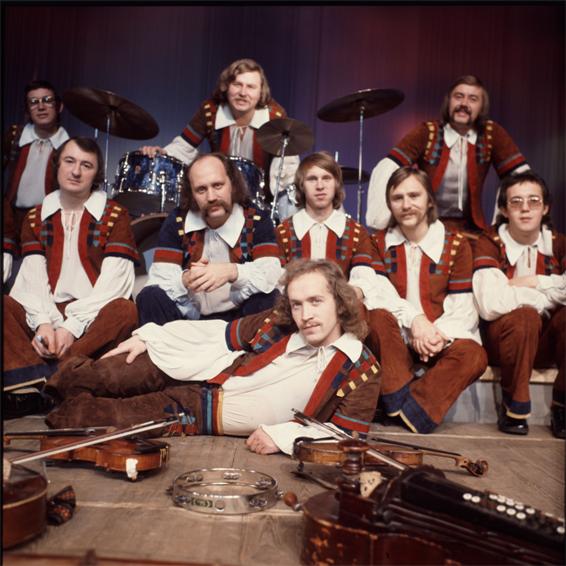
Recently I’ve been listening to the folk-tinged rock music of Creedence Clearwater Revival, on the one hand, and the rock-tinged folk music of Pesnyary on the other. Creedence were a Bay Area band who emerged out of, and came to exemplify, a certain strand within the sixties counterculture—though they usually composed lyrics about, and were influenced by the folk culture of—Greater Appalachia, the Bayou, the American South generally. Pesnyary, by contrast, were a Soviet state-sponsored VIA (vokal’no-instrumental’nyi ansambl’, literally ‘vocal-instrumental ensemble’) who played acid-rock and progressive-rock arrangements of traditional folk songs as well as their own compositions. They were also one of the very few Soviet bands to actually tour in America—specifically in the American South. Creedence had split up by 1972; Pesnyary were then just getting started: officially, there are two bands calling themselves Pesnyary now and four or five others borrowing the name without licence, but most people agree that Pesnyary’s classic period ended in 2003 with founding member Vladimir Mulyavin’s death. Despite their very different origins and ‘stances’—the lyrical and thematic difference between ‘Proud Mary’ and ‘Ave Maria’, as it were—I’m finding I’m enjoying them for very similar reasons.
One of the reasons I find both of these bands so enjoyable to listen to, is because they invest these deceptively simple melodies and chord progressions (these are rock groups, after all) with a great deal of dynamic and emotional depth. Creedence Clearwater Revival build on a basis of swamp blues—the harmonica was there from early on—and diverge from there in various directions, adding more and more rock instrumentation, as well as elements like Hammond organ. By the end of their career, as one can hear on songs like ‘Sweet Hitch-Hiker’, they were veering very close to hard rock or even proto-metal. CCR’s tunes are catchy, instantly-recognisable, iconic: ‘Suzie Q’, ‘Down on the Corner’, ‘Fortunate Son’, ‘Have You Ever Seen the Rain?’, ‘Lookin’ Out My Back Door’.
As important as Creedence Clearwater Revival are for a certain generation of Americans, I’d say that the Pesnyary are equally as important for a certain generation of people from the former Soviet Union. The Belarusian group, led by Vladimir Mulyavin, took its influences both from Western rock music (particularly the Beatles) and from traditional White Russian folk melodies. Pesnyary songs blend guitar melodies, drums, keyboards and even saxophones with traditional folk instruments (wooden whistles, fiddles, flutes, accordions, hurdy-gurdies) in a unique way. The VIA was signed to the state-owned label Melodiya in the Soviet Union (the only real game in town, as it were), and their albums sold millions of copies. Their unique approach to making accessible music with depth and feeling—with hits including ‘Aleksandrina’ and ‘Belovezhskaya Pushcha’—and Mulyavin’s ability to seek out and recruit talented multi-instrumentalists and singers, made the Pesnyary very literal rock stars in the Soviet Union.
John Fogerty and Leonid Bortkevich are, obviously, two very different vocalists—but even here there are some interesting similarities. Fogerty gives a very nasal delivery, with occasionally having a hoarse or a hard edge to his tenor melodies. There’s definitely a ‘country’ or ‘Southern’ inflection to this delivery, but it’s easy to hear the lasting influence on rock—even hard rock and heavy metal—that Fogerty’s voice had. Leonid Bortkevich was a much more traditional tenor: clean-toned, pectoral delivery, like a classically-trained singer. On the surface, he sounds much more like John Denver than John Fogerty. But Bortkevich deploys some interesting flourishes in his singing—a breath’s delayed approach to the note, a glide or a back-throat catch, that can make his vocals sound grittier, or ‘folksier’ (a good example of this being ‘Do Tret’ih Petruhov’).
It’s a bit strange. I’ve explored a lot of the musical differences between the two bands here. If we take account of their analogical positions within their respective cultures, the countercultural and ‘oppositional’ political nature of CCR’s music (‘Fortunate Son’, ‘Effigy’) more closely aligns with the career of the alternative rock / new wave band Kino headed by Viktor Tsoi. Pesnyary, meanwhile, despite the influence they took from the Beatles, probably more closely aligns with the folk-revival artists like Lead Belly, Woody Guthrie, Pete Seeger, Burl Ives and so on than with the later tail of the folk-rock trend in American music to which Creedence belongs. But somehow it seems more natural to my ear to connect these two bands. Both of them evince a vitality and a creativity that tends in a similar direction. Both CCR and Pesnyary seek their inspiration in the deep roots of their respective countries—not without a critical eye in each case—and both draw them out to infuse them with the sounds of their contemporaries. Certainly both bands are worth listening to and appreciating.
Labels:
Chicomoztoc,
culture,
Dixie,
folk rock,
Holmgård and Beyond,
Mizheekay Minisi,
music
The Legendarium according to Smaug
I’ve watched the first two episodes of Rings of Power. Even though I promised I wouldn’t.
It’s bad. And I mean really, holistically bad.
Let’s get the trivial concerns out of the way first. Casting Black actors and actresses to play hobbits, dwarves, men and elves isn’t at all a problem for me. If anything, Tolkien’s dwarves are supposed to be swarthy-skinned and dark of complexion, which for some reason they weren’t in the Jackson movies; and the hobbits were envisioned as being just as diverse of physical appearance as humans. The question is whether the actors and actresses can act well. (Sir Lenny Henry and Sophia Nomvete can and do act well here. Ismael Cruz Córdova? Not so much.) Also if it isn’t done cynically, which is a bit more questionable. Race politics have nothing to do with why I think Rings of Power is a full-on betrayal of Tolkien’s work.
What does, then? One word: Galadriel.
In Tolkien’s Silmarillion, Galadriel was originally a stubborn, headstrong and adventurous girl—this much is true. She did have something of a growth arc. The reason she came to Middle Earth at the end of the First Age was because she was intrigued by the place. She was tempted, in part, by Fëanor’s promises of glory, and longed to see the shores of an unknown land and even to rule them as queen. But she refused to join Fëanor’s quest for revenge against Melkor for the death of his father (Galadriel’s grandfather) Finwë, and she (along with her father Finarfin and her eldest brother Finrod) refused to engage in the political quarrels of the Noldor which ended in the slaughter of the Kinslaying and the Burning of the Ships.
That is as much as to say: she was stubborn and adventurous, but neither brooding nor vengeful—she was of like mind with her father and brother, not having sworn Fëanor’s oath of revenge. Further, it is highly hinted by Jack himself that the reason she stayed in Middle Earth was because she loved it. She loved the people, she loved the living creatures, and she especially loved the forests. The reason she stayed in Middle Earth was because she found hope there.
Melian said: ‘There is some woe that lies upon you and your kin. That I can see in you, but all else is hidden from me; for by no vision or thought can I perceive anything that passed or passes in the West: a shadow lies over all the land of Aman, and reaches far out over the sea. Why will you not tell me more?’
‘For that woe is past,’ said Galadriel; ‘and I would take what joy is here left, untroubled by memory. And maybe there is woe enough yet to come, though still hope may seem bright.’
In Rings of Power, there is no love at all in the character upon whom they wrongly bestow the name of ‘Galadriel’. There is no joy. There is not even a trace of hope. Her reasons for staying in Middle Earth have nothing to do with any kind of attachment to Middle Earth, land or creatures or people—and everything to do with hunting down her brother’s killer, Sauron. The makers of Rings of Power have made this ‘Galadriel’ into precisely a bitter, brooding, violent woman who is dead-set on revenge: in short, they have made her into Fëanor Mark II.
This is partly ideological. There is a current in the corporate culture machine’s interpretation of feminism, that thinks that in order to pander to women viewers they should make all female characters ‘strong’ by putting weapons in their hands—by making them ‘action heroines and corporate girl-bosses’. But this isn’t good writing, and arguably it isn’t even good feminism. Let me be blunt: Éowyn wasn’t a badass just because she picked up a sword, delivered a one-liner and stabbed a wraith in the ‘face’. If it had been just that, she wouldn’t have gotten any of the cheers she did. Éowyn was a badass because of the context of that action: she cared about Merry and her father enough to protect them.
This ‘Galadriel’? She doesn’t care for anything or anyone except her dead brother—and not even Finrod himself, but his ‘task’. This ‘Galadriel’ would never have been found worthy of the option of returning to Valinor in the first place—the pardon that the Valar bestowed only upon Finarfin and his children, among all of the Noldor. The only reason Galadriel was allowed to return to the Elf-home was because she wasn’t as vengeance-obsessed as Fëanor, and hadn’t taken Fëanor’s oath! Rewriting ‘Galadriel’ as another Fëanor doesn’t strengthen her—it diminishes her in ways that are frankly blasphemous.
And what’s worse, Rings of Power tries to make her Fëanorish vindictiveness a sign of her sagacity. Like Cassandra she warns of Sauron’s known-to-the-audience return when everyone around her, High King Gil-Galad and ‘Elrond’ particularly, disbelieve her and tell her she’s overreacting (the mansplaining chauvinist bastards). Never mind that in the book, Galadriel was the one urging Gil-Galad to show caution, not the other way around—and she was right to do so!
I’ve got other grievances with Rings of Power that operate on a similar level. The portrayal of ‘Elrond’ as Gil-Galad’s political staffer and speechwriter is particularly offensive. As is the notion that Celebrimbor would be worried about the size of the elves’ ‘workforce’ in building his Super-Duper Mega-Forge—sending ‘Elrond’ off to literally hammer out (and I do mean with a literal hammer) a labour contract with Durin’s dwarves. Tolkien would be appalled at this! His elves and dwarves had their flaws, but they were not industrialists and capitalists. Their crafts, were crafts. Capitalism was personified in Lord of the Rings by Saruman, and assembly-line Fordist industrialism metonymised by Isengard. They were certainly not valorised the way they are here.
But this should not come as a surprise. Both my gripes against ‘Galadriel’ and the characterisation of the elves and dwarves generally stem from a much broader complaint. That is: Rings of Power is nothing more and nothing less than the Legendarium according to Smaug. It’s Tolkien’s universe as interpreted by Jeff Bezos—born on third base, mega-polluter, war hawk defence contractor, exploiter of the poor—someone who doesn’t even value Tolkien or his œuvre and has nothing to do with Tolkien’s own ecological-minded Christian Tory-anarchist mythopoesis. Of course any interpretation he sponsors in order to garner a greater market share for his streaming service, is going to run dead against the logic of Tolkien’s universe.
Tolkien often expressed his own view through the words of Faramir. And this was Faramir’s view: ‘I do not love the bright sword for its sharpness, nor the arrow for its swiftness, nor the warrior for his glory. I love only that which they defend.’ Rings of Power, so far, takes the opposite view: trying to dazzle with special effects, battle sequences, blood and fire—while holding the substance of their source material, the characters and the setting, in utter contempt.
Give this one a hard pass.
Labels:
Adam and Eve,
books,
folklore,
movies,
science fiction,
the Internet,
Toryism
25 August 2022
For Faina
I looked truth in the eye today,
in both of her lake-green eyes:
pools in whose depths
too much wordless fear and
anguish had been anchored.
And then I heard her speak.
She had a child’s voice,
soft and high and sterling-clear.
Such a voice should not belong
to eyes which have seen so much,
to tear-stained eyes which have taken
in from the tender age of five
the explosions of the shells,
the shredded bodies in rubble,
the flowers laid at infants’ graves.
But, even more than that,
when one hears such a voice
from a face with such eyes,
it is hard to turn away from.
And so, many choose not to hear.
Truth speaks, and she writes.
Her mind is full of starships,
and her heart is full of cats;
for that I’d praise her courage—
but my throat catches on such a word.
Not for any lack in her of courage!
No! I balk at the obscenity:
no thirteen-year-old girl
should ever have her ‘courage’
tested under shell fire for eight years.
And yet still that voice comes:
soft and high and sterling-clear,
defying those who would consign her
to darkness and to silence.
Truth has always spoken thus.
- Matthew Cooper, 25 August 2022
14 August 2022
A letter to the OPF listserv
As a member of the Orthodox Peace Fellowship mailing list, I get to see a lot of e-mails from people with a lot of different perspectives on global affairs. Sometimes the discussion gets somewhat spirited. This time I was moved to respond. A certain member of the group, responding to this story on NPR, held it up as an example of how our government was ‘empowering an adversary’ and ‘exacerbat[ing] the threat’ of an ascendant China to world peace. I was compelled to respond in the following way (sans the links):
Dear brothers and sisters in Christ,
I have deep concerns about labelling China as an ‘adversary’. And not only because my wife is Chinese and my children are half-Chinese by ancestry.
In the Orthodox Church, we must consistently remember that ‘we wrestle not against flesh and blood, but against principalities, against powers, against the rulers of the darkness of this world, against spiritual wickedness in high places’. The factory worker in Dongbei who puts together a vanadium redox battery is not my adversary. The engineer who designs the battery isn’t my adversary either. It seems to me that both of them must work to eat. It seems to me that neither of them is motivated, at least prima facie, by lust for power or desire for dominance over others. They are not the enemies. It seems to me that the enemy in this story is not China at all, though of course NPR will nowhere acknowledge this because NPR is state propaganda. Gary Yang tried to get American banks and American companies to invest in his batteries but couldn’t. They were looking for a quick turnaround. The enemy here is instead a system that looks for instant gratification and short-term returns on investment, and which prioritises profit over the common good. In short: the enemy is of this story is not godless Chinese communism, but godless American capitalism. And it is precisely this concern American companies and American banks have with gaining advantage, gaining profit, gaining power over others, that requires us to participate in the spiritual struggle against ‘wickedness in high places’. Blaming China might feel good, but it fixes nothing about our own flaws. If it wasn’t China, it would be India, or Brazil, or South Africa.
Furthermore, I think that the inability of Americans to look inward, to search out their own faults, to understand the failures of their own spiritual laziness of habit and their own comfort with ‘the way things are’, is at the root of many of the world’s problems right now. We blame Russia for the war in Ukraine, and to a certain extent rightly so, but this is a lazy stance, which is why it is so popular. It costs Americans nothing to condemn Russia. Scapegoating Russia and no one else means that we don’t have to look at the long-standing debt politics of the IMF (which has operated this way since the 1960s and 1970s, putting poison-pill terms in their loan agreements to rob governments of their ability to provide social safety nets or discipline international capital in the national interest) that turned Ukraine into, essentially, a puppet government of Western corporations who have no interest in the well-being of the Ukrainian people. We don't have to examine how over a quarter of Ukraine’s total arable land is now in the hands of Monsanto, Dupont and Cargill corporations, rather than in the hands of Ukrainian people themselves. And we don’t have to examine our own culpability in participating in and upholding a predatory system of international finance, and supporting policies which continue to rob Ukrainians of the same agency we praise them for supposedly defending.
It strikes me that there are not enough Saint Moseses among us, who are willing to look at the leaky sack on our own backs with our own sins trailing behind us. It strikes me that there are not enough Alexander Solzhenitsyns among us, reminding us that the moral universe is never so simple as the ‘bad people over there’ in Russia and China doing evil things, but instead that the line between good and evil cuts through every human heart. It strikes me that there are not enough Saint Marias among us, to take us to task for the social sins we are engaged in every day, while we blithely condemn and disparage our brothers. It strikes me that there are not enough Saint Tikhons among us, to encourage us to love each other beyond artificial boundaries erected by power politics, or indeed by domestic ‘blue vs. red’ politics.
If we wish to quote Franklin's old yarn about ‘an ounce of prevention’, it strikes me that first we ought to follow his advice regarding civic virtues: fasting; imitating Jesus and Socrates; not wasting anything; not injuring others; not practicing deceit; avoiding extremes; avoiding excessive worries; not despairing over common setbacks; avoiding hurtful speech and trifling conversations; keeping all of our things to their own places; promising to do what we ought and doing what we promise to do. Worrying about what China is doing, and not about what we are doing--this is emphatically not what Benjamin Franklin would advise us to do. (And please, let’s not be unkind and point out those places where Franklin failed to follow his own advice. All of us are hypocrites - myself foremost of all.)
With love in Christ,
Matt
07 August 2022
One German musician’s wise perspective on the Ukraine conflict
I have reposted this from the public Facebook profile of a German industrial-rock musician, a certain Mr J—, with whom I share a mutual contact. I am providing here my own translation of his post. Speaking for myself, I think his perspective here is quite wise, and should be shared broadly.
For the thing which I greatly feared is come upon me, and that which I was afraid of is come unto me.- Job 3:25
If this war has shown us anything, it is primarily that each side invested in it has achieved with its actions, the exact opposite of what it wished to achieve.
Putin (likely) hoped for a ‘liberated’ Ukrainian (brother-)people, who would throw themselves around the necks of the Russian soldiers as soon as they marched in. Instead, he got embittered enemies who only hated his people even more, and wanted even less to do with him than they already had. He also wanted ‘less NATO’. But now, he has even more NATO countries around him: an even more cohesive NATO with greater manpower.
The Ukrainian state leadership, politically driven by ultra-nationalist and Russophobic white supremacists such as Azov, who honour as Ukrainian national heroes war criminals and Jew-murderers like Stepan Bandera, name boulevards after them and depict them on postage stamps, wanted economic prosperity (especially for their oligarchs and corrupt political elites) and territorial integrity. They will get – as it currently stands – a country in even greater ruin, and even more lost territory.
The USA wanted to crush their rival Russia and expand their global hegemony. Instead, they have damaged themselves economically and politically, and promoted an alliance between Russia and arch-rival China, thereby finally destroying their chances for hegemony. The arch-rival, China, is thus ‘the laughing third party’. In turn, the West in turn wanted to harm Russia, but have primarily harmed themselves, politically destabilised themselves and further damaged confidence in their political leadership.
Hopefully, this will prove to be a lesson for all, that conflict is better off being settled peaceably, than ‘rendering evil for evil’ (1 Peter 3:9), and it will hopefully lead to the realisation that war is simply ‘not worth it’. Anyone who is involved in it in any way, only loses.
Labels:
history,
Holmgård and Beyond,
Huaxia,
international affairs,
politics,
Teutonia,
theology
06 August 2022
Pointless video post - ‘Как болит голова’ by Август
What month is it again? Oh yeah:
The Saint Petersburg formation August (or Август) was one of the first-ever Soviet rock bands, and they shared a label (Melodiya) with other acts like Black Coffee, Master and Cruise. At first they played a rather eclectic mixture of pop-rock, art-rock and heavy metal (in part due to the Soviets’ disapproval of certain styles of rock music), but later on their style congealed into something similar to Rainbow or Deep Purple or Uriah Heep. Their first album, from which this song comes, was a runaway success. Enjoy!
Labels:
history,
Holmgård and Beyond,
metal,
music
26 July 2022
Good general wisdom from VK
A Belarusian woman, Marishka B—, whose account I follow on VK posted the above two images to her public feed. I thought they made some very profound points in general, not just with relation to this war, so I’m resharing them here on my blog with a quick-and-dirty translation.
Some very sound advice from Ms. B—, to always be human no matter what side of an argument you fall on. I won’t pretend I’ve always been (or still am) a model of good online behaviour according to these nine points, but with God’s grace I can try.
- Any war will end.
- Every nation is made up of different people. Not everyone participates in war. Don’t insult everyone in one group.
- The politicians will end up agreeing. And you? You’ll be left with the mud you fling at your ‘ideological opponents’.
- In wartime, EVERYONE lies. Don’t spread info that you're not 101% sure (or can’t verify) is true. If you want to write something, write only about what you saw with your own eyes. That’s being honest. The rest is participation in lies.
- If you want to express your attitude to politics, express it. It’s not necessary to insult someone [while doing so].
- You don’t like somebody else’s opinion, but you really want to speak out? Then speak out - about the opinion and not about the person. Because most often you don’t know them personally.
- Hating people you don’t know is pathological.
- People’s relationships are very complicated, even at the level of a family or a work group. [Relationships] between states are still more difficult. Only to idiots is everything clear and simple to understand. Don’t be an idiot. Don’t jump to conclusions.
- Always be human and remember point 1.
Subscribe to:
Posts (Atom)