Showing posts with label Iberia. Show all posts

24 September 2020

Holy Equal-to-the-Apostles Thekla, Protomartyr of Antioch

Saint Thekla of Antioch

Today in the Holy Orthodox Church, the twenty-fourth of September, we commemorate one of the holiest women of Antioch and of the Early Church, Saint Thekla of Antioch, who was a follower of Saint Paul and a bold witness among the pagan Greeks and Romans. The great deeds and holy life of Saint Thekla illuminated many thousands of souls in the Near East, and bore witness to the divine illumination and the unburning fire of Christ. She did this even as she repeatedly showed herself proof against the flames of lust and the flames of fire with which the pagans tried to scorch her. With great celebration together with the Christians of Syria we honour her memory today.

Saint Thekla [L. Thecla, Gk. Θέκλα, Ar. Taqlâ تقلا] was born in the city of Iconium [which is modern-day Konya in Turkey] in the year 16. Her parents were rich and illustrious, and Thekla grew up into a marvellous beauty whose affections were highly sought-after. Her parents found it not difficult at all to arrange a suitable match for her, a youngster by the name of Thamyris. When Saints Paul and Barnabas came into Iconium to preach the good news of Christ’s resurrection, Thekla was intrigued and wished to join the crowds to hear them. Her mother Theokleia, however, forbade it, and kept her confined to the house. However, the will of God for this his martyr could not be so easily thwarted. The young girl found that she could go out onto the balcony from her room, and the air carried the words of the Apostle from where he stood to the balcony where she sat, for three full days and three nights while he preached.

St Paul’s preaching enthralled and electrified Thekla, and she was especially drawn to Paul’s preaching on the subject of chastity. She began to desire with her whole heart to serve the Lord and to embrace Christ crucified and risen. Both Thekla’s mother Theokleia, and her betrothed Thamyris, noticed the abrupt change in Thekla’s demeanour, and they went to the governor of Iconium to complain about Saint Paul’s preaching. In order to pacify the crowd, which was growing more and more incensed by the preaching of the two apostles, the governor had Saint Paul and Saint Barnabas arrested and thrown into prison.

When Saint Thekla heard of this, she stole out of her house and used her golden bracelets to bribe Paul’s gaoler, and having gained admittance to his cell, fell at his feet and kissed the chains and shackles that bound him. She spent hours kneeling at the feet of the Apostle, listening to him discourse upon Christ, upon His good news to the poor, and upon the virtues of faith and hope and love. She was gone long enough that her mother and her affianced grew worried, and they asked her servant where she was. The servant said that she had gone to visit one of the strangers in Iconium, who had been imprisoned. From this they were able to gather that she had visited Paul. At this, Thamyris and Theokleia went again to the governor, in a crowd of mingled Jews and pagans, and demanded that Saint Paul and Saint Barnabas be stoned at once and expelled from the city (Acts 14:19). The sentence was carried out, and they were left for dead outside the city, but the Lord preserved them both.

The governor scolded Thekla for her foolishness, and ordered her to return home to her mother and to her fiancée. Thekla refused, however, saying that she wished to retain her virginity and to serve the Lord Christ always. Her mother implored Thekla with tears, and then breathed threats against her which mounted in their severity, but still her daughter refused to return home. This sent her mother into a rage, and she demanded of the governor that the girl be severely punished if she did not obey him. The governor granted Theokleia’s request, and threatened Thekla that if she did not return home at once, she would be burned at the stake. The young martyr, however, was not moved by such threats, and would not forsake her Heavenly Bridegroom.

The governor then arranged for a stake to be righted in the arena, and Thekla approached it herself without fear, seeing a vision of the Lord beckoning her to Him, giving her strength. She was tied to it, and the fires were lit under her. But no sooner was this done than black clouds began to brew above her, and the skies opened up with thunder and lightning, heavy rain and hail. The fire around her damped down and died at heaven’s command. In embarrassment and anger, the governor then commanded that Thekla be banished forever from the city, and thrown out at the same gate that Saint Paul had been.

There, Thekla met Saint Paul, and told him of her trial and of the wonder by which she had been spared from death by fire. She asked the Apostle to baptise her, but Saint Paul, having a præmonition, refused the young girl, saying that God would accomplish this in His own time. However, the Apostle allowed Thekla to travel with him to Antioch. As they were entering the great city, it so happened that a young man of means named Alexandros chanced to see Thekla’s face, and was consumed with a desire for her. Alexandros tried to force himself on her, but Thekla fought him off, and being protected by God the force of Alexandros came to nothing. He was publicly humiliated – by a young girl at that – in front of the city. His pride could not endure this. He went before the governor of Antioch and demanded that Thekla be put to death for having shamed a nobleman. This governor agreed, and declared that Thekla was to be fed to wild beasts in the colosseum. Thekla asked only that her virginity be preserved until then, which the governor allowed. She was given into the custody of a high-born woman named Tryphaina, who kept her in her house until her day of execution.

Thekla was led to the arena, and a lioness was loosed upon her. Instead of attacking her, however, the proud animal instead went to her feet and curled up like a tame house-cat. The crowds were astonished. Next a bear was set loose upon Thekla, but as the animal attacked her, the lioness reared up and did battle with the bear, killing it. A lion was then set loose, and the lioness again did battle to protect Thekla, but though she managed to kill the lion, the lioness herself succumbed to her wounds. Then all manner of beasts were unleashed upon Thekla, who by this time had managed to free herself and dove into a pool where the aquatic predators were kept. In this manner she was baptised in Christ, and the water animals left her alone. Alexandros asked that the saint be given over to him, and he had her strung between two bulls to be torn apart. However, as this punishment was being prepared and the bulls were urged in opposite directions, by a wonder of God the bonds that held Thekla slid free of her wrists and ankles, and she emerged from them unharmed. She was again released into Tryphaina’s custody, where the noblewoman took care of her for eight days more. Thekla preached the good news of Christ to the noblewoman, and Tryphaina sought to be baptised along with all her house. Tryphaina gave Thekla many rich presents when she departed – gold, jewels and silks of immense worth.

Again Thekla went to seek out Saint Paul, who was then preaching in the town of Myra on the Lycian coast (now Demre in Turkey). She told him of everything that happened to her since they had come to Antioch, including her baptism in the pool full of aquatic beasts. Saint Paul marvelled at Thekla’s faith, and blessed her. Thekla gave to Paul all of the gold and jewels and precious things that Tryphaina had given her, to be distributed among the poor and hungry and homeless as the Apostle saw the need. She then departed back into Syria.

Saint Thekla lived for many years in the Syrian mountains, in holy solitude and prayer and vigil. She passed her life in such a way, præfiguring the disciplines of many great ascetics and anchoresses who would come to grace the Syrian deserts. However, clearly she retained much of her beauty well into middle age, and despite the harsh mode of life that her discipline enjoined upon her. She was seen by a pagan youth as she was praying amongst a lonely outcrop of rock, and inflamed by an evil desire the young man attempted to rape her. As he cornered her, Thekla prayed to Jesus Christ that He would protect her as He had done so often before. At that moment a cleft opened in the rock behind her, and Thekla was able to slip through it and out of the reach of the evil-minded young man.

Saint Thekla continued in her devotions until the age of ninety, praying in seclusion in a cell on a lonely mountain pass in the southwest of Syria. Her bodily needs were met by a holy well that sprang up there as she prayed, whose waters had restorative properties. She was not unknown to the people there, and she gave wisdom and comfort to the people who came to her, and in particular the young women. She managed to convert many of the outlying villages and towns to Christianity. When she reposed in the year 106, a group of young women came to her cell to honour her, and built a complex around her anchorage where they could live as virgins consecrated to the Lord. This complex would become Dayr Mâr Taqlâ, a Patriarchal Monastery of the Church of Antioch consecrated in 1935, situated in the Christian village of Ma‘lûlâ in southwestern Syria – one of the few places on earth where Aramaic is still spoken as a living, vernacular language. It has long been a site of pilgrimage for Orthodox and other Christians in Syria, and is registered as a UNESCO World Heritage Site.

Saint Thekla is venerated broadly throughout the Christian world, however, not just in Syria. She is taken as a symbol of feminine strength by the Christian women of Ægypt, many of whom went on to preach the gospel of Christ to their fellows. Among the Catholic and Anglican Christians of the West she is honoured as well, being the patron of Tarragona in the Catalan country of Spain, of Chamalières in France, as well as of a cathedral in Milan, Italy. Her cultus even spread as far as Wales – not an unknown thing by any means – where there is a Llandegla and a holy well named in her honour in the Welsh northeast, in Clwyd. It is and ought to be a matter of deep shame for the Christians of the West – including those of the UK and France – that the neoconservative and neoliberal elements in their governments all colluded in a brutal attack on Saint Thekla’s earthly homeland, and funded and supported the Sunnî radicals who would murder her followers and despoil her resting-place.

Because this was one of the holy sites of Christianity which was most affected by the civil war in Syria. The three thousand Christians of Ma‘lûlâ were persecuted and forced out of their homes in September of 2013 by the radical militants of Jabhat an-Nuṣra, who burned and looted the homes and holy places of the people living there – and the Dayr Mâr Taqlâ was not exempt. Many priceless icons and relics dating back hundreds of years were smashed or plundered. An-Nuṣra also kidnapped twelve of the nuns of the Dayr, though forty of them stayed in the monastery until the town could be liberated in April of the following year by the soldiers of the Syrian Arab Army and Ḥizbu’llâh. Our selfless Shi‘ite and ‘Alawî brothers restored the monastery of Mâr Taqlâ to the Orthodox nuns; we owe them our deepest thanks, and the faith of these followers of ‘Alî ibn ’Abî Ṭâlib puts to shame the faith of us Christians in the West. Forgive us sinners, Saint Thekla! Holy mother of the Church, equal to the Apostles, pray unto Christ our God that we may be saved!
Apolytikion to Saint Thekla, Tone 4:

You were enlightened by the words of Paul, O Bride of God, Thekla,
And your faith was confirmed by Peter, O Chosen One of God.
You became the first sufferer and martyr among women,
By entering into the flames as into a place of gladness.
For when you accepted the Cross of Christ,
The demonic powers were frightened away.
O all-praised One, intercede before Christ God that our souls may be saved!

Dayr Mâr Taqlâ

17 January 2020

Holy and Right-Believing Emperor Theodosius of Rome


Emperor Saint Theodosius

The seventeenth of January is the feast-day of Emperor Theodosius, the last man to rule a united Roman Empire in the last quarter of the fourth century. Theodosius was also the man – not, contrary to certain received wisdom, Constantine – who made Nicene Christianity the official religion of the Roman Empire. Theodosius is of interest particularly to British Christian history on account of his foundation of Cor Tewdws, the institution of higher learning led by Saint Illtud Farchog which produced the most celebrated of Welsh, Cornish and Breton hermits and monastic founders.

Personally, I’m of two minds or more about Theodosius, as I tend to believe any honest Orthodox Christian should be. Theodosius significantly advanced the cause of Nicene Christianity by using the power of the state to promote Orthodox bishops and to suppress paganism and hæresy. It is Theodosius rather than Constantine who deserves the credit for making Nicene Orthodoxy into an Imperial Church, with everything that double-headed eagle and double-edged sword implies. The admirable aspects of the complex of Orthodox political theology – including the separation of state and ethnos; the expectation of public philanthrōpía; even the model of church-state symphonía – owe their development and flourishing, if not its very existence, to the Theodosian settlement. On the other hand, this legacy has left us with some lasting and intractable problems of political theology, which are now playing out in some fairly ugly ways.

Many of his actions as emperor were not particularly saintly. His political murders of the family of his kinsman Magnus Maximus come to mind – although his sparing of Maximus’s wife, Saint Elen Luyddog, and their two daughters is commendable. There also stands as a black mark on his record, the civilian massacre he ordered at Thessaloniki. For this last outrage, he had to be excommunicated from the Church for several months, while he literally repented in sackcloth and ashes.

Flavius Theodosius was born in 347 in Roman Hispania, the son of Comes Flavius Theodosius, and his wife Thermantia. Because his father was made a magister equitum præsentalis to Emperor Valentinian in 368, Theodosius the Younger was obligated by law to enter military service as a young man. His father brought him, under his command, to Britannia, where he – alongside his cousin, the aforementioned Magnus Maximus – was assigned to quell a rebelling garrison posted at Hadrian’s Wall, as well as the various barbarian groups (Picts, Scots, Saxons and Franks) that attacked in the middle of that power vacuum.

Theodosius seems to have had a promising military career, having cut his teeth in Britain quelling this revolt and barbarian invasion. He was made a dux in the province of Mœsia Superior (modern-day Macedonia and parts of Serbia and Albania), and was placed in command of the troops there. However, while leading a campaign against the Sarmatian people to the east in 374, the Mœsians under his command had a falling-out with another Roman unit, from Pannonia. The Sarmatians took advantage of the division in the Roman ranks and scored an easy victory. An enraged Emperor Valentinian demanded the resignation and retirement of Theodosius the Younger on account of his ‘cowardice’ – for so it was treated legally when he failed to keep his troops in line and the Empire lost battles as a result. Valentinian’s rage was not sated with this, however, and he had Theodosius’s father Theodosius the Elder executed in Carthage in 375 when he urged Valentinian to reconsider his verdict. After Valentinian died and Gratian ascended the throne, Theodosius was reinstated, placed in charge of the Illyrian province and sent back to the frontier against the Sarmatians. This time he seems to have acquitted himself, as Gratian would appoint him co-emperor in charge of the Eastern Roman Empire in 379.

As Emperor in the East, Theodosius found himself facing an immediate crisis in the form of the Goths, who had spilled over the Danube and were settling in the Balkans. Gratian left this problem explicitly for Theodosius to deal with after his taking the laurels at Sirmium, but the Gothic presence in Macedonia and Dacia remained intractable, with them fighting Theodosius largely to a draw, despite the surrender of Aþanareiks at Constantinople in 381. The compromise that Theodosius affected to end the Gothic Wars, was the creation of the fœderati: in essence, the Goths were allowed to settle on land on the near side of the Danube that belonged to the Empire, in exchange for a levy of troops to be called up under Roman command. The Goths would continue, however, to give the Romans a headache for as long as they maintained their autonomy within the Empire’s marches.


Goths Crossing a River
by Évariste Vital Luminais, c. 1880

Theodosius also undertook minor skirmishes against the at that time still-pagan Hijâzi Arabs, who were conducting raids in Syria and Petræa. Theodosius had more amicable relations, perhaps a bit surprisingly, with the Persians to the East, who were ruled by Ardašir II from 379, Šâpur III from 384, and Bahrâm IV from 388. A settlement engineered by Theodosius in 387 over Armenia managed to defuse a potential flash-point that might easily have provoked another border war between the two powers.

More troublous was Theodosius’s rule at home. He had to deal with two attempts at usurpation of the Empire – one from his own kinsman Magnus Maximus, mentioned above. The proud and ambitious Maximus had served together with Theodosius under his father in Britain, and while there married a British woman and cultivated close ties with the Romano-British elites. He also served in Africa, and in Illyria against the Goths. Maximus seemed to have an innate understanding of imperial management, and conflict between him and Gratian seemed to become inevitable when he landed British colonists – the first Bretons, by all accounts – in the province of Gallia. He took his British fœderati and marched on Paris, but Gratian fled him. One of Maximus’s lieutenants, a man named Andragathius, caught up with and slew Gratian en route to Lyons.

Maximus was able to hold onto power in the West after Gratian’s fall for about four years, but in 387 he made the decision to invade Italy and depose the other pretender to the Imperium in the West: Valentinian II in Old Rome. It was then left to Theodosius in Constantinople, to whom Valentinian II fled seeking help, to attack Maximus before he reached Italy, and he did so. The reason he claimed was to avenge the murder of Gratian – but it seems equally likely that he was consolidating power for his own immediate kin. Theodosius sealed his agreement with Valentinian by marrying his sister Galla, and then sent an army across northern Italy to do battle with Maximus. Eventually Maximus was caught after action in the Alps and executed; his son Victor was also put to death on Theodosius’s orders.

Theodosius also faced trouble from Valentinian II’s lieutenant Arbogast, who betrayed and assassinated his emperor after Theodosius returned to Constantinople in 391. As Theodosius was likely to avenge this political murder due to his wife’s influence, Arbogast struck first by declaring Eugenius emperor in defiance of Theodosius. Theodosius marched on Italy once more in 394 and routed Arbogast’s troops at the Frigidus. He then captured Eugenius and had him killed; Arbogast committed suicide. Theodosius’s victory over Arbogast signalled the reunification of the Eastern and Western halves of the Empire – and the last time any such political reunification would be achieved until the reign of Justinian 150 years later. Theodosius would not live much longer to enjoy his victory: he would die of an illness six months after the battle of Frigidus, in early 395.


Battle of the Frigidus
by Janez Vajkard Valvasor, 1689

In terms of œconomic policy, Theodosius raised taxes harshly on propertied citizens in the Empire, and enforced these taxes rigorously. Like Saint Constantine before him, Theodosius was a believer in progressive taxation: the more a Roman citizen had, the more a Roman citizen should be obliged to pay for the common weal. Ironically – and counterintuitively to the libertarian mode of thinking – this tax hike had the effect of encouraging population growth and investment in the cities of the Eastern Empire; this trend would continue from Theodosius’s reign all the way up through that of Marcian in 450. In terms of reforms of coinage, weights and measures, Theodosius also introduced to the Roman Empire the tremissis, a gold coin worth ⅓ of a solidus, which continued to be used in the Christian East centuries after the fall of the West.

As a military and political leader, Theodosius was competent if somewhat lacklustre. He stands out in the annals of late Rome on account of his religious policies. He was a zealous Nicene Christian, and this zeal showed itself forth in his laws and policy choices once he became emperor. He converted to Christianity after his accession to the Eastern Empire in 380, when a life-threatening illness prompted him to reflect and choose a direction. He expelled the Arian bishop of Constantinople, Demophilos, and handed the see to Saint Gregory the Theologian, an action which earned him a number of enemies in the City and at least one attempt on his life. Throughout his reign Theodosius oversaw the transfer of thousands of churches and properties in the Eastern Empire from the wealthy, middle-class Arian community to the poorer Nicene one. He also had a tendency to look the other way when Nicene Christian officials and parties attacked and destroyed pagan temples and centres of worship, even though he had a policy of official toleration for certain pagan rites and observances. However, he did directly order the destruction of the Serapeum in Alexandria – an action which gave licence to private individuals and groups to carry out similar acts of destruction elsewhere.

Emperor Theodosius seems to have changed for the better after having made the acquaintance of Saint Ambrose of Milan. Holy Father Ambrose held the emperor to high standards of personal and political comportment.

To give one example of this: in 390, Theodosius had ordered his Gothic fœderati to punish the people of Thessaloniki, after they had rioted and killed one of his generals – a Goth named Bauþareiks – who had had a charioteer arrested and thrown in gaol on charges of sodomy. He sent the troops to the Greek city with orders for a severe collective punishment, before immediately thinking better of it and sending a messenger after them with revised orders telling them to identify and punish only the instigators of the riot. But the messenger arrived too late. Acting on their initial orders, the Goths put out false advertisements for a chariot race, and when all the spectators had gathered in the hippodrome the fœderati locked all the gates and began slaughtering the racing fans – about 7,000 of them.

When Saint Ambrose heard of this, he was volubly outraged, and compared Theodosius unfavourably to King David – likening his action to the betrayal of Uriah the Hittite. Saint Ambrose had Theodosius literally locked out of every Nicene church until the emperor not only spent eight months publicly mourning and repenting of his sins in sackcloth and ashes, but also by promulgating a law supported by Ambrose, by which condemned criminals were to be given a thirty-day stay of execution after the sentence was handed down. As an aside – this, gentle readers, is what the repentance of political leaders and public persons is supposed to look like in the apostolic Christian view. None of this maudlin, sentimental ‘only God knows the heart’ nonsense which American evangelicals like to indulge. Next time one of them has the chutzpah to compare the incumbent to King David, give them the answer of Saint Ambrose to Theodosius.


Theodosius Repulsed from the Church by Saint Ambrose
by Alessandro Magnasco, ca. 1700

At any rate, Emperor Theodosius seemingly did repent of his action with a sincerity that puts to shame all of our modern politicians. He made good his word to pass and enforce the law giving condemned criminals a solid thirty days’ chance at reprieve. More importantly: his public penance gave an indication to future emperors and churchmen of what symphonía can and should look like at its best, with the church behaving as a voice of conscience to the state.

Theodosius married twice. His first marriage was to a senatorial-class woman of Hispania, Saint Ælia Flavia Placilla, who bore him three children: two sons, the future emperors Arcadius and Honorius; and a daughter, Pulcheria. (The later Saint Ælia Pulcheria was actually Theodosius’s granddaughter by Arcadius.) This marriage was almost certainly a marriage of affection, as Theodosius was at that time out of favour with the emperor and living in forced retirement. Also, even when he was Emperor he cherished Placilla, gave her the coveted title of Augusta and favoured her with monuments – including one at Antioch which was very nearly the victim of vandalism by tax protesters. His second marriage, after Placilla’s death in 386, was much more a political match, to the aforementioned Galla, sister of Valentinian II. She bore him two children: a son, Gratian; and a daughter, Ælia Galla Placidia.

Theodosius’s reign is important for still another reason. He not only made his first military mark by fighting under his father’s command in Britain, but he actually left an academic mark in Britain by sponsoring and lending his name to the oldest institution of higher learning there: the College of TheodosiusCor Tewdws in Welsh – at Llantwit Major. It’s uncertain if Theodosius went in person to open the College, which admitted its first class the year of his death, in 395. The College unfortunately fell into disuse after the barbarian invasions of Britannia. However, the site was given by Saint Dyfrig into the hands of Saint Illtud Farchog, who resurrected the College of Theodosius as a monastic school. There, he trained such intellectual luminaries of the Western world as Saint David of Mynyw, Saint Peulin of Léon, Saint Samson of Dol and Saint Gildas the Historian. At its peak under Saint Illtud, the monastic school boasted six lecture halls and housed over two thousand students, making it comparable in size to Oxford or Cambridge.

Theodosius’s reign is, as one can see here, quite chequered, but one can easily see in him certain admirable strains of nobility, compassion and self-reflection – as well as a violent temper that desperately needed curbing by Saint Ambrose. By blood, I am a descendant and kinsman, not of Romans or Greeks, but of the barbarian tribes Saint Theodosius did his level best either to kill off, drive off or buy off: Goths and Gæls, Saxons and Britons. Yet I cannot help but sympathise with Theodosius from a political view, forced as he was to deal with successive internal political crises. And his ability for repentance is something we badly need to emulate today. Righteous emperor Theodosius, patron of learning and unifier of east and west, pray unto Christ our God for our salvation!


The monastic grange dovecote at Llantwit Major, Wales

14 July 2019

Holy Hierarch Deusdedit, Archbishop of Canterbury


Peterborough Cathedral

Today in the Orthodox Church we celebrate the sixth Archbishop of Canterbury, the first native-born Englishman to hold that see. First, a note on naming. In the world Friþwine, this Archbishop of Canterbury was given a Greek name that is transcribed into Latin in various ways. In the local English sources, it is always, including by Saint Bede (who should have known better), written Deusdedit. But the name Deusdedit (‘God has given’) is an inaccurate Latinisation of the Greek name Theódotos [Θεόδοτος] (‘given by God’), which is more appositely rendered in Latin as Deodatus or Adeodatus, the ‘simple, devout, wise and shrewdpre-Schismatic saintly Pope of Rome for whom the English Deusdedit was likely named! In fact, the English Deusdedit is known precisely by this latter name shared with his patronal Pope (Adeodato, Adeodat) in Southern European Romance countries like Portugal, Spain, Italy and Romania. I use the name Deusdedit in this blog post both to avoid confusion for my primarily English-language audience as well as out of respect for the primary sources, but I do want to take the opportunity to register with firm resolution that I find this Latinisation inept and improper. Saint Iþamar, I wag my scholarly finger at you – naughty, naughty!

This is something of an opposite case from that of his predecessor Saint Mellitus, where a certain degree of etymological overcorrection led his name to be sometimes incorrectly transcribed in our iconography as Meletios [Μελέτιος] despite the two names having completely different origins. See, Greeks can get it wrong, too.

Ahem. As I was saying…

Friþwine was a South Saxon monk, probably of the first generation of insular Saxons raised by Christian eldern since the conversion of the saintly Æþelberht King by Saint Augustine of Canterbury. He was consecrated as bishop by the aforementioned Saint Iþamar of Rochester, and subsequently elevated to the position of Archbishop of Canterbury. He was the first native-born Englishman to occupy that office: his saintly predecessors –Augustine, Laurence, Mellitus, Justus and Honorius – had all been Romans of Italy, OG members of the Gregorian mission to the English.

Friþwine, who was given the name of Deusdedit at his consecration, had the misfortune – or perhaps good fortune, depending on whom you ask – of becoming Archbishop of Canterbury at a time when the power and prestige of the office was at a low ebb. There were few new consecrations of bishops under his rule – the one notable exception being the West Saxon Damian, Iþamar’s successor as Bishop of Rochester. However, Deusdedit did consecrate several new churches and monasteries during his tenure, such as Medehamstede Abbey – which is now the notable Peterborough Cathedral.

Deusdedit was Archbishop of Canterbury for, again according to Bede, nine years, four months and two days. Little else is known of him for certain, except that he seems to have lived the meek, humble and blameless life expected of a monastic, and one fit for sainthood. After an ominous solar eclipse appeared in May of 664, southern England was wracked by an episode of bubonic plague, which afflicted Saint Deusdedit. The Synod of Whitby took place during this year, though the Archbishop was too ill to attend in person.

Deusdedit reposed in the Lord on the fourteenth of July, 664, and one of his priests – a ‘good man well-fitted to be a bishop’ named Wigheard – was sent to Rome to attain the Pope’s blessing to succeed him. Sadly, Wigheard too succumbed to the plague during an outbreak in Rome; and a Greek of Asia Minor, Saint Theodore of Tarsus, was chosen instead on the recommendation of the African monk Saint Hadrian by Pope Saint Vitalian of Rome to succeed Saint Deusdedit in Canterbury. Holy Father Deusdedit, meek and loving archpastor of the Kentish folk, we ask you entreat Christ God to save our souls!

18 November 2018

Völkerwanderung, agriculture and civilisational crisis


Peter Heather’s book on The Goths was a fascinating read, though Heather himself seemed to be positioning his thesis in between two extremes of archæological and historiographical interpretation – that is to say, between the advocates of historical discontinuity and the advocates of continuity; or between the advocates of a migration-favourable historiography and those that favour stable populations. Heather has been touted as a kind of ‘rehabilitator of the Völkerwanderung’, but at least in the present book he is a fairly moderate one, and he does acknowledge and endorse to a certain extent the warnings of the migration-sceptics about reading too much movement of peoples into the archæological record. The book is a thorough education in a subject I had hitherto known little about: to wit, the Gothic ethnogenesis among the Wielbark and Chernyakhov cultures, and the establishment of the Gothic kingdoms in Italy and Spain. On the other hand, there were some treatments of the subject of the Teutonic migrations and the fall of the Western Roman Empire that should make for some discomfiting reading in our current political climate.

For one thing, pretty much all of the policy ‘solutions’ to the current immigration ‘problem’ that America seems to be facing were tried by the Roman Empire in the crises of the third through fifth centuries, and none of them seems to have worked particularly well. The Teutonic leadership brought in to serve as fœderati were not particularly keen on being assimilated; a ‘path’ to Roman citizenship through military service does not seem to have served as a particularly strong enticement in the end. And Heather notes that the Romans did build border walls to keep out barbarians, particularly after the first noticeable ‘trickles’ of the Teutonic Völkerwanderung in the third century; however, these walls were not particularly effective against either the movement of Germanic peoples within the Roman borders, or against the Huns (some of which walls the Goths themselves erected in their wake) when they arrived from regions eastward. The historical record does not appear to look kindly on those who endorse a one-size-fits-all solution; indeed, taken holistically, it appears to stand witness against both our political ‘sides’ on this question.

But though the Roman experience of the Völkerwanderung may seem somewhat relevant to the ‘immigration’ debate (like all analogies, there are some hard-and-fast limits to this one as well), there are also issues which are much more dire underlying it. Though (again) Heather stresses against popular readings of mass migrations as sudden or occurring in ‘waves’, he nonetheless does posit that a migration of people occurred in the third century from the northern reaches of Poland toward the shores of the Black Sea and the marches of the Eastern Roman Empire. Further, he indicates an agricultural crisis and population crisis as two of the factors coinciding with the gradual movement of people south and east:
Between the birth of Christ and the late Roman period, agricultural practice was transformed throughout central and northern Europe. At the start of the period, an extensive agriculture, of generally low productivity, prevailed across much of northern and central Europe. Based on the so-called ‘Celtic field’ system, it alternated short periods of cultivation with long periods of fallow. Little other effort was made to maintain the fertility of cultivated fields. For this reason, it was marked by dispersed, short-lived settlements. The regime was neither productive enough to generate dense settlement patterns, nor capable of maintaining crop yields in any particular area for an extended period … Ploughing took the form of narrow, criss-crossed scrapings, and the addition of ash – perhaps reflecting a slash-and-burn agriculture – the only form of fertilisation … Studies of so-called ‘micro-regions’ have suggested, consonant with this, that family groups would occupy a given area for between only two and three generations.

By the late Roman period, much more intensive agricultural regimes had evolved. The inhabitants of these villages practised mixed farming, part arable, part pastoral. The fact that they occupied the same site for several centuries shows that their inhabitants had developed new techniques for maintaining the fertility of their arable fields. In particular, they were to some extent integrating arable and pastoral production, using manure from their animals, together, probably, with some kind of two-crop rotation to maintain yields. These changes represent a revolution in agricultural productivity. It is now broadly accepted that these changes were associated with a substantial and general increase in population. Another broad indication of the same thing has been provided by pollen diagrams. Between the birth of Christ and the year 500, cereal pollens reached unprecedentedly high percentage values, at the expense of grass pollens, in wide areas of what is now the territory of Poland, the Czech Republic and Germany.
Heather notes further that the carrying capacity of the soil in those parts of what is now northern Poland settled by the Wielbark culture simply was not particularly amenable to this new kind of exploitation (or to the subsequent increase in population), while the lands south and east of the Carpathian Mountains were much better-suited. This, in combination with the fact that the warlike East Germanic peoples found the pickings from raids on richer peoples closer to the Roman border to be better, seems to have been the trigger for the first ‘trickles’ of Gothic peoples into the Balkans and onto the Roman march. Both positive inducements and negative environmental constraints seem to have driven the Goths in their first ‘wandering’, from northern Poland to the Balkans.

This analysis should set off some rather loud klaxons in the present. Even a series of relatively small interlinked technological changes in agricultural practice seems to be linked to one of the most politically-potent mass migrations in Western history. Now, we have a system of global monoculture, driven largely by the imperatives of multinational corporations and high finance, ridiculously dependent on fossil fuels to maintain its output, and it is manifestly maintaining its yields at the expense of the biosphere to the point where we already seem to be rendering some areas of the world markedly less hospitable to human agriculture and even habitation. The current technological fossil fuel and Green Revolution-driven change to the biosphere makes what the historical agricultural revolution did in central Europe look like child’s play, and we can already see how climate change is driving migration in the present. Given these indications, the fall of the Imperium Americanum looks likely to be more spectacular than that of the Imperium Romanum Occidentalis, and neither walls nor technocratic fixes nor broader citizenship are likely to stave it off.

Speaking honestly (there is a lot to unpack here, and I don’t plan to do it all here in one blog post) I don’t see anything short of an agricultural counter-revolution or alter-revolution being able to stem or blunt that fall. The shape of that agricultural counter-revolution is being indicated largely by Via Campesina, the New Rural Reconstruction and the Russian dacha movement. I don’t think it is an accident, either, that agrarian, peasant societies themselves are articulating this counter- or alter-revolutionary resistance to the dominance of monoculture, technological dependence and dependence on fossil fuels. At the same time, they are not doing so through bourgeois theories like distributism; in general, they appear to be accommodating pragmatically to existing political structures while building up alternative institutions for themselves at the local level. The direction indicated by these disparate movements is indeed more similar to the political projects of Gar Alperovitz or Jaroslav Vaněk.

Even though, as Peter Heather tells it, the Goths themselves were either destroyed by Byzantine military might and cunning, or else adapted themselves to an Iberian-Roman latifundia system that ended up subsuming their identity, that wasn’t the only possible response to the crisis. Others among the Teutonic peoples of the Völkerwanderungthe Alamanni in particular, but also the Franks, the Saxons and the Angles – began to build precisely these kinds of socialistic communal ownership schemes and common-pool systems for themselves (notably, the ‘open field system’); and they built them largely in response to the same œconomic pressures and agricultural innovations that exerted themselves among the Goths. But lest we be overly encouraged by the example of the early Germans, we need to be mindful that these institutional innovations were a response to a crisis. It seems others in the ‘crunchy’ counter-cultural conservative blogosphere have been thinking in the same direction. We human beings have enough inertia in our habits that we generally don’t reach for these sorts of alternatives, unless we are forced to by circumstances outside our control. This time, though, we really can’t afford to let our inertia get the better of us; and it strikes me that we need to marshal and direct the counter-cultural impulses from a broad range of political philosophies to overcome it.

25 September 2017

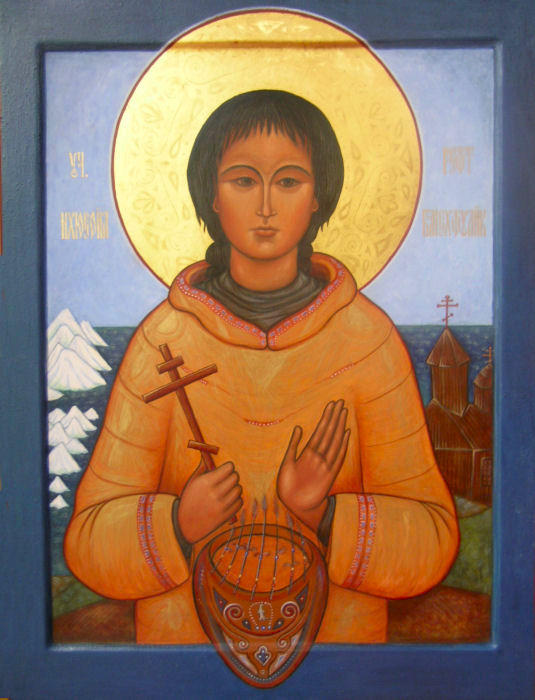
Neomartyr Peter (Čungagnaq) the Aleut


Holy New Martyr Peter the Aleut

This past Sunday was the feast day of the New Martyrs Yuvenaly and Peter of Alaska, who died in defence of the Orthodox faith in North America. The Orthodox Church in America has the following hagiography of Neomartyr Peter the Aleut:
Saint Peter the Aleut is mentioned in the Life of Saint Herman of Alaska (December 13). Simeon Yanovsky (who ended his life as the schemamonk Sergius in the Saint Tikhon of Kaluga Monastery), has left the following account:
“On another occasion I was relating to him how the Spanish in California had imprisoned fourteen Aleuts, and how the Jesuits (actually Franciscans) were forcing all of them to accept the Catholic Faith. But the Aleuts would not agree under any circumstances, saying, ‘We are Christians.’ The Jesuits argued, ‘That’s not true, you are heretics and schismatics. If you do not agree to accept our faith then we will torture all of you to death.’ Then the Aleuts were placed in prisons two to a cell. That evening, the Jesuits came to the prison with lanterns and lighted candles. Again they tried to persuade two Aleuts in the cell to accept the Catholic Faith. ‘We are Christians,’ the Aleuts replied, ‘and we will not change our Faith.’ Then the Jesuits began to torture them, at first the one while his companion was a witness. They cut off one of the joints of his feet, and then the other joint. Then they cut the first joint on the fingers of his hands, and then the other joint. Then they cut off his feet, and his hands. The blood flowed, but the martyr endured all and firmly repeated one thing: “I am a Christian.’ He died in such suffering, due to a loss of blood. The Jesuit also promised to torture his comrade to death the next day.

But that night an order was received from Monterey stating that the imprisoned Aleuts were to be released immediately, and sent there under escort. Therefore, in the morning all were sent to Monterey with the exception of the dead Aleut. This was related to me by a witness, the same Aleut who had escaped torture, and who was the friend of the martyred Aleut. I reported this incident to the authorities in Saint Petersburg. When I finished my story, Father Herman asked, ‘What was the name of the martyred Aleut?’ I answered, ‘Peter. I do not remember his family name.’ The Elder stood reverently before an icon, made the Sign of the Cross and said, “Holy New Martyr Peter, pray to God for us!”
We know very little about Saint Peter, except that he was from Kodiak, and was arrested and put to death by the Spaniards in California because he refused to convert to Catholicism. The circumstances of his martyrdom recall the torture of Saint James the Persian (November 27).

Both in his sufferings and in his steadfast confession of the Faith, Saint Peter is the equal of the martyrs of old, and also of the New Martyrs who have shone forth in more recent times. Now he rejoices with them in the heavenly Kingdom, glorifying God, the Father, the Son, and the Holy Spirit, throughout all ages.
There do appear to be some doubts about the authenticity of the martyrdom of Saint Peter. Long story short, these largely revolve around the question of whether one accepts the word of Peter’s Aleut compatriot who came back from there, or that of the Franciscans (there were no Jesuit missions in California at the time) who appear to have killed him. What it really boils down to is that white scholars are more likely to trust the written word of a Spaniard over the spoken word of an Indian. The tortures he is described as suffering at the hands of the Franciscans are not out of line with other contemporary accounts of the Spanish missionaries’ treatment of Indians in California – torture and mutilation were common punishments inflicted upon Indians who committed a crime under Spanish law. And fatal ‘misunderstandings’ between Orthodox and Catholic Christians were still, at this time, sadly common – and would continue to be so throughout the nineteenth century.

In the end, the question of Peter’s martyrdom was decided on by the Church based on the accounts that were offered to it, and Father Saint Herman, whose spiritual insight, personal comportment and care for the people are unimpeachable, accepted Peter as a martyr for the faith directly upon hearing his story. Even if some elements of Holy Martyr Peter’s story have been embellished in retrospect (with even saints’ memories being, at times, fallible), Saint Peter’s status as a martyr for the faith is unquestionable.

Holy Martyr Peter (Čungagnaq), pray to God for us!
Today Alaska rejoices and America celebrates
For the New World has been sanctified by martyrdom.
Kodiak echoes with songs of thanksgiving,
Iliamna and Kenai observe the Festival of Faith.
The apostle and martyr Juvenaly is glorified
and Peter the Aleut is exalted by his voluntary sacrifice.
In their devotion and love for the Lord
they willingly endured persecution and death for the Truth.
Now in the Kingdom of Heaven they intercede for our souls.