17 April 2019

Monkmartyr Donnán of Eigg and the Fifty-Two with him


Saint Donnán of Eigg

On the seventeenth of April we commemorate one of the great Scottish martyrs for the faith, Donnán of Eigg, and the fifty-two monks with him who suffered ‘red martyrdom’ for Christ at the hands of the heathen Picts.

Saint Donnán was born most likely in Ireland around the year 550. His parentage and genealogy are unknown. He was known to Saint Colum Cille of Iona and perhaps even made his religious profession under him there, though their relationship subsequently seems to have been one of rivalry. Donnán asked of Colum Cille that he might become his anam-chara (that is to say, spiritual father), but Colum Cille refused him for reasons which are somewhat vague. It may have had something to do with Donnán being an itinerant and Colum Cille at that point being bound to Iona. Or, it may have been that Colum Cille did indeed foresee, as the hagiographies of Donnán make plain, that the latter saint did bear about him the cloak of ‘red martyrdom’ – that is to say, a martyrdom by the sword – and was awaiting a crown in the kingdom of God.

Saint Donnán and his followers evangelised all the way up and down the western side of Scotland, particularly in the Isles. It’s possible to trace his voyages by the toponyms associated with the saint. As one can see from this map, place-names associated with Saint Donnán range from Slewdonan in the far southwest of Scotland at Kirkmaiden, all the way up to the Outer Hebrides at Sgìr’ Ùig and around to the environs of Aberdeen in the far northeast, with his holy well at Auchterless. Certainly he managed to spread the good news of Christ far afield in the north.

However, his main settlement was the monastery at Eigg, the ruins of which were uncovered in 2012 at Kildonnan Graveyard on the southeast side of the island, by an archæological expedition led by Dr John Hunter, OBE of Birmingham University. It was here, on the seventeenth of April 617, that Donnán and fifty-two other monks were immolated within the walls of their sanctuary, by a vengeful wealthy landlady of the Pictish nation, along with her followers.

Disputes between monastic communities, which often did not respect the property claims of the landed wealthy, and the landed wealthy amongst whom they lived, were not uncommon at all – as one can see in the lives of the great British saints. The Irishman Donnán was no different. In merely being present on the Isle of Eigg, he managed to offend the Pictish Queen of Moidart who lay claim to the island as her own personal sheepfold. As far as she was concerned, Donnán and his monks were squatters and trespassers. She ordered that the monastery be burnt down and that no prisoners from the monastery be spared. And so it was done. Raiders from the sea, despatched on Moidart’s orders, came to Eigg and set the monastery aflame. One tradition holds that the raiders waited to kill the monks until Donnán had finished saying the Liturgy and administering the Gifts to his spiritual children. Saint Donnán and fifty-two of his fellow-monks were then herded into the refectory of their monastery and burnt alive, thus achieving the martyrdom foreseen by Saint Colum Cille. Holy father Donnán and the holy monks who suffered alongside him at Eigg, pray unto Christ our God that our souls may be saved!


Eigg Castle, Eigg, Scotland

‘Îd al-Jalâ’


The seventeenth of April is Evacuation Day (‘Îd al-Jalâ’ عيد الجلاء) in Syria. The day celebrates the occasion in 1946 when the last French troops left Syrian soil. As one might suspect, the fact that Syrians celebrate their independence on this day rather than on, say, the first of January – when the Allied Powers during the Second World War recognised Syrian independence from France – shows precisely how tenuous that guarantee of independence was, and also showcases the very good reasons the Syrian people have to distrust the French even when they make such promises. Among the foreign leaders who commemorated Evacuation Day with the Syrian people this year were Belarusian President Aliaksandr Lukašenko and Armenian President Armen Sarkissian.

This year nature too is joining the festivities, as flowers are blooming across the country and butterflies and birds are returning. The Syrian people, too, this year have a few reasons to rejoice, though particularly on an œconomic front their struggle is far from over. The war is winding down; Syrian refugees and displaced people are returning home; Dâ‘iš has been decisively weakened (but not yet quite defeated); and most of the country is firmly under the control of the rightful government of Baššâr al-’Asad. Peace talks are being held in Qazaqstan.

However, not all is yet well in Syria. There are still foreign jihadis and Kurdish forces still operating in the country. There is a shortage of resources, particularly fuel, which is the direct result of a brutal sanctions régime from the Western countries and which are directly impacting the poorest and most deprived sectors of the society. And the rightfully-Syrian Arab Hadbatu al-Jawlân is still under foreign occupation – a sad fact which is also commemorated on each Evacuation Day. That occupation sadly has now been validated, over the heads of all the Arab peoples, by our own criminal government.

Additionally, and importantly, our beloved Aleppine archpastors of the Christian confessions, Sayyidna Paul Yâzijî and Mâr Yôhanna Ibrâhîm, are still missing – and this week, six years will have passed since they were abducted. May this Evacuation Day also see renewed and intensified prayers on their behalf, for their release from captivity and for their safe return. May God keep and protect them, and keep them ever in His own memory.

May God grant victories to the Orthodox Christians over their adversaries. May He save and have mercy upon Baššar al-‘Asad and upon the righteous and Christ-loving Syrian Arab Army; may He surround Syria’s sovereignty with peace and subdue beneath their feet every enemy and adversary. May He grant it that the whole of the Syrian nation be liberated from foreign occupation and oppression!

15 April 2019

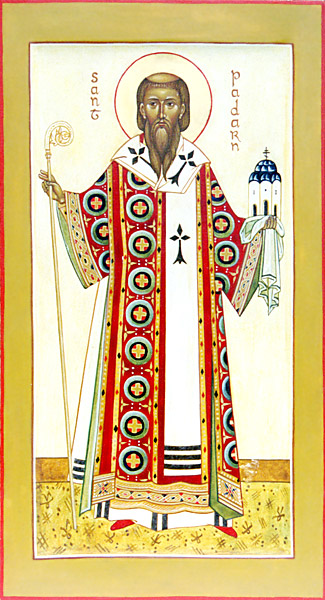
Venerable Padern, Bishop and Abbot of Vannes


Saint Padern of Vannes

On the fifteenth of April we celebrate another great Breton founding saint and sixth-century holy man, Saint Padern of Vannes. A missionary as well in Ceredigion and Ireland, Padern founded numerous churches throughout the Brythonic-speaking territories during the Age of Saints. He is remembered with fondness both in Wales and in Brittany. His Vita is one of the few earlier documents that mention King Arthur, though its sole mention of Arthur in connexion with Padern is not particularly laudatory.

Padern [also Padarn or Paternus] was a Breton of rather high birth: he was kin to Saint Cadfan, in whose company he travelled and whom he helped in his missionary efforts. He is also listed as a nephew to Hoel Mawr, King of Brittany, though he may have been born either in Brittany or in Wales. His father – whose names is given as Petran – separated amicably from his wife Guean, dedicated himself to the Church and left to found an anchorage in Ireland. Guean too left to take holy orders. It was not too long afterward that his son followed in their footsteps, by joining Saint Cadfan in 524. At that time Saint Padern was still a young man, but his hagiography notes that the ascetic rule he kept was that of a man in mature years.

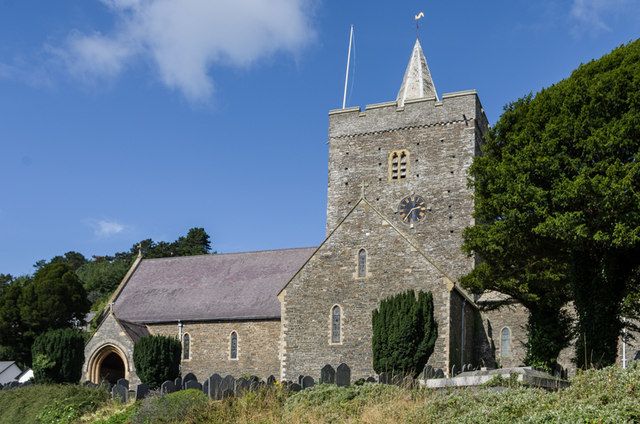
He was sent with recommendations to the College of Saint Theodosius at Llantwit Major run by Saint Illtud Farchog. At this time he also met and befriended Saint Samson, who mentored and guided Padern in his pursuit of the hermit’s ascetic life. And after he left Saint Illtud’s College, he did indeed live a life of solitary prayer and war against the passions. But his time there was altogether brief: disciples began to seek him out and ask for guidance. His hagiography even states: ‘Not at his own request, but his cousins, seeing him hastening to the height of perfection, appointed him.’ Even the spiritual elders at Llantwit gave their blessing for Saint Padern to build a monastery in Ceredigion – this would be Llanbadarn Fawr, the modern St Padarn’s Church. He led a community of perhaps 120 monks (his hagiography gives him 847) while he was abbot there, over a period of twenty years. One of these, a certain Nimmanauc, was so distraught without his spiritual father with him that he crossed the English Channel afoot to Llanbadarn Fawr in order to be with Saint Padern.

During his tenure as abbot at Llanbadarn Fawr, he became renowned for his gentle humility and love, which encompassed all the people under his care and beyond, in both material and spiritual ways. Whatever he spoke, was spoken out of love for God and for people. He founded numerous churches throughout Ceredigion, and Llanbadarn became one of the most active centres of Welsh monasticism, alongside Mynyw and Llandaff. He steadfastly opposed the old pagan beliefs and used his office to bring the pagans to Christ.

He did manage to make a voyage to Ireland to visit his father Petran. The earthly father welcomed his son in the name of the heavenly Father and Son and Holy Spirit, and the two of them conversed at length on holy matters. Unfortunately, at that time Ireland was riven – as was not uncommon in those days – between two rival princes and their armies, and much devastation and grief were wrought by these two contenders. The bishops of Ireland sought out Padern to make peace, and they brought him bodily between the two armies which were arrayed against each other. They dared not make war while a holy man stood between them; and so they sent out heralds, from either side, to speak with the holy man in an attempt to get him to withdraw. Instead, the humble Padern greeted them with mild words and bade their kings come forth instead. His unassuming manner and gracious words, delivered in the name of the Holy Trinity, worked a minor wonder on that field in Ireland, as he managed thereby to broker a peace between the two sub-kings.

On another occasion, Maelgwn King of Gwynedd attempted to defame Saint Padern and ruin his monastery in the following way. They heaped up gravel and moss into sacks and bore them with great decorousness to Llanbadarn. Maelgwn bade his servants take them in to Saint Padern and inform him that he was leaving several superlatively dear treasures of his in the saint’s possession. Saint Padern accepted, and told Maelgwn that ‘they will be found even as they had been left’. Then Maelgwn sent his servants back to collect his ‘treasures’, and upon emptying the contents of the sacks accuse Saint Padern of stealing them and replacing them with the worthless matter. But Saint Padern’s reply was the same before his accusers as that he had left them with.

The matter was brought to trial, which meant trial by ordeal. Saint Padern was ordered by Maelgwn King to thrust his hand into a pot of boiling water at its hottest point. After he had done so, protesting his innocence, he withdrew his hand, the flesh of which came out perfectly sound and cool. His accusers, when put to the same test, were instantly scalded, and their hands came out red and blistered. After this test, Maelgwn himself was stricken blind, and his blindness was not healed until he bent his knee before Padern and asked his pardon. Maelgwn then gave Padern and his monastery a grant of land along the Afon Rheidol by way of repentance and restitution for his sin.

Padern was one of the three saints – the other two being Dewi Sant and Saint Teilo – who made pilgrimage to the Holy Land. When the three of them arrived, by the grace of God and by the strength which they lent to each other, they were greeted and welcomed hospitably by the Orthodox Patriarch of Jerusalem. Patriarch Peter was impressed with the holiness and the speech of these saints. He sent them back not only with his blessing, but with omophoria and the honours due to bishops. The omophorion bestowed upon Padern was richly woven and gilt, and was of a kingly beauty.

It is here that Arthur is mentioned in Padern’s tale. It is said that Arthur, taken by a devil of greed, desired Padern’s omophorion for himself. He first tried to cajole the saint and to buy it from him, but Padern had none of it. He then left the monastery in a rage, stamping the earth with his feet and threatening to raze Llanbadarn to get what he wanted. Hearing him fume thus, Padern said a prayer under his breath, and the ground opened up and swallowed Arthur up to his neck! Arthur begged Padern’s forgiveness for his wrath and threats, and by Padern’s prayers the earth released him again. After that Arthur left Llanbadarn well alone, and sought Padern’s blessing for his endeavours.

Saints Padern and Samson were very dear friends to each other, and when Samson was about to depart for Brittany, Padern was deeply vexed. Upon hearing that his friend wanted to speak with him one last time before he crossed the ocean, Saint Padern ran out of doors with only one shoe and did not stop, going only thus half-shod, until he had met with Samson. The two conversed together over many holy things, and once they were done Samson set sail. Padern himself was not long in following Samson to Brittany, and indeed he founded his famous monastery at Vannes – today the Église Saint-Patern de Vannes – during his faring there.

Here the hagiographies diverge. The Welsh hagiographies have it that he returned to Ceredigion and ended his days there, with his relics being translated to Ynys Enlli by the monks of that blessed isle, who being fellow-voyagers with Saint Cadfan numbered among the close friends of his youth. The Bretons hold that he reposed in the Lord in Vannes, and that his remains rest there. There are thus two locations that claim his relics – the one Welsh, the other Breton. It is, however, agreed that Saint Padern reposed on the fifteenth of April in the middle of the sixth century, around 550. It is equally agreed that Saint Padern’s holy influence is spread throughout both countries. Holy father Padern, gentle father of monks in Wales and Brittany, pray unto Christ our God that our souls may be saved!
Thou didst confirm the truth of the Gospel
By working many miracles, O glorious Father Padern.
Thou didst accompany St David to his consecration at Jerusalem
And return with him to Wales.
Pray to Christ our God that we may be found faithful
Throughout our earthly pilgrimage
And may receive His great mercy.

St Padarn’s Church, Llanbadarn Fawr, Ceredigion

The first real victory of Arab nationalism


Patriarch Meletios II (Dûmâni) of Antioch

According to the Arab nationalist pædagogue Sâti‘ al-Husrî, the first true victory of the Arab nationalist movement, and the very impetus for the Arab Awakening that followed, was the election of Meletios II (Dûmâni) of blessed memory to the Greek Orthodox Patriarchate of Antioch in 1899 – the first Syrian Arab to be selected to the office in 175 years since the repose of Patriarch Athanasios III (Dabbas) in 1724. Many thanks to Dr Joseph Zeitoun’s blog for the biographical information that follows, which I’ve done my best to paraphrase here.

Patriarch Meletios was born in the eastern quarter of the old city of Damascus (aj-Jûrah, near the Roman gate at Bâb Tûmâ, where Saint Thomas lived and where Saint Paul had his conversion experience – and more recently Saint Joseph (Haddad) of Damascus, Saint Raphael (Hawaweeny) of Brooklyn and Ba‘athist philosopher Michel ‘Aflaq), on the eighth of November, 1837. Historically, the district was majority-Orthodox Christian, but the Christians lived in loving, harmonious relationship with their Shi’ite and Alawite neighbours. His family were apparently fairly pious – they prayed, fasted and regularly worshipped Christ at the churches in the neighbourhood. He was sent to the Patriarchal School in Damascus and learned under Saint Joseph of Damascus. He became learned in Arabic, Greek, Latin and Turkish as well as in both theology and the sæcular sciences; upon graduation, he sought after the higher wisdom of the love of God and entered the monastic life.

As a monk, Meletios studied theology and music, where he actively contributed to a great reawakening of the Antiochene hymnal tradition. His musical achievements brought him to the attention of Patriarch Hierotheos, who took Meletios under his wing and sent him as part of a delegation to Constantinople, where he took part in a council of the churches of Constantinople, Antioch, Alexandria and Jerusalem discussing issues of relevance to the Orthodox Christian millet in the Ottoman Empire. At this council, his deep spirituality and humility, his clear and beautiful singing voice and his well-rounded scientific knowledge were noted by Patriarch Cyril II of Jerusalem.

The Christian community in Damascus suffered a great catastrophe in 1860, when Druze and Sunnî warlords who had been fighting in Lebanon entered the city, burned down Bâb Tûmâ along with its several churches and Shi‘a mosques, and killed around 8,000 Christians in a massive pogrom, including the martyr Saint Joseph of Damascus. Meletios returned from Constantinople after this horrific event, and was trusted by Patriarch Hierotheos with bringing monetary aid and aid-in-kind from the church to help the victims, orphans and widows from the pogrom – both Christian and Muslim. He discharged this task faithfully, honestly and with love for the sorrowing; this earned him great goodwill among the residents of Bâb Tûmâ and a commendation to the rank of archimandrite from Patriarch Hierotheos. After the bishop of Latakia reposed in 1865, Meletios was appointed bishop by unanimous vote of the Antiochian synod and assigned to Latakia.

Latakia was then one of the neediest Orthodox diocæses in Syria. Meletios did much to improve and streamline the administration of the diocæse. In addition, he established a young boys’ school which provided instruction in Arabic, Greek and French, and repaired seven of the diocæsan churches. His service in Latakia was marked by personal austerity but great generosity to the poor, and he gave much of his own funds for the upkeep of the churches and to keep the school running in its early years. He sponsored several students to the Halki Seminary, including Saint Raphael (Hawaweeny) – these students for the most part returned to Syria and took up positions in the Antiochian Church, where they greatly enriched its intellectual and spiritual life.

Though Constantinople and Antioch were at this time coöperating to great effect on academics, when it came to cultural and administrative processes the two churches were in a state of contention. The synod of Antiochian bishops demanded the removal of Patriarch Spyridon (Euthymiou), a Greek Cypriot who had been appointed from Constantinople in 1891, and his replacement with a native bishop from among their own ranks. The Russian Empire and the Qudsi Brotherhood of the Holy Sepulchre (of which Patriarch Spyridon was a member) were both involved in the dispute over the Patriarchal office. Long story short: several purely administrative miscalculations which brought Patriarch Spyridon into conflict with both Moscow and Jerusalem ended with his resignation from the Patriarchate; however, the simmering issue which subsequently rose to the surface was one of restored ‘native’ Arabic autonomy versus a ‘Hellenist’ status quo.

This conflict did have some continuities with the earlier ‘Bulgarian question’ and Balkan conflicts more broadly, but with some interesting twists. Ecclesiologically, the question was merely that the bishops of one of the original five Patriarchates wished to restore to themselves the right to appoint their own primate. Ironically, this meant that the Arabic bishops used anti-nationalist language to make their case, appealing instead to the ecclesiological principle of local appointment of the local patriarch in the local church. (Sound familiar?)

Bishop Meletios was at this point one of several personalities involved in the question of the succession following Patriarch Spyridon’s resignation. Another was locum tenens Patriarch Gerasimos (later of Jerusalem), who represented the interests of Constantinople. Three bishops – those of Aleppo, Edessa and Kilikia – supported Gerasimos as the new Patriarch. When the rest of the Antiochian bishops elected Bishop Meletios as Patriarch instead, these three bishops sent complaints to Constantinople, which then attempted to get the walî of Damascus to decide for Gerasimos; however, the Ottoman government, under pressure from the Russian ambassador not to intervene, declined. In a massive popular ceremony at the Mariamite Cathedral, Meletios was enthroned as Patriarch on 27 April 1899. However, Constantinople continued for several years working against him, refusing to recognise him and attempting to get his enthronement overturned.

Patriarch Meletios committed his intense energies of spirit to improving the state of education in Syria and Lebanon, and advocated tirelessly for both public and churchly schooling. He reopened the Balamand Theological Seminary and invited professors from Greece and Russia to teach classes there. He also helped to reform and improve the administration of monasteries and cathedral churches, stamped out corruptions and abuses, built new churches and schools in Damascus, and supported a charitable Orthodox sorority in in al-Qusa‘a which worked primarily with poor women.

His reform work was much-appreciated and much-needed, and more would have been done if not for his death. Patriarch Meletios succumbed to a sudden, and somewhat suspicious, stroke in 1906. Grieved by all Damascenes, Christian and Muslim, he was buried at the Mariamite Cathedral. He was succeeded by Patriarch Gregorios IV (Haddad) – the second post-1724 Arabic Patriarch of Antioch, who would be recognised by the patriarchs of Constantinople, Alexandria and Jerusalem only in 1909.

Even though the ecclesiological argument for Meletios’s enthronement was fully ‘localist’ and Orthodox, the event had much broader implications. According to William Cleveland’s biography, Sâti‘ al-Husrî acclaimed both the enthronement (which happened 120 years ago today) and Patriarchal rule to be the ‘first real victory of Arab nationalism’. In al-Husrî’s view, Patriarch Meletios enabled Arabic Christians in Syria, Lebanon, Iraq and Palestine to fully realise their linguistic and historical affinity with a pre-Islâmic Arab heritage, and to join the demands for reform of (and later revolt against) the Ottoman Empire. The prominence of Orthodox Christians like Shiblî Shumayyil and ‘Isa al-‘Isa in Arab movements for reform and independence in subsequent generations can be to some degree attributed to the witness and work of the Antiochian Orthodox hierarchy. On that note, may God make the memory of His Holiness Meletios to be æternal!

13 April 2019

The coöperative movement among the Bashkirs


Village in Bashkortostan
Cross-posted to Solidarity Hall

Among the ethnic-minority peoples of the Russian interior, the Bashkirs are one of the groups that hold the most interest for me. There are several reasons for this. One of them is that they are (like the Qazaqs) a Qypchaq people, warrior-poets, and – as residents of the Ural Mountains and straddling the geographical boundary between Asia and Europe – Eurasians par excellence. Another of them is genetic-genealogical: most Bashkirs belong to the ‘Western European’ R1b haplogroup. Not only, then, are they my distant paternal cousins, but they are also very likely the closest thing there is to an ‘indigenous’ people among those of us with R1b-derived Y-DNA. The third reason is that, politically and œconomically, the Hanafî Sunnî Bashkirs have historically tended toward a left-wing populism toward which I am deeply sympathetic.

Like the Evenkil of Siberia, it was traditional for the Bashkirs to hold land in common. Also, similarly to the Cossacks, the Bashkir people have long and honourable traditions – both of service to, and of resistance to, the Russian Tsarist government. Bashkirs took a prominent place, particularly their national hero the warrior-poet Salawat Yulai uly, in the rebellion of the Cossack Emelyan Pugachev against Empress Catherine in 1773 – the single largest peasant revolt in Russian history. Thereafter, however, Bashkirs also played a prominent rôle in the Russian resistance to Napoleon, and were among the Russian troops who defended the Netherlands from French troops and who entered the Avenue des Champs-Élysées in 1814. Their relationship to the Russian government, parallel to that of the Cossacks to the Russian government, is therefore a little… complicated.

The distinctions between the Bashkirs and their neighbours (sometimes friends, sometimes bitter rivals) the Kazan or Volga Tatars were not always that clear-cut. Both speak mutually-intelligible Northwestern Turkic languages derived from Qypchaq. Members of both groups thought of themselves instead as Bulghars. In some ways, the division between Bashkir and Tatar was more socioœconomic than cultural: according to Charles Steinwedel, in the early Tsarist period, mounted warfare and animal husbandry were more ‘Bashkir’ occupations, while mercantile trade was more ‘Tatar’. However, the connexion of both the Bashkirs and the Volga Tatars to the political formations of pre-modernity is something to be considered seriously. Chinese historiographers of the Sui Dynasty considered the Bashkirs (Beiru北褥) to be part of the Xiongnu 匈奴 descended Tölöš or Tiele 鐡勒 confederation; Arab historians thereafter accounted them either as an independent khanate or as a part of the Volga Bulghar polity. Both groups were part of the Qypchaq confederation which at one point menaced the Kievan Rus’, and thereafter were incorporated into the Altyn Orda.

The Russians under Dmitrii Donskoi defeated the Altyn Orda decisively at the Battle of Kulikovo Pole in 1380, and the power of the Orda would not recover. Gradually, the Russian Empire exerted suzerainty over several of the defeated remnants of the Altyn Orda – including the Bashkir people – under Tsar Ivan IV, and the latter swore loyalty to Tsar Ivan as аҡ бей ‘white Bei’ and батша ‘great Shah’. Though technically this fealty was willingly-sworn, there were few other options at that time for the Bashkirs – who found Russian rule preferable to Nogai domination.

Though the Kazan Khanate (one of the fragments of Altyn Orda to which the Bashkirs belonged) had already begun the process of sedentarisation and established permanent villages, aspects of the Bashkir’s former nomadic lifestyle remained: the Bashkirs primarily herded sheep and cattle, and continued to breed horses for the purpose. They also grew grain and tended beehives in the forested areas of their homeland (Bashkir honey is nowadays considered a major delicacy). In fact one of the proposed etymologies of the ethnonym Bashqort Башҡорт is that it derives from the Qypchaq word for ‘beekeeper’ (башлыҡ ‘head’, ‘boss’ + ҡорт ‘bee’). Their diet as described by Cossacks and Russian administrators consisted primarily of milk (including the fermented variety koumiss, ҡымыҙ), meat, rice and stuffed dumplings. The Bashkirs also concelebrated with their neighbouring Tatars the agrarian ‘festival of the plough’, Habantui Һабантуй.

The Bashkirs also had a particular attachment, notable even among Turkic tribes, to their oral history. As mentioned before, they honoured a ‘Bulghar’ heritage; however, their elders (aqhaqaldar аҡһаҡалдар) and bards (šaǧirźar шағирҙар) were the faithful custodians of several poems and legends of unmatched antiquity. Among them: Ural-batyr «Урал батыр» and Alpamysha «Алпамыша». There were among the Bashkir people skilled musicians; one of the national symbols remains the Ural edgepistil, the long woody stem of which they craft into a flute, the hauntingly-beautiful qurai ҡурай. Although – as with the other Turkic peoples of the steppes – Bashkir ‘belonging’ was fairly fluid and negotiable, there was certainly a cultural ‘core’ that consisted of these tales, songs and other art forms.

From Ivan IV’s rule until Peter’s, Russian suzerainty did not overly disturb the Bashkir way of life. They were fairly fortunate in that (despite being quasi-sedentary agriculturalists) they were never subject to serfdom, and also in that Moscow’s tax burden early on fell lightly on their shoulders. In any event, the imperial ambitions of Moscow focussed primarily on their western frontiers. During the early imperial period, Bashkir communities were subject to a general policy of ‘benign neglect’ that amounted to a position of prestige within the Russian Empire comparable to the Don Cossacks. Becoming a ‘Bashkir’ under law was an attractive proposition to other inorodtsy, and the Bashkirs ‘let in’ a number of Chuvash, Tatars, Mari and Siberians – who were collectively considered pripushchenniki (‘peasant-tenants’) by the Russian authorities.

This privileged position changed with the Petrine reforms and the imposition of autocracy – along with a colonial rush to access trade routes to the East. Tsar Peter saw and envied the wealth of England, Spain and Portugal, and sought to rebuild the overland trade route to match their sea-based empire. The Bashkirs, whose land straddled the Urals, were suddenly of great active interest to the Tsar. The establishment of a fortified city at Orenburg under Tsarina Anna led to a brutal five years of open warfare between the Russians and the Bashkirs, who were losing the traditional freedoms and immunities they had enjoyed under the Tsars before the Petrine reforms.

Even after the Petrine autocracy, though, there was an active attempt by the Tsarist government to avoid policies that would subject the Bashkirs, Tatars, Chuvash, Mari and other minorities of the Russian ‘East’ to genocide. Even the later Russian (and especially Cossack) administrators of the ‘East’ were well-aware of the Black Legend and the (at least somewhat-deserved) reputation of the Spanish Empire among the Native Americans. One may speculate about their motives, but the Russian government did make a deliberate and conscious point of not being like Spain in its policies toward the non-white inorodtsy of the ‘East’. In ecclesiastical affairs, this attitude produced the gentle ‘Irkutsk model’ of evangelism. Orthodox Christianity promoted neither a ‘crusading ideology’ nor a ‘civilising mission’. The effects of exploitation had also been mitigated by the deliberate policy that ‘Muscovy sent tax collectors east, not settlers’.

On the other hand, this is not to say that post-Petrine rule wasn’t still detrimental to many of these communities, or that displacement did not occur at all. Indeed, the imposition of autocracy undermined both the traditional rights of the Bashkir warriors. The resulting discontent among ordinary Bashkirs proved a potent force, as they began to join the ranks of Cossack revolt. Though Pugachev’s revolt was brutally crushed and their noble prince Salawat sent to die in penal servitude in Estonia (thus making him a legend the rival of Robin Hood), the common cause they had made with the Cossacks allowed the skilled Bashkirs to again take up a parallel service in the armies of Tsar Paul I – who had a particular Romantic attachment to the Turkic peoples and their particular reputation for chivalry and honesty.

In the wake of Catherine’s ham-fisted (oh, sorry – ‘enlightened’) reign and the uprising that resulted, there was far less land theft from the Bashkirs, but the former still struggled under conditions of deprivation and pauperisation. In subsequent decades, Bashkirs would be drawn into the circles of radical peasant action and narodnichestvo. Again – Bashkirs were never made serfs; the presence of serfdom in Bashkortostan was always fairly marginal. However, in the early years of the Russian Empire, due to the nature of Russian territorial expansion and competition with the Ottomans war was never far away from Bashkir territory, and this resulted in low agricultural productivity. In addition to this, taxation and land policy both ensured that Bashkirs often disproportionately felt the ‘pain’ of hard years. Long story short: the social privileges and military honours that Bashkirs had enjoyed from the Russian Tsar in the 1600s and early 1700s did not at all translate to œconomic welfare in subsequent decades and centuries. Functionally, the socioœconomic status of the common Bashkirs differed very little from that of their impoverished Russian peasant neighbours.

The reforms of Alexander II were therefore of particular, and double-edged, importance to the Bashkirs. Even though the abolition of serfdom did not affect them personally (they were neither serfs nor serf-owners), the establishment of the zemstva very much did. For the first time since their period of independence under and alongside Volga Bulgharia, the Bashkirs found that they had a strong collective political voice in their own local affairs as well as a greater degree of œconomic freedom. The institution of the zemstvo did not limit participation only to Orthodox Christians, but opened it also to Muslims; as a result, Bashkir imams found themselves formally empowered through the new institution. On the other hand, the traditional communal land tenure of the Bashkirs was undermined by the extension to individual Bashkirs of a legal right to sell the land. The tension between a greater degree of formal freedom and a weakening of traditional institutions caused a grave crisis in these communities. As Steinwedel says of this era:
A combination of market forces, official corruption, and in-migration then undermined Bashkirs economically. Since semi-nomadic pastoralism had grown difficult on reduced landholdings, many Bashkirs sold their land at ridiculously low prices or were essentially swindled out of it by a combination of alcohol, trickery, and force. Local officials took advantage of efforts to survey Bashkir land to redistribute it to their friends and local allies.
As a result, by the time the 1900s rolled around, the Kazan Tatars and the Bashkirs of the Urals were some of the most enthusiastic adopters of coöperative œconomic strategies to ward against precisely this exploitation and alienation of the land, and the concomitant pauperisation of the people. (Ironically, they accomplished this primarily through the zemstva.) As Azade-Ayşe Rorlich writes regarding these institutions:
Aimed at providing cheaper goods for the community, while at the same time helping the participating members market their own products, cooperatives became increasingly popular in the communities beyond the Urals, which were inhabited by both Tatars and Bashkirs and had lower economic status.
Rorlich notes that among both Tatars and Bashkirs, the village coöperatives and credit unions were organised as a result of input from (Russian) village teachers, doctors and nurses of the zemstvo hospital system, that local élites and particularly religious leaders were often excluded, and that these socialistic zemstvo initiatives were intimately associated with Hanafî reformism. The particular enthusiasm of the Bashkirs for the coöperative movement is sharply highlighted by the figures cited by Tatyana Gennadevna Sirotina in her 2009 dissertation on coöps in the southern Urals, where she cites Orenburg Province’s 2,881 credit coöperatives in the year 1916, compared with Ufa Province’s (western Bashkortostan’s) 10,255 credit coöperatives with 166,112 members in 1908.

Regarding this rural modernisation movement of the Russian zemstvo among the Bashkirs in the reign of Nicholas II, Dr Ilya Gerasimov of Rutgers University has this to say:
The mobilisation of Bashkir villagers by rural professionals was successful: Bashkirs cooperated with agronomists, attended agricultural courses, and eagerly established cooperatives. By joining zemstvo-sponsored initiatives Bashkir peasants became more rational farmers and members of a larger Russian society, yet they were doing so not as “new economic men” or “citizens” [after the Enlightenment pattern], but as “Bashkir/Turco-Muslims,” now more conscious than ever of their group distinctiveness. Absolutely unintentionally, rural modernizers contributed to creating the framework and channels of future ethnoconfessional mobilization in the Bashkir countryside.
The relationship of the Bashkir peasantry to their own élite class was far from trusting, and that shows primarily in the way that the peasantry adapted themselves to the zemstvo. At the same time, their experience among these Russian institutions inadvertently shaped their ‘communitarian’ consciousness as a separate ethnic and religious community. Even so, the overall political thrust of the Bashkir coöperative movement was leftward, directed toward class consciousness, as it was for populists in the rest of the Russian East. Sirotina, though she somewhat disagrees with the particulars of Gerasimov’s analysis, links this consciousness to the Soviet-era work of agrarian theorist Alexander Chayanov, who posited a non-capitalist logic for peasant families and coöperatives. It is, however, easy to see how this could have gone very differently by comparing the Bashkir experience with what happened to the Bashkirs’ southwestern counterparts, the Ukrainian Cossacks. Gerasimov goes on to explain the difference between this movement and that among the Ukrainians:
Furthermore, unlike Bashkirs, educated [middle-class] Ukrainians eagerly invested their “human capital” in the task of mobilizing and modernizing the village. While they did not need the patronizing initiative of the zemstvo and Russian-speaking rural gentry in order to begin a dialogue with the peasantry, the nature of this dialogue was problematic. The inevitable degree of populism shared by rural modernizers almost universally, had a different meaning in different national contexts. In the “Russian” Russia, that populism was socioeconomic in character, expressing itself in the preferential treatment of peasants over gentry landowners, and of midsize “labor peasant farms" over capitalist farms with hired workers. In the Ukrainian context, particularly in the parlance of Ukrainian social activists, the term “people” sounded different, and its meaning changed from a social category of “common folk” to a “folkish” connotation of the “people as a nation.” The tropes and slogans of the all-Russian public modernization campaign acquired a distinctive national(ist) dimension in the Ukrainian context… The very fact of a “translation” of this program into the Ukrainian language and Ukrainian sociocultural context altered its character significantly. Ukrainian “darkness” differed from all-Russian “darkness.” Economic rationality alone could not eliminate it; any remedy had to be in conjunction with interest “in the native language.”
The mid-Soviet caricature of ‘Ukrainian bourgeois nationalism’ as predominantly the refuge of fascists clerical and lay is undoubtedly an exaggeration, but there does seem to be a kernel of truth in its central conceit. The late-Tsarist coöperative movement in, for example, Bashkortostan had a very different political tenor than in the Ukraine, despite the similarities of the Bashkir and Cossack traditions of political rebellion, military service and tribal honour. In Bashkortostan the coöperative movement enhanced political mobilisation on behalf of the poor as well as a mild, moderate, even anti-fundamentalist form of Muslim communitarianism. In the Ukraine, however, the subtle turn from class-based action to language politics ensured that the coöperative movement would engender various forms of right-wing völkisch nationalism centred among the educated middle class in the cities.

The Bashkirs, along with the Evenkil and much of the rest of central and eastern Russia, understood the Tsarist-era coöperative movement primarily in œconomic terms associated with Great-Russian populism or the Slavophil obshchestvo. By the way, as a not-unrelated point of interest, the patriarch of the Slavophil Aksakov family, Sergei Aksakov, was born and raised on an estate outside Ufa, in what is now Bashkortostan, and his fond memories of the place and the coöperative lifestyle of its people – Slavs and Turks – undoubtedly coloured the his sons’ ideal of the peasant commune, the obshchina община.

As evidenced from Gerasimov’s writing, the Bashkirs did not merely passively receive from the zemstvo this movement or its associated mindset; they made it their own. It fused with the legacy of Salawat Yulai uly and the Bashkir rebels of Pugachev’s time, as well as with the contemporary Hanafî madhhab tendencies of Jadidism and Qadim – both of which ‘moderate’ tendencies effectively subdued the ‘rightward’ impulses to fundamentalism and ethnic separatism. The result was not, as one might imagine, entirely to the liking of the Russian authorities, either ecclesiastical or sæcular. One need only read about the career of Bishop Saint Andrei Ukhtomskiy of Ufa to determine this – but at the moment we must leave this most interesting radical ‘catacomb’ hieromartyr for a future piece.

The Bashkirs and their cousins the Tatars, who had this long history of negotiation with and rebellion against the Russian state, found in the coöperative movement of the early twentieth century a certain set of tools that they could use, both to assert and advance themselves as communities against competition and capitalist exploitation from the outside, and to preserve a certain sense of traditional cohesion underneath a rapidly-modernising legal régime. The New Œconomic Policy of Lenin’s USSR – in fact an extension of Stolypin’s reforms – did coöpt these tools and subordinate them to a policy of regularisation which under Stalin’s policy (disastrously for these minority ethnic groups) would become collectivisation. Even so, today the ethnic minorities of Russia – not only the Evenkil and the Bashkirs – are already looking to and learning from these institutions in order to creatively adapt to post-Soviet realities.

11 April 2019

An English Abba Anthony


Venerable Gúðlác of Crowland

Our father among the saints, Venerable and God-bearing Gúðlác of Crowland, is celebrated today in the Orthodox Church. In the Orthodox Church we refer to this great eremitical elder as the ‘English Abba Anthony’, because he bore the wisdom and the holy life of the Ægyptian Desert Fathers into the swampy, unreclaimed fens of the Lincolnshire countryside.

Gúðlác, a contemporary of Holy Bede, was born to Penwealh Iclingas and his noble wife Tette, in 673. According to Felix’s Life of the saint, at his birth a sign appeared from heaven: a red hand holding a cross, which pointed to the house in which Tette had given birth. He also had a sister, Pega, a nun who lived a holy life and is venerated as a saint in her own right. In his youth, Gúðlác was a bright and filial child to his eldern; he didn’t spend his time in frivolous pursuits. Like Saint Biscop before him, Gúðlác was a þegn and weapon-bearer in the here of Æðelrǽd King of Mercia, the son of Penda, between the ages of fifteen and twenty-four. Felix’s Life gives this time of his life a somewhat darker cast.
Then, as though he had woke from sleep, his disposition was changed, and he collected a great troop and host of his companions and equals, and himself took weapons. Then wreaked he his grudges on his enemies, and burned their city; and ravaged their towns, and widely through the land he made much slaughter, and slew and took from men their goods… It was about nine years that he was thus engaged in hostile raids, the blessed Gúðlác, and he thus wandered amidst the tumult of this present world.
After this, he seems to have a crisis of conscience, a ‘dark night of the soul’. Though he had been drawn into thegnship by tales of worldly glory and heroism passed down from his forefathers, it dawned upon him that all of their strivings had ended in death and wrack.
It happened on one night when he had come from an expedition, and he rested his weary limbs, and thought over many things in his mind; that he was suddenly inspired with divine awe, and his heart within was filled with spiritual love; and when he awoke, he thought on the old kings who were of yore, who thinking on miserable death, and the wretched end of sinful life, forsook this world; and the great wealth which they once possessed, he saw all on a sudden vanish; and he saw his own life daily hasten and hurry to an end. Then was he suddenly so excited inwardly with godly fear, that he vowed to God, if He would spare him till the morrow, that he would be His servant. When the darkness of the night was gone, and it was day, he arose and signed himself with the mark of Christ’s rood. Then bade he his companions that they should find them another captain and leader of their company; and he confessed to them, and said that he would be Christ’s servant… God’s love burnt so within him, that not only did he despise this world, but also his parents’ wealth and his home, and even his companions he all forsook. When he was four and twenty years old, he forsook all the pomps of the world, and set all his hope on Christ.
Thus, thinking upon his own death, he put aside his weapon and did off his byrnie, calmed the rage of his soul and went into the double monastery at Repton, placing himself meekly under the rule of Abbess Ælfþr‎ýð, who held sway over both the monks’ monastery and the nuns’ cloister there.

During his time at the abbey, his repentance was regarded as extreme even by his fellow-monks. He would touch no wine at meal-times, and because of this the brother-monks at Repton at first believed him to be haughty and proud. However, upon becoming known to them, they found him to be the very opposite: kind, loving, forgiving and mild toward them – and neither haughty nor overbearing. He spent his time reading from the Psalter, the Holy Gospels and the writings of the Holy Fathers, and he made a number of true friends among the monks during his two years there, but he was drawn toward another kind of life than what was offered under Ælfþr‎ýð. Upon reading about the lives of Anthony the Great and the other fathers of the Ægyptian Desert, he was seized by a strong desire to emulate their eremitical way of life, and after having spent two years as a monk he sought permission from his Abbess to withdraw from the monastery into the fens, there to be closer to Christ. Abbess Ælfþr‎ýð and the monastic prior, beholding the sincerity of his request, gave him their blessing.

When he came to the fens he met a man named Tatwine. Tatwine told him of a remote island in the midst of the fens, which men had often tried to settle but, on account of the deadly plights and the ‘manifold horrors and fears’ of the fens and the wicked spirits and dæmons that lived there, they never could succeed. Upon hearing of this place, Gúðlác straightaway bade Tatwine to take him there, and they both went by boat to this island – Crowland – which lay in the middle of the fens. Gúðlác landed upon the island on the feast day of Saint Bartholomew, and for that reason in all his ascetical strivings and mighty struggles against the dæmons upon the island he called upon Bartholomew’s name for aid, after that of Our Lord. Several times the blessed Apostle came to him in visions, and helped him in sundry ways, with both struggles of the soul and struggles of the flesh.

Gúðlác lived in the side of an old heathen barrow of raised earth, which had been broken and plundered by grave-robbers long ere he came. On the unbroken side of the barrow, a rain-cistern had been built, and beside this cistern Gúðlác built his dwelling-place. He clothed himself in animal pelts, and he lived only on barley bread and rain-water, and on that only when the sun had gone down. The dæmons who attacked him tormented him with many trials. With flattery they sought to drive him to extremes of asceticism or to relax his fast altogether. They fell upon him in great numbers in his house, and threw him into the mud of the fens or else into the brambles to tear his flesh. They beat him with iron knouts when he called upon the Lord to save him. They brought him as in a vision to the gates of Hell, where before him all manner of unrighteous men were being tormented, and tried to push him into the fire – and Gúðlác was saved by the intervention of Saint Bartholomew, who ordered the dæmons to deliver him, and not to torment the ascetic again.

On this isle Gúðlác was attacked not only by dæmons but also by more this-worldly foes: Welsh Britons who lived in the Fens, and who grew wroth with this English intruder and sought to kill him or drive him out. The Life describes more ‘dæmons’ who spoke in the Welsh tongue, who came in numbers and burned Gúðlác’s house and tried to attack him with spears. He overcame them only by singing from the Psalter, after which these Welsh-speaking ‘dæmons’ drew off. At another time, a priest named Beccel came to live with Gúðlác, but he was tempted with envy by one of the dæmons, and crept up on Gúðlác to slay him with a knife. But the hermit, seeing through Beccel’s intention, harshly rebuked him and the evil spirit which had lain hold of him; whereupon the dæmon was driven out and tempted priest fell at the hermit’s feet with tears and confessed his sins. Gúðlác not only forgave Beccel, but indeed became his steadfast friend and helper.

Gúðlác made such progress in his ascetic endeavours, and was meek enough in his bearing, that even the wild animals of the fens obeyed him, although some – particularly the ravens – were wont to play him mischief. At one time, a monastic came to Gúðlác to seek his wisdom; having written down some notes, he lay them aside and went out briefly. When he returned, his paper had gone missing, and the monk saw it in the claw of a raven who had borne it off. The monk fell to tears; when Gúðlác beheld this, he consoled the brother and advised him to row in a boat after the raven. The monk did so, and found his paper perched among the reeds as though it had been gently lain there by a human hand; rejoicing, he thankfully took back his notes to Gúðlác, who attributed this finding to God’s mercy. The ravens of Crowland had just such a habit of thieving whatever they could lay their claws on; Gúðlác bore it with patience as an example to his followers. But – much like the hermits of the Russian Thebaïd – the rest of the wild animals and fish and birds of the fens obeyed Saint Gúðlác’s every word, and he fed them from his own hands. One monk named Wilfrið was amazed at the swallows who would come and sit on Gúðlác’s shoulders and arms and knees and sing for him.

At another time, a high-born kinsman of Gúðlác, Æþelbald, accompanied this same Wilfrið to see the holy hermit and converse with him. Having landed on the island he left his gloves in the boat. At once the ravens snatched them up. Gúðlác, to whom this hidden event was known, asked Æþelbald if he had left anything, and Wilfrið answered that they had left his gloves. Then they saw the raven with one of the gloves in his beak, perched on the roof of his house – Gúðlác rebuked the naughty bird, which let fall the glove at once, which Wilfrið retrieved from the roof with a stick. Three men came to Crowland, also by boat, and after their visit they told Gúðlác of a strange thing – another glove had fallen right into their boat from the air, having been dropped by a raven. Gúðlác took the glove from them, smiling, and gave it back to Æþelbald.

Gúðlác was also instrumental in restoring the wits of a good and filial young East Angle named Hwætred, who of a sudden went bear-sark in his father’s house, so that he bit and scratched himself and cut himself with iron in a violent fury. When his kinsmen came to restrain him, Hwætred took an axe and killed three of them with it, and wounded many more. They could do little else but bind him and bring him to the priests, who tried in vain for four years to exorcise him. His kin grieved of Hwætred and even wished him dead rather than in this dæmonic frenzy. But they heard of a hermit living in Crowland, and they brought him there. Gúðlác, hearing their tale, was moved to great pity for the young man, took Hwætred into his house and prayed over him for three days without cease. On the morning of the third day, Gúðlác doused Hwætred in holy water and breathed upon his face, and the might of the heathen spirit was crushed. The lad came back to himself as though he had been asleep, and went back among his wondering kinsmen. He was never to suffer again from the same illness. On another occasion, a thrall named Ecga likewise took leave of his senses under the power of a wicked spirit, and his kinsmen brought him also to Gúðlác. Ecga, Gúðlác cured to health by laying his girdle upon him, and he too was never so afflicted the rest of his days. Gúðlác thus met many sick folk, armly and rich, and not only from Mercia but from sways far beyond, and none departed from him unhealed.

The grace of Christ gave the ascetic Gúðlác great powers of foreknowledge and spiritual insight. At one time, an abbot of Repton came to visit him with two brother-monks in attendance. Before they reached Crowland, the two brother-monks begged to go their own way on needful business, and the abbot agreed. However, when the abbot conversed with Gúðlác, the latter spoke to him that his two attendants were in fact drinking strong drink and carousing in the home of a certain widow. When the abbot met the two brother-monks afterward, he upbraided them for their deception; knowing they had been found out, the two brothers fell at their abbot’s feet, owning that it was just as Gúðlác had said, and begged his forgiveness.

On another occasion two monks came to visit Gúðlác, but they had drunk some ale on the way and hidden the remainder under a grassy knoll to have with them on the return journey. Gúðlác greeted the monks warmly, spoke with them on many spiritual things, and left the monks greatly edified by his words. But as they went to leave, in a laughing good humour the hermit said: ‘Wherefore hid ye the bottles under a knoll, and why brought ye them not with you?’ The two brothers were dumbstruck by this saying, and they fell at Gúðlác’s feet and begged his blessing as they departed.

Another man, a þegn of Æþelbald the Exile named Ofa, came to visit Gúðlác, but on his way there he put his foot through a briar whose thorn pierced his foot straight through. In blinding hurt, Ofa trudged on and found his way to Crowland. By this time, the wound from the thorn had festered, and the infection had caused his nether body to swell from his heel all the way up to his waist, so that he could neither sit nor stand. Ofa told the hermit the tale of how all this had befallen him; and taken with pity Gúðlác stripped off his clothes and bade Ofa wear them. No sooner had Ofa done this but the thorn and shot forth from his body even as an arrow flies, and landed many yards afar off. In the same moment the festering and the pain left Ofa’s body. Ofa lay fully healed, and spent a long time conversing with the hermit in a happy mood, and went forth from the island hale in body and free from any hurt.

Even bishops were drawn to Crowland to benefit from the hermit’s wisdom. Bishop Hædda went forth to see the man of God, and took with him a bright but rather boastful young clerk named Wigfrið, who had spent some time in Ireland, had seen some fraudulent hermits there, and thus thought himself well able to detect whether Gúðlác’s holiness was true or delusional – and he said as much proudly to his master. When Hædda arrived, Gúðlác met him and his whole retinue warmly, and conversed with them all, and did so with such meekness of roust and generosity of spirit that it seemed to them it was not a man standing before them but an angel. Hædda offered to Gúðlác to make him a priestmonk, which eventually Gúðlác accepted as the will of God. But as the bishop made to depart, Gúðlác saw Wigfrið among the host and spoke calmly to him: ‘Now, brother Wigfrið, what sort of man seemeth thee now the priest is, of whom thou saidst yesterday that thou wouldst try whether he were good or bad?’ Wigfrið, stricken with compunction, fell upon his face before the hermit, confessed his fault and begged his forgiveness. This, Gúðlác gladly gave. And so Crowland was hallowed by the Church – five days before the feast-day of Saint Bartholomew.

Another Abbess of Repton, Ecgburg daughter of Ealdwulf King of the East Angles, dearly loved Gúðlác and sent to him the gift of a winding-sheet and a fine coffin with a leaden lining, and asked that when he departed this life for the æternal life of blessedness that he would deign to be placed within it. She also asked him who would tend the holy place of Crowland after this would take place. Gúðlac took this message and gift kindly, and answered her that the man who would take care of his hermitage after his passing was as yet a heathen, and had not yet been dipped in the life-giving waters, but that this would come to pass ere long. Iwis enough, the heathen Cissa soon came to British shores and was taken into the Church.

Not long thereafter, again the aforementioned Æþelbald came to Crowland. This time he was in flight, hounded by Ceolred who was then King of the Mercians, forsaken by all his friends. He sought out Gúðlác for shelter, for guidance and for comfort. And the holy hermit had this to say:
O! my son, I am not forgetful of thy troubles; for this cause I took pity on thee, and for thy troubles I prayed God that he would have pity on thee and support thee; and he has heard my prayer, and he will give thee kingdom and rule over thy people, and they shall flee before thee who hate thee; and thy sword shall destroy all thy adversaries, for the Lord is thy support. But be thou patient, for thou shalt not get the kingdom by means of worldly things, but with the Lord’s help thou shalt get thy kingdom.
With these words and many more Gúðlác gave comfort to the fleeing atheling, and the latter made firm his will to serve God in all things, and not to trust in worldly wealth or power, and to forgive even his enemies and be kind to his friends.

Saint Gúðlác fell ill on the Holy Wednesday of 714. Understanding that his earthly end was near, and that he was being called to Golgotha with Christ, the holy hermit began cheerfully making ready to leave this life for the æternal. For seven days, including the Pascha, he bore the illness, holding the Liturgies of Holy Week each day as he would do were he in the fullness of health, until on Bright Wednesday he reposed in the Lord. During this time, at his side was the same saintly brother Beccel, who gave Felix a full account of the saint’s illness and death. With his last words, Gúðlác bade Beccel to go to his sister Pega’s side, and tell her that her brother had not shown himself before her in this life that they might be united forever in the next, before the face of God – and also instructed her to wind him in the sheet and lay him in the coffin which Abbess Ecgburg had furnished him. On that Bright Wednesday the hermit took the Eucharist for the last time. Upon his death, Beccel saw the house filled with a brightness brighter than noonday, heard on the air the fair rousts of angels in song, smelled a wondrous and sweet smell, and beheld a fiery tower reaching from earth to heaven that put the sun’s light to shame. Amid this, Beccel trembled with holy fear. After this he did everything exactly as Gúðlác had told him to do.

Saint Pega, in great sorrow for her brother’s passing, buried him in Abbess Ecgburg’s garments and coffin, and told the monks and nuns of her Abbey to sing three days of hymns commending his soul to God. Twelve months after, Saint Pega decided to translate her brother’s relics into a more fitting resting-place. Though he had been dead a full year, the brothers and sisters beheld to their amazement that the body of Saint Gúðlác had suffered no corruption nor decay, and was even as lithe and sound as though he were merely asleep. Even the winding-sheet was as fresh and white as the day it had first been put around him. Saint Pega beheld these things with great awe and joy, and with still greater songs of praise she translated him, and even kept Abbess Ecgburg’s coffin in a stead of honour. For in life, the holy hermit had fully repented of his violent and bloody youth: ‘never was aught else in his mouth but Christ’s praise, nor in his heart but virtue, nor in his mind but peace and love and pity’.

Some time after the translation, a boatman in the service of Æþelbald who had for twelve months suffered from blindness as a result of corneal ulcers, was brought before Gúðlác’s resting-place. His friends spoke to Saint Pega, and she led the blind man into the church before Saint Gúðlác’s relics, washed one of his eyes with salt water which had been hallowed by the saint in life. Before she could so rinse the other eye, the sight of both had been restored, and the corneal ulcers had been healed. The boatman went home hale and in full possession of his sight.

Æþelbald of Mercia himself, when he heard of Saint Gúðlác’s death, was stricken with sorrow and hurried to the grave of his old benefactor. He threw himself upon the tomb of the saint and wept bitter tears until he had cried himself to sleep. When he awoke, there was an eerie light all around him, and standing before him was Gúðlác himself, enveloped in the light. Gúðlác’s soul gave words of comfort to the young atheling, telling him not to despair but that in twelve months he would be made ruler in Mercia, and would no longer have to flee and hide for his life. All came to pass in such a fashion. And during his later reign Æþelbald did not forget Gúðlác, but established a holy house for monks, with many buildings, in the saint’s honour.

There is a long-established and well-attested link between the spirituality of the early Celtic hermits and that of the hermits of the Ægyptian desert. That is, indeed, one of the major themes of William Dalrymple’s book! However, Venerable Gúðlác of Crowland’s example demonstrates that this link existed also with the recently-baptised English people, who were eager to learn holiness not only from Rome, but from the rest of the Christian world. Remember that Saint Richard’s destination was not Rome, but Palestine! The fact that Saint Gúðlác’s particular brand of holiness – a bright, cheerful and hospitable holiness; a holiness of labour; a holiness of regular and abstemious but by no means extreme or contorted ascesis – has such a clearly-attested link with Abba Anthony the Great demonstrates this as well. Holy Gúðlác, our venerable and God-bearing father, we beseech your prayers to Christ our God to save us sinners!
Dwelling from thy youth amid trackless and watery wastes, O divinely wise father,
With holy zeal thou didst strive to follow the commandments of Christ.
Wherefore, the ranks of angels were amazed, beholding thee, a man of flesh and blood,
Contending valiantly against the passions, O all-wise one,
And prevailing over all the hordes of the dæmons.
On earth thou wast a peer of the angels,
And in heaven thou art ever an intercessor for mankind.
O venerable Gúðlác, entreat Christ God that He save our souls!

10 April 2019

Abbot Beocca, Priestmonk Eðor and the Ninety Holy Monastic Martyrs of Chertsey


The ruins of Chertsey Abbey

In the year 870, the Great Heathen Here which had landed in York was marching southward, plundering, pillaging and killing their way toward Wessex. Five months prior, they had martyred Éadmund of East Anglia by tying him to a tree and shooting him full of arrows. And they had already laid waste to Peterborough and destroyed the monastery there, as well as the abbey at Bardney in Lindsey.

The Danes wound their way into Surrey, where they came across the Abbey of Saint Peter at Chertsey which had been founded by Saint Eorcenwald in the year 666, and the companion Abbey of Saint Mary at Barking built for Saint Æþelburg. Houses of worship and monasteries were singled out by these sons of Ragnarr Lóðbrók, both because of their ornamentation and because the raiders bore a fanatical hatred of the Christian faith. The ravages of this Danish army could not be countered by any conventional force; they would only be stopped by the asymmetrical guerrilla warfare of Saint Ælfrǽd and the prayers for deliverance of Saint Neot.

The venerable and worthy successor to Saint Eorcenwald at Chertsey was a humble and meek abbot named Beocca; he was assisted in his labours by the priestmonk Eðor [also called Edor or Hethor]. When the Danes arrived in Surrey and lay waste to the town on the tenth of April, they barged into the monastery and cut down the non-resisting monks, including these two. They then plundered and burnt the Abbey of Saint Peter, killing ninety monks. They also plundered and burnt the Abbey of Saint Mary at Barking, killing all of the nuns inside, ‘whose names, not known on earth, are recorded in the Book of Life’. The date of this tragœdy is not known either.

Holy martyrs for the faith at Chertsey and Barking, including the righteous Beocca and the faithful Eðor, pray unto Christ our God for the salvation of us sinners!
O venerable martyrs of the Lord, mindful of the Sacred Scriptures,
Ye did not resist the rage of the heathen, but gave place unto their wrath;
And blessing those who cursed you,
Ye bowed your necks beneath their swords,
Surrendering your souls into the hands of your Lord,
Who alone is good and loveth mankind.