28 November 2011

Pointless video post - ‘World Chaos’ by Holy Moses


Holy Moses is another one of those criminally-underrated German bands (like Tankard), dating back to the infancy of this newer and more aggressive style of metal that came to be known as thrash, that deserve a much more hallowed place in the annals of metal history than they often receive. Sabina Classen slays so much it’s crazy; given that female vocalists in thrash are so seldom found, you just know they have to be that much more epic than the rest. Ms Classen simply never disappoints here. Even though World Chaos (for which this is the title track) is very much a work of ‘crossover’ thrash (as the punkish lyrics readily attest) and doesn’t quite live up to the sheer, consistent kinetic force of, say Finished With the Dogs or New Machine of Liechtenstein, it still ranks among my favourite thrash metal albums, full stop.

Enjoy, my gentle readers! \m/

25 November 2011

A few words on Metternich

Klemens Wenzel Nepomuk Lothar, Fürst von Metternich-Winneburg zu Beilstein

Happy turkey day, gentle readers!

People who know me well are usually not surprised to know that I’ve had a fascination with the historical figure of Klemens Wenzel, Fürst von Metternich, since before I graduated from college: a bundle of contradictions (or seemingly so) drawn to another. Metternich has garnered in much of the world the reputation of an arch-conservative, even an absolutist reactionary, seeking quixotically to hold back an inevitable tide of progress, which finally saw him defeated in the liberal revolutions of 1848. During his heyday, though, he was the bogeyman of many a ‘free-trade’ liberal, nationalist and free-speech advocate in his day, with the anti-nationalist Karlsbader Beschlüsse being the primary symbol of the censorship and repression with which Metternich was associated. As a personal figure, as well, he appeared to exemplify at once both the worst and the best of the old European nobility. Peter Viereck describes him as a ‘Frenchified German dandy… witty, pleasure-loving and arrogant’, which is perhaps not an unfair description. Continental in his attitude toward marriage (to put it politely, given his affairs with a number of high-profile women including Caroline Murat, Napoleon Bonaparte’s sister) and almost hubristically confident in his (formidable, to be sure) intelligence and abilities, he nevertheless dedicated those very same talents of which he was so cock-sure entirely to the service of his emperor and to the ancien régime.

Yet, under the international system he engineered, Europe enjoyed over a generation of peace – and what is more, it was not a peace enforced by the hegemony of a single economic or political regime, but rather a participatory and (largely) communicative system wherein powers were balanced with each other. He did not always get along with Emperor Francis; indeed, he opposed the most egregious forms of domestic censorship, advocated moderate local self-rule for Italians and Hungarians, was an ardent defender of the rights of Jews across the Continent in an era when they were still massively unpopular even amongst liberals, and was a consistent advocate for constitutional reforms within the Habsburg Empire. He attempted to bridge the gulf between the serfs, the growing proletarian class, and the landed gentry through his ‘socialisme conservateur’ – a vision of political economy which shares in its cosmopolitan reconciliation of the classes a great deal of overlap with later Catholic social theology, and by which the Prince made himself the ‘enem[y] of anarchy, moral and material’. In a time where liberal thought was converging upon the nation-state as its greatest vehicle of political empowerment, Metternich turned his vision at once upward to a greater international order and downward to more local forms of order.

One may argue the finer points over whether or not what he did was ultimately best for Europe as a whole, but there are many points that I think one can successfully take from his thought. For one thing, Metternich was far-sighted enough to see that the ethnically-homogeneous ideal of the nation-state was a horrible idea (a hearty thank-you to California Constantian for the link!), and that the secret societies within such ideas were allowed to manifest themselves in violent extremes were not a healthy development but rather a ‘gangrene of society’. Though one may decry that the Karlsbader Beschlüsse themselves were an extreme and repressive measure, one must remember that out of the ‘liberal’ Burschenschaften against which they were primarily aimed arose many of the aggressive hyper-nationalist and anti-Semitic tendencies which ultimately plunged the European continent into another total war, a genocide. By contrast, it is well to remember that Prince Metternich’s socialisme conservateur was at once the fountainhead of his support for the traditional monarchical state, as well as being the very source of his defence of the basic dignities of the Italians, the Hungarians and the Jews in Europe.

In keeping with the season, in addition to the other parts of my life for which I give thanks, I feel I owe a debt of gratitude to the intellectual inspiration of Fürst Metternich – a flawed but nevertheless incredibly profound political theorist as well as master diplomat.

23 November 2011

Yan Xuetong: ‘China must display humane authority in order to compete with the United States’

I’ve been linking to the Hidden Harmonies blog a lot these days. There’s a good reason for it, however. Although Hidden Harmonies gets a pretty bad rep in the China-expat blogosphere for being basically (an ‘angry youth’ 憤青 outlet / a five-dime 五毛 corner store / a bunch of supposedly-ignorant ABCs venting about American media bias and international relations / all or any of the above as the detractor’s narrative demands), and even though the commentary on many of the articles does sometimes get a bit heated, they truly are an invaluable resource when it comes to the analysis, translation and dissemination of critical research from within China, partly because of their enthusiasm for the subject at hand. It also doesn’t hurt, from my humble perspective at least, that they have a rare, sensitive and often penetrating scepticism of the ways in which the neoconservative foreign policy agenda of the Bush Administration (and to a certain extent, Obama’s as well) has shaped both our foreign relations and our journalistic best practices; this is a sensitivity which a number of other China expat blogs very much lack.

So it was with considerable interest, nay, enthusiasm that I read the redoubtable DeWang’s link-up to and commentary on a New York Times editorial which was translated from an essay by Yan Xuetong, Dean of the Institute of Modern International Relations at Tsinghua University. Dr Yan’s thesis boils down to the argument that what is needed right now in China is a healthy dose of actual Confucianism, rather than the current government’s fad use of Confucius and his students as mascots of Chinese culture and CCP rule. In short, the Chinese government needs to be more focussed on developing local, domestic institutions than on its foreign PR, shift away from developmentalism to focus on social and economic equality, and serve as a better moral role model for the rest of the developing world rather than attempting to compete in terms of hard power and economic influence.

It is a profoundly, indeed unabashedly, palaeoconservative argument (Dr Yan speaks approvingly of the traditions of virtue ethics and the independent civil service in China going back past the Tang Dynasty – one might cite approvingly his parallels with the political thought of George Grant, though his positing China as an alternative vision of ‘nation’ rather than Canada will result in a very different-looking philosophy), with just enough of a hint of Chinese New Leftism in his prescriptions of social safety nets and economic justice measures meant to collapse the growing wealth gap to get an ovation from me. Though Dr Yan is a self-professed realist (and I have no reason to doubt him), here he hints at a normative international relations approach which mirrors and encompasses the profounder insights of realism without succumbing to Reinhold Niebuhr’s heretical interpretation of original sin; marking a moral dimension to power itself rather than merely to its uses.

I very much look forward to reading more of Dr Yan’s work to see how he fleshes out more of these ideas.

20 November 2011

月氏歌

天山路叉選一條
颳北風示吾歸遭
颻雪被戎血泮燒
聽遠西漠中慨號
追赤鹿者凡等儼
劃江船并遊凍原
酷滄長晦鍛煃魂
寒黑中聽烔義論
- 郭明正, 2011年11月20日

Translation:

Song of the Tokharians

I choose a path from a fork in the Tian Shan road,
As the North Wind whispers to me, 'turn back'.
The driving snow is melted by the heat of my barbarian blood
As I hear the distant lament from the western desert.
Among the followers of the elk, all are equally glorious,
The river-boat rowers and the tundra wanderers.
Bitter cold and long nights forge hearts afire;
In the winter dark one hears the scalding word of justice.
- Matthew Cooper, 20 November 2011

19 November 2011

Localism, finance and federalist legalism + pointless video post – ‘River of Rapture’ by Death Angel

In the past couple of days, I have attended a heavy metal concert featuring thrashers Testament, Anthrax and Death Angel, as well as a brown-bag talk from Pitt economics PhD student Xu Yilan and her paper on the effect of financial deregulation on home foreclosures. Her paper was very well-conceived, painstakingly rigorous in methodology and quite interesting both in terms of its own argument and in terms of the history it uses to tell its story.

In November 2006, the Ohio Supreme Court overturned a city ordinance issued by Cleveland, heavily regulating loans originating at interest rates higher than 4.5% above the T-bill base rate in order to discourage usurious mortgage lending practices, on the basis that they were more restrictive than state laws governing mortgage lending, and thus violated the ‘home rule’ provision of the Ohio State Constitution. Maryland’s Supreme Court slapped down a similar county-level ordinance at about the same time. As a result, according to the study by Ms Xu, subprime lending practices took off (subprime loans increasing by 30%, and total loans by subprime lenders by 40%) even though overall credit was unaffected. In addition, there was a nearly 50% increase in loan foreclosures! This study suggests, quite tellingly, that:

  1. local regulations do impact the housing market, often to a higher degree than higher-level regulations,

  2. heavy regulation does not necessarily have a deleterious impact on the total amount of credit in the market, and

  3. lenders will take what slack they are given – that is to say, if subprime and usurious lending practices are deregulated, you will find more of them in the market as a result.


It also demonstrates a rather uncomfortable tendency in American political discourse to limit our discourse on federalism to merely the relationship between states and the federal government, getting bogged down in arguments about ‘states’ rights’. I must confess that, despite my distributist and pro-subsidiarity inclinations, I am heavily sceptical to the point of dismissive of the common run of ‘states’ rights’ arguments in American political discourse given the way that they have been aligned with some incredibly ugly race politics in the American South, predating the Civil War. That is an important argument, but separate from the one I want to make here, however – and it is the case that the amount of legal leeway given to states has, granted, resulted in some remarkable institutional experimentation. It is certainly not an empty reputation of the federalist system that it allows for a significant degree of regional autonomy and difference, to the point where states may be justly thought of as ‘crucibles of democracy’.

At the same time, though, states have proven that they can be every bit as tyrannical as the federal government in terms of enforced conformity, if not more so. Jim Crow is only the most egregious historical example. Cleveland created its own laws and apparently had some success in enforcing them; as a result of state-mandated deregulation, however, predatory lending practices boomed again within the city itself. It strikes me as a structural weakness of our political system that local politics are bound up entirely in their relationships with the relevant state authorities, whilst the ‘federalist’ arguments are relegated to the national stage and concern only ‘states’ rights’ rather than the rights of cities, towns, counties and communities. Additionally, the corporate news media, also hoping to create news with the broadest possible audience in mind, focusses disproportionately on this higher level. Small wonder the American public care so much more about presidential and congressional politics than what goes on in their own backyards!

Thus, it strikes me that in such cases as Ohio and Maryland, ‘states’ rights’ as commonly advocated by libertarians and palaeoconservatives with national political aspirations, are in fact the bane of truly distributist and localist concerns. This is just my interpretation of the paper, however. I highly recommend reading Ms Xu’s work on its own merits – as presented, it was a very interesting economics paper in its own right.

The night before, however, I attended an epic concert on the North Shore by Testament, Anthrax and Death Angel. My gentle readers may be familiar with my Testament fandom (and Anthrax aren’t bad at all either!), but their fellow Bay Area thrashers Death Angel are also worth an honourable mention and pointless video post here. As a live act, the Filipinos pull some massive weight, and in terms of their energy and presence were able to stand toe-to-toe with the renowned brethren for whom they opened. Their new album Relentless Retribution not only has some of the most awe-inspiringly ferocious album art I’ve seen on a thrash album in a long time, but also has some awe-inspiringly ferocious music as well, such as ‘River of Rapture’ here:


My favourite song on the album is still probably the opening track, ‘Relentless Revolution’, though: classic thrash metal at its peak, spirited, aggressive and incendiary (this one they did play at the concert!). I certainly appreciated hearing Death Angel for the first time – amazing stuff.

10 November 2011

Authority, intelligence and the IAEA


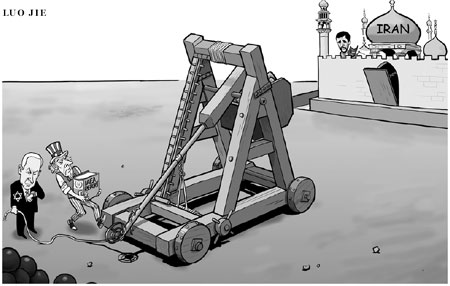
Cartoon courtesy China Daily cartoonist Luo Jie 羅傑, via Hidden Harmonies blog.

The IAEA released its report on Iran earlier this week, and it was followed by the all-too-predictable chorus among the EU calling for more sanctions, as well as the all-too-predictable objections from Russia and China (though China’s was carefully massaged and muted). There are authority and credibility problems abounding, however, that go far beyond the anticipated objections of international political players. For example, the entirety of the first eight pages of the recent report, whilst in some respects quite alarming, refers solely to:

45. The information indicates that prior to the end of 2003 the above activities took place under a structured programme. There are also indications that some activities relevant to the development of a nuclear explosive device continued after 2003, and that some may still be ongoing.


The entire report, in fact, is littered with this sort of highly-qualified and very vague language – high on incidents and accidents, hints and allegations (some of which are in excess of ten years old), yet somewhat low on current facts; much more suited to a press release for an elected official than to an internal policy document of a respected international agency. What facts there are, are facts referring to activities that are at least eight years old. And yet, how is this news being reported?

Report: Iran developing nuclear bombs (and later, Iran’s nuclear programme alarms world powers)
Iran ‘months from building atomic bomb’, claims atomic agency report
The truth about Iran
IAEA report: Iran has been working toward nuclear bomb since 2003

At this point, it appears that both the news media and the IAEA itself are actually being used as ready-to-hand tools of the foreign policy agendas of a few national governments. The New Statesman’s Mehdi Hasan and Emptywheel’s Jim White each cover in some detail the ways in which IAEA has been institutionally compromised and made a tool of the foreign policy priorities of the United States in particular with this report. One of the difficulties of being a member of an Abrahamic faith in an age such as this one, is that the sorts of truths and authorities one wants to be able to take for granted (like those responsible for our physical security) appear to be, in actuality, the fear-spreading tools and playthings of the powerful where most they should be the goods all people can hold in common. This is a theological and philosophical argument, but the way the assumptions are being hashed out in practice could very well end up placing a lot of real people – Iranian, Israeli, British, American – in harm’s way.

09 November 2011

Pointless video post - ‘No Fear’ by Rage


Since 2005, the Rhenish-Belarusian power trio Rage has been on the warpath, so to speak, against the post-Bush foreign and economic policies of the United States, and delivered three albums which contained outraged political broadsides against the military-industrial complex, corporate greed and neoliberalism: 2006’s Speak of the Dead (with Mike Terrana of Masterplan on drums), 2008’s Carved in Stone and 2010’s Strings to a Web. ‘No Fear’, from Speak of the Dead, was perhaps the trendsetter in this regard. In addition, the song is a sterling example (alongside, say, Angel Dust’s ‘Bleed’) of what power metal should sound like - hard, crunchy and heavy whilst at the same time losing as few of the melodic or emotional elements as possible, something at which Peter Wagner and Victor Smolski are both rather ingenious. The album is slightly schizophrenic, which is by no means a bad thing, since it features also a lengthy symphonic arrangement (‘Suite Lingua Mortis’) with the Belarusian Inspector Symphonic Orchestra accompanying. Rage unfortunately also has a twinge of the knee-jerk anti-religious sentiment to which heavy metal in general is often prone, and their lyrics aren’t necessarily the deepest around, but in the face of their sheer all-around awesomeness I think a great deal can be forgiven.

Enjoy, gentle readers!