Showing posts with label anime / manga. Show all posts

08 August 2020

Your Name 《君の名は。》

I want to help build landscapes that leave heart-warming memories… I didn’t even know anybody in that town. Why does the scenery of a town that no longer exists wring my heart so?
Back when I did my review of Flavours of Youth I promised I’d get around to seeing this film: Your Name, directed by Shinkai Makoto 新海诚. In short, I’m incredibly glad I did. This film is a masterpiece, one which well deserves its reputation as a classic of Japanese animation.

Your Name is best described as a fantasy/sci-fi romance, which speaks directly to a Japanese but also a more broadly East Asian experience of being disconnected in time, of the tensions and antinomies that arise from being part of a landscape where ageless antiquity and glittering hyper-modernity exist side-by-side. But the two main characters, despite their frequent and sometimes heartbreaking alienation which sometimes takes the form of literal jumps in time, still seek a genuine connexion with each other. And the heart of the film rests in how they mature and grow.

Your Name is a story that defies easy categorisation. It’s a story about a (literal) disaster, when a comet strikes a remote, traditional Japanese town. It’s also a bildungsroman and a breathtakingly bittersweet teen romance. It freely borrows from SFnal tropes about time-travel (including multiple timelines and alternate futures), as well as fantasy tropes about body-swapping (think the Warehouse 13 episode ‘Merge with Caution’). It is steeped in traditional Chinese lore, Daoism and Shintô religious rites, but it also has the feel of a young-adult fantasy book by TA Barron. It would be easy for any feature film, but particularly a Japanese animated one, with this many moving parts to feel overstuffed, overwrought and pretentious. But Your Name avoids this in part because of the tender vulnerability and humanity of the two protagonists.

Your Name uses a lot of traditional tropes from East Asian literature that might get lost on American audiences. The ‘red thread of fate’ is probably a familiar enough one, and it gets used liberally here between the two protagonists. The ‘butterfly dream’ of Zhuangzi is also alluded to. The tradition of fermenting rice wine with human saliva (kuchikamizake 口嚼酒) plays an important rôle in the story. And despite all the fractures and disconnects in time that occur between the two protagonists, there is a subtle but persistent theme of continuity, of history repeating itself, of déjà vu.

A comet, whose orbit comes within sight of Earth once every 1200 years, passes overhead. As it enters Earth’s gravity well, its nucleus fractures, producing a spectacular meteor shower. One of these fragments is large enough to fall on the village of Itomori. It destroys the town and kills 500 of its inhabitants. Two young teenagers look up at the night sky and watch the comet streak across. One of them, Tachibana Taki 立花泷 is a high-schooler and part-time waiter in a fancy restaurant in Shinjuku ward in Tôkyô. The other, Miyamizu Mitsuha 宫水三叶, is a high schooler in Itomori, and one of the two granddaughters of the keeper of the local Shintô shrine there.

Mitsuha is frustrated with her limited surroundings, being (embarrassingly) involved in the rites of the shrine, getting unwanted attention from being the village mayor’s daughter, and feeling like she’s trapped in a fishbowl. She screams from underneath the torii that she hates her life, she hates her town, and she wishes she could be reincarnated as a handsome boy in Tôkyô. Not long after this, Mitsuha and Taki begin to have strange dreams.
Formerly, I, Zhuang Zhou, dreamt that I was a butterfly, a butterfly flying about, feeling that it was enjoying itself. I did not know that it was Zhou. Suddenly I awoke, and was myself again, the veritable Zhou. I did not know whether it had formerly been Zhou dreaming that he was a butterfly, or it was now a butterfly dreaming that it was Zhou. But between Zhou and a butterfly there must be a difference.

昔者莊周夢為胡蝶,栩栩然胡蝶也,自喻適志與!不知周也。俄然覺,則蘧蘧然周也。不知周之夢為胡蝶與,胡蝶之夢為周與?周與胡蝶,則必有分矣。此之謂物化。
As though in answer to Mitsuha’s wish, Mitsuha and Taki begin swapping bodies, randomly, whenever they fall asleep. This part of the story might have been handled gratuitously or exploitatively, and sometimes it rides the line. (What’s the first thing Pete does when Robert Louis Stevenson’s bookends trap him in Myka’s body? Yup, Taki does the same thing. Typical teenage boy.) But Taki and Mitsuha are quickly intrigued by each other in deeper ways. Mitsuha finally gets to visit Tôkyô, go out to eat in stylish urban cafés, and hold down a job in a fancy restaurant. And Taki is enchanted by the charming architecture and wondrous vistas of Itomori – including the huge round lake which is very clearly and ominously a crater.

The two teenagers quickly begin setting ground rules for each other, what they are and aren’t allowed to do in each other’s bodies, leaving each other messages including by writing on each other’s hands and wrists with marker. Going through each other’s smartphones, they learn details about each other’s lives that they can appreciate. Taki begins asserting himself among Mitsuha’s classmates to get them to stop teasing her. And Mitsuha sets Taki up with an older girl at his workplace, Okudera, whom he has a crush on, and tells him in a message that he should be able to see the comet that night.

Taki’s date with Okudera goes poorly and no comet appears. He tries calling Mitsuha with the number she left him, and she doesn’t answer. The body-switching stops, but Taki can’t forget about the dreams he had from when he was Mitsuha. He then embarks, together with Okudera and his classmate Tsukasa, on a half-baked quest to find Mitsuha and her village. The only thing he has to go on, though, since he can’t remember her name or the name of the village, are the landscape drawings and sketches he did of the views from her house and the temple. An old man recognises his sketch as that of Itomori before the disaster, and Taki ultimately learns from him that Mitsuha was killed along with the rest of the village when the comet struck Itomori three years before.

Taki decides to leave Okudera and Tsukasa to try and find the holy place where Mitsuha’s grandmother took her to pay respects to the old Shintô god that had come 1200 years ago. It happens to be in the middle of a crater – and Mitsuha’s grandmother had told her that crossing over into the grounds of the shrine was like taking a step into the underworld. Taki finds the rice wine that Mitsuha made inside the shrine, and drinks it. This reconnects Mitsuha and Taki, and allows the two of them to rewrite the history of Itomori and save the townspeople from the impact of the comet fragment. But, as history changes, the dream ends, and the two of them lose each other again, even forgetting each other’s names…

I’m not going to spoil the ending here, but suffice it to say this: Shinkai Makoto has a brilliant and touching ‘ear’ for the voices of young adults. He makes real the connexion between these two people, so utterly different from one another and separated by time, space, class, sex, tradition and modernity. Although the director very cautiously refrains from overtly editorialising at any point in the film – with one partial exception – one gets the distinct impression that the same longing the characters feel for each other is connected intimately to a sense of loss of the traditions that Mitsuha embodies in her life even as she rebels against them.

One sees this same sort of traditionalism, actually, even in the gender-bending body-swap plot. Even though it’s a explicitly a comic point to see ‘Taki’ (inhabited by Mitsuha’s consciousness) act like a traditional-minded Japanese girl, and ‘Mitsuha’ (actually Taki) behave live a typical urban high-school boy – right down to their body language and pronouns (‘Taki’ almost gives the game away by calling himself by the feminine ‘watashi 私’ before landing on the more masculine ‘ore 俺’) – they each come to have a tender respect for each other’s physical embodiedness and an active interest in each other’s social lives. There is an almost Ruist sensibility here, in that Taki and Mitsuha come to understand and love each other by experiencing relationships with friends, family and surroundings through each other’s eyes.

The single most strained relationship in the film, actually, is that between Mitsuha and her father, who is a (presumably ruling-party) politician in the town, and who rather callously left his daughters behind with his shrine-keeping mother-in-law after their mother died. Throughout the film Mitsuha’s father refuses to listen to her or take her seriously. This is where I think the partial exception to Shinkai’s refusal to editorialise comes in. Mitsuha’s father represents a deliberate rupture with tradition even though he uses it to attain his personal goals.

As to be expected from a CoMix Wave production, the animation quality is amazing, even if – by Shinkai Makoto’s own admission – not quite reaching the Studio Ghibli gold standard. Both the urban and the rural backdrops are lovingly, painstakingly rendered – as though each frame is meant to be a landscape painting. The technical and stylistic use of proportion and perspective, also, enhance the thematic preoccupations with separation and reunion, rupture and continuity, alienation and connexion. I highly, highly recommend this film.

EDIT: Also, the title of the film called to mind this Tad Morose song, the lyrics to which seem almost appropriate at times:

05 November 2019

Holy Hierarch Kea, Bishop of Devon, and Holy Deacon Fili


Old Kea Church Tower, Cornwall

Remember, remember, the fifth of November… True, the Gunpowder Plot and Guy Fawkes are of course the common folk remembrances of the English on this day, and of course they’ve gotten a new lease on life thanks to that delightful mad genius of the graphic novel medium Alan Moore, but it sometimes escapes remembrance that in addition to being the date of the Gunpowder Plot, the fifth of November is also celebrated in southwest England and Brittany – and in the Holy Orthodox Church – as Saint Kea’s Day, the feast of a fifth-century Irish missionary hermit, later a bishop, who came to evangelise the coasts of Cornwall and Devon. We remember both Saint Kea today, and also his faithful helper and deacon Saint Fili who accompanied him.

This young monk from Ireland was apparently of noble birth and profoundly educated, but he gave up all his wealth to the poor and abandoned the life of a courtier for the life of a holy man when he was old enough to make the decision. The story of Saint Kea [also Quay in French, (Lan-te-) or Ché in Breton, and Kay or Keyne in English] is strikingly similar to that of Saint Ia, the sister of Ss Euny and Erc. His hagiography opens much as Saint Ia’s does: watching from the southern shores of Ireland, seeing his brother-monks depart in their coracles for the heathen shores of Western Britain, and longing above all things that he might go with them. Burning with missionary zeal, he went to a certain promontory on the shore, which was a large boulder of granite, and prayed to God that if He willed it, Kea might go and preach the Gospel among the heathen Cornish.

And then the wonder happened. Just as with Saint Ia, a leaf floated by which by the power of her prayers was transformed into a coracle large enough for her to ride, so too with Saint Kea the very rock upon which he prostrated himself became broad and hollow. As the tide rose around the oblivious saint who was still lost in prayer, the waters of the sea lifted the granite rock off its perch on the shore and carried it out onto the open water. It floated as calmly and as lightly as any coracle made from hide. Saint Kea sprang to his feet upon seeing this, and in trembling awe cried aloud to God: ‘To Thee and only to Thee, my God, do I trust my soul!

Saint Kea spent many days on the water in his unlikely granite boat, drifting hither and thither as the tides willed, or blown this way and that by the winds and waves. Despite not having food or drink with him, Saint Kea was sustained by his faith, and he knelt upon the rock three times a day and prayed fervently to God. At length, the faith of the saint brought him safely to the mouth of the Fal River on the southern coast of Cornwall, and he landed at a spot on the western shore at the confluence of the Fal and the Truro, which today still bears his name. It was here that he set up a hermitage and oratory for himself, which at length grew into a monastery. The only remains of this monastery, the Old Kea Church, are the ruins of a tower which still stands there.

There is a holy well that is dedicated to Saint Kea near the Old Kea Church. There are also place-names associated with Saint Kea in Devon – such as Landkey – which attest to his missionary presence there. It’s a near certainty, given the toponyms to this saint in Brittany, that he ended up across the Channel as well and founded churches there: like that at Saint-Quay-Portrieux on the Côtes d’Armor. He is said to have reposed in the Lord on the first Saturday in October, in Cléder in Finistère. He may also have had some connexion with Saint Gildas, who is said to have fashioned one or a set of the excellent Celtic bells for the saint.

Saint Kea is also associated with a younger British bishop, the ill-attested Saint Rumon of Tavistock (f.d. 30 August), who may have assisted Kea in founding his monastery after his landing. Saint Fili [also possibly Scofili] is an equally-obscure figure, though he is portrayed as a deacon assisting Saint Kea in the mediæval Cornish hagiographic tradition, and he is putatively the patron saint of Philleigh on the opposite shore of Truro from Kea, as well as Caerphilly in Wales. Local tradition has it that Saints Kea, Rumon and Fili worked to organise churches all around the Fal Estuary, and even fortified the area to defend against Saxon pirates. Even after the later conquests of Devon and Cornwall by Wessex, the kings of Wessex and England kept alive each local cultus of the Brythonic saints, and even revered them themselves – in much the same way that the Saxon Saint Ælfrǽd venerated the Cornish Saint Neot. Holy hierarch Kea, by whose faith even rocks were made to float, pray unto God that our souls might not meet shipwreck, but that we too may be saved!
Apolytikion to Saint Kea, Tone 1:

Thou wast unsparing in thy missionary labours
In Brittany and Cornwall, O Hierarch Kea.
As thou didst make the flame of the Orthodox Faith
Burn brightly in the face of defiant paganism,
Pray to God for us,
That we devote our lives to confronting the paganism of our times
For the glory of Christ's Kingdom and the salvation of men’s souls!


St Philleigh Church, Cornwall

16 August 2019

Tuǵan jer: a mild early assertion of Kazakh-ness


Bayan (Murat Ahmadıev) and his grandfather (Elýbaı Ámirzaqov) in Tuǵan jer

Rich Hall says the road movie genre is in large degree determined by the vagaries of the vast landscapes of the American West. Well, if that’s so – and I never doubt that particular film-critic comedian – then Kazakhstan too is particularly well-suited to the spiritual demands of the genre. And Sháken Aımenov’s Tuǵan jer (Zemlya ottsov, Land of the Fathers) is indeed a road movie. More than that, it’s a successful road movie, insofar as it uses the new (WWII-era) railway to illustrate alienation and elements of the Kazakh cultural identity that had been repressed under previous Soviet policies; and that it does so against a changing backdrop moving from the vast Kazakhstani steppes into the Russian heartland.

The film follows a boy, Bayan (Murat Ahmadıev) and his old aqsaqal grandfather (Elýbaı Ámirzaqov), as they journey from the Kazakhstani inland to Leningrad. There they are to reclaim the body of Bayan’s father, the aqsaqal’s son who died fighting the Nazis on the Eastern Front of the Great Patriotic War, and bring him home for a burial in his own homeland. Their transportation is arranged by a voluble and vivacious red-headed Russian named Egor (Viktor Shevtsov) – on one of the cargo cars of a westbound freight train. (It’s never quite clear from the movie whether or not their presence on the train is legal. They do refer to other passengers on other trains as ‘stowaways’.)

On the train, they meet with a Jewish-Russian archæologist (Yuri Pomerantsev) and his pretty daughter Sofia (Tamara Kokova). Egor is instantly smitten with Sofia, who is not quite so impressed by his attempts to hit on her. Meanwhile, Bayan begins talking shop with the old archæologist, much to his traditional grandfather’s chagrin. (The aqsaqal doesn’t want his grandson handling human bones, which is a bit ironic given what they set out to do.) A discussion ensues between the old archæologist and the aqsaqal, pitting the new Soviet all-brotherly progressive mentality against the need for tradition: faith, homeland, roots, patrimony. The aqsaqal’s transgressive behaviour, unlike in an American road film, is that he is very much, and very proudly, backwards by Soviet standards. Speaking as a Jew, I did wince a bit when the old aqsaqal called the archæologist ‘not quite human’, ‘a thorn, a tumbleweed’. But the assertion of his own Kazakh-ness, in an understated defiance of Stalin, was something to cheer.

At the same time, despite his progressive attitude and despite his not belonging to a particular patrimony, we can see that the archæologist himself is in thrall to the past. He and Sofia are searching for a lost ninth-century city, a pursuit which has ‘driven everyone mad’. He has dedicated his life to this pursuit, and as he approaches the end of his life, he realises his chances are few. After he and his daughter find signs of their quarry, they face a fateful choice that may be the archæologist’s last.

Bayan, on the other hand, sees the journey as a rite of passage; an opportunity to prove his manhood. He reveals to Sofia that he never cried when he heard about his father’s death, and he sees that as a source of shame. He also reveals to her that, although he teases the girls in his village in a teenage-boyish way, there’s one girl he likes: an orphan, Mariam, who is four years his elder. He wants to prove his adulthood, not only to his grandfather and not only to earn his adult name, but also to her, so he can pursue her properly as a Kazakh man. (One has to wonder, did Mori Kaoru watch this film before writing Otoyomegatari? Bayan and her precocious hero Qarluq share many of the same qualities, including the need to grow up and to be the object of romantic desire for an older woman.)

The tension between traditional and modern is always present, but in some cases it’s deftly subverted. In one scene we see horse riders – presumably Kazakh – chasing the train, and we are led to expect some kind of daring armed robbery or raid. But it turns out that the lead horse rider is just celebrating the birth of his son. He asks for a possible name for his son from the folks on the train, and Egor exuberantly offers his own. Sofia, on the other hand, suggests Bayan, which the rider likes better. Giving them his traveller’s blessings, he and his posse ride off. It’s a somewhat anticlimactic moment, but it’s also a bit touching.

At a train station where they stop for drinking water, the aqsaqal meets an old Chechen who rides on the train roof to be closer to the sky and to God, and who is going home to the Caucasus to die. Despite not having anyone back home, he still wants to end his life in the land he grew up in. The grandfather appreciates this sentiment, and comes to regard the Chechen as a friend and a kind of sacred charge. However, as Bayan and Egor observe the aqsaqal feeling more and more lost outside his homeland, they start to fear that he’s losing his grip; and when the old man and the Chechen get left behind at a train stop, Bayan’s mission takes a very different turn.

One of the most prominent motifs that runs through this film, literally, is water: the water of rivers, water for drinking and washing, the salt water of tears and spit. At the opening of the film, we see Bayan exuberantly washing in and drinking from a shallow brook in his homeland. But as they make their way west, water becomes harder and harder to reach. It has to be pumped, strained, boiled, even as they cross the immense Volga. At the end, it has to be asked or begged: Bayan is dependent on the hospitality of the Russian villagers of Nosakino, where his father was killed (even though at one point he is mistaken for a Gypsy and attacked by local boys). Bayan also learns to shed tears as he makes his way west: the reality of his father’s death hits home for him when he sees his name on the collective monument erected to the Soviet soldiers who fell at Nosakino.

It’s worth noting that even though Aımenov wants to assert a distinct and traditional Kazakh identity, he does not indulge a narrow or chauvinist view. The wreckage and memory of the war is a constant background presence, a touchstone for many of the characters. The recent shared fight against the fascists as well as the shared experience of having lost loved ones – fathers, husbands, brothers – is shown to be a bonding force for Russian, Kazakh, Jew and Chechen, in ways that ideology cannot be. It’s also a bonding force across generations, even where one of those generations is notable only by its absence. Egor is one of the very few living men of fighting age that we get to see – the rest of his cohort are visibly scarred (with missing arms, for example). But in many senses Egor is the linchpin of the film: he is able to bridge the traditional and the modern; able to bridge the generation gap; even able and willing to bridge the gap between the cultures. In this, he anticipates a late-Soviet or post-Soviet identity that has continued to guide Eastern European and Eurasian politics down to the present. The loss of war stands in the landscape as well, and in the everyday lives of the people along the railway. An old veteran unsuccessfully tries to sell Egor a mouth-organ that had been owned by a German. Nosakino is pitted by the blast craters of German mortars – some of which themselves have been brought back as trophies of war. In one iconic scene, Bayan and his grandfather embrace as a train goes by, in front of a bombed-out building pitted with shrapnel.

The pacing of the film is ambling, and Aımenov’s preference early on in the film for long, slow-pan takes which privilege the rugged, arid, desolately-beautiful natural scenery and the traditional Islâmic architecture somewhat anticipate – both in a visual sense and thematically – an early Jia Zhangke movie (like, say, The Pickpocket 《小武》). Aımenov has a similar sensitivity as Jia to loss, whether cultural or personal, whether as the result of war or of technological progress. The movie is shot in black-and-white, which is an interesting choice, but he doesn’t use it as boldly or as dramatically as Eisenstein. The film is dark – not thematically, just from a lighting perspective, with the exceptions being the scenes in which the scenery of Kazakhstan takes centre stage. Regardless, Tuǵan jer is a remarkably fine film. As an example of an early and mild expression of multivalent ‘national’ belonging in the Soviet Union, it’s also a noteworthy entry in Soviet – and Kazakh – cinema.

18 June 2019

Shal: ‘My god is the steppe’


Qasım (Erbolat Toǵyzaqov) in Shal

Another film by Ermek Tursynov (the director of Kelin), 2012’s Shal (Шал, The Old Man) is a cinematic transposition of Ernest Hemingway’s The Old Man and the Sea onto the Kazakh steppes. However, this brief description elides the important continuities between Shal and Tursynov’s former film Kelin.

Certain themes explored by Kelin are more deeply explored in Shal: the tension and the continuity between the generations; the closeness of the ‘Kazakh soul’ to nature; the duality of natural forces and will; the shamanic sense of tragœdy inherent to a præ-Abrahamic worldview. Certain motifs – both musical and cinematographic – also provide a sense of continuity between the two films. The shots of wildlife and natural vistas of steppe and tundra are exquisite (though the latter are sometimes rendered a bit claustrophobic by the often-present obscuring fog), and they are bolstered by a soundtrack which makes generous use of traditional flutes and fiddles. In general, Shal showcases to a greater extent than Kelin, the æsthetic-spiritual point Tursynov tries to drive home about Kazakh identity and the incompletion and ‘thinness’ of her Muslim formation in contrast to the ‘thickness’ of her affinity with and attachment to the native landscapes and œcosystems which she inhabits. Ideologically speaking, Shal (and Kelin) stand in contrast to the grand national narrative put forward by Kóshpendiler and Jaýjúrek myń bala: not necessarily in terms of what they count as the Kazakh virtues and heroic excellence, but rather in terms of how they characterise the faith of the Kazakh people.

Shal follows Qasım (Erbolat Toǵyzaqov), an elderly gentleman living in rural Kazakhstan who has an obsession with football – spending much of his time watching what games he can on his rickety and temperamental antenna. (Qasım even goes so far as to name all of his sheep after famous footballers, and paints their wool with their team numbers.) He is aided by his truculent, disrespectful handheld console-playing grandson Eraly – whom the old man calls his ‘little Satan’, and who in turn swears he’d rather hang himself than end up like his grandfather. One day a group of Kazakh and Russian men, led by a wealthy hunter (Ondasyn Besıkbasov) roll up in a fancy Humvee, setting out to snag some wolf pelts. Qasım shows them the way to the hunting ground, but warns them that it’s the off season and the wolves will have just borne their pups. The hunters don’t regard his warning, and drive off anyway. Qasım, taking his sheep out to pasture onto the steppe, gets lost in the fog. He hears gunshots out on the steppe as the hunt he aided goes badly wrong, and subsequently he is thrown into a bloody and harrowing game of survival, pitting man (and horse, and sheep) against wolf.

This, like Kelin, is a survival film – and, indeed, more explicitly so. Like Kelin, too, there is a North Asian shamanic undercurrent that underscores the visceral connexion between man and nature, and the porous divide between the realms of death and life. There is a deep and sacred connexion, too, between the young and the old, and the turn of the generations which was the penultimate punchline of Kelin.

Qasım may not always get along well with Eraly, but he clearly loves the boy – and it is this love which, he confesses to a wolf-hunter (the one played by Ondasyn Besıkbasov) he rescues, drives his will to survive. Eraly, too, loves his grandfather more than he lets on. Early on, after the old man falls asleep when watching television, Eraly covers him with a blanket. Later, when Qasım goes missing, it is Eraly who runs off to ask his uncle and neighbours where he has gone, and Eraly who calls for and then joins the official search parties that go in search. Shal also functions as something of a bildungsroman for Eraly, who is growing into the ways of Kazakh manhood. In fact, one could see in Eraly a bit of spiritual kinship with the more mild-mannered and easy-going Qarluq in Mori Kaoru’s Otoyomegatari. But the turn of the generations is marked in several other intersecting ways. Not just Qasım and Eraly, but also the pregnant ewe who gives birth to a lamb in the middle of a brushfire during a wolf attack. Also, in fact, the alpha female and her cub. It is a testament to Tursynov’s remarkable direction, that this bloody contest between nature and human being, which claims so many casualties – a contest which is in several points hinted at being a supernatural one – leaves the viewer at the end feeling more sympathy for the wolves than for their hunters.

Technology – and especially technological failure or insufficiency – is also a major recurring theme in Shal. The implicit critique of television and video games is present in the early relationship of Qasım to his grandson – and it’s worth noting that the film neither singles out the youth for his technological addiction, nor does it write Eraly off as irrevocably spoiled. Still, the handheld console is presented to us as an obstacle, as is the old television antenna. Elsewhere ‘gadgets’ appear, they always seem to fail in their intended purpose. The hunters disturb the balance of nature with their Humvee and their guns – both of which are ineffective at protecting them when the wolves attack. When Qasım discovers the hunters’ SUV – abandoned – the tablet with Google maps doesn’t help him get back to safety, and when he picks up one of the dead hunters’ ringing cellphone, he can’t understand the voice on the other end nor she him. (Ultimately, the cellphone serves as a deadweight makeshift grave marker for its owner.) And the helicopters and SUVs the rescue party uses are ultimately of no use in finding the lost and dying Qasım: it is only a grandson’s spiritual, instinctive-intuitive connexion to his grandfather that is shown as effective, when he turns back away from the search party and finds his bleeding grandfather lying down a gully in the snow.

There is a bit of perhaps-inadvertent Christian imagery here which Tursynov may have inherited from Hemingway: Qasım’s bleeding wounds during his last-stand fight with the wolves are on his arms, on his ankles and in his side, and he defends himself with a carpenter’s hatchet. In addition, as a literal shepherd, he sacrifices himself in an attempt to save what is left of his flock. But the explicit religious message of the film is not even Muslim, but (crypto-)Tengriist. When Qasım and the hunter are talking with each other at a campfire, Qasım reveals that he has never made the pilgrimage to Mecca as his ancestors had done – instead, the steppe is his both his place of pilgrimage and his god.

Toǵyzaqov’s acting in this film is phenomenal. A somewhat cantankerous but mostly good-humoured and gentle (except when riled) old man who alternately prays to and rails at the open steppe in his solitary wanderings with his sheep, he easily and naturally evokes our sympathy as viewers. Though Tursynov’s favoured direction is still minimalist – whether in dialogue or in music – the approach he took with Toǵyzaqov in Shal is perhaps more effective than the somewhat artificial silence he enforced on the characters in Kelin.

Shal, like Kelin, is a beautiful but harrowing watch – Tursynov is a master of building and maintaining dramatic tension across a movie which, despite its ninety-minute runtime, often takes the leisurely pace fitting to the lost old man at its centre. In addition, it seems that Tursynov better managed to get across his point about national character and priorities – the Kazakhs’ closeness to the land and potential pitfalls in relying on high technology and modern creature comforts against an often-precarious œcological balance of which the people are very much a part. Exploring both figuratively and literally a foggy liminal borderland between the realms of life and death as well as between the realm of the human and the realm of the nature gods, Shal manages to synthesise and articulate the strong points of both Kelin and Ulzhan without the silent-film obscurity of the former or the meandering pretentiousness of the latter.

08 September 2018

Flavours of Youth

There’s a certain style of Orthodox iconography. It’s called a triptychon. They are three icons mounted together on hinges at the sides, that open in the middle. The holy images included in a triptychon are typically part of the same spiritual theme, or contribute to a larger whole: for example, a Christ Enthroned icon seated between the Mother of God and Saint John the Forerunner; or icons sequentially narrating the progression of the Crucifixion or the Resurrection. However, all the figures and all the moments are present simultaneously to the prayer before the icon. Past and futurity are eliminated. Time collapses within a diptychon or a triptychon just as sæcular time collapses within the liturgy. Moments in a diptychon, a triptychon or any other kind of sequential icon are not meant to be taken as repeated or consumed, but rather reiterated and renewed through liturgical participation or prayer.


The Chinese-Japanese animated film Flavours of Youth (《肆式青春》) came out last month, and got put on Netflix. A collaborative effort between directors Yi Xiaoxing 易小星, Takeuchi Yoshitaka 竹內良貴 and Li Haoling 李豪凌 and produced by CoMix Wave Films, Flavours of Youth consists of three animated shorts (one from each director) that fit together a bit like a triptych. Even though Chinese animation, like Chinese film generally, is traditionally structured in an operatic format, here really only one of the shorts comes anywhere close to having that operatic feel. But all three have very similar themes – like trying to grasp at fragments of meaning and reality in a hyper-real modernisation where time speeds up and leaves all merely-human things in the dust. Reassembling the human element is done here through a kind of iconography. Moments are reiterated. Time is collapsed. Sense begins to filter through only when futurity and past are liminally overridden. In the beginning of the first short, all of the main characters are sitting together in a Beijing airport waiting on a flight to Guangzhou. WARNING: SPOILERS FOLLOW BELOW. Skip the next three paragraphs to avoid them.

The first of these shorts, ‘Memories in a Bowl of Mifen’ (一碗鄉愁) doesn’t have much of a plot. It’s impressionistic. The narrator and main character Xiaoming 小明 begins in Beijing, reflecting on his childhood in Hunan Province – how he used to eat bowls of rice noodles or sanxian mifen 三鮮米粉 together with his grandmother. He reflects on the taste of the noodles, how the traditionally-prepared noodles were rich in flavour, the vegetables were fresh and liberally-spread over the bowl, and the soup had a full and satisfying body. His grandmother bought the noodles from a store with no name and no sign, run by an old local couple who ran the shop for 20 years before having to move out. Later he went to another store which served the same kind of noodles, but only so he could watch the girl he liked ride by on her bike on the way to school. There isn’t much by way of story or characterisation here, but the local details are lovingly dwelt-on and touchingly portrayed: the ingredients in the noodles, the terraced landscapes and bamboo garden fences, the zip-up nylon school uniforms, the open storefront, everything right down to the decorations on the bowls. These are juxtaposed with images from Beijing: solid slab concrete, jianbing stands and crowded subway stations. The store which serves sanxian mifen in Beijing is jarring in its unlikeness to the local mom-and-pop mifen shops in Hunan: machine-cooked noodles, big metal pots of soup, glass windows, a fast-food counter, plastic bowls and chopsticks. (Xiaoming remarks that they’re stingy with the vegetables, and he doesn’t enjoy eating rice noodles as much anymore.) Only news that his grandmother is dying recalls Xiaoming to Hunan, and after she passes on he tries to find the old sanxian mifen shop where he used to watch his senpai ride by on her bike, and the short ends with him smiling as another pair of schoolgirls ride by on bikes.


The second short, ‘A Little Fashion Show’ or ‘Neon Lights’ (霓裳浮光) has none of the impressionistic, local flavour of the first short, but what it lacks there, it makes up with a bit of psychologically-profound characterisation. It focusses instead on a well-established Guangzhou fashion diva, Yilin 依琳, who is considered to be getting a little too old by her industry, and her younger college-student sister Lulu 璐璐, who makes clothes by hand. Yilin takes Lulu into her home and supports her with her work, and Lulu is happy to look after the house and her studies in spite of her older sister’s overworking herself and neglecting her. However, Yilin’s preoccupation with scoring modelling gigs and keeping up her youthful looks (particularly when a smug young rival fresh out of high school comes along), both causes her health to deteriorate and her relationship with Lulu to suffer. We learn that Lulu chafes more than a bit under Yilin’s condescension, and that she isn’t learning to sew clothes only to make money – she really wants to be a good sister to Yilin. The ending kind of fell a bit flat for me, in that Yilin doesn’t end up having to choose between her sister and her job, and she’s kind of talked out of her problems by her manager. In the end, Yilin and Lulu come to have a professional partnership as well as a closer relationship as sisters.


But the third short is where the collection as a whole really started to shine. Somehow the iconographic conceit of the entire collection was seized upon with gusto by Li Haoling, and he put together the tear-jerker ‘Shanghai Love’ or ‘Sun After a Light Shower’ (纖雨初晴) that collapses time as it narrates, with operatic flourish, the disjointed life of real-estate developer Li Mo 李墨 and his first crush Xia Xiaoyu 夏小雨. Discovering an old cassette tape from when he and Xiaoyu were in middle school together that he didn’t remember ever playing, Mo rushes back to his grandparents’ house in a condemned old part of town so he can find a tape deck to play it in. Along the way there, he begins to remember the messages that he and Xiaoyu used to pass to each other on tape. The cassette – and the walk back toward his grandparents’ house – begin to take on additional significance as his memories of Xiaoyu return. The two of them had a fight over which high school they would try to go to. Mo stopped slacking off and started studying harder to get into Xiaoyu’s school, while Xiaoyu failed her gaokao 高考 exam (enraging her abusive father). The two of them no longer talk together (symbolically represented by Mo’s CD Walkman). Mo begins to regret that fight and everything that followed from it – as he ventures back into the neighbourhood that his firm wants to tear down, there is something of a progress of the prodigal son. The sequences run together, memory and present blur seamlessly. Mo borrows the tape player from his grandmother and learns that Xiaoyu deliberately failed her exam just to be together in the same school with him, in spite of her father. It is a poignant religious moment in a Kierkegaardian or Dostoevskian sense for Mo: a moment of repentance that spans the entirety of their relationship. The screen forms a diptychon as the teenage Xiaoyu talks into the tape recorder to a weeping adult Mo about her love for him, about the hopes and dreams she had for their life together.


There is something deeply Grantian about this collection, in that it voices certain ‘intimations of deprival’. It’s not a Jia Zhangke film by any stretch of the imagination, but the intimations are there. The hyper-real modern forces, forces of capital – symbolised by the Beijing noodle shop (or really Beijing tout court, which functions like Saint Petersburg in a Dostoevsky novel), by the Guangzhou modelling agencies that refuse Yilin on account of her age, by the real-estate firms that tear down old Shanghai neighbourhoods, even by small and ordinary things like the CD Walkman that prevents Li Mo from listening to Xiaoyu or the cellphone that Yilin ignores – are continually pressing in, and they appear to be winning in time. But there are these glimmers of hope – small moments of human connexion that rebel against the tyranny of time and the ontology of age and death.

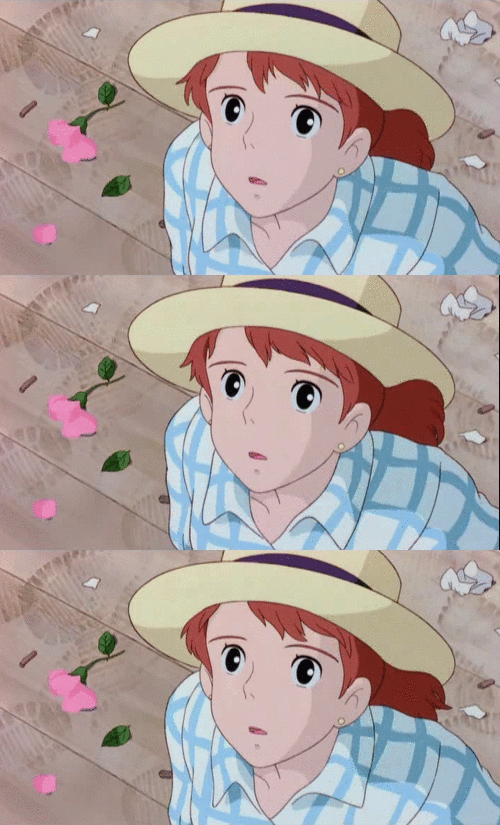
It’s slightly unfortunate – I say slightly here because I am indeed a fan of the animation style – that the directors and the producers chose to use a hyper-modern Japanese artistic vernacular to illustrate three very modern Chinese stories. It is far too much to ask that there be a return to Havoc in Heaven-style visual conventions, which probably wouldn’t fit these stories anyway, and of course as a joint venture there is a marketing angle to consider. Netflix branded the collection as ‘From the Creators of Your Name’ – a Japanese animated film I will now have to check out. But the exquisiteness of the local details – in some places rivalling films like Studio Ghibli’s Spirited Away or From Up on Poppy Hill – seem to mark a point on the revitalisation of conventional animation currently in progress on the Chinese mainland. Flavours of Youth is definitely worth your time to go see.

06 October 2017

Zhao the Orphan, reimagined as Tory jeremiad


I have recently been reading popular Yuan Dynasty zaju 雜劇. As my gentle readers will know, I was overcome by a slight bout of nostalgia about a month back, and began watching Maison Ikkoku again. (I was always more of a Ranma ½ fan, but I did occasionally pick up Maison also.) It struck me on this watch-through that it was a slightly-satirical modernisation of the caizi jiaren 才子佳人 tradition of Chinese literature, with a particular resemblance to the Yuan zaju, The Romance of the Western Bower 《西廂記》. In the same volume that I’ve been reading, there is a retelling of another, very different, Yuan zaju, Zhao the Orphan 《趙氏孤兒》. And I came across an interesting little historical tidbit related to the story that was certainly of interest to me, and I hope would also be of interest to my gentle readers.

In short, Zhao the Orphan is a grand tale of revenge. It begins with the descriptions of two ministers in the State of Jin 晉國, Zhao Dun 趙盾 and Tu’an Gu 屠岸賈, who were courtiers of the Duke of Jin, who was given to drunkenness, vapid entertainments and an opulent and lascivious lifestyle. He had a resentful and cruel personality, and thought nothing of torturing and killing servants and ladies who displeased him. Zhao Dun, the prime minister of Jin, missed no opportunity to remonstrate with the Duke on his cruelties and excesses; on the other hand, Tu’an Gu did everything to encourage the Duke in his dissolute habits, with the aim of taking the State of Jin for himself. Zhao Dun was righteous, but lacked caution – Tu’an Gu succeeded in framing him for an attempt on the Duke’s life, and ordered the extermination of the entire Zhao clan. Tu’an Gu oversaw a bloodbath which murdered 300 innocent Zhaos, and then moved against Zhao Dun’s son Zhao Shuo 趙朔, who was the brother-in-law of the Duke. He forged a letter ordering Zhao Shuo to commit suicide, leaving only his pregnant wife, the Duke’s older sister Zhuang Ji 莊姬. Tu’an Gu then made plans to murder the infant as soon as it was born; however, Zhuang Ji managed to smuggle her son out of the palace with the help of a maid, her family doctor Cheng Ying 程嬰 and a righteous general named Han Jue 韓厥. Han Jue, Zhuang Ji and her maid thereupon killed themselves to escape Tu’an Gu’s wrath.

Cheng Ying fled into the countryside, but Tu’an Gu published notices to the effect that if the Zhao orphan was not handed over to him within five days, he would send soldiers to kill all children under half a year old. Cheng Ying then drew up a ruse with Zhao Dun’s old friend from the court, the righteous official Gongsun Chujiu 公孫杵臼, to pass off his own infant son Bo, in place of the Zhao orphan. Gongsun Chujiu was taken and killed by Tu’an Gu, along with Cheng Bo, and the Zhao orphan – thought to be Cheng Bo – was taken into the Jin palace to be raised by Tu’an Gu jointly with Cheng Ying.

Cheng Ying taught the Zhao orphan letters and manners, while Tu’an Gu taught him the military arts. When the last of the Zhaos reached the age of twenty, Cheng Ying – omitting all of the names so that he would be believed – began to tell him about the tragedy of the Zhao family and the deaths of the righteous people who had fallen to save the orphan. Zhao, roused to indignation and fury by so grievous an injustice, asked where the last of the Zhaos could be found – and then at last it dawned on him that his ‘father’ was the doctor in the story, and that his ‘adopted father’ was the villain who had murdered his entire family. As the lecherous and cruel old Duke had died, Zhao the Orphan went to the new Duke Dao of Jin 晉悼公 (a better man than his predecessor), told his tale as he’d learnt it, and begged the right to take vengeance upon Tu’an Gu.

That’s the story, as scripted by Ji Junxiang, in the rough strokes. As can likely already be noticed, it explores, in a high tragic tone, the dialectic between the Confucian duties of family loyalty and justice absolute, with Cheng Ying and Han Jue being subjected to the greatest degree of tragic choice, left with no options but those which can bring disgrace, pain and death upon them. But the interesting historical tidbit is this: a full score years before Voltaire butchered the story with his adaptation, a more faithful French translation of Ji Junxiang’s opera had been made by a Jesuit priest named Joseph Henri Marie de Prémare.

Prémare’s French version, in turn, was adapted into English by William Hatchett – a Yorkshire actor, pamphleteer and possible lover of actress Eliza Haywood – who also happened to be a Jacobite sympathiser and a ‘violent Tory of the old school’. Hatchett’s The Chinese Orphan was written primarily as a scathing attack on the Whiggish prime minister Sir Robert Walpole, particularly for his high-handed treatment of Field-Marshal John Campbell, Second Duke of Argyll, who opposed the Walpole government’s increasing authority over the king, and was sacked for it. Hatchett’s royalist tweaking of Zhao the Orphan makes the Duke of Jin a much more sympathetic character, and attributes all of the wrongdoing to Tu’an Gu (who is renamed ‘Siako’ and clearly made to stand in for Walpole), whereas Zhao Dun and possibly Han Jue are meant to stand in for the Duke of Argyll. The Chinese Orphan was never performed, and indeed was not even published until 1741 – the year Walpole was to be dismissed.

Even though Hatchett makes a deliberate (and polemical) reversal of the ‘literary’ and ‘military’ noble roles in the play from Ji Junxiang’s original in order to drive home his domestic political point, it’s still an interesting early use of the ‘orientalist’ motif in Western European literature. (And – I will be blunt – one I’m much more sympathetic to than Voltaire’s, for blatantly partizan and political-philosophical reasons.) Perhaps once I’m done with my current reading, I’ll have to make a foray into Hatchett’s adaptation!

31 August 2017

The subtle Sinophilia of Maison Ikkoku


The usual SPOILER WARNING, of course, stands here.

I started watching Maison Ikkoku 《めぞん一刻》 recently – an animated series adapted from one of Takahashi Rumiko’s 高橋留美子 earlier serialised works alongside Urusei Yatsura 《うる星やつら》. I had originally begun watching it because, as a fan of Takahashi-sensei’s work since high school, I was feeling somewhat nostalgic – which is probably a bad reason to get back into anything. I also found I could justify it based on the farcical elements and situational humour, a bit like Fawlty Towers, except with the tenants rather than the management providing the awkward and embarrassing situations. It is also classified as a romantic comedy targetted at young men (seinen 青年), but it struck me as I was watching that it’s a romantic comedy in a very particular style. Maison Ikkoku belongs, albeit with a couple of satirical and dramatic twists added, in the late-Imperial Chinese popular genre of caizi jiaren 才子佳人, or ‘scholar-and-beauty’, plays and novels.

Caizi jiaren fiction was not high culture. Didacticism aside (a bit more on that later), caizi jiaren works were often condemned by Confucian moralists of a puritanical streak as lewd, unfilial, vulgar and otherwise unfit for wholesome minds. Occasionally they had good reason for thinking so; during the Ming Dynasty in particular, caizi jiaren fiction could be remarkably bawdy. It’s possible to make too much of this, though: similar allegations have been made by English-speaking Protestant moralists about theatrical performances and novels in general, as long as there have been either novels or theatres. But caizi jiaren, as a genre and a trope, was deeply influential on later Chinese high literature, most notably the great Qing-era novel Dream of the Red Chamber 《紅樓夢》.

The story of Maison Ikkoku, for those gentle readers not up on their 1980’s Japanese pop culture (and I wouldn’t blame them one bit), is as follows. A young student named Godai Yûsaku 五代裕作, after having flunked out of qualifying for his college entrance exams, and lives on his own on a shoestring budget in a ramshackle apartment building called Ikkokukan 一刻館. Surrounded by obnoxious and hard-partying neighbours (particularly his next-doors, the bizarre Mr Yotsuya 四谷, the sloshed Miss Roppongi 六本木, and the gossipy Mrs Ichinose 一之瀨) who think nothing of using his apartment as their ‘common room’, Yûsaku no sooner decides to move out than Ikkokukan comes under new management: that of the lovely young widow Otonashi Kyôko 音無響子, with whom he is instantly smitten – and decides to stay in his apartment while pursuing his studies. The subsequent story is basically one of Yûsaku attempting to pursue Kyôko and repeatedly falling on his face, often with the unwitting (or equally as likely, malicious) assistance of the aforementioned neighbours, who see his schoolboy puppy love as cause for amusement and mischief. In the meanwhile he struggles with his studies and part-time work, suffers from being broke, and fights off unwanted romantic entanglements and a rival suitor for Kyôko’s affections. The basic structure of Maison Ikkoku’s story strongly reflects that of the caizi jiaren template in a number of ways, and appears to deliberately subvert it in several places.


An illustration from The Story of the West Wing

In the original works caizi jiaren drama and ‘light’ fiction, the ‘scholar’ and the ‘beauty’ are both only children of good families, and both have remarkable literary talents – one or both of them may be orphaned. The plot in caizi jiaren fiction usually starts with love-at-first-sight and is usually driven by the struggles of the ‘scholar’ and his attempts to pass the civil service examinations, or else by the distance between the lovers or the parents of one or the other young lovers who oppose the match. Ultimately what the ‘beauty’ wants in the end is for the man she loves to become worthy of her by attaining official rank or academic standing; therefore there is often a not-so-subtle didacticism at work in the story. A notable caizi jiaren play is the Yuan Dynasty work The Story of the West Wing 《西廂記》, which features all of these elements: Zhang Gong 張珙 as the scholar and Cui Yingying 崔鶯鶯 as the beauty; Yingying being raised alone by her widowed mother (who also doesn’t like Gong); Gong falling in love with Yingying at first sight; his having to court Yingying from a distance (in his case, through poetry); and lastly, his having to pass the civil service examination in the capital before he can marry Yingying. Another feature of The Story of the West Wing is the character Hongniang 紅娘 (‘matchmaker’, or more literally, ‘red girl’ or ‘red maid’), who serves as an informal support to the young lovers, encouraging them, deterring other suitors or in other subtle ways helping the scholar to win the beauty. Hongniang connives at an assignation between Gong and Yingying, to persuade Yingying’s mother to agree to the wedding. Hongniang’s name later became a byword for unsanctioned matchmakers of all sorts.

Maison Ikkoku’s plot follows most of the same beats – though again with a modern-day and slightly-satirical twist. Yûsaku is more of an ‘everyman’ than a ‘talented scholar’ (he starts off as a failed student who gets into a third-rate college with Kyôko’s assistance and encouragement), and much of the comedy derives from the ways in which his neighbours take advantage of him. However, he conforms to the caizi archetype not only in his studiousness and hard work. He is also kindly, fair-minded, decorous and painfully earnest. This being a comedy, these traits are exaggerated into indecision and naïveté. The modern take on the ‘orphan’ aspect (which would be even more unacceptable to the more puritanical strain of Confucianism) is that Kyôko herself is a widow whose father-in-law is the landowner of Ikkokukan: Kyôko still grieves over her husband’s death, and this also provides some of the dramatic tension. The ‘distance’ between the two characters arises primarily from the setting: the apartment-dwellers at Ikkokukan often prevent Yûsaku and Kyôko from spending time together. But the main driver of the plot is that Yûsaku has to grow up, has to graduate and has to earn his position before he can pursue his relationship with the landlady – and this is of course the major defining feature of caizi jiaren literature.

Maison Ikkoku even has a subverted Hongniang of sorts, in the barmaid Roppongi Akemi 六本木朱美, both whose name (Akemi 朱美 means ‘vermilion beauty’) and flaming red hair are some rather unsubtle dramatic hints at her rôle in bringing Yûsaku and Kyôko together. To begin with, Roppongi is basically ‘Noisy Neighbour № 6’: constantly-drunk, dishevelled and in a state of compromising undress, with no sense of modesty or personal space. But she does several things to aid Yûsaku in his romantic pursuits. When Kyôko’s wealthier suitor Mitaka Shun 三鷹瞬 shows up, Roppongi usually begins aggressively flirting with him and putting herself bodily between him and Kyôko – even though her reasons are apparently selfish. By the end of the series, she also helps Yûsaku definitively break it off with his own unwanted romantic interest, Nanao Kozue 七尾こずえ. She also eggs Kyôko on in several ways, such as threatening to seduce Yûsaku. At last, she calls Kyôko ‘pathetic’ to her face for pining after Yûsaku but not trusting him enough to get close. Kyôko, uh… finally takes the hint.

Now, not too much should be read into this analysis here. Maison Ikkoku can and should be enjoyed in its own right as a romantic comedy; it goes without saying that one doesn’t need to understand fourteenth-century Chinese theatre in order to get the humour. And Maison is far from being Takahashi Rumiko’s most overtly-Sinophile work; that particular honour may have to go to Ranma ½, her martial-arts rom-com which takes place partly in China and prominently features themes and stylistic elements adapted from Chinese mythology and drama. But I did find it interesting to note how Maison overlaps with a style of popular dramatic literature in mediæval and late Imperial China, in a way which showcases another level of subtle Sinophilia which runs in Takahashi’s work.

14 June 2017

Some thoughts on From Up on Poppy Hill


WARNING: This post contains movie spoilers!

Miyazaki Gorô’s From Up on Poppy Hill is a fine piece of animated cinema. It is not usual Studio Ghibli fare, of course. The soundtrack alone, heavy on 1960’s kayôkyoku 歌謠曲 jazz-and-blues tunes, is already far removed from the epic, sweeping orchestral compositions of his father’s films, and sets the tone for a film which is much more subdued in tone and substance. But it certainly has Ghibli hallmarks (and those of Gorô’s father Miyazaki Hayao) stamped all over it. A sweet, innocent young romance; a spirited female lead with a strong sense of responsibility; the lack of a clear villain among the characters; the tragic interplay between old traditions and new technologies; a wistful love for the life-ways of an earlier age; the fascination with and enchantment of mundane details in a unique kind of magical realism. And also, very much like in his father’s work, there is a subtle-but-persistent left-wing critique of modern Japanese society which runs through the film, and a sensibility (albeit one refreshingly devoid of postmodern cynicism) regarding the deprivations associated with œconomic ‘development’ which calls somewhat to mind the filmography of Jia Zhangke.

The plot revolves around two interconnected themes: the fate of two children of war-ravaged naval families in the decades immediately following the Second World War and the Korean War, and the planned demolition and replacement of Konan Academy’s Quartier Latin clubhouse, an ancient, decrepit (but well-loved by its members) school building, to make way for new facilities in light of Tôkyô’s hosting of the Olympic Games. High school senior Kazama Shun publishes a poem about junior Matsuzaki Umi (called by her French cognate nickname ‘Mer’) in the school newspaper, about the signal flags she raises every morning in memory of her dead father, which he sees flying every day as he takes a harbour tug to school. Later the same day, Shun leaps off the clubhouse roof as a stunt designed to draw attention to the student-activist ‘cause’ of keeping the old clubhouse intact (something which fails to impress Umi). The two eventually bond and develop a romantic interest over their shared work in that ‘cause’; but their relationship becomes complicated by their war-torn family pasts.

Kazama Shun turns out to be a war orphan who was adopted by the local electrician in order to keep him from ‘falling between the cracks’. After hearing about how Umi’s own military father Sawamura was killed (by a mine off the coast of Korea during the war) and seeing an old picture of Sawamura with two of his shipmates, Shun begins to suspect that he and Umi are biological siblings. Shun tries to distance himself from Umi on discovering this, but their feelings for each other continue to grow. When the board of the school votes to tear down the clubhouse and they have to travel to Tôkyô together to argue to the school chairman for it to be kept, Umi confesses her love to him, not caring about the incestuous implications. And Shun reciprocates.

Shun’s story, though, gets ‘a little complicated’, as Umi’s mother Ryôko later reveals to her. Shun’s family was wiped out in the atomic blast that incinerated Nagasaki, his mother died in childbirth, and his father Tachibana, Sawamura’s shipmate, was killed in a similar accident several years before. In the MacArthur years, Shun had to be adopted ad hoc by the Matsuzaki family in order to avoid being sent to an orphanage, at which point he was given to the Kazama family (who had recently lost their own child). Umi is moved to tears at finding out Shun is not her biological brother, and Ryôko arranges for Shun to meet the third serviceman in the photograph. The Quartier Latin is saved from destruction by the chairman, who is impressed both by the students’ dedication to their old clubhouse and particularly by Umi’s manners. The final scene, where the last living friend of Umi and Shun’s respective fathers greets the two children as though ‘seeing [his] old friends again’, ends the film on a bittersweet-but-hopeful note.

Despite these complications, the sweet and natural relationship between Umi and Shun is never once presented in a prurient, fetishistic, exploitative or transgressive way. Instead, it may be best to see it as a remark on how traditional Confucian morals and right relationships – even those between friends and siblings – were literally blown apart by the wars and the social and cultural upheaval of its aftermath, with the pieces left to be retrieved as best the survivors could. Indeed, the anti-war themes and broader cultural commentary can be seen poking out in multiple places, some quite obvious.


There is a school debate scene early in the film in which Shun denounces the pro-demolition students as being ‘just like the old men who run this country’, and declaims that ‘there is no future for people who worship the future and forget the past’. For defending an old building on grounds of historical and cultural memory, Shun is branded an ‘anarchist’ and dragged down from the stage by the pro-demolition crowd. The debate devolves quickly into fisticuffs after that (stopped only by the school president in order to fool the teachers who come to investigate). But the scene illustrates very nicely how, in East Asia, particularly in Japan and particularly in the wake of the Meiji era, the concerns of the hard left and the concerns of the traditionalist right have gone merrily hand-in-hand against the presentist, liberal-‘conservative’ bureaucratic-corporate-military-political establishment. Miyazaki Hayao’s films also show the same kind of confluence of leftist anti-militarist and anti-capitalist concerns with perennial traditionalist ones, though seldom in such a forthright way as here.

The artistry of the film is, as to be expected from anything put out by Studio Ghibli, wonderfully intricate, lovingly crafted with great attention to the realistic small details, from the rusty old tugboat to the lush greenery of Coquelicot Manor’s backyard, from the rice fields and beaten-up old shops with their hand-painted placards standing alongside dirt roads to the newfangled neon-lighted neighbourhoods with new trolleys rolling through. They are presented side-by-side, without judgement and with equal care. But there is some true love, inspiration and Ghibli magic aplenty bestowed on the old Quartier Latin, a Victorian mansion with ornate wood panelling, stairways and railings, balconies and stained-glass windows, an old clock-tower with a kanji clock face, subdivided ramshackle, overrun with dust and cobwebs, overflowing bookshelves and lined with stacks of old newsprint, with bits and pieces of every high-school student boy’s hobby one can imagine. The clubhouse is practically a character in its own right, and one you come to care more and more about as the film goes on, and the main characters put more and more work into renovating it… and, of course, this intimate love for the old fits very well with the theme of the film.


From frame one, From Up on Poppy Hill is not your ‘typical’ Ghibli film. It was not received as enthusiastically by foreign audiences as Miyazaki Hayao’s other films. But it’s by no means to be considered a ‘lesser’ one for its lack of fantastic supernaturalism. Indeed, the domesticity and historical grounding of the story allow the film to delve deep, and ask questions as trenchant and meaningful as those Porco Rosso, Nausicaä and Mononoke-hime did.

13 April 2016

De anoraco comburendo

This Atlantic article by Asher Elbein is well worth a careful read, a careful re-read, and perhaps a critical evaluation. But the thesis it makes: that by taking on the language of ‘canon’, nerd-fandoms have, in a way which is troubling on multiple levels, constructed elaborate religions out of fictional characters and universes, is one which is worth contemplating in-depth.

First, let’s clear the air a bit. I’m a nerd. I enjoy Star Trek, Star Wars, Lord of the Rings (and yes, I’m one of those guys who’s read the Silmarillion and likes the books better than the films), Harry Potter, Firefly, Warehouse 13, Hayao Miyazaki films (and manga), Paul Verhoeven films, Cadillacs & Dinosaurs (the game and the comic books both), Japanese animation of various sorts, the wuxia novels of Jin Yong, and science-fiction books by Lois McMaster Bujold, C. S. Lewis, Isaac Asimov and Terry Pratchett. I’ve had friends recommend to me classic science fiction works by Frank Herbert and William Gibson, and look forward to reading those as well. In addition, I consider myself a devotee of the fiction works of Jonathan Swift, Jane Austen, Dorothy Sayers, Edith Pargeter and Robert Hans van Gulik. And yes, these are all works of fiction that you can invest yourself in heavily – as with all good fiction, each is a world with its own mythos and beloved characters, and none are so aware of this fact than the creators themselves. Think of the amount of time J. R. R. Tolkien spent on the Silmarillion and tell me these things aren’t immersive!

Also, arguments like Elbein’s about how harmful or how dissociative fiction can be for fans in the ‘real world’, go as far back as fiction itself. Think of Jane Austen’s Northanger Abbey, and the gentle satire she aimed, through the charming-but-slightly-outlandish credulity of her Gothic-obsessed Romantic heroine Catherine Morland, in the direction of her fellow authoress Ann Radcliffe. As such, I think it would be salutary to take Elbein’s analysis of nerd culture with the much-needed grain of salt that comes with historical perspective. It’s also difficult to tell what exactly Elbein ultimately wants to do here. Is he faulting us-the-fans for being overly-concerned with the ‘reality’ of fictional worlds, or the corporate culture at Disney/Marvel and DC, which figured out it could use this enthusiasm to make lorry-loads of money?

If it’s the latter, then Elbein has a valid point indeed. There is a very real danger in blurring the distinction between fantasy and reality, and a further danger in allowing corporate control over these very public shared fantasies to shape real-world consequences. When he says that ‘when Snyder or Abrams speak about canon, they speak with the weight of Warner Brothers and Disney behind them’, Elbein is making a very worthwhile and incisive commentary on the way we’ve even managed to outsource our fictive imaginations – the very engines which drive fictional creation in the first place – and turn them into a packaged product for consumption, stamped with official seals of approval and watched over by the most stringent possible intellectual property laws. He’s watching critical engagement and reimagination get crowded out, and he doesn’t like it. Nor should he.

If it’s the former, though – if Elbein is simply lambasting fans for being fans – then we start wading into far trickier waters. There’s a noticeable and troubling subtext to Elbein’s writing which itself gives off more than a whiff of Puritanical zeal. To the point where one begins to wonder if he would smoke out the superstition and crypto-Popery of these wicked, ‘vicious’ and ‘toxic’ fans (in whose unenlightened hearts-of-darkness lurk those boogeymen of the Massachusetts imagination, the demons of sexual perversion, now recast as violence and misogyny), drive them all to the stake and purge them with fire. This is, indeed, a genre we’ve seen before. Multiple times, in fact. The idea that someone – someone male and nerdy, in particular – somewhere, might be having fun talking about something fictional, something possibly titillating or even (oh, the scandal!) fun, is so odious to such latter-day Salem judges that it must be stamped out at all costs.

Not that Elbein is the most egregious in this genre – and, as before-stated, Puritanical nerd-bullying might not at all be the intent of his writing this piece. As he himself says, ‘the elevation of corporatised canon to scripture in geek culture is a particular issue’, and it is a real one. The stifling of creativity by a culture concerned only with the money that can be made from it, is a longstanding concern in everything from music to painting to storytelling. But once a creative work is out in the world, it can, does and should take on a life of its own, a world which can and ought to be respected, and not subject to the violence of an ‘infinity of interpretations’. The idea that the ‘only true’ fictional world ‘lives inside your head’ is a good one if it drives exploration and fictive creativity. The problem is that the same thesis, that fiction is only ‘inside your head’, can also be read as though it should stay locked up there and never leave.

11 February 2016

Rise, fall, echoes of Chinese-school animation


This past week on WeChat, a certain Zhao Haoyang penned a lengthy essay which, using the classic Chinese 1964 animated feature Havoc in Heaven, described both the influence of Chinese animation styles on top-rated Japanese animators and manga artists, and the unfortunate loss of Chinese artistic character in recent output. His thesis centred on the use of traditional Chinese landscape painting techniques, ancient Chinese temple architecture, folk painting, Mogao-style Buddhist art, paper-cutting, opera masques, as well as operatic characterisation in Havoc in Heaven – a style Zhao Haoyang sums up as 丹青靈韻,水墨精神 (red-and-blue visual tones, the essence of water-ink painting) – and how each of these elements went on to inspire Japanese artists of the subsequent generation… before the Chinese animation style itself (exemplified in the 1999 animated remake of the same story) became a faint imitation of the other styles it inspired, became crassly-commercial and lost its own sense of uniqueness and vibrancy.

Among the styles the Chinese school of animation inspired, according to Zhao Haoyang, was indeed the Japanese style of animēshon. Tezuka Osamu, Miyazaki Hayao and Takahata Isao were all directly influenced by Havoc in Heaven, and all were crestfallen, even heartbroken, to see the once-great Chinese school of animation fall into a slump after Deng Xiaoping’s era of reform. Zhao Haoyang attributes the success of the Chinese school of animation to the centralised planning initiatives of the government at the time, and the subsequent laziness and imitation as the result of studios having to rely on a quick turnaround in the open market, thus curbing creativity to pander to the lowest common denominator.

This interpretation probably shouldn’t be dismissed out of hand. The great masters of the Japanese style of animation were, after all, all committed leftists. Tezuka Osamu was consistently, stridently anti-war, and even flirted at times with the Japan Communist Party. Takahata Isao is well known for the anti-war themes of his movies as well, and has recently been an outspoken critic of revisions to Article 9. Miyazaki Hayao, of course, began his career as a Marxist, and ended up espousing a form of distributism or – in his own words – a ‘local production for local consumption’ form of ‘democratic socialism’, and likewise recently found himself deploring the Abe administration’s belligerence toward China in particular. This pro-China slant among the Japanese left should come as no surprise to those who have studied the history. There is, in fact, a strong and long-standing Sinophile streak in Japanese leftism that is in no way averse or hostile to healthy expressions of tradition, particularly in the visual arts and material culture.

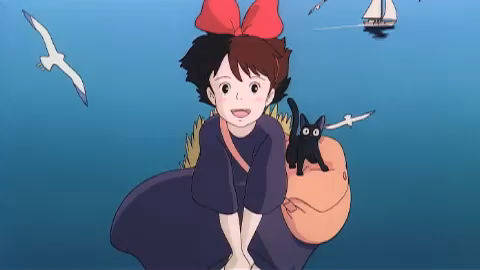
It is very well-known by now, how Miyazaki himself was drawn toward becoming an animator after seeing the Japanese animated version of the Chinese Tale of the White Serpent, which was storyboarded and produced by Hiroshi Ōkawa to ‘strike a tone of reconciliation’, particularly with China, in the wake of the Second World War. But Miyazaki’s own Sinophilia comes off rather indirectly in his own films. The ‘red and blue visual tones’ of the Chinese school (and particularly Havoc in Heaven) find a minor, subtly feminist echo in Miyazaki’s films, which are drawn to an environmental palette of deep blues and greens drawn in contrast with the colourful, red or pink clothing of the female protagonist (even if it’s something as simple as a red bow), or who may have a bright complexion or bright red hair. His fantastic landscapes, which may or may not be literally shrouded in mist (see Mononoke-hime), may also invite comparisons with Chinese watercolour paintings. Whereas in Ponyo Western critics were very quick to note the Wagnerian influences in the story and in the score, the Chinese-operatic influences also showed through particularly in Miyazaki-sensei’s characterisation in his earlier work. Spirited Away in particular uses a Taiwanese villagescape as direct inspiration for the fantastic, dreamlike setting, and I know I’m not the first person to notice the striking similarities between the visual characterisation of Kaonashi and Chinese opera face-paint.

We have a direct attestation in Zhao Haoyang’s essay of Tezuka Osamu’s love for the 1964 version of Havoc in Heaven: a sketch by the great artist showing Astro Boy shaking hands with Sun Wukong. In fact, though, Tezuka himself did a version of Journey to the West four years before Havoc in Heaven came out (though, naturally, the most famous animated iteration of Journey to the West, at least here in the United States, remains Toriyama Akira’s Dragon Ball). But returning to Tezuka, he treated the entire enterprise of animation as though it were an operatic stage production or an early Hollywood studio – his Star System reused the same animated ‘actors’, though in different roles in different productions. The features of Tezuka’s Star System character designs deliberately reflect Western animation conventions of the time – think Disney and Warner Bros. in particular – but Tezuka’s vibrant animation and visual design can also be seen to reflect the bombast, the exaggerated mannerisms, the instant impressions of a character’s visual appearance, which are so prominent in jingju and kunqu.

I highlight all this, not at all to belittle Japanese visual or dramatic culture in any way, or to posit it as subservient or dependent on its Chinese antecedents. Indeed, it’s a tribute to these artists that they took their influences and ran with them in unique directions. But it does point, both to China’s vast untapped potential in terms of its much sought-after ‘soft power’, and to an impoverishment in the modern turn that prevents that potential from being realised. The Japanese greats, who were also great Sinophiles, voiced great disappointment and disillusionment over China’s lapse in the character of its visual arts.

As for me, I’m looking forward to watching Havoc in Heaven now.

02 December 2015

The Confucian moral worldview in Fatal Fury


There are two excellent reasons to watch the animated miniseries Garō Densetsu 餓狼傳說, or Fatal Fury as we call it in English… and no, I’m not talking about those two reasons, gentle readers. Though one might want to dismiss it as a simple-minded fighting-and-fanservice OVA, there are two very clear aspects which mark it off as having a distinctly Confucian flavour. The first is the importance of the five fundamental relationships in Terry Bogard’s life, which manages to blend over into a meditation on the relation between the martial virtues and filial piety; the second is an implicit discourse on vengeance and fate, which lends the adventure a possibly-unintended political dimension.

The first one is perhaps easier to discuss. Terry and Andy Bogard are the students of Tang Hulu shifu (yes, a clear reference to tanghulu), the last living master of the near-lost Baji Shengquan 八極聖拳 school of Chinese martial arts. Their foster-father Jeff, also a student of Master Tang, belonged to the senior generation of Baji Shengquan; however, as Terry and Andy looked on helplessly, Jeff was murdered by his fellow-student and rival, Geese Howard. In order for the school to continue on, and in order to avenge Jeff Bogard’s death, Master Tang agrees to teach the final technique of the Baji Shengquan school to one of his two students after ten additional years of training, after which they will meet each other by Jeff’s grave.

Ten years pass, and Terry returns to his hometown to fulfil his obligations to his shifu and to his brother, to learn the final technique of his school and avenge his father’s death. He stumbles into a nightclub where he meets a young lady, Lilly McGuire – and is challenged by Joe Higashi, whom he later befriends. He meets up with Andy and his master when he goes to visit his father’s grave, and the two brothers decide to enter the King of Fighters tournament, organised by Geese Howard himself, to decide who will win the right to learn the last Baji Shengquan technique and face Geese personally. In the meanwhile, Terry meets Lilly in the street, giving food and money to some homeless children, and promises her that he will free her from her predicament – as he can tell that she is under an obligation to Geese.

However, Geese has arranged a trap for Terry, Andy and Tang at the King of Fighters tournament, and plans to have them all killed when they fight. However, he is foiled by Joe and Lilly; though Joe, Terry and Andy manage to escape, Geese kills Lilly and has Billy Kane inflict a mortal wound on Master Tang. As she is dying, Lilly tells Terry that she had helped Geese kill his father, but Terry, having seen the incident and remembered the little girl who had accompanied Geese, had known all along and still loved her. After bringing Tang shifu to the hospital, Andy immediately goes back for revenge, accompanied by Joe; however, Terry stays behind. Tang then awakens and teaches Terry the Baji Shengquan’s ultimate technique – not because he is stronger, but because his character has been better-developed than Andy’s has. Joe had remarked when watching the two brothers fight that Andy fought like a hungry wolf, but Terry stood firm like a sapling with deep roots, able to bend and withstand the wind. The final technique in the Baji Shengquan, in fact, draws power from the earth – but the interesting thing about it is that the ‘earth’ is visually represented both by the physical earth and by Terry’s relationships with Jeff, Tang shifu, and Lilly.

It is intimated that Terry’s martial ability depends very strongly on his filial piety, and on his correct keeping of the five relationships: his reverence for Master Tang, his admiration for his father Jeff and his desire to avenge his death in the proper way, his care for his younger brother Andy, his intense but ill-fated love for Lilly and his mutually-strengthening friendship with Joe. As it turns out, Andy and Joe are not capable of defeating Geese by themselves; only Terry can do so – and as it turns out, he can only defeat Geese by properly remembering the five people to whom he is accountable, and by knowing his proper place with regard to heaven and earth.

One can expect, in the tradition of martial-arts films, books and comics, that most of them would uphold some form of Confucian-inspired honour code, given the indebtedness so many Japanese artists and storytellers in this particular oeuvre have to Romance of the Three Kingdoms and Water Margin, along with later works like those of Jin Yong. Indeed, the Confucian roots of the shōnen comic culture have not been overlooked by their English-language fans. I just hadn’t been expecting the Confucian overtones of a work like Fatal Fury to be quite so in-your-face. I had been half-expecting one of the brothers to quote directly from the Book of Rites: 「 父之讎,弗與共戴天。」 ‘With the enemy who has slain his father, one should not live under the same heaven.’ Certainly the principle is endorsed by Andy and Terry.

If anything, in the sequel, Fatal Fury 2: The New Battle those overtones are even stronger. In this story, Terry faces Wolfgang Krauser, Geese Howard’s half-brother and an immensely-powerful martial artist who makes his living as a bodyguard for Europe’s nobility. At once, the audience is confronted with both the similarity and the distinction between the two fighters. Terry fought to avenge his family and his master; Krauser fights, it is intimated, only to seek amusement – even though his own brother has been crippled by Terry. Terry cares deeply for Andy, who in turn respects and honours his older brother; by contrast, Krauser treats Geese with contempt, and Geese is frightened of Krauser but has no affection for him. Clearly when we meet Krauser for the first time, we are meant to regard him as something of an equal, a counterpart to Terry. He is strong enough in their first encounter to beat Terry senseless.

At the same time, Andy’s jūdō master Yamada Jūbei remarks that Krauser is a monster – because he murdered his own father. There are very few crimes in the Confucian canon for which the Master directly prescribes the death penalty, but two of them – the most serious – are regicide and parricide. Indeed, as the Book of Rites has it, in the words of Duke Ding of Zhu-Lou:
臣弒君,凡在官者殺無赦;子弒父,凡在宮者殺無赦。殺其人,壞其室,洿其宮而豬焉。

When a minister kills his ruler, all who are in office with him should kill him without mercy. When a son kills his father, all who are in the house with him should kill him without mercy. The man should be killed; his house should be destroyed; the whole place should be laid under water and reduced to a swamp.
The revelation that Wolfgang Krauser is a parricide is the single aspect of his character that serves to distinguish him as a foil for Terry; in nearly all other respects they are shown to be equivalent, in ability and even (in a strange way) motivation. They both actively seek out fights. When they fight, they match each other blow-for-blow. They understand each other’s techniques. It is heavily implied that the only reason Terry is able to win against Krauser, is because he is still being guided by the people in his life who are most important to him. It takes an upbraiding by Joe to snap him out of his funk after losing to Krauser the first time; it takes a visitation by the spirits of Lilly and Master Tang to convince him that he is capable of defeating Krauser; and it takes fighting with Andy for Terry to realise the technique of the ‘Power Geyser’. Krauser, on the other hand, only thinks about his father once every year, and at that only to gloat over how powerful he has become.

All of this is underscored by the fact that witnessing everything Terry does is a young boy, Tony, who hero-worships Terry and wants to be just like him. However, Tony’s father died in a fight, and his mother doesn’t want to see her son go the same way. Terry continually tells Tony to go home and look after his mother… yet Tony continues to follow him, even accompanying him to Krauser’s mansion. Tony sees first-hand the equal abilities of Terry and Krauser, and in the end is witness to Krauser’s suicide after his shameful defeat. It is only after Terry makes his point clear to his young worshipper that his way of life isn’t for him, that Tony goes back and agrees to look after his mother. There is a moralistic, even heavy-handed aspect to this part of the story that serves to make the foregoing Confucian virtue-ethical points with the cinematic equivalent of a sledgehammer.

It is worth noting again that the entire genre of martial-arts anime is heavily dependent on the fictional devices used in wuxia 武侠 fiction, including Romance of the Three Kingdoms and Water Margin, and its youxia 游侠 poetic antecedents. The itinerant lives of the fighters in Fatal Fury and the extralegal honour and vengeance codes they uphold can be traced in their pedigree back to the literary jianghu 江湖, the subculture of martial artists, itinerant monks, dissenting scholars, beggars, outlaws, hucksters and unsavoury characters of all sorts which made up the background for much of this variety of fiction.

Which brings us to the second point of interest about the Fatal Fury series, which is that it treads on a certain idea of familial obligation and the duty of vengeance which are common to the Confucian tradition, and particularly to Gongyang scholarship, which has been historically used to argue for legal leniency and conciliatory justice in certain cases of banditry and members of poor and ill-connected clans taking the law into their own hands. That idea is on full display here; Geese Howard is seen to have the police firmly bought and paid for, and even tries to use them to kill Terry and Andy. The law is not a recourse, not for characters like Lilly or Tony. It may not be too fruitful or useful to read much into this: from a literary perspective, this simply serves to heighten the tension and highlight the danger Terry, Andy and Joe have placed themselves in at the King of Fighters tournament. Certainly the message, insofar as there is one, is primarily moralistic rather than political. But I do have to wonder if there isn’t something else behind it.

Long story short, just appreciating some of the wuxia tendencies in a work that probably doesn’t get a lot of attention. With the honourable exception of Shiranui Mai, naturally.