Showing posts with label Chicomoztoc. Show all posts

22 February 2024

Of Guatemala and Gaza


This past Tuesday, after two and a half years of construction and labour of those monastics and faithful under the guidance of Archimandrite Evangelos Patá, a seminary and mission centre opened in the Huehuetenango District of Guatemala, reports Pravoslavie.Ru. The Orthodox community in Guatemala is one of the explosive success stories of twenty-first century Orthodox mission work, particularly after 2010 when 500,000 Guatemalans—mostly indigenous Maya people—converted en masse. A steady stream of converts into the Orthodox Church has continued since then.

This new seminary and mission centre will ‘serve the spiritual, educational and administrative needs of the faithful’, who are As Fr John Chakos puts it on his blog: ‘The palpable joy that filled this day reflected the vibrant Christian faith of the long suffering Mayan people who endured much throughout their tragic history, but never lost hope.’


How true this is. The ‘tragic history’ of the Guatemalan Mayan people is one which can be attributed directly to American imperialism and the legacy of colonialism. During this time, the Guatemalan military and government forces, trained by the School of the Americas and funded by the American government, used ‘scorched earth’ tactics against the Indigenous people of the country: including death squads, ‘disappearances’, strafing from helicopters, internment camps, forced starvation, torture and sexual violence. Leftists, labour leaders and union organisers were also subjected to this targetted violence from the state. Canadian folk-rock musician Bruce Cockburn, after visiting Guatemala during this time, wrote the song ‘If I Had a Rocket Launcher’ specifically about this situation.

The flocking of Indigenous Maya Guatemalans to the Orthodox Church in the present day, may be considered one of the fruits, primarily, of the career of Archimandrite Andrés Girón, a cleric who took up the cause of the Indigenous peoples of Guatemala, specifically during this time of the US-backed military dictatorship in the 1980s. For his efforts, Archimandrite Giron was excommunicated from the Roman Catholic Church on account of his pro-Indigenous stand, and he fled to Mexico after several assassination attempts on him by the right-wing government, after which he joined the Orthodox Church and continued his advocacy work. Although he was an agrarian-minded Christian and not a Marxist, he gained the moniker ‘Father Revolutionary’ from both his supporters and his opponents, particularly when he began supporting progressive land reforms which would benefit the Indigenous peoples. He even began political action against the US-backed military government, at the head of the left-wing, anti-capitalist Asociación Nacional Campesina Pro-Tierra, and direct action by occupying and farming land collectively for the benefit of the people living there.


Archimandrite Andrés Girón

Even though his electoral campaigns did not win him much support in terms of government reform, the Indigenous Mayans quickly gravitated to his social ideals, not to mention his religious convictions. At a time when the Catholic Church was divided between a reactionary hierarchy and a liberation-theological parish priesthood (and the hierarchy winning out more often than not); and when Evangelical Protestantism was marching in lockstep with state violence and American-style capitalism and white supremacy; Orthodox Christianity began to look all the more attractive. When Fr Andrés Girón joined the Orthodox Church in 2010, hundreds of thousands of Indigenous Mayans came with him. Stop me if any of this starts to sound familiar.

I beat this drum a lot. I have remarked before, and repeatedly, that the Indigenous peoples of Asia and America are a valuable witness within Orthodoxy. Orthodoxy at its best does not see Indigenous traditions and languages as things to be assimilated from the outside or suppressed from above. It values these traditions and languages in themselves, and transfigures them from the inside.


Orthodox womens’ monastery in Kyltovo, Komi Republic, Russia

For example: Orthodox Bibles, prayer books, patericons and religious texts have been published in Indigenous languages such as Sakha, Nenets, Evenki, Chukchi, Khanty, Skolt Sámi, Komi, Veps, Aleut and Tlingit and Yup’ik. Saint Innocent of Irkutsk, Saint Herman the Wonderworker of Alaska and, later, Saint Tikhon of Moscow defended Indigenous rights against oppression and exploitation first by Russian and later by American pecuniary interests and colonisation. (One can see from these examples that the witness of Fr Andrés Girón was not without precedent!) But Indigenous people themselves have contributed to Orthodoxy in profound and ineluctable ways. Saint Peter the Aleut, Saint Jacob Netsvetov, Saint Olga of Alaska... these Indigenous saints have deeply and without question enriched the experience of American Orthodoxy. And the former two of these saints did so, while Indigenous people in the Americas were undergoing one of the worst genocides of human history.

Now, let us turn our attention, for the sake of comparison, to another Indigenous people. The people of the country of Palestine are descended, indisputably from a scientific and genetic point of view, from the ancient Levantines. Modern Palestinians are genetically closest to the Bronze Age inhabitants of Canaan, with unbroken ancestral roots in the Levant going back nearly 4000 years. (We ethnic Ashkenazim simply cannot claim the same thing: over forty percent of our autosomal ancestral DNA originates in Western Europe--France and Germany.) What appears clear now, is that this Indigenous population of the ancient Holy Land has undergone numerous cultural and religious and linguistic shifts through the millennia. So although Palestinians are culturally Arabic, and the majority are Muslims, their presence in the place where they are long predates the Arab conquests and the rise of Islâm!


Church of St Porphyrios, Gaza, Palestine

Indeed, Palestinians were among the first Christians. Gaza was a Christian city. The Church of Saint Porphyrios, which was bombarded by the Israel Occupation Forces two weeks into their current war, dates back over sixteen hundred years. Gaza was home to Christian saints such as Bishop Saint Porphyrios himself, Abba Dorotheos, Saint Vitalios and Saint Silvanos, to name but a few. Before Palestine was Muslim, Palestinians followed Jesus Christ. And before Palestinians followed Christ, Palestinians were without question among the people who worshipped the God of the Hebrews, the God of Abraham and Isaac and Jacob, at the Second Temple.

Despite the prevarication and mealy-mouthed excuses that issue from on high in Washington and New York, there can be very little doubt now that what is going on right now as we speak, in the home territory of this very oldest of Christian Churches, is a genocide of the Palestinian people, at the hands of another US-backed far-right parafascist government: complete with scorched-earth tactics, death squads, weaponised starvation, torture, sexual violence. In short, the Palestinians now are suffering everything that the Indigenous Guatemalans faced from the military dictatorship of that country in the 80s and 90s. And the American government backs the Israeli fascists to the hilt.


Archbishop Alexios of Gaza

But if there is another Indigenous genocide occurring right now in Gaza, there is also another Fr Andrés Girón, in the saintly Archbishop Alexios of Gaza. Archbishop Alexios has courageously declared that he will not abandon his flock there even if he is the last Christian standing in Gaza. And he has dedicated his work to giving food and clean water and shelter to any who have come to need it, even as they are being denied these by the military. And he has rededicated himself to praying for the dead, the dead without number: and many of these dead are Christians.

The Indigenous Christians of the Holy Land need our solidarity, and they need it now more than ever. But, just as Efraín Ríos Montt has gone down to Sheol, while the relatives of people he ordered to be slaughtered by the tens of thousands are flocking to the Church to be joined to Christ, so too will Netanyahu and his hateful right-wing butcher-regime and his death squads go down to the pit, while the names of the innocents who died at Saint Porphyrios shall be sung by the heavenly choirs without end. Of this I am sure. And if God wills it, may He let Gaza again breathe, be free and be green, as Guatemala may now (to a certain extent) do.

05 September 2022

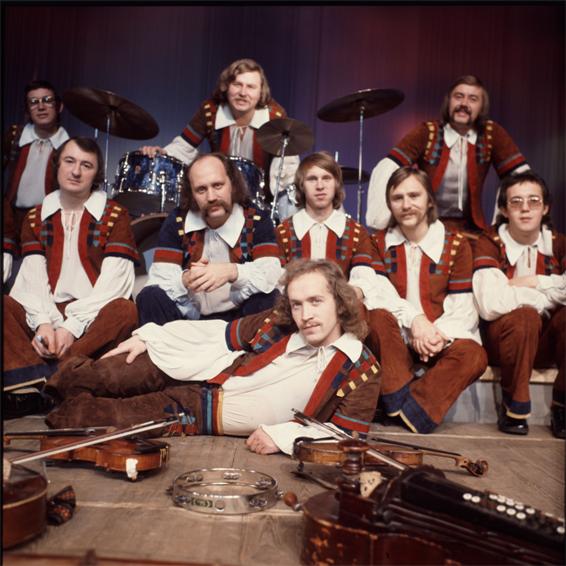
The twin geniuses of Creedence and Pesnyary


Creedence Clearwater Revival

Recently I’ve been listening to the folk-tinged rock music of Creedence Clearwater Revival, on the one hand, and the rock-tinged folk music of Pesnyary on the other. Creedence were a Bay Area band who emerged out of, and came to exemplify, a certain strand within the sixties counterculture—though they usually composed lyrics about, and were influenced by the folk culture of—Greater Appalachia, the Bayou, the American South generally. Pesnyary, by contrast, were a Soviet state-sponsored VIA (vokal’no-instrumental’nyi ansambl’, literally ‘vocal-instrumental ensemble’) who played acid-rock and progressive-rock arrangements of traditional folk songs as well as their own compositions. They were also one of the very few Soviet bands to actually tour in America—specifically in the American South. Creedence had split up by 1972; Pesnyary were then just getting started: officially, there are two bands calling themselves Pesnyary now and four or five others borrowing the name without licence, but most people agree that Pesnyary’s classic period ended in 2003 with founding member Vladimir Mulyavin’s death. Despite their very different origins and ‘stances’—the lyrical and thematic difference between ‘Proud Mary’ and ‘Ave Maria’, as it were—I’m finding I’m enjoying them for very similar reasons.

One of the reasons I find both of these bands so enjoyable to listen to, is because they invest these deceptively simple melodies and chord progressions (these are rock groups, after all) with a great deal of dynamic and emotional depth. Creedence Clearwater Revival build on a basis of swamp blues—the harmonica was there from early on—and diverge from there in various directions, adding more and more rock instrumentation, as well as elements like Hammond organ. By the end of their career, as one can hear on songs like ‘Sweet Hitch-Hiker’, they were veering very close to hard rock or even proto-metal. CCR’s tunes are catchy, instantly-recognisable, iconic: ‘Suzie Q’, ‘Down on the Corner’, ‘Fortunate Son’, ‘Have You Ever Seen the Rain?’, ‘Lookin’ Out My Back Door’.

As important as Creedence Clearwater Revival are for a certain generation of Americans, I’d say that the Pesnyary are equally as important for a certain generation of people from the former Soviet Union. The Belarusian group, led by Vladimir Mulyavin, took its influences both from Western rock music (particularly the Beatles) and from traditional White Russian folk melodies. Pesnyary songs blend guitar melodies, drums, keyboards and even saxophones with traditional folk instruments (wooden whistles, fiddles, flutes, accordions, hurdy-gurdies) in a unique way. The VIA was signed to the state-owned label Melodiya in the Soviet Union (the only real game in town, as it were), and their albums sold millions of copies. Their unique approach to making accessible music with depth and feeling—with hits including ‘Aleksandrina’ and ‘Belovezhskaya Pushcha’—and Mulyavin’s ability to seek out and recruit talented multi-instrumentalists and singers, made the Pesnyary very literal rock stars in the Soviet Union.

John Fogerty and Leonid Bortkevich are, obviously, two very different vocalists—but even here there are some interesting similarities. Fogerty gives a very nasal delivery, with occasionally having a hoarse or a hard edge to his tenor melodies. There’s definitely a ‘country’ or ‘Southern’ inflection to this delivery, but it’s easy to hear the lasting influence on rock—even hard rock and heavy metal—that Fogerty’s voice had. Leonid Bortkevich was a much more traditional tenor: clean-toned, pectoral delivery, like a classically-trained singer. On the surface, he sounds much more like John Denver than John Fogerty. But Bortkevich deploys some interesting flourishes in his singing—a breath’s delayed approach to the note, a glide or a back-throat catch, that can make his vocals sound grittier, or ‘folksier’ (a good example of this being ‘Do Tret’ih Petruhov’).

It’s a bit strange. I’ve explored a lot of the musical differences between the two bands here. If we take account of their analogical positions within their respective cultures, the countercultural and ‘oppositional’ political nature of CCR’s music (‘Fortunate Son’, ‘Effigy’) more closely aligns with the career of the alternative rock / new wave band Kino headed by Viktor Tsoi. Pesnyary, meanwhile, despite the influence they took from the Beatles, probably more closely aligns with the folk-revival artists like Lead Belly, Woody Guthrie, Pete Seeger, Burl Ives and so on than with the later tail of the folk-rock trend in American music to which Creedence belongs. But somehow it seems more natural to my ear to connect these two bands. Both of them evince a vitality and a creativity that tends in a similar direction. Both CCR and Pesnyary seek their inspiration in the deep roots of their respective countries—not without a critical eye in each case—and both draw them out to infuse them with the sounds of their contemporaries. Certainly both bands are worth listening to and appreciating.


Pesnyary

25 February 2021

Batting zero

The Forever War rolls on...

This past election cycle, I made for myself a five-item ‘litmus test’ that I would cast my primary ballot on, as well as decide how to cast my general election ballot. My litmus items were: Medicare for All, $15 an hour, ending the forever war, relaxing visa restrictions on legal immigrants and meaningful criminal justice reform. (As I have said before: even though I am solidly pro-life in my political convictions, that issue has been relegated to a position of electoral irrelevance, largely by the fact that Republicans want to keep it as a culture-war ‘wedge’ and won’t do anything about the issue.)

Even this five-item litmus test was in fact a slightly watered-down and dumbed-down version of the seven-item litmus test that I made early in the primary season in response to the candidates’ answers to survey questions in the press. I pulled a 1944 Russell Kirk and voted for Gloria La Riva on the Peace and Freedom Party ticket, because Biden’s record was against him on all five of the issues that I care about and decided to stake my vote on.

Recent events, and at least two events this past week in particular, have confirmed over and over again my choice to not support the Democratic Party with my vote. We’re back to Bourbon Democracy, in that the Democrats have both forgotten nothing about their failure in 2016, and learned nothing from it. Biden is clearly hankering after a thorough drubbing in the midterms next year, and a devastating loss in 2024 to a Republican candidate who will no doubt make Trump look like a tame kitten in comparison.

Let’s start with Medicare for All – a reform to our healthcare system which we desperately need, and some version of which all other industrialised countries and even conservative monarchies have… and which Biden said he would veto if it crossed his desk. Biden’s healthcare plan was literally written by the insurance companies. And not only does it fall short of Medicare for All, but it doesn’t even provide for a public option, which was the compromise position for the Democratic candidates back in 2008 when Obama was running for president! Joe Biden is facing down a massive crisis in the American healthcare system and doing nothing to fix it. He’s not even slapping a plaster on a massive hæmorrhage.

Now let’s go to the issue of raising the minimum wage to $15 an hour. Biden has privately told governors he is not going to fight for it, despite this having been his one single campaign promise that I liked, and which could have swayed me to vote for him if I thought he was sincere about it. Clearly he wasn’t. His politics around wage increases are clearly a cynical ploy to attract working-class voters into his electoral base before abandoning them. Biden having won the election, he could very easily put pressure onto Democratic senators like Joe Manchin with vulnerable seats, and twist their arms to get them to support a $15 per hour mandate in the relief bill. But that promise was all hot air. He isn’t going to do it, for the same reasons that Obama didn’t push for a public option in the Affordable Care Act. His interests are with the donor class, and the donor class simply doesn’t want to pay their workers more.

Asking for meaningful criminal justice reform or meaningful policing reform from the key Democratic sponsor in the Senate of the infamous 1994 crime bill should probably have been seen as trying to squeeze blood from a stone. And the recent attempts by centrist Democrats to continue qualified immunity for police officers accused of wrongdoing, in the name of quixotically-elusive ‘bipartisanship’ and ‘political compromise’, along with Biden’s administrative attempt this past week to refund the brutal COPS initiative of the Clinton-era Department of Justice (which placed resource officers in public schools, for example), do not offer a great deal of hope that he’s likely to advance this cause either.

Visa reform? Rights for legal immigrants and asylum seekers? I had little enough hope for that on the campaign trail, when Biden decided to blow up at immigrant-rights advocate Carlos Rojas and told him to vote for Trump. This past week saw Biden open new detention facilities, and reopen an infamous Texas tent camp to continue processing deportations and family separations. Biden is not only straight-up continuing all of Trump’s most hideous abuses of legal asylum seekers, he actually appears to be expanding them.

And then there is the forever war, of which Biden has long been a supporter, and now appears to be continuing with all the incontinence and callous disregard for human life we ought to have expected from him from the start. Biden has just bombed Syria. Again. Just like Trump did and just like Obama did. The people of Syria and especially the long-suffering Orthodox Christians of that country have suffered more than their fair share and certainly more than they ever deserved at the hands of the American government and its hideous head-lopping takfiri-jihâdist proxies. Backed up by the war propaganda and manufactured consent from inane mouthpieces of the CIA like 60 Minutes, the Biden Administration seems as hellbent on continuing this revolting, heinous, profligate, destructive war on sæcular and Christian Arabs, Assyrians and Armenians in the Middle East. Biden also seems to be continuing in Trump’s determination to harass, beleaguer and starve the people of countries like Venezuela and Haiti. And still he continues to ramp up a strategically-insane new cold war with both China and Russia.

(It goes without saying that on life issues, Biden stands foursquare against his own church, and with the most radically-libertine elements within his own party that seek to trample down all legal humane considerations for unborn and even recently-born children. Again, though, this issue is so politically-polarised as a culture-war wedge that it is impossible to expect anything productive in policy to result from voting one way or another on it. Republicans continue to fund Planned Parenthood, for example.)

Biden is currently batting zero in terms of his actions in the fields of policy that I pinned my vote to this time around. That isn’t to say, by the way, that he isn’t undoing some of the damage to American infrastructure and the mechanisms of government that Trump did. But those gains are as ephemeral as the executive orders and signing statements that enacted them, and they can be blown away with the next shift of the electoral weathervane. But on the issues that can sway significant portions of the middle America that has remained so alienated in politics in the past two election cycles, Biden is either doing nothing or worse than nothing. I take no pleasure in saying this, since many of the options that are looming on the horizon when democratic legitimacy collapses in this country are far more horrifying than the banality of Biden’s evil, but these things needed to change long ago if we are to have any hope of recovery as a nation.

01 December 2019

Iconoclasm versus syncretism in Bolivia


A Bolivian indigenous man holding a wiphala flag

The political upheaval in Bolivia has been all over the news recently, and as it happens I do want to comment about it rather badly. What we are seeing happening in Bolivia right now is, in fact, a coup. And it is an unfolding crackdown specifically against indigenous interests, and it’s taking a turn for the sanguinary.

From a purely political perspective, the perpetrators of the coup against Evo Morales are utterly illegitimate, and their comportment is reprehensible. On account of Orthodox Christianity’s unique position within Christendom vis-à-vis indigenous rights, neither our hierarchs nor our laity should be silent about condemning this coup. Indeed, many of our Orthodox brothers and sisters in Guatemala already are.

Needless to say, I agree with Tulsi on this. Sorry, Liz, you’re not very credible on this issue. Sorry, The Economist, you’re not either, nor on many others. And of course, the same goes for Foreign Policy magazine (see also here), the New York Times, the Washington Post and the rest of the usual gang of bloodthirsty cheerleaders for American imperium.

But there is a deeper problem than that, which can be seen in the new junta’s quasi-religious, clerical-fascist rhetoric. Most of that government are Protestant fundamentalists, and their antipathy to the country’s indigenous majority is couched in chiliastic terms. What’s more, Bolivian cultural symbols like the wiphala, the tawa chakana and Pachamama have become battlegrounds. They are being attacked even as the people are being attacked, by Bolivia’s new junta. The flags are being burned, and Pachamama is being denounced.

And thus the political problems, including the one of the coup d’état mentioned above, become infused with theological ones. This almost always presents problems, particularly (but not always) when it happens in the Western Hemisphere, where right-wing Protestantism and right-wing Catholicism tend to ally in an œcumenism of fear. This is also the case here. The fundamentalists – and certain Catholic traditionalists as well – would have us believe that the distinctions are clear-cut and the battle-lines have been drawn. But even if the problems have been drawn up falsely, they are not problems to run away from. Sadly, Orthodox commentators in English-speaking countries have a tendency either to dismiss these as ‘Catholic problems’, or else ally themselves with the most retrograde elements within Catholicism and Protestantism as part of this same œcumenism of fear. Both of these positions are reactive and do not draw upon the corpus of the relevant Orthodox social witness among non-Christians, particularly in Russia and Alaska.

First of all, it’s necessary to take at least a cursory account of the history of Bolivian popular worship. Pachamama was not invented at the Amazonian Synod, and not adopted overnight by Pope Francis. Pachamama has been, in fact, a long-standing element of syncretic Catholicism in South America, and has been identified with the Virgin Mary at least since the 1500’s. It is not an immaterial historical point that this kind of syncretism is endemic to the regions in the New World conquered by the Catholic colonial powers: Santería, Voudun, the modern Puebloan religion. This particular form of religious syncretism almost always appears as a form of indigenous resistance to being conquered. That is not an excuse for, let alone an endorsement of, such syncretism. It is merely a statement of historical correlation.

Secondly, Pachamama originally referred to the Andean goddess of nature; however, it is a title and not a name. It means, literally, ‘World-Mother’, and it has been used to refer to the Virgin Mary since the introduction of Catholicism to South America. Whether it’s appropriate to assign the title of Kósmotokos (the Greek equivalent of Pachamama) to the Theotokos is a purely theological problem, and as such it is way out of my league. I wouldn’t dare to comment on it for myself, let alone for the Church. But acknowledgement of this fact places the problem of the Pachamama at the Amazon Synod in the same realm, with the same theological stakes, as the Nestorian controversy. Again, I do not dare to take a side on this question, not without the guidance of the Fathers or the received Tradition – except to say that titles are important, and can make the difference between a genuine case of idolatrous hæresy or a relatively-harmless theologoumenon.

An Orthodox Christian – or, for that matter, a cogently Catholic – answer to the current problem of syncretism must therefore be informed by both the historical and theological stakes, and by our own tradition of iconography. Politics is limited, and merely taking refuge in political reaction renders us powerless and subject to the whims of the prevailing political winds. Mere blind opposition runs the risk of turning us into iconoclasts, or idolaters of a different sort.

Above all, we must not pretend that Orthodox cultures are somehow pristine, pure and unblemished by these problems. Orthodox history also has instances in which conquest and imposition have resulted in religious syncretism. The occurrence of, or at least the scholarly interest in, dvoeverie in Russia is probably the best example of this. Contrary to romantic-nationalist mythmaking and Soviet anti-Christian polemics, dvoeverie (Russian ‘double belief’, or paganism) was probably not a continuous and unbroken presence in Russia from the times of Kievan Rus’ up to the present. Instead, it’s much more likely that ‘double beliefs’ arose as a reaction against the bureaucratic reforms of Peter the Great, and became the object of interest only in the nineteenth century and the advent of romantic nationalism. The current prevalence of dvoeverie in the North Caucasus and among Russian Cossacks in particular would seem to support the recent nature of the phenomenon.

Even so, the patient, humble model of evangelisation embodied in our holy fathers Saint Tryphon of Pechenga, Saint Innocent of Irkutsk, Saint Innocent of Alaska, Saint Herman of Alaska, Saint Jacob Netsvetov and others is probably our best response. These saints did not journey among foreign peoples in arrogance, immediately smashing their places of worship, declaring them to be filthy and cowing them into the church. Instead, they lived among them in a discipline of ascesis and an attitude of humble service and love; and when the people in need of evangelisation were ready, they would come or their own accord to hear the Word of Truth. When these non-Christian people were exploited or abused by Christians, these saints would rally to their non-Christian neighbours’ defence. This model is not the sole patrimony of the Christian East, either: this gentle model of evangelism was heavily promoted by Saint Gregory the Dialogist, Pope of Rome.

This model of evangelism, instead of retrenching the failures of earlier generations, offers forth the possibility and necessity of repentance on the part of Christians who must own a historical legacy of violence and exploitation. Indigenous syncretism is, after all, a rebuke against Christian failure to preach the Gospel without violence. More importantly, it offers indigenous people the possibility of becoming iconographers for themselves. The life and witness of Matushka Olga of Alaska is a great example of this. I do not know if Matushka Olga ever made an icon out of wood and clay and paint with her own hands, but I do know that she tended to the indigenous young women in her parish who came to her, and that she treated each one as an icon of the living God. This is equally an important work of iconography, to pay reverence to the icon of Christ in the human person.

Pachamama may or may not be a retrievable form of such iconography. Like I said before, that involves assigning titles to the Holy Theotokos, and that is a labour of the intellect way above my pay grade as a lay Orthodox blogger. All the same, it is this model of evangelism, both historical and current (witness Archimandrite Andres Girón de Leon of blessed memory) that we must uphold. This is not only to rebuke the perpetrators of the current political violence against the indigenous people in Bolivia, which is shamefully being committed in the name of our Lord. This is not only to rebuke the hidden civilisational idolatry of the œcumenists of fear. It is also to retain the promise of Christ that all cultures are capable of receiving Him and being transfigured in Him – without necessary reference to any other.

19 June 2019

Kóshpendiler ten years on, and Jaýjúrek myń bala


Mansur (Kuno Becker) and Eraly (Jay Hernandez) in Kóshpendiler

I started this blog, then called Matt’s Existential Musings, ten years ago to the day in 2009. The blog was set up to be a Peace Corps journal. Peace Corps didn’t quite work out. Blogging, it turns out, did – though the result turned out far, far differently from what I expected. I began it with an entirely-insufficient review of a 2005 movie called Nomad (or Kóshpendiler in Kazakh), starring Jason Scott Lee, Kuno Becker, Jay Hernandez and Ayanat Ksenbai. That I would go back this summer and start reviewing Kazakhstani movies like Baikonur, Kelin, Shal, Ulzhan (another film with Ayanat Ksenbai), Otyrardyń kúıreýi, Tulpan, Kavkazskii plennik (another Bodrov), Shıza (yet another Bodrov), Ya ne vernus’ and Pervyi eshelon, seems more than a bit convenient and coincidental. Please believe me, gentle readers, when I say that it’s serendipity, and I didn’t plan it this way. Even so, going back and taking another look at Kóshpendiler did seem like too good an opportunity to pass up.

Kóshpendiler is a movie in that elusive category that the French call ‘nanar’. It can loosely be called a historical epic and it is definitely an action movie – and Sergei Bodrov certainly had a creative vision that is brought in full force onto the screen. It makes enthusiastic and effective use of sweeping landscape cinematography, thundering herds of horses, vast period sets and intricate costume design, and as a result is visually lush and convincing. But the casting choices, the acting direction, and even the writing conspire, in the end, to produce something endearingly terrible instead.

Set during the Kazakh-Dzunghar wars of the seventeenth and eighteenth centuries, Kóshpendiler centres around the life and career of Abylaı Han – whose given name was Ábilmansur. The voice-over narration from Jason Scott Lee informs us that the Kazakh people are being destroyed and enslaved by the brutal Dzunghars, and that the Kazakh tribes are too disorganised to put up any kind of unified resistance. A prophecy known to Lee’s character, Oraz the Wise, says that a direct male-line descendant of Shyńǵys Han will be born, who is fated to unite the Kazakh tribes and liberate them from the tyranny of the Dzunghars. Unfortunately, this prophecy also becomes known to Galdan Tseren, the ruler of the Dzunghars, who takes repeated steps to kill this child who will bring an end to his dominion. The broad contours of the story of Kóshpendiler will be familiar to anyone with a passing knowledge of heroic mythology throughout the world, from King Arthur to Star Wars. Even so, here’s the standard warning: spoilers ahead.

The hero, Mansur (Kuno Becker), is saved at his birth from being killed by Galdan’s Herodic paranoia at the hands of his best warrior Sharysh (Mark Dacascos) and his band of Dzunghars. However, Sharysh manages to kill Mansur’s mother, the wife of Sultan Válı. Oraz, who saved Mansur, brings him to his grieving father, who is glad that at least his son was saved and agrees to grant one thing to Oraz. Oraz asks him for the right to raise Mansur – a request that Válı is loath to give, but does so both to keep his word and to assure Mansur’s safety from the wrath of Galdan. Oraz raises Mansur alongside a group of young boys from every Kazakh tribe. He teaches them to fight together without distinction between their clans or families, teaches them the history of Shyńǵys Han and the origins of the Kazakh people, and even references the old yarn about a bundle of arrows being harder to break than each arrow individually. But Mansur is closest to Eraly (Jay Hernandez), whose fighting ability matches his.

Sultan Válı pays a surprise visit to Oraz and his training school for nomadic boys, who all line up dutifully to greet him. When he comes to Mansur and Eraly, he wonders why they don’t give him their tribal names, and Eraly answers him: ‘We know our tribes, but Mansur and I call ourselves Kazakhs.’ From this Válı is able to guess that one of them is his son, but Oraz isn’t telling him which. Growing up alongside Mansur and Eraly is the lovely Gauhar (Ayanat Ksenbai) who seems to take an early interest in Mansur. At first, to all appearances, Mansur is more interested in her colt Moonchild (Kazakh priorities!), but soon learns to appreciate her. Unfortunately, he learns that Eraly is also in love with her, and thus refrains – despite Gauhar’s open encouragement – from chasing her so as not to strain their friendship.

We soon learn why Oraz put together this training school. The Kazakh khans and sultans, called together to answer the Dzunghar threat, spend their time swaggering, posturing, loudly bowing to no one, and generally refusing to work together. Meanwhile, Galdan somehow learns that Mansur is alive and again sends Sharysh to attack the city of Túrkistan. Sultan Válı sends the women and children, including Gauhar, out of the city to a safe hiding-place, but Gauhar rides back – followed by her brother Qasım – to be with Mansur and both are thus easily caught by Sharysh in ambush. A leering Sharysh, threatening her brother with a torturous death if she doesn’t comply, sends her back to Dzungharia to become his tenth wife.

Sharysh besieges Túrkistan, but for some reason agrees to a duel with a single warrior of the Kazakhs’ choice. Eraly volunteers, but Oraz chooses Mansur to go instead – telling Mansur that Sharysh killed his mother. As Sultan Válı watches from the walls, Mansur rides out and fights Sharysh on horseback, handily lopping off his head with the help of some incredible horsemanship – and then Válı recognises his own son. Eraly is initially joyful, but becomes jealous of Mansur’s preferential treatment by Oraz and Sultan Válı. Eraly learns that Gauhar has been captured, and rides off alone to her rescue without telling anyone except Oraz. This seems to be a theme. Mansur rides out after him – first stopping at the tree of Shyńǵys to pray – and is easily caught by the Dzunghars.

He is brought before Galdan and subjected to various tests clearly meant to kill him, although in his captivity he befriends Galdan’s son and unwittingly enchants Galdan’s daughter, whose advances he refuses. The tests include having to ride through two lines of archers shooting at him, and finally having to duel Eraly – though both of their faces are hidden from each other by chainmail veils. Mansur embraces a dying Eraly as he is told by Galdan that he’s free to leave the next morning. In secret, though, Galdan plans to have Mansur’s drink poisoned. The captive Gauhar sees this, and risks her life to steal Moonchild and rescue Mansur from the Dzunghars.

Galdan’s enraged Dzunghars besiege Túrkistan again in force, and this time they mean business: they beat up and quarter the Kazakh herald. Mansur sends out messengers to the other Kazakh tribal leaders, hoping that they will answer and ride to Túrkistan’s defence in time. Much of the rest of the movie, which sports some impressive battle choreography, horsemanship and pyrotechnics, narrates the battle for Túrkistan, which is saved even as the reinforcements arrive. The Dzunghar strength is broken, and Galdan’s son is captured. Mansur, however, shows mercy and sends Galdan’s son back to him with a model globe sporting the new realm of ‘Kazakhia’ and a message: Don’t mess with the Kazakhs.

End spoilers.

Again, Kóshpendiler has all the technical prowess of a modern action blockbuster, but the acting and writing are both delightful B-movie hams, with the Kazakh characters in particular seeming to routinely indulge in frankly boneheaded acts of bravery (though Sharysh isn’t exempt). From a historical perspective this is more than a bit unfortunate, because the historical Abylaı Han wasn’t just a brave batyr – he was also a preternaturally deft statesman and a wily military strategist, and deserves a reputation like that of China’s Zhuge Liang. Kuno Becker and Jay Hernandez in particular throw themselves into their rôles with a bit too much gusto. But the movie is telling in certain of its ideological aspects. The Kazakh nationalist narrative which the film gives voice to is multifaceted. The Kazakhs claim descent from Shyńǵys Han, the Mongol leader – and yet their enemies the Dzunghars lay perhaps an even better claim to the same descent. This being the case, the Kazakhs are shown by the movie to be inheritors of the spirit of the steppe: they are brave, honest, just, merciful to captives and hospitable to guests. Galdan, Sharysh and the Dzunghars, on the other hand, are shown in a different light. Galdan is an unmistakeable Herod figure, willing to slaughter children to secure his own power. He is willing to use poison to kill his captive Mansur. He brutally murders a Kazakh envoy. He shouts orders at his troops safely from the sidelines rather than fighting beside them. This contrasts starkly with Mansur, who shows mercy to Galdan’s young son and is willing to fight alongside and suffer in solidarity with his people.

There is a religious ‘us-them’ dichotomy that is drawn between Kazakh and Dzunghar. Kazakhs all pray openly and devoutly to God, like good Muslims. They all bow toward Mecca and they all stand together as equals – even though, without Mansur, they also squabble and boast and fracture when the time comes to take action. The religion of the Dzunghars is portrayed far less sympathetically. Galdan is attended by an obnoxious, obsequious and theatrically-toadying shaman whom the khan clearly despises. This runs alongside an æsthetic ‘us-them’ dichotomy that shows Kazakhs as embodying the noble qualities of both East and West, both Islam and the steppe tradition. Dzunghars, by contrast, are a steppe people who have gone soft and ‘forgotten their roots’. Galdan luxuriates in golden robes and lounges on a Chinese-looking throne beneath a silken canopy. The Kazakh Gauhar is a rugged steppe shieldmaiden who can ride and fight better than many Dzunghar men; but Galdan’s daughter is pampered, made-up, dressed in Chinese silks, and is easily seduced by the virile Mansur.

As a bit of national mythos-building, Kóshpendiler is both instructive and entertaining. All the same, given the lukewarm reception Kóshpendiler received overseas, it’s understandable that for the twentieth anniversary of Kazakhstani independence, the national film company Kazakhfilm Studios would want to revisit their earlier work. The result was 2011’s Jaýjúrek myń bala, directed by Aqan Sataev.


Kazakh warriors riding to battle in Jaýjúrek myń bala

It would be something of a waste of time and blog space to discuss the plot of Jaýjúrek myń bala, because it’s essentially the same as that of Kóshpendiler. The most significant difference is that instead of focussing on the big-name political figures like Abylaı Han (Dasten Shakırov) and Ábilqaıyr Han (Berik Aıtjanov), it focuses instead on the life and travails of a young orphan turned anti-Dzunghar resistance fighter named Sartaı (Asylhan Tolepov) and his band of fellow-orphans and friends who demonstrate bravery and self-sacrifice as they seek to drive the marauding, enslaving Dzunghars out of their homeland. Sartaı is similarly orphaned by the Dzunghars and seeks revenge on the Dzunghar commander who murdered his family. He and his best friend Taımas (Aıan Ýtepbergen) demonstrate the same strained foster-brother relationship that Mansur and Eraly do in Kóshpendiler – but perhaps an even better analogy would be an even further callback in Kazakhstani cinema: the psychologically-dense rivalry between Uzarov and Monetkin in Pervyi echelon. Sartaı even has a love interest in Zere (Alııa Anýarbek) who displays a similar lack of regard for her personal safety.

Let me state first off that, on practically every single objective and technical level, Jaýjúrek myń bala is a far better movie than Kóshpendiler. It may lack the sweeping grand-historical scope, swagger and colourful costume-drama flair of the 2005 movie, but it more than makes up for that in attention to period-specific detail, grit and acting chops. It works far better as a ‘serious’ war drama on less than half the budget. Yet, at the same time, in this driven pursuit of making an efficient, muscular action blockbuster in the mould of Braveheart or Gettysburg, more than a bit of the B-movie charm of the original Kóshpendiler got lost.

One noteworthy thing is that Jaýjúrek myń bala seems to actually double down on the ideological portrayal of the Dzunghars as a foil for the Kazakh national mythos and identity-building. The ancestral touchstone for Kazakh identity here is no longer the Mongol Shyńǵys Han, but instead the Turkic epic hero Alpamıs who also features in Bashkir oral legend, the tales of whom Sartaı’s elderly uncle Nazar (Tlektes Meıramov) tells to the young people around the campfire. The Kazakhs in Jaýjúrek myń bala are again shown to be both the true guardians of steppe chivalry, honesty and hospitality, and faithful Muslims who trust in God’s justice and providence. The Dzunghars are shown to be practically without redeeming qualities. The uniforms of the Dzunghars are black from head to toe. The Dzunghars shoot Kazakh children for sport; round up villages and slaughter the inhabitants; take Kazakh slaves whom they treat with callous casual brutality. Muslim piety is also made a more explicit touchstone of the ‘us-them’ distinction. Dzunghar leaders are also shown to be idolaters who bow before statues of the Buddha, get drunk on strong liquor and horse-whip beggars who ask them for alms. Despite all of this, ironically, the storytelling – which is more self-awarely gæopolitical – downplays the Sinification of the Dzunghars. The Kazakh leaders acknowledge that the Dzunghars are fighting a two-front war against both them and the Qing Dynasty.

When it comes to recommendations, I would actually highly recommend both Kazakhfilm productions – but for vastly different reasons despite their near-identical storylines and shared historical subject matter. Jaýjúrek myń bala is a proficient action movie in its own right and should appeal broadly to American audiences who love well-shot, well-acted war films. But the inadvertent comedy delivered by the overacting and ‘taco kung fu’ of Kóshpendiler give it an earnest nanar-ific charm that Jaýjúrek myń bala lacks, while it still carries the high production values and lavish costumes and technical effects of most Western blockbusters.

So, with that, I think I’ve wished a fitting happy tenth birthday to the blog! It’s been a long and bumpy ride from Providence across the steppes of Kazakhstan through Inner Mongolia and Henan to the west side of the Mississippi River – and I can’t say that I don’t have any regrets. But this online journal of mine is not one of them. Zdorovy!

20 January 2019

Orthodoxy and indigenous solidarity


Orthodox celebration in Aleut community in Nikol’skoe, Russia

I am not going to pass direct comment on the Covington Catholic / Nathan Philips story, for the simple reason that I wasn’t there and am not in a position to pass comment. However, I do feel strongly about the ‘framing’ of the story, and the artificial way in which pro-life and indigenous-rights concerns were opposed to each other, on the basis of one being traditionally a concern of the American ‘left’, and the other a concern of the American ‘right’.

I won’t belabour the theological and anthropological reasons for Orthodox Christians to take such a stand, but Orthodox Christians in the United States are, for understandable and (in my own opinion) correct reasons, drawn to the cause of the defence of the unborn. That is well and good. However, I believe we can likewise draw a strong moral and practical case for Orthodox Christians to embrace the cause of indigenous rights.

I am not simply speaking of the ample historical witness of great Orthodox holy men who witnessed among indigenous peoples and spoke up on behalf of their dignity whenever it was trampled: Saint Mark the Evangelist, Venerable Tryphon of Pechenga; Saint Herman the Wonderworker of Alaska; Patriarch Saint Tikhon of Moscow; Saint Jacob (Netsvetov); Archimandrite Andres (Girón) of blessed memory and Fr Themi (Adamopoulos) – though these witnesses are indeed important.

And I am not simply speaking of the general moral principles of justice within and between nations which hold that the only defensible war is a war of defence (and not a war of conquest), within the Church that peoples deserve a certain measure of collective identity outside of church and state, that cultural identity is not overridden by either religious or sæcular pretensions to a singular abstract universal truth – though, obviously, these are important too. Particularly when it comes to assessing questions of historiography.

At its best – or rather, when it holds to its own principles – Orthodox ecclesiology itself militates on behalf of indigenous peoples, for the simple reason that the Orthodox Church seeks to present the tactile and specific reality of the risen Christ to the people in a tongue that they can understand. Orthodoxy evades also the Protestant temptation to eradicate local customs – again, Orthodox missionaries seeking to redeem rather than erase and then superimpose foreign structures upon the cultures of the non-Christian peoples amongst whom they worked.

In addition, we must address the current realities. Orthodox Christianity, despite being the official religion of the Roman Empire for a significant length of time, nonetheless seems – at its best – to draw near to the crucified peoples of the world: the Arab Christians of Palestine and Syria, the Rusins – and historically, the Bulgarians and the Greeks. The plight of the Arab Christians in the Middle East is real: they face extinction at the hands of Sunnî fundamentalists and the revanchists of Turkey, Israel and Kurdistan. There is a very real affinity between the Orthodox historical witness and the current plight of the world’s indigenous peoples.

That plight is strikingly similar the world over. The Índios of Brazil, the Maya of Guatemala (many of them Orthodox) and Honduras – both face direct persecution and settler encroachment at the hands of right-wing governments. The indigenous inhabitants of the Congo have faced genocidal violence for over 20 years at the hands of neoliberal states after their mineral wealth. In East Asia, indigenous Taiwanese people face cultural discrimination and abridgement of their œconomic rights. The indigenous people of Okinawa are still fighting a battle against the American Marine base at Futenma, and for their land and water rights. And here in the United States, we have the indigenous resistance to the Tar Sands pipelines – first Standing Rock, and now Line 3 – and to the abuse and abduction of indigenous women.

Here’s the thing. Just as the plight of unborn children is not a ‘left’ issue or a ‘right’ issue, the plight of indigenous people is also not a ‘left’ issue or a ‘right’ issue; indeed it has some overlap with both. Indigenous values include traditional manhood, traditional womanhood, respect for the elderly and the sanctity and integrity of the child: all things which traditionalist conservatives can appreciate. On the other hand, indigenous worldviews also establish priorities for œcological and œconomic justice, promote reciprocality and generosity, and eschew acquisitive individualism: things which the socialist left can understand and admire. These are all, furthermore, concerns which the Orthodox Church also holds dear.

08 November 2018

The inconvenient politics of everyday acts of decency


I have only ever met His Beatitude Vladyka Tikhon (Mollard) once; and that was at Saint Mary’s Cathedral in Minneapolis. My first impression (and at that, the all-too-brief impression of a lay parishioner of a visiting bishop) was that of a calm, genteel and well-educated man, not overbearing in his intellect but demure and irenic in his demeanour: in other words, a temperamental conservative. That impression has been expanded upon and deepened by several things I have read about him recently: not only his pastoral letters on various topics of importance, but his actions, like condoling with the victims of the horrific tragedy in Pittsburgh, or sending birthday greetings to the sole canonical Orthodox bishop in Kiev.

Let me assure you, gentle readers, of my awareness that by remarking on these acts by our Metropolitan myself, I am contributing somewhat to the sense that these things are not simply what a bishop, or indeed what a human being, ought to do at such times. Of course we ought to comfort the bereaved! Of course we ought to celebrate our friends’ birthdays! And, in a less politically-fraught time, perhaps, these little and unobtrusive acts of simple neighbourly and friendly decency would pass as unremarkable. But now they have a deeper significance, as Vladyka Tikhon himself alludes in his letters.

As I have said before, one condoles with the Jews of Squirrel Hill by condoling with the Jews of Squirrel Hill. As Israeli-American journalist Mairav Zonszein puts it: ‘showing support for Israel does nothing to combat anti-Semitism or bolster the safety of Jews in the United States’. One should think that this is a fairly obvious thing. But Orthodox and Catholic priests showed greater common sense, greater grace and greater humanity in this instance than did Israeli leaders like Naftali Bennett. How is this so? It is not the show of solidarity itself that is political, but instead an environment of strategic calculation which lends it a political ‘look’. It may look naïve, but the true and unmediated love of neighbour comes only from a certain (implicit or explicit) trust in the Most High, the ‘source of mercy, consolation and hope’, who can ‘free’ us ‘from the assault of attitudes and ideologies of prejudice and hatred, fear and anxiety about those who are indeed our neighbours’. And that was true of the Tree of Life congregation themselves, who reached out to help Honduran refugees without pausing to consider that they were not Jews or white Americans, but (largely) Catholic Hispanics and mestizos. They did a right and decent thing, even though this right and decent thing was seen as inconveniently radical.

A similar trust pervades likewise with the birthday wishes of Metropolitan Tikhon to his brother Metropolitan Onufriy. It is a simple letter (but not a simple-minded one), expressing simple but heartfelt sentiments. Some observers might even call it naïve, in a political environment fraught with questions of imperial legacies and ideological constructs like New Rome, Third Rome, Hellenism and the ‘Russian World’. But who is to say that the simpler approach isn’t the correct one here? Has Metropolitan Onufriy ever once alluded to a ‘Russian World’ or proclaimed a Third Rome? Even these concepts are broadly (and in some cases wilfully) misunderstood, both by their supporters and by their detractors, and I will get to that at a later post. For now, though, it is worth dwelling on the position of Metropolitan Onufriy himself.

Metropolitan Onufriy is a man of deep faith, whose guilt and transgression in the eyes of the state he lives in, is that he sat in silent protest at a state event commemorating the Ukrainian armed forces, when doing so would mean taking a side in a civil conflict in which members of his flock were murdering each other. (Sound familiar?) Indeed, he was doing the only right and honourable pastoral thing in refusing to stand, even though it brought down a charge that he was taking sides. He was saying, in effect, that ‘East Ukrainian Lives Matter’ (and Russian, American, Black and Asian lives) and refusing to assent to a lie that would erase them from the picture. Of course, the nativist right-wing over there could no more tolerate such a protest, however civil, than the one over here could. They had to find a way to punish the good Metropolitan for his protest, and they did so by attacking his Church and by branding him an enemy of the state. Note that all of the ideological miasma, the talk about duelling Romes and Greek vs Slavic Orthodoxy, arose in the aftermath, when the Œcumenical Patriarchate chose to intervene on Poroshenko’s side. Again, we see that the simple, decent thing which Metropolitan Onufriy did in virtue of his office, is inconveniently radical in the eyes of those with an agenda.

There is the risk of engaging in something of a tautology, pointing out that even small everyday actions toward our neighbours are political. (After all, what is politics but the question of how to treat our neighbours?) But that is the thing about tautologies; they happen to be true. The recent actions and words of Metropolitan Tikhon show clearly that even these small gestures can have important political ramifications in a world awash in what Dr Aleksandr Shchipkov would call ‘post-digital idols’. It can be difficult to rid oneself of the imperialist hangover (doubly so for those of us living in the sole post-Cold War empire left standing) and start seeing clearly again with eyes of faith, but it can be done.

10 October 2017

Realism, history and politics

The ancients, who were our betters and nearer the gods than we are, handed down the tradition, that whatever things are said to be are composed of one and many, and have the finite and infinite implanted in them: seeing, then, that such is the order of the world, we too ought in every enquiry to begin by laying down one idea of that which is the subject of enquiry; this unity we shall find in everything. Having found it, we may next proceed to look for two, if there be two, or, if not, then for three or some other number, subdividing each of these units, until at last the unity with which we began is seen not only to be one and many and infinite, but also a definite number; the infinite must not be suffered to approach the many until the entire number of the species intermediate between unity and infinity has been discovered—then, and not till then, we may rest from division, and without further troubling ourselves about the endless individuals may allow them to drop into infinity. This, as I was saying, is the way of considering and learning and teaching one another, which the gods have handed down to us. But the wise men of our time are either too quick or too slow in conceiving plurality in unity. Having no method, they make their one and many anyhow, and from unity pass at once to infinity; the intermediate steps never occur to them. And this, I repeat, is what makes the difference between the mere art of disputation and true dialectic.

   - Socrates, Philebus
This passage from Plato’s Philebus was brought to mind by a couple of conversations I had been party to on Facebook recently – only one of which was on the topic of colonialism. The problem with modern discussions of colonialism (among other historical phenomena needing critique), that I can tell, is that they vacillate between two mutually-irreconcilable and incommensurate poles, which themselves nonetheless exist in a strange kind of dialectic with each other. The first is the one of moral outrage – the idea that colonialism was a horrific evil (which it was), and that any effort to differentiate or distinguish between different forms of colonialism is an attempt to muddy the issue or to exculpate oneself wrongly from the institutions which resulted. The second one is one which pretends to understand the issue, but which actually does exculpate an involved historical figure by claiming – without any further reference to the context – that he or she was a ‘product of his time’.

Actually, the conversation which brought this issue to mind was a discussion of Jehan Cauvin, in the wake of a rather tone-deaf article by Calvinist author Marilynne Robinson attempting clumsily to portray Cauvin’s Geneva as some kind of enlightened proto-Scandinavian welfare state, and Cauvin himself as a jolly French liberal humanist and democrat. Contrarianism can be charming, but not when it comes at the cost of historical fact. I pointed out that the Consistory which handed down totalitarian repressions, tortures and death sentences with relative abandon was largely the work of Cauvin himself, and backed up my argument with evidence drawn from Geneva’s own judicial records. The response, tellingly, was that Cauvin was a product of his time, and that similar tortures and executions were carried out in France and Russia.

Leaving aside the historical fact, here, that even though corporal punishment was used often, execution was vanishingly rare in Muscovite Russia until after the reign of Peter the Great, there is still a distinction that needs to be made. Cauvin’s Geneva was demonstrably worse in the torture-and-executions regard, even than nearby Zürich. In just seventeen years, Cauvin’s Geneva – one city of about 10,000 people – executed 139 – an average of over eight executions per year. This may be compared with the record of the canton of Zürich with over 73,000 people, in which 574 executions were held in the entire sixteenth century, an average of under six executions per year in the entire county. Cauvin’s Geneva was actually worse than the prevailing norms when compared with other examples from its own time and space. These drastic differences in degree should hint to us that it’s simply not enough to excuse the very real evils for which Cauvin was directly responsible, by simply making him a ‘product of his time’ and submerging him and his ideas both in the misleading philosophical unity of his historical epoch.

Likewise, cover is given if we dismiss the Europe of the Reformation and the Renaissance as characterised by a false infinity of iniquity. The initial, lazy slacktivist overreaction which refuses to draw distinctions between different kinds of ‘social evil’ – different kinds of slavery, different kinds of colonialism, different kinds of misogyny – discredits itself by rebelling against our moral intuitions that qualitative differences exist between different circumstances and environments: the same intuitions to which Socrates alluded in Philebus. We miss highly significant differences when we absolutise a particular kind of evil, and we discount these differences altogether when we relativise evils under the guise of ‘historical progression’. As I was arguing earlier, following the labour historian Frank Tannenbaum’s book Slave and Citizen, slavery in Anglo-America was a demonstrably crueler institution than it was in Latin America. In Latin America, slavery was still slavery – and attended by all of the brutalities and inhumanities that characterised slavery in the former British colonies. But, as Dr Tannenbaum carefully notes, manumission was nowhere near as difficult in Brazil and in New Spain as it was in North America; freedmen were treated with full legal dignity; and ‘miscegenation’ was not frowned upon at all.

If we’re going to find a way out of the current war between these emotivist factions in our politics, both the identitarian left and the identitarian right, then that way out needs to find a way to draw distinctions, make meaningful comparisons and create apposite analogies that can situate and orient us realistically within our historical moment. The aim of Socrates and Protarchos in the Philebus was to seek out and define ‘the good’ for the human person; here we are using some of the same insights to sort between evils. But the end goal is the same. Politics is about finding and implementing a course of action which moves us toward the good. Dithering between the poles of false unity and false infinity does not get us there.

06 September 2017

Natural families are natural. And families.


Captain Obvious, right? Well, I think so. Apparently I’m in a minority in my own land.

If you object to the government arbitrarily defining away the residency status of professional-class undocumented immigrants, as a way of legally recognising, protecting and supporting the situated realities of such immigrants – in other words, if you support the Daca and Dapa programmes – it follows in the same vein that you should also object to the government arbitrarily defining away the ontological, biological basis of marriage, as a way of legally recognising, sanctifying, protecting and supporting the situated reality of natural families (consisting of a biological father, a biological mother and their biological children).

The reasoning undergirding Daca / Dapa is, in fact, the same which undergirds the defence of the natural family by the Protestants who put together and signed the Nashville Statement. The exact same, in fact. The entire rationale for Daca was that the children of the union of undocumented immigrants, by virtue of their status as natural children, should be entitled to the array of legal protections afforded to the children of citizen parents. Dapa, similarly, was an assertion of parental rights to the society of their natural children.

Undermine the understanding of marriage as a permanent and procreative union between one man and one woman, and you’ve already started to undermine the philosophical basis for the legal protections given to Dreamers and their families.

The converse logic also holds. If you start selectively defining which resident family units count as family units on the basis of the immigration status of one or both parents, as the Daca / Dapa repeal would do, then you remove any chance or possibility of reëstablishing an ontologically-valid understanding of marriage. Let alone any of the legal ramifications of such an understanding.

Unfortunately, neither of our two parties can see this, because American politics is tribal rather than rational or consistent. On the other hand, it is wholly rational and consistent to support both a traditional view of marriage and policies which protect the integrity of the natural families of immigrants who are not guilty of any violent crime.

(Note that I am neither calling for open borders here, nor for the persecution of LGBT people. Yet I fully expect the fanatics of either side will attack me for doing both.)