There is good reason to be thankful, first of all, that a holiday exists in American public life upon which gratitude—not merely a sentiment, but a virtue indeed—can still be, and is expected to be, expressed. Gratitude, which presupposes contentment with the good things one has, and which excludes by its nature expressions of covetousness and of entitlement, is a virtue completely alien to the ideology and the ethos of hyper-capitalism and hyper-individualism which suffuses the vestiges of the American public sphere. If this isn’t good reason to be thankful that Thanksgiving still exists, I quite frankly don’t know what is.
I am grateful, firstly, to God for His manifold blessings, for His creation, for His tireless labour through which creation exists, for His Sabbath rest (undertaken not out of His need but out of ours). I am grateful that God precedes us all and yet still loves us; I am grateful that God chose that we should exist, rather than that we should not. I am grateful to our Lord Jesus Christ, the only-begotten Son of God, for whatever hope I have left in me. I am grateful to my parents, without whose love and support I would not be here, sustained me when I was hospitalised and still sustain me now. I am grateful to my ancestors of whatever country they come—English, Welsh, German, Jewish, Illyrian and Scythian.
One reason why this Thanksgiving is special, is because my parents-in-law have arrived here from China for an extended visit. Their arrival is timely and deeply appreciated. Because I am their son-in-law and they are my parents-in-law, it’s to be expected that we don’t see eye-to-eye 100% of the time. However, I can already tell that my wife is happier because they’re here. I can already tell that my children are happier because they’re here. And they are already making our home a more complete one while they are present. My parents-in-law have been an inestimable help to my wife and me, in getting us physically and financially established in our living situation here in the Twin Cities metro area, and in assisting us with various aspects of our life here together. I am and will continue to be grateful to them for as long as they live and as long as I live.
This reflection on the Chinese side of my extended family, prompts me to undertake an examination of my own weak spot for the Arab cause. The root of the matter is this: my family would not be here with me in the United States, if it were not for the sustained Herculean efforts of the Arab-American community in Pawtucket, Rhode Island prevailing against the legal inertia of the DHS and immigration services. In particular, I want to give thanks for Fr Elie (Estephan) of St Mary Antiochian Church, whose own efforts in helping Syrian and Lebanese refugees find support and shelter here from war and deprivation at home, equipped him to address my own (much less dire) family situation.
In 2015 and 2016, Fr Elie assisted me with a list of contacts and advisers as well as his own introductions and good words, including with Ms Susan Saliba (an immigration attorney in Massachusetts) and Mr Albert Mokhiber (an immigration lawyer in DC), who afterward assisted me pro bono with completing the paperwork and navigating the ‘grey areas’ necessary for my wife and kids to join me here legally and in a timely way. For this reason, ever since that time I have always felt a need to pay it forward. Those same war refugees, who are the main beneficiaries of this legal and financial and physical assistance, and in much greater need than I am, I have come to see in a very real sense as my own family by virtue of our common situation. This is what underlies, to a significant degree, my sympathy and support for the cause of Syrian peace, and for the cause of Palestinian peace.
I am grateful to St Alexander Nevsky Church in Saimasai, Kazakhstan, for introducing me to the Orthodox Christian faith. I am grateful to Fr Sergey (Voronin), one-time rector of Holy Dormition Church in Beijing, China, for educating me and guiding me gently into that faith, and chrismating me. I am grateful to St Herman’s Orthodox Church, and to all of my friends and fellow-parishioners there, for continuing to assist in my salvation. I am grateful to them for putting up with my eccentricities, and for encouraging me to continue learning the Russian language.
I am grateful to the school I teach at, and to the Saint Paul Federation of Educators for being a source of community belonging and a source of strength for me. (Pray that we get a just contract!) I am also grateful to the students I teach—even the ones who misbehave occasionally!—Hmong, Karen and Vietnamese; White and African-American; Ojibwe and Hispanic. I learn as much from them as they learn from me, and I hope that in my classroom at least, they get as many chances as they can to explore how much they have to offer, and to exercise the reserves of strength and wisdom they possess.
And I am grateful indeed to the Ojibwe and Dakota nations whose guest on this earth I am. I am grateful that the Ojibwe and the Dakota are still here and still speaking and still active, and that they continue to bear witness to the sacredness of things like clean drinking water and healthy land. (And if this sentiment is somewhat subversive of the civic mythology of Thanksgiving: so much the better! I was always a bit of a Mary Dyer at heart; that’s something I come by honestly, and am also grateful for.)
To all I wish a Thanksgiving filled with love and gratitude: for the good things that we have been given, and for the one Good One that is given us to expect at the end of the season, through the prayers and labours and faith of our Lady, the Most Holy and Most Pure Birthgiver of God and Ever-Virgin Mary.
Notable post-Keynesian economic historian and policy advisor to the Russian government Sergei Glaz’ev has the following money quote (pun very much intended) regarding the economic theories of Milton Friedman and his ‘sound money’-advocating intellectual forebears:
По своей сути монетаризм представляет собой откровенную апологетику интересов держателей монет, которые заинтересованы в повышении их покупательной стоимости. Она использует наукообразную терминологию, но по своему методу сродни квазирелигиозной догматике, поскольку не приемлет сомнений, игнорирует факты и не признает эксперимент. Поэтому многие мыслители считают монетаризм современной версией ветхозаветного культа Золотого тельца, религией обожествления денег. Исходя из этого, наверное, следует и оценивать практические результаты монетаристской политики, проводившейся с 1992 года: хотя российская экономика за этот период в основном примитивизировалась и сжалась в нефтегазовую трубу.
At its core, monetarism is a frank apology for the interests of coin holders who are interested in increasing their purchasing value. This doctrine merely serves their interests by imposing self-restrictions on the state in managing the issue of money. It uses pseudo-scientific terminology, but its method is akin to quasi-religious dogma, because it does not accept doubts, ignores facts and does not recognize experiment. Therefore, many thinkers consider monetarism a modern version of the Old Testament cult of the Golden Calf, a religion of deification of money. Proceeding from this, it is probably necessary to evaluate the practical results of the monetary policy pursued since 1992, although the Russian economy during this period was basically primitive and shrank into an oil and gas pipeline.
Or, put more bluntly, in the words of Fr Andrew Phillips: ‘Monetarism is just another word for Mammon.’ And he says so in light of the selfsame historical events that Glaz’ev does here. Understand that the legacy of the 1990s in Russia is very much so the result of the neoliberal reforms spearheaded by the Harvard Boys (themselves taking their cues on shock therapy policy from the Chicago Boys, in turn avowed devotees of Milton Friedman), taking direction from the IMF and the United States government. In the wake of the societal collapse that followed, practically none of its authors could be brought to a public account in their lifetimes. Not Chubais, not Gaidar, not Berezovskii, not Khodorkovskii, not Shleifer, not Browder, and certainly not the Harvard Boys.
Which isn’t to say that people didn’t pay. However much it pretends otherwise, the Golden Calf is nothing if not a bloodthirsty god.
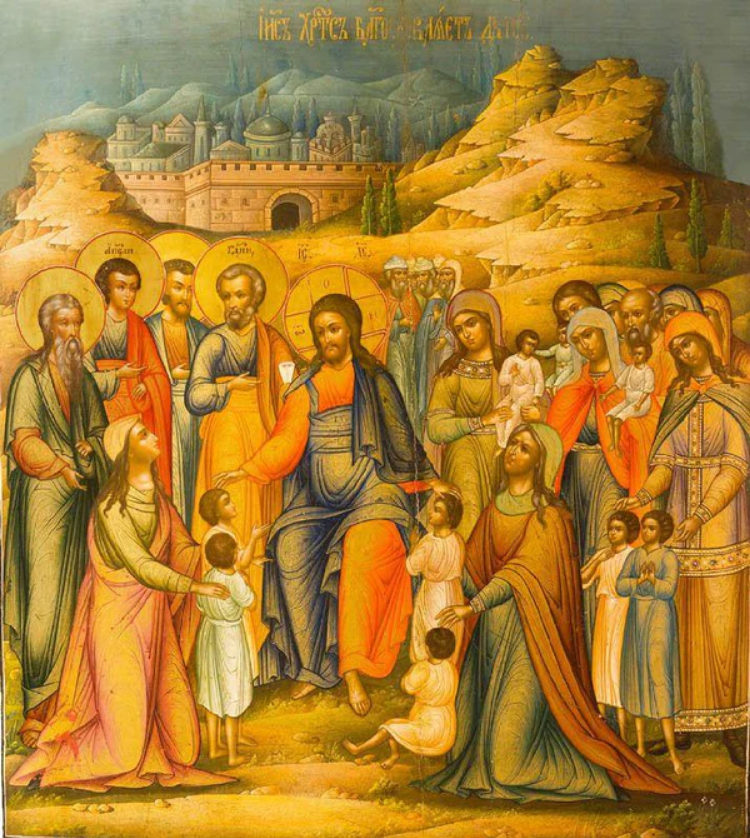
Christ confronts the pride of the disciples, Russian icon
Now I beseech you, brethren, by the name of our Lord Jesus Christ, that ye all speak the same thing, and that there be no divisions among you; but that ye be perfectly joined together in the same mind and in the same judgment. For it hath been declared unto me of you, my brethren, by them which are of the house of Chloe, that there are contentions among you.
Now this I say, that every one of you saith, I am of Paul; and I of Apollos; and I of Cephas; and I of Christ. Is Christ divided? was Paul crucified for you? or were ye baptized in the name of Paul?
For the Jews require a sign, and the Greeks seek after wisdom: But we preach Christ crucified, unto the Jews a stumblingblock, and unto the Greeks foolishness; But unto them which are called, both Jews and Greeks, Christ the power of God, and the wisdom of God. Because the foolishness of God is wiser than men; and the weakness of God is stronger than men.
- 1 Corinthians 1:10-15, 21-25
The divisions currently evident in American Orthodoxy are entirely American in character, and not one whit Orthodox. They are reflective of the culture war priorities in American politics and, as such, represent parochially American concerns. The Fordham and Butte sects in American Orthodoxy represent a ‘liberal’ and a ‘conservative’ pose within American culture, respectively, which neither liberates, nor conserves. They are, in fact, like most heresies which come in pairs, both heretical.
By the Fordham Sect, I mean the culture-war liberals which centre on the so-called ‘Orthodox Christian Studies Centre’ at Fordham University. This ‘Centre’ is squarely under the thumb of the Catholic Jesuits, share entirely the Jesuitical cultural-political priorities, and are entirely adept at performing an Orthodox step-‘n’-fetchit ‘minstrel show’ for the sake of the grant money their Ignatian ‘Massa’ provides. George Demacopoulos and Aristotle Papanikolaou, the elders of this ‘house-Ortho’ greekface minstrel-show act (along with First Things contributor, Michael Novak apostle and all-around pretentious popinjay David Bentley Hart, Notre Dame-based scion of effete Tidewater plantation-gentry, replete with a ready arsenal of affected transatlanticisms and sesquipedalian highfalutin puffery which he, his indefatigably-miserable elder brothers, and his sycophantic clique of pseudointellectual toadies routinely mistake for wit), have assembled around themselves a veritable rogues’ gallery—Nathaniel Wood, Nicholas Denysenko, Sarah Riccardi-Swartz, Paul Ladouceur, Cyril Hovorun, Paul Gavrilyuk, Sr Vassa Larin, Antoine Arjakovsky, Inga Leonova, the defrocked Giacomo Sanfilippo—of well-manicured academics and experts whose sole purpose in life seems to be to mock and denigrate the hoi polloi of Orthodox believers both here and abroad; to pay a crescendo of degrading obsequies to the American war machine; and to ‘push the envelope’ of acceptable practice, particularly with regard to sexual ethics, in directions which have never been acceptable at any other time in Church history.
And by the Butte Sect, I mean the opposing culture-war conservatives and reactionaries which have nucleated in several places around several increasingly-radical Montagnard cults of personality. Fr Josiah Trenham seems to be the (ahem) ‘Tren-setter’ in this regard along with Fr Johannes Jacobse, though he has of course been joined by the increasingly-unhinged political pugilist Abbot Tryphon, the disgraced former metropolitan of the OCA Archbishop Jonah Paffhausen, YouTube chuds and social-media gadflies like Jay Dyer and (at the fringes) ‘Brother’ Nathanael, and bloggers like George Michalopulos and the cartoonishly-camp Rod Dreher. They claim to be the true defenders of Orthodoxy in America, and yet they rally around open heretics and political lightning-rods like pill-popping kvetch and Pelagian pedlar of penny-ante Jungianism Dr Jordan Peterson in their misguided pursuit of purity-through-far-right-political-action. I call them the Butte Sect because several of these figures are planning to meet later this month in Butte, Montana at something of a ‘constituent assembly’, if you will: the so-called ‘Patristic Faith Conference’.
It may seem strange to you, readers, that I take such pains to describe the ‘liberal’ side of this cultural divide using descriptors which would seem to belong to the ‘right wing’, and that I take such pains to describe the ‘conservative’ side of this cultural divide using those which belong to the ‘left wing’. But there is a reason for this.
~~~
The Fordhamites fancy themselves to be ‘open-minded’ and ‘tolerant’, but in reality their cultural attitudes give inadvertent voice to forms of white supremacy and Eurocentrism that should have been left behind with the death of Jim Crow. One example may suffice here as an archetype. Hovorun, writing for Fordham’s blog Public Orthodoxy, speaks of Africa like a latter-day apostle of Cecil Rhodes and Leopold II of Belgium would. Lamenting the departure of ‘the Western democracies’ (by which, one presumes, he can only mean Britain, France, Germany, Italy and Belgium) from their putatively-benevolent colonial overlordship of the African continent, he points the finger at Russia and China—the ‘Eastern authoritarian regimes’—for a ‘recolonisation’, a ‘second Scramble of [sic] Africa’ which depends on infrastructure and investment on the Chinese side, and patronage of ‘murderous regimes’ on the Russian.
Never mind that the typical characterisation of Russia as an ‘Eastern’ dictatorship falls right in line with a long litany of tired Orientalist tropes (many perpetrated by the Jesuits), or that the characterisation of China in equally insidious terms is meant to recall the Yellow Peril. Never mind that the attempt to ascribe demonic motives to China falls particularly flat given Debt Justice UK’s explanation that China is emphatically not to blame for the current debt crisis on the African continent—private Western concerns hold three times more African debt than China does. The true point here is that one searches in vain to find anywhere in Hovorun’s essay, any attempt either to ascertain or place value upon the inherent well-being and dignity of the peoples of Africa. For him, Africans are relegated to the status of pawns, and his preference is merely for a (presumably benevolent) Western colonialism over an (evil and insidious) Eastern one.
This is not a one-off phenomenon for Fordham, nor is it indicative only of the usual bigotry with which Ukrainian nationalists routinely discriminate against and attack Africansand Asians. I have mentioned before how there is more than a germ of genteel liberal cultural discrimination against Middle Easterners by the contributors to Public Orthodoxy, such as Katie Kelaidis. And, of course, more recent essays by different PO contributors have doubled down on Orientalist and Yellow Peril scaremongering, in service of the foreign policy goals of the American military-industrial complex.
Which brings me to Fordham University’s current toast of the New York Times booklist, Sarah Riccardi-Swartz. It is a truism in the Orthodox deposit of spiritual wisdom that accusation is a kind of confession: as Saint Jerome said in his epistles, ‘When you believe you are excusing yourself, you are accusing yourself.’ So when Riccardi-Swartz goes around ROCOR parishes in West Virginia and sees there only white supremacism and fascism and Lost Cause mythology, one ought to suspect that she is merely confessing, in bad conscience, to the faults of which she and her own academic peer group are already guilty. One can hardly blame ROCOR for the widespread nature of the veneration of Tsar Nicholas II, for example—whose blessed feast is upcoming. On balance, given that he is perhaps (from a more objective standpoint) one of the more humane and forward-thinking figures in modern Russian history (or of his era in general!), attributing nothing but the darkest motives to such veneration appears to be a classic case of Freudian projection. The academics at Fordham and their associates are quick to signal their alliance with sexual minorities to burnish their liberal bona fides, and then promote and join witch-hunts against what they view as openly racist elements in the Orthodox Church—so that no one will think to scrutinise their own discriminatory tendencies, their own Eurocentric lenses of interpretation, their own enthusiasm for America’s wars of choice on the other side of the globe.
~~~
Now let’s talk about the other side of the coin: the Butte side. Even if ‘the lady doth protest too much, methinks’, Riccardi-Swartz isn’t wholly wrong in her diagnosis of a certain subset of ‘vocal’, ‘digitally-savvy’ Orthodox converts who flock to far-right political causes. The effect of these digital communities, which tend to propagate themselves around self-promoters like Jay Dyer and Rod Dreher, can be felt even within fairly ‘normal’ Orthodox parishes. Ironically, given how much they like to inveigh against ‘the Left’ (which is to blame for every manner of social ill from mass shooting to pornography to transsexualism), in truth their programmatic tactics resemble nothing so much as those of a revolutionary vanguard party in a Montagnard or Trotskyist vein.
There is an irreducible germ of Gnosticism or Kabbalah in the œuvre to which Dyer, Dreher and (sadly, increasingly so) Abbot Tryphon belong. The entire conceit of this œuvre is that an occult They (Hollywood, the ‘Cultural Left’, the Jews) are seeking to control society and control the spirits of the people through esoteric-occult means, and only by knowing the code can one hope to defeat them. This promise of a key to hidden knowledge, of initiation into mysteries, acts as the lure by which people gain entrance to the ‘inner circle’. This is analogous in many ways—and follows from—the phenomenon of being ‘redpilled’ or ‘blackpilled’ on online message boards. And of course, once one is gifted with this initiation, this occult hermeneutical ‘key’ to the inner workings of the hidden Them, one is essentially primed to be handed the Programme. And it is similar in many ways to the initiation practices of many secret societies and revolutionary cadres throughout history; the irony is that many of those thus initiated do not see it—they believe instead that they are counter-revolutionaries.
It is not, therefore, an accident that classic fascism and other far-right ideologies have a draw on such people. Fascism has historically held great appeal for those who believe themselves privileged with a degree of superior knowledge into a mythopoeic-symbolic order, to combat the degeneracy of their surroundings. It is well-known—and one can cite authors like Goodrich-Clarke on this—that fascist movements drew heavily on and even grew out of an idle middle-class fascination with esotericist movements such as Theosophy and the Thule Society.
Likewise, this preference for ‘keys’ that break into a mythopoeic-symbolic order creates synergies with the half-baked pseudo-Jungian pop-psych claptrap bandied about by Joseph Campbell, Jordan Peterson and the like. Of course, there is nothing particularly Christian about any of this, as evidenced by Peterson’s completely Pelagian understanding of Christianity – or, as my friend Dan DeCarlo aptly described him, ‘[an] anti-Tolstoy who has rewritten “The Death of Ivan Ilyich” but changed the ending’. That doesn’t prevent it, however, from being alluring. As St Paul warned us, false teachers will never go wanting for itching ears. And some of those itching ears, sadly, claim for themselves the mantle of Orthodoxy.
~~~
I must beg the pardon of friend and kinsman Luke L—, who coined the slogan ‘Neither Fordham nor Montanica’ for precisely this purpose. I must also beg your pardon, readers, if my wording here seems a bit eristic, in the tradition of the aforementioned Saint Jerome and the more recent Saint Alexis of Wilkes-Barre. I have always held to this point. Also, I have long since run out of patience with both sides, and in this case, proper Christian love for adherents of these twin, very public, errors requires a certain public sharpness. Indeed, as far as I can tell, this split in Orthodoxy between Fordham and Montanica seems to be a repetition-as-farce of the errors of the Hellenisers and the Judaisers, respectively. The pride of Fordham’s scholarly sect is in its philosophical erudition, its professed adherence to the norms of modern academia, and its greed for the simulacrum of virtue which passes for currency in elite circles. And the pride of the Butte sect is in its purity and holiness as those possessing the true revelation, fancying themselves its sole inheritors and upholders, through initiation into its secrets. Yet the fullness of truth rests with neither of them.
Culture wars are not spiritual wars, despite what the combatants themselves might think. Culture wars by definition divide humanity into warring camps. These camps then fight over things which are decidedly not spiritual: wealth, power, prestige, glory, conquest, the adulation of men, the warm fuzzy feelings of being on the ‘right side of history’, the thrill and passion of being a ‘chosen one’ in a cataclysmic battle between light and darkness. Academics are jealous of their ‘seats of honour’. YouTubers and social media personalities are driven by the cash generated by ‘likes’. There is no room for the great mass of humanity in either of these formations (the great majority of whom are geopolitically non-aligned). And it goes without saying that there is no room for Jesus Christ in either of these formations. Orthodox Christianity as a whole must therefore stand up and cast aside such divisions within itself, because they are not of Christ.
Two articles that came out earlier today in American Compass that are deliberately paired off with each other, one on either side of the political divide, attempt to explore the ‘deadly sins’ of the left and the right. The first article, written by Ruy Teixeira, purports to explore the five deadly sins of the American left: idpol, retro-socialism, catastrophism, growth-phobia and techno-pessimism. And the second article, written by Henry Olson, explores the three deadly sins of the American right: market fundamentalism, snobbery and hubris. Both of these articles are well-intentioned attempts at introspection and self-examination of certain political mythologies and forms of inertia that have accumulated largely through the ‘bubble’ effect; and I appreciate them both for attempting to concentrate and explore the blindnesses, weaknesses and self-indulgences inherent in the political lifeworlds that most Americans now inhabit.
However, I would – to extend the metaphor slightly – like to play devil’s advocate to each. When it comes to discussions of ‘sin’ what we are really discussing is a moral anthropology and the relationship of man to the divine, and as such these questions are fundamentally religious in character. I would therefore like to think I am approaching these from a point of view that is faithfully Orthodox Christian in accordance with what is to date still the most trenchant and insightful document articulating the political and social values of the Church, though ultimately I must leave that to my confessor and to the hierarchs of my Church to judge.
Regarding the first article, by Teixeira. I agree with some of its central tenets. Firstly, I agree with Mr Teixeira that the American left suffers intensely from its fixation on identity politics, which despite the rhetoric of ‘intersectionality’ actually only serve to fracture the body politic into various grievance groups, and cast all social problems through a lens of oppression. I also agree that the left has allowed itself to be coopted by an elite politics which hides, underneath a ‘green’ veneer, a thoroughly nasty and anti-human Malthusian streak (of which I’ve been consistently critical these past eight years), and which tends to see poor people as a dead-weight problem rather than equal agents and partners in the political process. Insofar as he shares these points with the ‘realist left’, I tend to agree with him.
However, I would push back on a couple of the assumptions Mr Teixeira makes here. There is one really big one that he gets wrong, and that is the assumption that more is always better.
I am not convinced, frankly, that people actually always do want more. Based on the data, I’m fairly sure that’s not actually the case. The data consistently show, in fact (the linked CNBC story being only one example in a genre of œconomic studies that has been going on since the early 2010s), that up to a certain point, more material abundance does correlate with human happiness and satisfaction. Actually, that point is right around the average purchasing power parity in most modern Western developed nations, $75,000. However, past that point, having more material wealth doesn't actually make us happier even though we don’t stop trying to accumulate it. It’s the law of diminishing returns. With apologies to Daft Punk, there comes a point where harder better faster stronger just doesn’t get people off, and mo’ stuff actually begins to correlate with mo’ worries.
The irony is not lost on me that Teixeira is using the language of ‘sin’ here, because he is ignoring a critical dimension of the left’s failure to engage. The techno-enthusiasts and the growth-philes ignore these studies and these bodies of data at their own peril, because they are prescribing the wrong medicine – that of more material prosperity – for what is ultimately a hunger of the spirit. Saint John of Patmos put it correctly in his first Epistle: the problem with the ‘lust of the flesh, the lust of the eyes and the pride of life’ is that it the stuff of the world that these desires want to find satiety in, is all ‘passing away, along with its desires’. Even though we cannot do without the material – Christ never condemned the material; He came in a material Body and by that Body gave us a material means of salvation – we look for more happiness in more material in vain. And we literally name as deadly passions – as sins – the sorts of behaviour Teixeira wants to encourage: lust, gluttony, avarice. Here is what the Russian Orthodox Church says about this:
The Church is not someone who defines the rights to property. However, the material side of human life is not outside her field of vision. While calling to seek first «the kingdom of God and his righteousness», the Church does not forget about people’s the need for «daily bread» and believes that every one should have resources sufficient for life in dignity. At the same time, the Church warns against the extreme attraction to wealth, denouncing those who are carried away by «cares and riches and pleasures of this life». The Church in her attitude to property does not ignore the material needs, nor does she praise the opposite extreme, the aspiration for wealth as the ultimate goal and value of life.
And still more emphatically:
Wealth cannot make man happy. The Lord Jesus Christ warns: «Take heed, and beware of covetousness: for a man’s life consisteth not in the abundance of the things which he possesseth». The pursuit of wealth makes a baneful impact on the spiritual condition of a person and can lead him to complete degradation. St. Paul points out that «they that will be rich fall into temptation and a snare, and into many foolish and hurtful lusts, which drown men in destruction and perdition. For the love of money is the root of all evil: which while some coveted after, they have erred from the faith, and pierced themselves through with many sorrows. But thou, O man of God, flee these things».
And again, with regard to the human impact on œcology, here is what the Russian Church has to say. Note the relationship between material desire, technological progress, and spiritual loss:
Relationships between anthropology and ecology are revealed with utter clarity in our days when the world is experiencing two concurrent crises: spiritual and ecological. In contemporary society, man often loses the awareness of life as a gift of God and sometimes the very meaning of life, reducing it sometimes to the physical being alone. With this attitude to life, nature around him is no longer perceived as home and all the more so as temple, becoming only a «habitat». The spiritually degrading personality leads nature to degradation as well, for it is unable to make a transforming impact on the world. The colossal technological resources cannot help humanity blinded by sin, for, being indifferent to the meaning, mystery and wonder of life, they cannot be really beneficial and sometimes become even detrimental. In a spiritually disorientated man, the technological power would beget utopic reliance on the boundless resources of the human mind and the power of progress.
One of the first unambiguously-left politicians to have foreseen the problem of too much prosperity, and how this prosperity should be dealt with and distributed, was General Secretary Hu Jintao, when he made a suspiciously Confucian (specifically, the Odes) call for a xiaokang shehui 小康社会, or a ‘moderately prosperous society’. It’s been a practical goal of the Chinese left since 2002 to aim for a society where a certain basic standard of living is met but not exceeded; and Xi Jinping has included this aim specifically in his ‘Four Comprehensives’ policy. Note that Chinese policy has not been anti-growth per se, and certainly not anti-technology per se. But according to their own internal documents they are still only willing to pursue growth up to a certain point and are committed to a goal of ultimately tapering off.
So here is where I would say that Teixeira needs to reevaluate. He accuses the left of something like ingratitude when he comes to the topic of technology. I think that’s fair. The left does need to evince a certain degree of gratitude for the frontiers in medicine, sanitation, infrastructure, communications and so on that have been pushed by technological innovation. But the attitude of ‘I want more’ runs thoroughly counter to this position of gratitude. Indeed, what happens when the ‘more’ that people want is inevitably unable to be satisfied by greater material wealth? If ‘more is better’, and ‘more’ even beyond the point of satiety – or even to the point of satiety – is all that the left really wants, then Dostoevsky and Solzhenitsyn were completely right to reject it. And American voters will be right to reject it.
~~~
Coming to the second article, on the sins of American right, by Henry Olson… this article strikes me as a trifle strange on account of its fixation on the figure of Reagan. More on that later, though. The fact that Olson is straight-up willing to criticise these streaks in the Republican Party – not just the market fundamentalism but also white Protestant snobbery and the tendency to idolise the businessman and the pious patriarch – is truly laudable. What’s more, I don’t really dispute Olson’s diagnoses, though it must be admitted that I approach this topic more from a grounding in the American left than in the American right, and thus have a predisposition to affirm these critiques. Even so, there is a certain Whiggish anthropological falsity even under these needed and praiseworthy correctives, that needs to be addressed – and so I feel I have to play Devil’s advocate here as well.
Market fundamentalism is indeed a sin, and it is indeed a sin of the Republican Party in general going back to the 1980s. (It’s an intriguing bit of sleight-of-hand Olson uses to elide the fact that Reagan himself did much to foment and popularise within the Republican Party at least the first of these three cardinal partizan sins he discusses, despite a couple of protectionist flourishes Reagan made in his second term.) The Russian people know about market fundamentalism, having had a direct experience with the ‘shock doctrine’ between 1992 and 1998. So it should come as no surprise that the Orthodox Church likewise censures, first, the absolute commitment to private property among people:
According to the teaching of the Church, people receive all the earthly blessings from God who is the One who holds the absolute right to possess them. The Saviour repeatedly points to the relative nature of the right to property in His parables on a vineyard let out to be used, on talents distributed among many and on an estate handed over for temporary management. Expressing the idea inherent to the Church that God is the absolute owner of everything, St. Basil the Great asks: «Tell me, what do you have that is yours? Where from did you take it and bring to life?» The sinful attitude to property manifested in the conscious rejection of this spiritual principle generates division and alienation among people.
And second, that the Russian Orthodox Church condemns the idea that ‘market relations’ should be the sole or even primary consideration in the distribution of goods like healthcare:
Without giving preference to any organisational model of medical aid, the Church believes that this aid should be maximum effective and accessible to all members of society, regardless of their financial means and social status, also in the situation of limited medical resources. To make the distribution of these resources truly equitable, the criterion of «vital needs» should prevail over that of «market relations».
I likewise agree with Olson that snobbery and hubris – these two appear to be synonymous with the passions of vainglory and pride – are common failings on the political right, though they are far from exclusive to the right. Olson seems to be angling after a particular anthropology or genealogy of the American right, with his observations of these sins: a genealogy which is rooted in its class origins and in its religious origins. I’m a trifle uncomfortable with this genealogical account of conservative sins for, I guess we can call them ‘Quakerdox’ reasons (and, yes, I’m aware of the irony), but fine, we may take it as read.
Olson accuses the Republicans of entertaining, too often, a kind of white and Protestant intégrisme, which elevates the (private, devotional, pietistic) religious concerns of the holders of power over considerations of policy – that theological failings are tantamount to political failings. I kind of get this complaint, and I share it. But he’s treading out on some very thin anthropological ice. The common roots of sæcular law and religious law are more deeply entangled than he wants to permit, and the common roots of morality and religious devotion as well:
Historically, both religious and secular laws originate from the same source. Moreover, for a long time they only represented two sides of one legal field. This idea of law is also characteristic of the Old Testament.
The Lord Jesus Christ, in calling those faithful to Him to the Kingdom that is not of this world, separated the Church as His body from the world lying in evil. In Christianity, the internal law of the Church is free from the spiritually-fallen state of the world and is even opposed to it. This opposition, however, is not the violation but the fulfilment of the law of the divine Truth in its fullness, which humanity repudiated in the fall. Comparing the Old Testament norms with that of the Gospel, the Lord in His Sermon on the Mount calls people to seek the full identity of life with the absolute divine law, that is to deification: «Be ye therefore perfect, even as your Father which is in heaven is perfect».
At the same time, though, the law is written upon all human hearts; the law is made for all and all are bound to it, regardless of what religious beliefs they hold. There is a certain basic level of human dignity which cannot be reduced to mere religious belonging. Again, the Russian Orthodox Church on the subject:
Among the oldest monuments of the written language are numerous collections of homilies and statutes. Undoubtedly, they go back to the even earlier, pre-alphabet, existence of humanity, since «the work of the law» is written by God in human hearts. Law has been there in the human society from times immemorial. The first rules were given to man as far back as the paradise time. After the fall, which is violation by man of the divine law, law becomes a boundary and trespassing against it threatens the destruction of both the human personality and human community.
The law contains a certain minimum of moral standards compulsory for all members of society. The secular law has as its task not to turn the world lying in evil into the Kingdom of God, but to prevent it from turning into hell. The fundamental principle of law is: «do not do to others what you would not want to be done to yourself».
So I would go along with Olson happily, as long as what he is critiquing is a certain vainglorious image of homo conservativus, a certain false idol of the self which American conservatives are sometimes wont to lug around with them: an idol of the self in which sentimentality and private devotion (or worse yet, self-interest masquerading as piety!) substitute themselves for actual works of mercy. Merely going through the performative motions of religiosity is no substitute whatsoever for actual works of kindness and justice, true mortification of the will, true acts of courage. He and I can agree all day long on that count. As Khomyakov put it:
He who loved truth and righteousness and defended the weak against the strong, who fought against corruption, tortures and slavery, is a Christian, if only to some extent; he who did his best to improve the life of the workers and to brighten the wretched lot of the classes oppressed by poverty whom we cannot as yet make quite happy, is a Christian, if only in part.
But Olson only partially frees himself from the objections to such idolatry, because of the abject and even idolatrous hero-worship of Ronald Reagan which suffuses his article. Olson engages in the sæcular canonisation of a figure who (again, despite some protectionist flourishes he made as California governor and in his second term as president) possibly did more than any other to retrench the ideas of market fundamentalism on the American right, in a way that had not held sway since Calvin Coolidge. In an article which is meant to explore the sins of the American right, such an emphasis – at best – lacks good taste. At worst, it seems to be an admission of cluelessness with regard to how the American right arrived in its current plight.
Again, I don’t want to come down too hard on either of these authors. In many ways, they are doing better than I am: they are engaged in the hard and necessary work of metanoia on behalf of their respective political communities; and allowances are certainly to be made for excesses of overcorrection, or for lacunæ in the rearward view so dearly held. And I’m sure that there are such lacunæ and such overcorrections in my own idiosyncratic syncretic political views, which are themselves grown out of the crooked timber of sexual fantasies and utopian dreaming, which I have yet to address. I applaud the bravery of these two authors for the conversation they have begun.
EDIT: I cannot believe I posted something about the deadly sins without also referencing Maiden’s Seventh Son album. Bad hesher! Bad! Ahem. At any rate, here to make up for it is ‘Can I Play with Madness’:
Because we honour Saints Sergios and Bacchos in the Orthodox Church today, I cannot help but make two related addendums here. What has happened since to the holy resting place of Saint Sergios in Syria, is sadly an all too familiar tale in that country. The bottom-up œcumenism that held in the Middle Ages between the Muslims and the Christians was not so much fractured as it was actively attacked by Muslim fundamentalists and sectarians, following the dæmonic political ideology of Quṭb ’Ibrâhim. The Basilica was badly damaged when the Sunnî extremist, takfiri-jihâdi fighters of Dâ‘iš entered ar-Ruṣâfa; and they also destroyed a priceless ancient icon of Saint Sergios. The town of ar-Ruṣâfa was liberated on the nineteenth of June, 2017, by the Syrian Arab Army with support from the armed forces of Russia. This was cause for much celebration by the Arab Christians of Raqqa Governorate, although the damage to the holy site was done, much of which can never be repaired.
Likewise, when Ma‘lûlâ was attacked by Sunnî Salafist rebels of Jabhat an-Nuṣra, according to Reuters they entered Mâr Sarkîs monastery there, did great damage to the building, and smashed the icons and crosses. The building itself was damaged by shelling in the effort to retake the city. But now, thanks to the fact that the Syrian Arab Army controls Ma‘lûlâ, the indigenous Arab and Aramaic Christians who live there now at least have the chance to rebuild. The Christians of Syria are indeed grateful to Baššâr al-’Asad, who has proven himself to be a progressive and non-sectarian president in the country. At least now they have some modicum of protection and stability from which they are able to rebuild their fragmented communities.
But unfortunately, while the local cultus of Saints Sergios and Bacchos, and their icons were being attacked by reactionary right-wing Sunnî extremist forces, the plight of the Arab Christians with their patient supplications to these saints being invisible to Western eyes, the international cultus of Saints Sergios and Bacchos has come under a different, but – as we shall see – related attack.
The close companionship of these two saints, mentioned above in the hagiography, has been taken and reinterpreted by certain elements in the LGBTQ+ community. The source of this reinterpretation is a thesis by a professor at Yale University, John Boswell, a convert to Roman Catholicism from the Episcopal Church. Boswell’s thesis held that, according to the evidence from late hagiographies, the two saints were not only close companions but also gay lovers. Unfortunately, this thesis was built more upon wishful thinking than upon facts, and its central thesis – that early Christianity was more tolerant of homosexuality than mediæval Catholicism – has been consistently debunked by both sæcular historians and theologians of the Roman Catholic Church.
Now, in criticising Boswell’s scholarship I understand that I am leaving myself open to accusations of homophobia and anti-gay sentiment – the more so since I happen to belong to the Orthodox Church and happen to adhere to traditional Orthodox teachings on sexuality. However, it is not this blog’s policy to indulge in homophobic attacks on people, and I will not brook any scrutiny of Boswell’s sex life. At any rate, it is not needed and not relevant. We must instead examine Boswell’s connexions to the same American intelligence agency that funds jihâdist terror against Middle East Christians, through his ideological preferences and connexion to one CIA-funded academic in particular.
Indeed, his thesis draws more upon idealist, social constructivist ideas about sexuality and upon postmodernist theory than upon actual history or actual examination of social relations in the præ-modern Middle East, where close male friendships did exist, and where clearly homosexual relations also did exist – but the two of them were not contiguous. Even today in the Middle East there is a great deal more tolerance of expressions of affection between men, which is not extended to homosexuality! Boswell was, in point of fact, a close friend of the French philosopheMichel Foucault, one of the founding fathers of poststructuralist analysis, on whose work Boswell relied heavily for his analysis of these so-called ‘gay saints’, and who warmly welcomed the study when it was published. The Foucauldian dimensions of Christianity, Social Tolerance and Homosexuality are quite clearly apparent in his attempt to bring to bear a hermeneutic of suspicion upon primary documents and the writings of, for example, Saint John Chrysostom, and his attempt to portray an ‘alternative history’ in which faithful gay Christians were always ever acting against the institutional and social power of a hostile Church – and occasionally succeeding. In so doing, as explained above, Boswell erased the Middle Eastern-ness of these saints and their cultus, and successfully excluded from the conversation the voices of the people who have venerated them for over sixteen hundred years.
The problem is that Foucault was more of an apologist and defender of political power than he was a critic. It was not for nothing that the Central Intelligence Agency sought him out and began assiduously propagating his ideas in order to attack and fragment the French Left, and by extension the Left throughout the world. Speaking of the French Left, if I were feeling truly Sorelian today, I might also point to the well-cushioned academic positions which both Foucault and Boswell held as evidence that ‘where you stand is where you sit’. But the CIA had found an incredibly useful tool in Foucault’s thought: they could turn hermeneutics of suspicion upon the traditional tools of the left for self-organisation: upon vanguard political parties and upon labour unions in particular. We can thank Foucault for the fact that so much of the modern Western ‘green’ and ‘anarchist’ and ‘social liberal’ political blocs, and sadly not a few left ones as well, are all too ready to attack and discredit any successful movements for œconomic justice in the Third World, which thereby are forced to deal with all the messy problems of attempting to use the political power they have gained.
Thus it should not be a surprise that the same elements of Western liberalism that, encouraged by a Yale professor’s book, bring icons of ‘gay saints’ to pride parades, are also willing to attack the left in countries like Syria for their support of imperfectly-progressive leaders like Baššâr al-’Asad (and before him, his father; and before him, Nâṣir; and before them, Sukarno and Zhou Enlai). They are also willing to make common cause with ‘moderate rebels’ and ‘democrats’ who smash icons and raze churches dedicated to the same saints! We can see this in pinkwashing and homonationalist liberal outlets that claim an affinity with Orthodox Christianity. Public Orthodoxy and the utterly odious Orthodoxy in Dialogue, both give platforms to virulently pro-interventionist and pro-war views against Syria and most of its people, while they also try to claim these Syrian saints as literal‘gay icons’.
I’m sure that Public Orthodoxy and Orthodoxy in Dialogue would be appalled and offended, and take massive umbrage at being lumped in with an obnoxious group like the Proud Boys. Still, ultimately, they stand for the same thing. They stand for an idea of ‘Western civilisation’ that stands apart from and above the messy, dirty and less-developed societies of the Third World… which also happen to be the societies in which Orthodoxy is capable of having an independent witness which inclines politically to the left. The only difference is the liberal veneer and pretense of concern for ‘human rights’ and ‘democratic norms’ that Public Orthodoxy and Orthodoxy in Dialogue cloak themselves in to make their chauvinism appear that much more respectable to unsuspecting leftists and liberals. And they wouldn’t be caught dead saying something as gauche as ‘poophole’ when talking about Africa or the MENA, but clearly quite a few of them think it all the same.
So although I find ACROD priest Fr Edward Pehanich’s concerns for stateside florists and photographers and caterers a bit… um… quaint as yet, it is actually quite hard to disagree with him that these are attacks on the Faith, as well as attacks on the Third World and Non-Aligned politics. It is hard to think of an adjective other than ‘dæmonic’ for these sorts of attacks, which hold up these saints as icons of first-world libertinism – while actually encouraging fundamentalists to butcher the people in their homeland who have asked their intercessions for centuries, and continue to do so now, for a certain modicum of peace.
As I continue to mull over and reflect on the intellectual legacy of that towering theorist of violence and myth Georges Sorel – and his eerie applicability to our current American cultural moment in which not only our political system and structure, but also the basis of our national mythology is unravelling – I note with chagrin that the American left, fragmented and dispersed and sectarian as it is, has not fully escaped the ‘pull’ of the two duelling mythological ‘frames’ of American historiosophy. Indeed, the left has actually led much of this duel. It’s rather unfortunate that the American left has essentially tied itself to two horses going opposite ways, and is poised to fragment over this issue. It doesn’t need to.
As I have said before, we are currently faced with an attempt by a certain subset of the ‘woke’ élite to rewrite American history in the form of the 1619 Project. There is fairly openly displayed in this ‘framing’ of American history, a religious idea that America was conceived in the iniquity of slavery, and that this iniquity has shaped our national development ever since. There is a germ of truth hidden in this framing – a germ of truth which indeed appeals to my Johnson-inspiredHigh Tory antiracism – but actually the lens of racial determinism through which this germ is examined is fundamentally wrongheaded. This is no accident. Even if the historians who write for the New York Times are not themselves members of this élite (that we know), it is still absolutely necessary to understand that the ‘woke’ élite in fact represent the interests of global capital and want to continue as long as possible for their own benefit the Atlanticist policies of imperialism and exploitation of third-world wealth. The left, if they allow certain strands of anti-Americanism to carry them off in the direction of a 1619 mythology, stand only to lose, as they will be divided from a working class which is in fact highly patriotic, rooted to place and feels itself (justly) to be under threat.
So here it may sound as though I’m taking the stance advocated by the Trotskyite Fourth International, as articulated by Niles Niemuth, Tom Mackaman and David North at the World Socialist Web Site. Again, though, as I have said before, their analysis is deliberately left incomplete, and has its own problems with presupposing certain forms of historical determinism:
I agree wholeheartedly with Niemuth, Mackaman and North insofar as they hold to the limited argument against the 1619 Project and its central conceit. It is indeed not ‘in the DNA’ of America or Americans to hate each other based on the colour of their skin – either literally or figuratively. The biological and sociological determinism of the worldview behind the 1619 Project is ahistorical and, indeed, morally noxious – for the very reasons they describe.
But the problems begin to crop up very quickly when the authors for the Fourth International stray from this narrow critique into a broader take on world history, and their sweeping and reductive takes on ‘the global history of slavery, which extends back into the ancient world’. For one thing, classical slavery and modern chattel slavery were and are very different institutions, underpinned by very different material conditions. It’s actually something of a travesty, that authors proclaiming themselves to be Marxist overlook this. Any Marxist worth his salt should have a ready materialist explanation for the differences between classical and early modern slavery.
So we can start to see the fracture point even here. We have a ‘woke left’ – a ‘left’ in fact more postmodernist than Marxist – that is both deeply antiracist and also convinced that the American project itself is irretrievably racist. On the other hand, we have a certain fragment of the Old Left, the Trotskyites, who are willing to wed the entire project of class liberation to the mythology of the founding of the American Republic. In this they are quite consciously following in the footsteps of, say, Daniel DeLeon and his panegyrics to the Founding Fathers. Georges Sorel must be chuckling from his box seat in the Great Beyond – he saw the same thing happening in the France of his day.
Now, Georges Sorel was about as ideologically impure, from a standard leftist perspective, as it’s possible to get, having flirted at various points in his career with anarcho-syndicalism and with a certain traditionalist-right intégrisme before embracing Leninism – without ever having given up on the working class and without ever having really altered what he fundamentally believed. Indeed, he is often seen as a representative of the French far right! As a result, significant swathes of the American left are likely to view Sorel – as they would do Lasch or Mailer – as a figure too heavily compromised to be of any use to them. That’s a damn shame. Sorel had placed his finger squarely on the crux of our current predicament when he diagnosed the division within the French left of his day as being one of mythology. It’s true – he had little but contempt for parliamentary socialists whose mouths were ever full of the glories of 1789, viewing them (particularly Jean Jaurès) as opportunistic parasites who would happily sell out working-class interests in pursuit of political and bureaucratic sinecures. But this is somewhat beside the point. Better than any other intellectual figure in late nineteenth-century Europe, Sorel understood the power of mythology in motivating and directing action – and he sought to apply it to the idea of the general strike.
In Sorel’s view, it was superfluous for a man of the French left to seek to appropriate the imagery, the statuary, the religious and mythical symbolism of the French Revolution. The French Revolution itself had defined its mythology on its own: why should the working class be subject to it? For Sorel, such exhausted borrowed glory would be far and away inferior in motivating action – in driving great deeds of altruism, in spurring virtue and excellence and spirited ferocity in battle, in directing and giving meaning to targeted acts of political violence – to a mythology that was authentic and autochthonous to the labourers’ own experiences and history. Sorel sought to build a Mythos of the General Strike, in order to supplant the chimæra that the parliamentary socialists in France had created from borrowed bits and pieces of the glories of the French Revolution. He very much looked forward to a day when the Revolution was rendered politically irrelevant by the General Strike: ‘What remains of the present Socialist movement will be the epic of the strikes.’ Sorel appreciated the power of patriotism: but for him the working classes themselves were sufficiently patriotic in its own self-understanding; they didn’t need validation from the soi-disant caretakers of a past in which the workers and farmers had a limited and indeed often passive (if not antagonistic) rôle.
A similar situation attains in America. The mythology of Jeffersonian liberalism and the Constitutional compromise is a spent force. Its legitimacy has been squandered in the attempts to bring about old Tom’s ‘Empire of Democracy’. The apologists of the American mythos on the centre-right – your Brookses and Frenches and Sullivans – all sound curiously exhausted and beleaguered as they find themselves under sustained assault both from the political left and right, and from the dawning reality of a multipolar world which stubbornly refuses to acquiesce to the ‘requests’ of American military and diplomatic power. The attempts from certain portions of the left to siphon off the last ergs from this ideological dynamo are almost cartoonishly pitiable, and deserve much the same derision that Sorel reserved for the parliamentarian French centre-left.
Still, the left has an opportunity here which it is squandering with its rearguard actions over myth (both the 1619 version and the 1776 version). It’s a non-starter to hector the American working class for being insufficiently internationalist according to the vagaries of an ever-shifting abstract standard – or worse still, for being ‘racist’ and ‘deplorable’ and generally un-‘woke’. But it’s also highly ill-advised to take the Trot line and pander and condescend using the trappings of the American Revolution to a working class that’s, for one thing, sick to death of political posturing. For another thing, we who have always belonged to the working classes will always struggle to see ourselves reflected as a unified power in between the lines of a mythology which by its very nature glorifies almost exclusively Virginia planters and big Boston merchants – rather than dockworkers, millworkers, refugees, religious dissenters, smiths, carpenters, sharecroppers or slaves.
The patriotism of the American working classes is heartfelt and genuine. But the nature of this patriotism is, to a significant degree, pre-ideological. (It’s not quite right to say it’s non-ideological.) The American working classes love their physical places and do not want to abandon them. They love the culture that they grew up in. Ironically, the American working classes see their rootedness as a source of freedom, as a source of dignity and pride. If the left ever wants to have a shot at taking power, it needs to understand this. As it stands, the nouvelle nouvelle-droite understands this very well indeed, even if they are using this understanding for manifestly evil ends. Georges Sorel – in general, not the greatest fan of America himself – would nonetheless advise us, that this is the material from which the new mythos must be built, by which the working class can be spurred to new forms of virtue and excellence and martial heroism.
The left shouldn’t have to pretend to love powdered-wig planters and Boston Brahmin merchant princes to be considered patriotic. Nor should they jettison patriotism altogether because they can’t stand the bourgeois platitudes associated with it. Because here’s the secret: the working class has always been patriotic. Labour history is patriotic. The ones who – willingly or unwillingly, wittingly or unwittingly – sacrificed the most of themselves to build up this country were always the people on the bottom. A leftist mythos of America needs to start, not from a reference point associated with the upper classes, but instead from a reference point which sees the working classes fighting alongside and for each other, to better each other.
Gabriel Prosser Organiser of an 1800 revolt in Virginia by both free whites and enslaved blacks for mutual benefit
Today is, oddly enough, not only the feast-day of three great Syrian Orthodox ascetics in the Holy Orthodox Church, but also the Roman Catholic feast-day of the Throne of Saint Peter… at Antioch. Hmmm. This deserves to be, if it isn’t one already, an Orthodox feast day as well. Antioch is, after all, indeed one of the five ancient Patriarchal sees, the first at which the disciples were called Christians (Acts 11:26), and one of two founded by the Holy Apostle Peter. Old Rome isn’t quite as unique in that respect as she sometimes pretends to be in her apologetics materials.
I have a particular love for the Church of Antioch, for the simple reason that attending Divine Liturgy at Saint Mary Antiochian Orthodox Church in Pawtucket, Rhode Island in 2009 was one of several fragmentary formative experiences that led me into the Orthodox Church. Witnessing, and receiving, the blessing of Fr Isaac (Crow) and the warm, ebullient hospitality of the multinational layfolk there – Syrian, Lebanese, Armenian, Palestinian, Ethiopian, American convert – was the single factor that turned my cerebral embrace of Nikolai Berdyaev’s religious philosophy into something real, something lived. As a somewhat peregrinating soul, it is true that I may be in an OCA parish now, and it is true that I was received into the Moscow Patriarchate by chrismation. But whenever I go ‘home’ to Rhode Island, my ‘home church’ is Saint Mary’s.
Antioch was an important hub of Christianity in the late Classical world, in part because it was the place where many Christians who came to believe in Christ at Jerusalem fled after the stoning of Saint Stephen the Protomartyr. Because Antioch was also a critical strategic post for the Roman Empire’s military in its perennial wars against Persia, this city also became a site of repeated persecutions of Christians.
The Episcopal See of Antioch was founded by Holy Apostle Peter in 34 AD, and is a solid claimant for being the oldest continuing existing Christian Church in the world. Indeed, the Cave Church of Saint Peter still exists in Antakya. Origen and Eusebios both agree with Saint Luke that Saint Peter was the founder of the Church in Antioch. Peter was promptly cast into prison by the Roman governor shortly after his arrival there, on a charge of corrupting the people. Peter was joined by Holy Apostle Paul, as well as Apostle Barnabas of the Seventy, and they began to preach to the people in Antioch, who were a mixture of Greeks, Hellenised Syrians and Jews.
The first ecclesiological dispute emerged at Antioch over whether or not Gentiles should accept the entirety of Jewish law – particularly circumcision – before being baptised; and also whether Gentiles and Jews should eat separately. Apparently Saint Peter was originally of the opinion that the entirety of the Jewish law ought to be upheld, including circumcision and laws on food cleanliness and table fellowship. Saint Paul, on the other hand, held that the Gentiles who were baptised ought to be held to certain core aspects of the Law, but that the Resurrection of Christ had made a strict adherence to the Jewish Law superfluous. Saint Paul apparently confronted Saint Peter at Antioch and the two of them discussed the matter. Guided by Peter, Paul and James the brother of Jesus – each of whom fell on one side of that debate at first – the Church forged a middle path between the extremes of Judaïsation and Hellenisation. But it was this middle path blazed at Antioch, described in Acts 15, which preserved the true radicalism of the message of Christ: it was neither to Jew nor Greek exclusively proclaimed; and it was a message as much for the poor as for the wealthy; and as much for women as for men.
According to Church traditions both East and West, Saint Peter ruled as bishop in Antioch for seven years before he sojourned to Rome and established the Church there in 43 AD. He had left his family in Antioch, and to this day there are still Syrian families with the surname Sem‘ân which claim blood descent from Saint Peter. When the Jews were expelled from Rome under Emperor Claudius in 49 AD, Saint Peter and the small Christian community in Rome shared in their fate. He returned to Antioch in 49 and ruled there temporarily until after Claudius’s death in 54, when he left Antioch in the care of Apostle Euōdias of the Seventy, the second Patriarch of Antioch.
We can see from Peter’s tenure in Antioch several distinct aspects of Antiochian Christianity that will crop up later in the city’s history. I personally have witnessed the multinational character of the Antiochian Church, which is not only Syrian and Lebanese Arabs but also half a dozen other nationalities. So indeed was the city of Antioch when Peter first came there home to many nations. We also see the determination of the Antiochian Church to persevere even under severe persecution. The Christians of the Syrian Arab Republic have indeed persevered under a persecution aided and abetted by the governments of Turkey, Saudi Arabia, Qatar and (sadly) the United States. We can see also from Saint Peter’s and Saint Paul’s time, the understanding of Christ as human and a particular instance of humanity, which would come to colour the Antiochian school of exegesis in the fourth to sixth centuries. The question of how Christ Himself would have ministered to the Gentiles as opposed to the Jews was at the forefront of the dispute between Saint Peter and Saint Paul; and the entirety of the Church is the richer for their wrangling about and ultimately coming to an understanding on that question. We can therefore behold in the early Christianity of Antioch a very distinctly localist sensibility, which is at the same time supranational and even cosmopolitan for its insistence on that same locality.
So let us Orthodox Christians, too, spare a request to Saint Peter for his intercessory prayers for us on this day, when the Latins are remembering his stay among the people of Antioch. Holy Apostle Peter, who preached in the place where the disciples were first called Christians, pray unto Christ our God that we may be saved!
I’ll preface this by saying that I have disagreements with Ambassador Freeman on several issues – monetary policy most notably. And unfortunately, monetary policy takes up a lot of Freeman’s intellectual bandwidth. Strangely enough, here I tend to out-realist the realist. Money’s primary significance is symbolic, and to a certain extent it doesn’t matter whether money is digital or physical as long as it can handle the four necessary attributes of monetary exchange (of which Freeman acknowledges three). Freeman – like many of our élites, to be fair – overestimates severely both the uses of ‘dollar diplomacy’ and ‘dollar sanctions’, and thus also overestimates the impact de-dollarisation will have on both the American œconomy and foreign ones. Much more important and worrisome, to my way of thinking, is the ‘hollowing-out’ of America’s industrial capacity and productive potential. This difference in our monetary-œconomic views does colour our different approaches some issues downstream, mostly with regard to trade and foreign alliances, but not so many that I fail to appreciate what he gets right.
And Freeman gets a lot right here. The first and most important thing he points out is the arrogant belligerence of the Blob, which has turned its back wholesale on diplomacy and now relies exclusively on ‘taunts, threats, unilateral sanctions, ultimatums, cyberwarfare, drone and missile attacks, assassinations, proxy warfare, military invasions and pacification campaigns’. He points out the exorbitant costs of this machinery for perpetual warfare and the organisation of our œconomy on a permanent war footing. He points out how the Bush-era ‘Global War on Terror’ has not only metastasised into a pretext for overriding any other nation’s sovereignty we choose, to the detriment of our veterans and into the creation of something like a self-fulfilling prophecy, with an almost guaranteed generational blowback from American imperial violence in the Middle East, Africa and elsewhere. Also, without any set conditions for victory or disengagement – yet another Bush-era precedent – we have set all of these military adventures up to fail in the long run.
He points out that we are in a self-engineered crisis of legitimacy among nations which have been our partners in foreign policy for decades. Having forsaken many of our obligations abroad, we are forcing other nations to set up alternative or parallel foreign-policy structures and arrangements in which we have no say. Europeans and East Asians both have grown fed up with American intransigence on Iran, our perfidy and heel-dragging on climate change agreements, and our hypocritical and self-serving policies on arms control.
Very importantly, Ambassador Freeman points out that American foreign policy élites have, going back at least to Clinton and possibly back to Reagan, systematically mistaken private interests and rent-seeking behaviours for the public and national interest. In particular, he’s saying that private military contractors and defence industry concerns are racking up massive profits at the expense of both the American state and – increasingly – foreign states, and that this is putting an intolerable pressure on America’s ability to keep up or even revise its commitments abroad. This is something I have been harping on for years, and it’s a gratifying thing to see an American official spell it out in such stark and plain terms.
Alarmingly, Ambassador Freeman points out that ‘there is now no policy process in Washington capable of considering how to shape the American and global futures’. Congress has irresponsibly, and unconstitutionally, outsourced its authority on foreign policy to various agencies acting under the executive branch – which in turn have become unaccountable and ineffective, on account of their being mere vehicles for career advancement by toeing a certain established political line. I think he might be getting some part of his analysis backwards here, but Freeman describes convincingly how the Blob is functioning. All the while, both the media œcology and our political processes have been fundamentally warped and compromised by plutocracy. In short, Freeman says: American cupidity – in terms of finance, in terms of political capital and in terms of moral consistency – have engineered a global scenario, in which the horizons for future action toward the greater good are prohibitively constrained.
Freeman is also completely unsparing with regard to where the responsibility lies.
The causes and catalysts of the many nasty possibilities before us are, for the most part, decisions made in Washington, not abroad. The rise of China and India and the resurgence of Russia are not irrelevant but hardly central to what is happening. When one creates a strategic vacuum, it’s easier to blame the powers that are sucked into it than oneself.
This is, of course, precisely what is happening now. Russiagate has reared its ugly head again. We are now in the throes of a new ‘Yellow Peril’ panic. And the single candidate on either side of the party line who appears to be receptive to realism is characterised as a Hindu nationalist. All of these incidences – with the American élite class pointing the finger to blame in turn Bernie, Tulsi, Russia, China – are precisely indicative of Freeman’s assertion that there is no real analytical or prescriptive work being done within the ambit of American statecraft and strategy. The fact that a diplomat and statesman of Chas Freeman’s calibre and experience is sidelined in the current political moment, itself has some rather disturbing implications. Our imperial ship of state is on autopilot, and no one is within reach of turning it off. And that should be quite scary.
As to Ambassador Freeman’s conclusion: can American academia summon the fortitude, perspicacity, self-awareness and moral clarity fit to take on the task of speaking actual truth to actual power? I hope so. I really do. But first, it strikes me that academia has to collectively stand up to the political abuses to which it is subject – both on environmental issues and on foreign policy ones. And for American academia to be able to collectively do anything or act with any sort of moral authority, it first has to put a decisive end to the methodologically-individualist and alienating trends of performative wokeness and gender-ideological nonsense that it is currently glutted with, and which are currently detracting from its ability to put forward any kind of consistent moral voice on the issues which really are killing our nation and killing our planet.
Even so, God bless Ambassador Freeman for the work he is doing and for the direction he is trying frantically to point from his perch in the political wilderness. A true patriot, whether his patria acknowledges him or not!
It is very meet and right to call thee blessed, Who didst bring forth God, Ever blessed and most pure And the Mother of our God. More honourable than the cherubim, And more glorious than the seraphim, Who without spot didst bear the Eternal Word, Thee, very Mother of God, We laud and magnify!
Pray to God for me, O Holy Apostle Matthew, well-pleasing to God, for I eagerly betake myself to thee, who art the speedy helper and intercessor for my soul.
The Heavy Anglophile Orthodox is a blog. Its author occupies a tense and largely-unclaimed space on the Orthosphere somewhere between reaction and revolution.
I am an Orthodox blogger, chrismated into the Moscow Patriarchate and member of an OCA parish in Minneapolis. I am also a happy husband and father of two; an ex-expat of China; and a machinist and part-time English teacher based in the Twin Cities of Minnesota.
I am a Tory radical, although my politics are largely a holdover from my Anglican/Quaker background. My loyalty belongs to the regional culture of the Upper Midwest and Plains states (including Upper Canada), but intellectually I also have Anglophile, Slavophile and Sinophile tendencies. My interests are language, history, genealogy, theology, political œconomy and heavy metal.