Showing posts with label folk rock. Show all posts
22 February 2024
Of Guatemala and Gaza
This past Tuesday, after two and a half years of construction and labour of those monastics and faithful under the guidance of Archimandrite Evangelos Patá, a seminary and mission centre opened in the Huehuetenango District of Guatemala, reports Pravoslavie.Ru. The Orthodox community in Guatemala is one of the explosive success stories of twenty-first century Orthodox mission work, particularly after 2010 when 500,000 Guatemalans—mostly indigenous Maya people—converted en masse. A steady stream of converts into the Orthodox Church has continued since then.
This new seminary and mission centre will ‘serve the spiritual, educational and administrative needs of the faithful’, who are As Fr John Chakos puts it on his blog: ‘The palpable joy that filled this day reflected the vibrant Christian faith of the long suffering Mayan people who endured much throughout their tragic history, but never lost hope.’
How true this is. The ‘tragic history’ of the Guatemalan Mayan people is one which can be attributed directly to American imperialism and the legacy of colonialism. During this time, the Guatemalan military and government forces, trained by the School of the Americas and funded by the American government, used ‘scorched earth’ tactics against the Indigenous people of the country: including death squads, ‘disappearances’, strafing from helicopters, internment camps, forced starvation, torture and sexual violence. Leftists, labour leaders and union organisers were also subjected to this targetted violence from the state. Canadian folk-rock musician Bruce Cockburn, after visiting Guatemala during this time, wrote the song ‘If I Had a Rocket Launcher’ specifically about this situation.
The flocking of Indigenous Maya Guatemalans to the Orthodox Church in the present day, may be considered one of the fruits, primarily, of the career of Archimandrite Andrés Girón, a cleric who took up the cause of the Indigenous peoples of Guatemala, specifically during this time of the US-backed military dictatorship in the 1980s. For his efforts, Archimandrite Giron was excommunicated from the Roman Catholic Church on account of his pro-Indigenous stand, and he fled to Mexico after several assassination attempts on him by the right-wing government, after which he joined the Orthodox Church and continued his advocacy work. Although he was an agrarian-minded Christian and not a Marxist, he gained the moniker ‘Father Revolutionary’ from both his supporters and his opponents, particularly when he began supporting progressive land reforms which would benefit the Indigenous peoples. He even began political action against the US-backed military government, at the head of the left-wing, anti-capitalist Asociación Nacional Campesina Pro-Tierra, and direct action by occupying and farming land collectively for the benefit of the people living there.
Even though his electoral campaigns did not win him much support in terms of government reform, the Indigenous Mayans quickly gravitated to his social ideals, not to mention his religious convictions. At a time when the Catholic Church was divided between a reactionary hierarchy and a liberation-theological parish priesthood (and the hierarchy winning out more often than not); and when Evangelical Protestantism was marching in lockstep with state violence and American-style capitalism and white supremacy; Orthodox Christianity began to look all the more attractive. When Fr Andrés Girón joined the Orthodox Church in 2010, hundreds of thousands of Indigenous Mayans came with him. Stop me if any of this starts to sound familiar.
I beat this drum a lot. I have remarked before, and repeatedly, that the Indigenous peoples of Asia and America are a valuable witness within Orthodoxy. Orthodoxy at its best does not see Indigenous traditions and languages as things to be assimilated from the outside or suppressed from above. It values these traditions and languages in themselves, and transfigures them from the inside.
For example: Orthodox Bibles, prayer books, patericons and religious texts have been published in Indigenous languages such as Sakha, Nenets, Evenki, Chukchi, Khanty, Skolt Sámi, Komi, Veps, Aleut and Tlingit and Yup’ik. Saint Innocent of Irkutsk, Saint Herman the Wonderworker of Alaska and, later, Saint Tikhon of Moscow defended Indigenous rights against oppression and exploitation first by Russian and later by American pecuniary interests and colonisation. (One can see from these examples that the witness of Fr Andrés Girón was not without precedent!) But Indigenous people themselves have contributed to Orthodoxy in profound and ineluctable ways. Saint Peter the Aleut, Saint Jacob Netsvetov, Saint Olga of Alaska... these Indigenous saints have deeply and without question enriched the experience of American Orthodoxy. And the former two of these saints did so, while Indigenous people in the Americas were undergoing one of the worst genocides of human history.
Now, let us turn our attention, for the sake of comparison, to another Indigenous people. The people of the country of Palestine are descended, indisputably from a scientific and genetic point of view, from the ancient Levantines. Modern Palestinians are genetically closest to the Bronze Age inhabitants of Canaan, with unbroken ancestral roots in the Levant going back nearly 4000 years. (We ethnic Ashkenazim simply cannot claim the same thing: over forty percent of our autosomal ancestral DNA originates in Western Europe--France and Germany.) What appears clear now, is that this Indigenous population of the ancient Holy Land has undergone numerous cultural and religious and linguistic shifts through the millennia. So although Palestinians are culturally Arabic, and the majority are Muslims, their presence in the place where they are long predates the Arab conquests and the rise of Islâm!
Indeed, Palestinians were among the first Christians. Gaza was a Christian city. The Church of Saint Porphyrios, which was bombarded by the Israel Occupation Forces two weeks into their current war, dates back over sixteen hundred years. Gaza was home to Christian saints such as Bishop Saint Porphyrios himself, Abba Dorotheos, Saint Vitalios and Saint Silvanos, to name but a few. Before Palestine was Muslim, Palestinians followed Jesus Christ. And before Palestinians followed Christ, Palestinians were without question among the people who worshipped the God of the Hebrews, the God of Abraham and Isaac and Jacob, at the Second Temple.
Despite the prevarication and mealy-mouthed excuses that issue from on high in Washington and New York, there can be very little doubt now that what is going on right now as we speak, in the home territory of this very oldest of Christian Churches, is a genocide of the Palestinian people, at the hands of another US-backed far-right parafascist government: complete with scorched-earth tactics, death squads, weaponised starvation, torture, sexual violence. In short, the Palestinians now are suffering everything that the Indigenous Guatemalans faced from the military dictatorship of that country in the 80s and 90s. And the American government backs the Israeli fascists to the hilt.
But if there is another Indigenous genocide occurring right now in Gaza, there is also another Fr Andrés Girón, in the saintly Archbishop Alexios of Gaza. Archbishop Alexios has courageously declared that he will not abandon his flock there even if he is the last Christian standing in Gaza. And he has dedicated his work to giving food and clean water and shelter to any who have come to need it, even as they are being denied these by the military. And he has rededicated himself to praying for the dead, the dead without number: and many of these dead are Christians.
The Indigenous Christians of the Holy Land need our solidarity, and they need it now more than ever. But, just as Efraín Ríos Montt has gone down to Sheol, while the relatives of people he ordered to be slaughtered by the tens of thousands are flocking to the Church to be joined to Christ, so too will Netanyahu and his hateful right-wing butcher-regime and his death squads go down to the pit, while the names of the innocents who died at Saint Porphyrios shall be sung by the heavenly choirs without end. Of this I am sure. And if God wills it, may He let Gaza again breathe, be free and be green, as Guatemala may now (to a certain extent) do.
05 September 2022
The twin geniuses of Creedence and Pesnyary
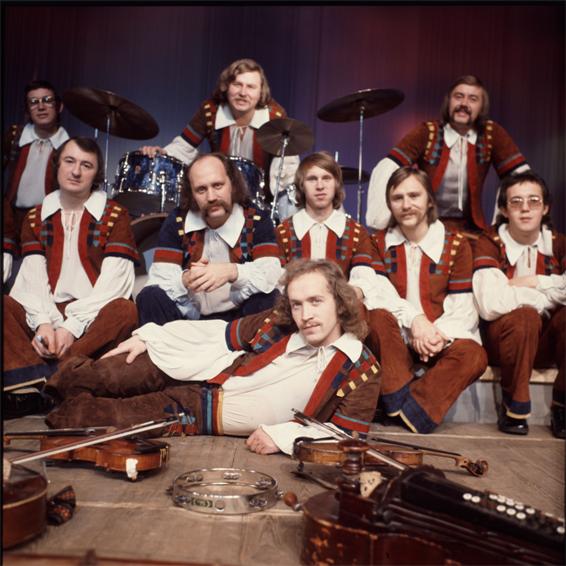
Recently I’ve been listening to the folk-tinged rock music of Creedence Clearwater Revival, on the one hand, and the rock-tinged folk music of Pesnyary on the other. Creedence were a Bay Area band who emerged out of, and came to exemplify, a certain strand within the sixties counterculture—though they usually composed lyrics about, and were influenced by the folk culture of—Greater Appalachia, the Bayou, the American South generally. Pesnyary, by contrast, were a Soviet state-sponsored VIA (vokal’no-instrumental’nyi ansambl’, literally ‘vocal-instrumental ensemble’) who played acid-rock and progressive-rock arrangements of traditional folk songs as well as their own compositions. They were also one of the very few Soviet bands to actually tour in America—specifically in the American South. Creedence had split up by 1972; Pesnyary were then just getting started: officially, there are two bands calling themselves Pesnyary now and four or five others borrowing the name without licence, but most people agree that Pesnyary’s classic period ended in 2003 with founding member Vladimir Mulyavin’s death. Despite their very different origins and ‘stances’—the lyrical and thematic difference between ‘Proud Mary’ and ‘Ave Maria’, as it were—I’m finding I’m enjoying them for very similar reasons.
One of the reasons I find both of these bands so enjoyable to listen to, is because they invest these deceptively simple melodies and chord progressions (these are rock groups, after all) with a great deal of dynamic and emotional depth. Creedence Clearwater Revival build on a basis of swamp blues—the harmonica was there from early on—and diverge from there in various directions, adding more and more rock instrumentation, as well as elements like Hammond organ. By the end of their career, as one can hear on songs like ‘Sweet Hitch-Hiker’, they were veering very close to hard rock or even proto-metal. CCR’s tunes are catchy, instantly-recognisable, iconic: ‘Suzie Q’, ‘Down on the Corner’, ‘Fortunate Son’, ‘Have You Ever Seen the Rain?’, ‘Lookin’ Out My Back Door’.
As important as Creedence Clearwater Revival are for a certain generation of Americans, I’d say that the Pesnyary are equally as important for a certain generation of people from the former Soviet Union. The Belarusian group, led by Vladimir Mulyavin, took its influences both from Western rock music (particularly the Beatles) and from traditional White Russian folk melodies. Pesnyary songs blend guitar melodies, drums, keyboards and even saxophones with traditional folk instruments (wooden whistles, fiddles, flutes, accordions, hurdy-gurdies) in a unique way. The VIA was signed to the state-owned label Melodiya in the Soviet Union (the only real game in town, as it were), and their albums sold millions of copies. Their unique approach to making accessible music with depth and feeling—with hits including ‘Aleksandrina’ and ‘Belovezhskaya Pushcha’—and Mulyavin’s ability to seek out and recruit talented multi-instrumentalists and singers, made the Pesnyary very literal rock stars in the Soviet Union.
John Fogerty and Leonid Bortkevich are, obviously, two very different vocalists—but even here there are some interesting similarities. Fogerty gives a very nasal delivery, with occasionally having a hoarse or a hard edge to his tenor melodies. There’s definitely a ‘country’ or ‘Southern’ inflection to this delivery, but it’s easy to hear the lasting influence on rock—even hard rock and heavy metal—that Fogerty’s voice had. Leonid Bortkevich was a much more traditional tenor: clean-toned, pectoral delivery, like a classically-trained singer. On the surface, he sounds much more like John Denver than John Fogerty. But Bortkevich deploys some interesting flourishes in his singing—a breath’s delayed approach to the note, a glide or a back-throat catch, that can make his vocals sound grittier, or ‘folksier’ (a good example of this being ‘Do Tret’ih Petruhov’).
It’s a bit strange. I’ve explored a lot of the musical differences between the two bands here. If we take account of their analogical positions within their respective cultures, the countercultural and ‘oppositional’ political nature of CCR’s music (‘Fortunate Son’, ‘Effigy’) more closely aligns with the career of the alternative rock / new wave band Kino headed by Viktor Tsoi. Pesnyary, meanwhile, despite the influence they took from the Beatles, probably more closely aligns with the folk-revival artists like Lead Belly, Woody Guthrie, Pete Seeger, Burl Ives and so on than with the later tail of the folk-rock trend in American music to which Creedence belongs. But somehow it seems more natural to my ear to connect these two bands. Both of them evince a vitality and a creativity that tends in a similar direction. Both CCR and Pesnyary seek their inspiration in the deep roots of their respective countries—not without a critical eye in each case—and both draw them out to infuse them with the sounds of their contemporaries. Certainly both bands are worth listening to and appreciating.
Labels:
Chicomoztoc,
culture,
Dixie,
folk rock,
Holmgård and Beyond,
Mizheekay Minisi,
music
04 May 2020
Qyz-Jibek: a slow stunner of a tragic period drama
The Kazakh film I’m reviewing today is the 1970 Kazakhfilm production Qyz-Jibek directed by Sultanahmet Qojyqov, the retelling of the epic tragic romance of the same name which had earlier been rendered into a production for the Soviet theatre. This film is glacially slow-paced, with barely enough of its Romeo-and-Juliet story to justify padding out its 142-minute runtime, and features a heavily-stylised formal cinematic language and theatrically-inspired acting direction that recalls the preferences of Eisenstein. As such it is certainly not be to everyone’s tastes. I won’t lie, it took me a long time to get all the way through it. But it is a stunningly beautiful film, which took full advantage of all of the technical versatility of its filmic medium. It lavishes gleeful attention on the natural beauties of the Kazakh landscape with its sapphirine lakes, dry rugged mountains and deserts and vast high grasslands. There are also a number of technically-impressive wildlife shots of swans and owls. The film also builds dramatic tension with close-up shots of the main actors. Careful craft clearly goes into practically every take. It’s a film which is difficult to like, but which one cannot help but appreciate just because it’s so pretty.
The story involves the ill-fated romance and courtship of the titular Jibek (Merýert Ótekesheva) with the warrior Tólegen (Quman Tastambekov), and Tólegen’s death at the hands of the cruel and treacherous brigand Bekejan (Asanáli Áshimov). There is a tone of high tragœdy about the original story, since the political forces that surround the two lovers through their families doom their marriage to a bitter end. The internecine conflicts for political power between Tólegen’s father Bazarbaı (Káýken Kenjetaev) and the clan of Bekejan, with Jibek’s father Syrlybaı Han (Kenenbaı Qojabekov) caught in between, offer some ideological overtones that resonated with a mediæval Kazakh audience.
There is a great deal of creative use of colour in the film, particularly red, white and black. The colour scheme actually mirrors that of Beloe solntse pustyni in some ways: a film which came out the same year. The duels and cavalry battles are intricately choreographed and spectacularly shot with a mixture of wide-angle ærial and mobile shots. The violence is highly stylised in a way that appears to præfigure Sergei Bodrov’s steppe dramas Kóshpendiler and Mongol. Attention is lavished in close-up on blood spatters across the sand, and these are often mirrored by flowering red blossoms in the field. Atmosphere is also used to great effect, with clouds and sunsets providing some of the needed lighting effects for the duels and battles between Tólegen and Bekejan.
The costumes and the set-pieces are equally lush; there is a great deal of effort put into giving the appropriate texture to seventeenth-century nomadic Kazakhstan. Each shot is meticulously framed, as though the director wanted to get the perfect angle to deliver the correct emotional impact – though my one complaint is that the editors were far too overly fond of wipes, and sometimes used them inappropriately. The scene in the yurt between Tólegen and Jibek on their wedding-night is admirably restrained: the eroticism is actually heightened and sublimated by the fact that it is expressed symbolically and refrains from ever ‘showing too much’. Despite this restraint, one can certainly see echoes of this scene in the (much more explicit) parallel sequences in Ermek Tursynov’s Kelin.
One can’t quite shake the feeling, as one is watching it, that one is watching the local equivalent of an Arthurian romance or a cinematic interpretation of some other folk tale. Despite the very disparate intended audiences, I was reminded more than once of the Errol Flynn and Olivia de Havilland version of The Adventures of Robin Hood: Quman Tastambekov does have a certain expression, bearing and mode of delivery that strongly recalls Errol Flynn at times. Certainly Tólegen is portrayed with a measure of Robin Hood’s humour, cunning and general nobility of spirit. On the other hand, the romanticised and æstheticised violence – along with the thematic concerns with a political anarchy that is only barely and imperfectly constrained by a veneer of traditional steppe courtesy – carries with it certain echoes of Sam Peckinpah’s The Wild Bunch. The film ends abruptly and discordantly, showing us one fragment of the death of Jibek after she learns of her husband’s fate.
These purely-stylistic comparisons don’t quite do the film justice, though, unless we take the parallel a little deeper. This film is iconic in a way that Robin Hood would be to the British or that the entire Western genre would be to us Americans. It has a mythopœic depth. That is to a significant extent because this film stands solidly at or near the fountainhead of the dastanic epic style in Kazakhstani cinema: with its high romance; its ideological focus on the struggle, here unrealised, for the unification of the tribes; its valorisation of an epic hero (or two in this case, Tólegen and Jibek) imbued with the martial and hospitable excellences of the steppe. It portrays an important national legend – not quite on the same level as Alpamıs, yet not very far off from it either.
The distinctions between Tólegen and Bekejan are highlighted here for the typically dastanic ideological purpose of highlighting the virtues of the Kazakh people. Tólegen is an obedient son – in most things. His choice of bride is not particularly welcomed by his father. And yet he loves his father dearly and rides to his rescue in battle. Tólegen is also shown to be brave, resourceful, respectful of the steppe traditions of fair play and hospitality – yet not without a certain degree of cunning. Bekejan, on the other hand, is portrayed as suitably masculine to work as a foil for Tólegen, but without respect for the steppe traditions. Though he is a formidable warrior, he is lascivious, disrespectful – and ultimately treacherous and ungrateful for Tólegen’s assistance in battle.
The version I watched was officially dubbed-over in Russian, with some of the original dialogue and particularly the singing being audible. The soundtrack features a great deal of Kazakh folk song and traditional dombyra airs: rendered in Russian to be intelligible to a broader Soviet audience, but still retaining their original flavour and melody. The singing and dombyra were provided by the characters
And so, when all of these elements are put together, there is an extent to which it is meant to feel as though we are watching not so much a film as a moving painting, an objet d’art meant to capture as much of the traditional Kazakh spirit as possible: whether in the costumes or the music or the landscapes or the cavalry battles. There is not as much of a sense of ethnographical voyeurism here as there is in, say, Amangeldy – because this is a film which has Kazakhs telling a uniquely-Kazakh story about themselves. The story itself, however, is one which has both a specific local political meaning and a universal appeal: the star-crossed lovers caught in the middle of a tribal feud.
Once again, though: although it is exquisite as an artistic accomplishment, and although it is an important landmark in the development of Kazakhstani film, this movie has a tendency to try the patience of the casual watcher. The martial set pieces are engaging and exciting enough, and the eye is naturally drawn to appreciate the framing and movement and technical mastery of the medium, but you have to navigate between them through turgid expository dialogue and establishing action whose delivery is theatrical to the point of being maudlin. I do recommend it for its sheer stunning beauty, but it is not the sort of film that I would go out of my way to rewatch for enjoyment.
Labels:
Adam and Eve,
Alash Orda,
culture,
folk rock,
history,
international affairs,
movies,
music,
politics
30 March 2020
Beloe solntse pustyni: a deserving cult-classic Ostern
Ваше благородие, госпожа Разлука,I had forgotten just how much I love this film – the first Soviet film I ever watched as a callow youth of twenty-two. That’s to my chagrin. Still, I can and will celebrate the fiftieth anniversary of the first release of Vladimir Motyl’s directorial masterpiece in 1970. It is traditional for Soviet and Russian cosmonauts to watch Beloe solntse pustyni (White Sun of the Desert) before launch, as a good-luck charm. That has something of an ironic echo in my own case, since I first watched this movie in preparation for my ill-fated but quite formative trip to Kazakhstan in 2009. Now, over ten years later, of course I can look back on that whole episode with a smiling eye – and I can watch Beloe solntse pustyni with a bit more appreciation and grounding in the Western (and Ostern) genre’s conventions. With all due thanks, of course, to Rich Hall.
Все мы с ней не встретимся, вот какая штука.
Письмецо в конверте погоди не рви,
Не везет мне в смерти – повезет в любви!
Beloe solntse pustyni takes place in the deserts of Central Asia, and follows one adventure in the life of a Red Army veteran of the Caspian Regiment ‘Ferdinand August Bebel’, Fyodor Ivanovich Suhov (Anatolii Kuznetsov) as he attempts to make his way home to his wife Katerina Matveevna (Galina Luchai) from his posting in Turkestan. On the way back he meets and rescues a man buried up to his neck in the desert – Said (Spartak Mishulin), a sharpshooter on a quest for vengeance against his father’s killer. In the next city he finds a Red Army detachment led by Rahimov (Musa Dudaev) as they’ve taken charge of nine women who were the wives of a certain cruel and vengeful Basmachi rebel captain named Abdulla (Kahi Kavsadze). Rahimov manages to convince Suhov to take the young women into his charge while he gets reinforcements, and he commandeers a local museum to shelter the women and fend off Abdulla until Rahimov returns. Suhov, and his young helper Petruha (Nikolai Godovikov) are left to their own devices, appealing – at first unsuccessfully – to the local customs officer, Pavel Vereshchagin (Pavel Luspekaev).
There’s a great deal to appreciate about this iconic film, justly considered a cult classic and beloved by generations of Russians. The premise of the film, to begin with, is Homeric in tenor: Suhov, the veteran of a great expedition to the East, finds himself wandering back home with small hope of return, yet vividly remembering and cherishing the memory of the Penelope to his Odysseus, his wife Katerina – to whom he composes mental letters, which serve as narration in the film. And on his travels he faces trials and temptations both, all of which seem to offer contemporary parallels to the monsters and beauties which grace the Odyssey. When I watched this film many years ago I lavished praises on the character of Said, whose laconic charisma and sang-froid is even now quite compelling to me. But despite his continuing ‘coolness’ as the hired gun who never misses, I’ve found that the other characters in the film, particularly Petruha and Vereshchagin, have taken on intriguing dimensions and meaning in light of a classical reference which I had little conception of on my first watch.
If there is a Greek chorus to observe Suhov’s feats, actually, it’s a silent one – but no less eloquent for all that. The four aqsaqaldar, literally white-bearded old men, who sit by the wall on the Caspian seaside hardly say a single word the entire time, but they are there watching, often with patient bemusement, all the outlandish and violent events unfold in front of them. As seems appropriate in a film like this, there is a deliberate contraposition of the bleak desert with its vast dunes and rugged stone architecture with the idyllic, green and red flower-covered meadows of Suhov’s home with his beloved Katerina standing patiently among them, only glimpsed in flashbacks or daydreams. (Suhov spends a lot of his time on screen reclining or napping on the sand, often to comic effect.) The colour schemes are entirely different, and they offer us tantalising hints into Suhov’s inner psychology and motivations.
As seems to be a commonplace in Westerns, the weapons are reflections of the characters of the people who wield them. Suhov wields a Nagant revolver, while Abdulla wields a Mauser C96 – the weapons of ‘gentleman’ cavalry officers. The ill-fated Petruha wields a rifle with a bayonet attached, which never manages to fire except on accident. The Basmachi bandits all wield carbines. Vereshchagin either fights with his bare fists or hurls sticks of dynamite – both a testament to his temper and a foreshadowing of his tragicomic demise. Said, the survivor, successfully improvises with whatever is closest to hand, whether it’s stealing an enemy’s gun or throwing a knife.
The relationships between men and women are another filmic motif: Suhov’s devotion to his wife notwithstanding, his suddenly being placed in charge of Abdulla’s harem, together with a green youngster who clearly has no experience with women, places a significant temptation on him, as we are made to see through his daydreams. The fundamentally decent Suhov represents a familial ethic which is new and Soviet as far as his charges are concerned: one woman for one husband, and one husband’s affections for one wife. Suhov gains the attentions – or at least curiosity – of one of Abdulla’s burqa-wearing wives, the fifteen-year-old Gúlchataı (Tatyana Fedotova), whom Petruhov also admires despite not ever being able to see her face. Gúlchataı struggles to understand the benefits of Christian-slash-Soviet monogamy, seeing the lot of a single wife in charge of an entire household’s chores as drudgery – but it also seems she’s the most receptive to the idea. This motif of a progressive versus an Islâmic-patriarchal understanding of sexuality does not actually shy away from subtly ribbing the Soviet position. Suhov posts big red propaganda posters around the museum reading – in Russian – things like ‘Women are human beings too!’ But at the same time, Suhov does occasionally entertain the fantasy of keeping a harem, with Katerina as the chief wife and supervisor…
And then there is the relationship between Vereshchagin and his own wife Nastasya (Raisa Kurkina): the old customs officer is torn between a certain degree of domestic security, bought at the cost of compromises with Abdulla’s gang at the behest of his wife, and his formerly glorious and daring military past – which is symbolised in the film by a kind of sæcular iconostasis on one wall of the customs-house, with paintings and lithographs, maps and old photographs – these of himself with his much-younger wife in his military attire and medals. There are hints and flashes of the old fire in Vereshchagin, and these are brought out mainly by his meeting with young Petruhov, to whom Vereshchagin takes an instant liking. It is strongly implied by the film that Petruhov reminds Vereshchagin of his own deceased son, whose military grave is far-off and unattended. Vereshchagin is also the one who strums and sings the folk song ‘Ваше благородие, госпожа Разлука’ quoted above, and which forms something of a theme for the film. It reflects also something of Vereshchagin’s predicament, being estranged from his old home, being unlucky in death but lucky in love with a devoted (but somewhat smothering and overprotective) wife.
The overall tone of the film is light, however – even comic. It is brisk-paced, well-choreographed with regard to the gunfights and standoffs, and has the benefit of never taking itself too seriously, allowing for its saturnine humour and its immortal one-liners: ‘The East is a delicate matter,’ for instance; ‘His grenades are the wrong type!’; and ‘Save at least one bullet, Abdulla, to shoot yourself!’ The main locations for filming were Dagestan (on the other side of the Caspian) and Turkmenistan for a few of the desert scenes. Luga, south of Saint Petersburg, was chosen for the pastoral location for shooting Suhov’s daydreams and flashbacks with Katerina. The palette for the film is notably warm, even gaudy, when compared with other films of the time. This is counterbalanced by a certain staid realism in the cinematography: lots of slow pans and flat, static takes, allowing the audience to have the same sort of ironic detachment from the action that the aqsaqaldar have, sitting outside in the sun.
If it weren’t already obvious, I consider Beloe solntse pustyni to be fully deserving of its status among the classics of Soviet film, full stop. Not for nothing was it added to the register of culturally significant films in Russia in 1998! It can easily bear the comparison to any Western of its time. It’s shot against starkly beautiful Caspian desertscapes. Its characters are all entirely and understandably human – even the homicidally jealous villain. It hits just the right notes of comedy and melancholia, action and emotion to solidify its place in cinema, and its classical literary moorings take it just that extra step beyond into the category of high art. This one’s absolutely a keeper.
Labels:
Alash Orda,
books,
culture,
Eranshahr,
folk rock,
history,
Holmgård and Beyond,
international affairs,
movies,
nerdiness,
poetry
21 September 2019
Sëstry: two faces of the ‘new Russia’
Though not technically a Kazakh film, Kazakh director Gul’shad Omarova’s screenwriting debut, before directing Shıza in 2005, was a 2001 Russian-language road movie called Sëstry (or Sisters), directed by Sergei Bodrov, Jr (son of Sergei Bodrov, Sr – who also got writing credits on this film – and the lead actor in Brat and Kavkazskii plennik). So I’m actually glad I reviewed Brat first, but I still feel at something of a disadvantage in reviewing Sëstry here, in part because the plot and characters of Ya ne vernus’ have many surface similarities to this film. But they are films separated by half a generation, and the broad thematic concerns of the two films are therefore quite different. Sëstry is ultimately a film about doubt; Ya ne vernus’, a film about faith in uncertainty. Post-Soviet questions loom large in the mind of Sëstry – whether œconomic uncertainty, pop-culture or ethnic identity – in a way that they don’t as much (though they are by no means entirely absent) in Ya ne vernus’.
A mid-level ethnic-Dagestani gangster named Albert ‘Alik’ Murtazaev (Roman Ageev) gets released from prison after serving his term. However, he lost some money that he owed to his former gang, and now the leader of the gang (Kirill Pirogov) is out to get his million rubles back. Alik sends his eight-year-old daughter Dina (Katya Gorina) and his thirteen-year-old stepdaughter Sveta (Oksana Akinshina) into hiding to escape from the criminals. The two daughters lead very different lives, and do not get on well at all in the beginning. Dina is spoiled and materialistic, precocious in some wrong ways and painfully naïve in others. Sveta lives a poorer life with her maternal grandmother, listens to Viktor Tsoi (whose memory she treats with hagiographical reverence), and trains at a range with her rifle, dreaming of becoming an army sniper. When Alik’s gang discovers the two girls, they are forced to flee and wander around on the road to elude them, all the while trying to contact their parents. Apart from Viktor Tsoi, another connexion with Igla is Seifullin (Aleksandr Bashirov, who played Spartak there), a Central Asian Muslim who takes the girls under his protection against the gang toward the end of the film; and Sergei Bodrov, Jr himself makes a cameo as Danila Bagrov, his character from Brat.
The briskly-paced film is driven in large part, just as Ya ne vernus’ is, by the odd-couple repartee of the two girls as they are flung together for survival and begin to form a bond. A substantial portion of the road-film drama to Sëstry arises from the fact that Russia is still in recovery from the Chechen war and still not socially or œconomically out-of-the-woods, so to speak. The police are still shown to be less powerful than the criminals, and occasionally on the take (though one policeman chooses to die rather than betray the girls to the mafia). The people they meet, even the people who help them, are reticent and suspicious – and understandably don’t want to get caught in the middle of a gang war. Ethnic tension is also something they need to navigate: Dina doesn’t look quite Russian, and that complicates their situation somewhat. At one point they get taken in by an extended family of Roma, who help them get back on their feet by busking and – at one point – gambling with Danila Bagrov.
Psychologically, this film is remarkably astute. One has to give some mad acting props to the thirteen-year-old Oksana Akinshina here. She is cool, unflappable, instantly relatable and not given to overacting – she carries herself with a distinctively-Russian sang-froid, which is all the more evident and convincing when she’s staring down the scope of a rifle. But she is able to convey profound and complex emotion – disdain, compassion, terror, pain, relief, joy, sorrow – with subtle facial and body language that backfills her sparse spoken dialogue with reams of subtext. Katya Gorina performs well, too, giving a bit of a sly edge to her spoiled eight-year-old character that ends up becoming endearing. By the bittersweet end of the movie, we’re invested enough in the two half-sisters’ relationship that we actually come as close as Sveta does to tears – and her tears carry that much more weight for their rarity.
Dina and Sveta show us two faces of (what was then called) the ‘new Russia’ – the Russia that was warily making its way out of the gloom of the Eltsin years, and which hadn’t quite left it behind. Dina is clearly sheltered, but much cleverer than an eight-year-old ought to be (as when she asks Sveta how far she’s gone with her boyfriend). The two of them bond over, of all things, Indian belly-dance. Still, it’s Sveta who needs to acquaint her with the facts of life, with the nature of their father’s business and the seriousness of their situation. Sveta’s own blunt cynicism, her harsh criticisms of Dina’s lifestyle, her dim view of Alik’s ‘business’ and her hardscrabble ethic are abrasive and even jarring – particularly when she straight up breaks into what she thinks is her friend’s dacha to steal food. But it’s what keeps her and Dina alive, and Dina ultimately learns to appreciate it.
The soundtrack – another nod, perhaps, to Igla – consists mostly of 1980s Soviet and early-RF rock numbers from Kino and Agatha Christie. The film is lit like a BBC made-for-TV production from the same era. That’s not a compliment. However, otherwise, the cinematographer makes some bold and interesting choices, including a bit of over-the-shoulder shaky cam when the gangsters first break into the girls’ apartment, and innovative framing when moving from indoor sets to outdoor ones. Sëstry is nowhere close to being as claustrophobic as Brat (though you get flashes of it when Alik meets up for the second time with members of his gang in an old junkyard), but the film retains both Brat’s low-budget but high-efficiency props department and its anti-climactic and perfunctory approach to violence. I have to say here that I prefer the gritty realism of post-Soviet Russian film’s treatment of violent death, to the unwarranted glamour with which modern American action movies are always lavishing on it. This is absolutely a matter of æsthetics, but of course matters of æsthetics are usually indicators of something deeper.
Sëstry isn’t quite my favourite Soviet or post-Soviet gangster movie, but it’s got more than its fair share of brilliant glimmers. It truly is a shame that Sergei Bodrov, Jr (may his memory be æternal!) was not given more time to sit in the director’s chair. He clearly inherited more than a bit of his father’s talent for directing film. As a bookend or as a companion piece to Brat and its sequel, it’s charming and fits in well.
Labels:
Alash Orda,
culture,
folk rock,
Holmgård and Beyond,
Joseon,
movies,
music,
œconomics
17 September 2019
Brat: the film that made me a critical Russophile
Before I proceed much further in this Kazakhstani film series I seem to have touched off (and that dates back to the beginning of this blog, come to think of it), I think it’s probably worth going back and revisiting a cult film that left a fairly deep impact on me personally when I first watched it in college – even though it is very much not a Kazakh film. Having recently watched Igla I was inspired to go back and watch this film – one which I have seen before but not yet commented on. If Igla was a præmonition of Trainspotting, as I hinted in my recent piece, then this film was absolutely a deliberate echo of that film.
To demonstrate how deeply this film impacted me, let me just say this. When I was still an Episcopalian, this was one of two films that made me start to sympathise, in a critical and unromantic way, with modern Russia – the other being Kavkazskii plennik. It doubled as one of the sources, along with Naomi Klein’s The Shock Doctrine, that humanised the Russian people for me and made real to me their plight and desperation during the 1990s under Eltsin. The irony in this, is that despite this very real sympathy, it shows Russia at some of its very worst: violence – including sexual violence; drug abuse; alcoholism; escapist licence of all sorts; naked pursuit of lucre; casual racism; gharbzadegi; the ever-porous boundary (but in 1990s Russia particularly so) between biznes and gangsterism. I am talking, of course, about the low-budget crime thriller Brat by Aleksei Balabanov, starring Sergei Bodrov, Jr.
Brat deserves its place as a classic in Russian cinema, and Balabanov his reputation as a genius for having directed it. The film was shot on a shoestring budget; and the only reason it got off the ground at all was because of Balabanov’s relationships with Sergei Bodrov, Jr and the lead singer of Nautilus, Vyacheslav Butusov – whose music features prominently in the film.
The film follows the tight-lipped Danila Bagrov (Sergei Bodrov, Jr), a young demobilised army vet who claims he only ever served at HQ, and whose favourite expression of approval is ‘нормално’. The first time we see him he’s walking onto the set of a Nautilus music video, and gets into a fight with the director and the bouncers which sees him detained and threatened with arrest if he doesn’t shape up and get a job in a week. His disappointed mother, who sees him as a disgrace to the family, tells him to go find a job like his older brother Viktor (Viktor Sukhorukov), who lives in Leningrad. Danila, of course, does what he is told by his mother – like a dutiful son would.
Viktor, also known as ‘the Tatar’, is a hitman for a mobster nicknamed Krugly (Sergei Murzin) who talks seemingly only in rhyming clichés. Viktor is tasked with taking out a Chechen rival of Krugly’s, though Krugly dislikes Viktor’s cocky attitude and makes plans to eliminate Viktor at the same time. Viktor, in order to save himself, thrusts the job onto Danila when he arrives. Danila’s subsequent adventures in S. Peterburg see him attempt without success to buy Nautilus’s new album; befriend a homeless German named Hoffman (Yuri Kuznetsov) and a heartlessly-transactional bar-frequenting junkie named Kat (Mariya Zhukova). When carrying out his ‘job’, he is attacked by Krugly’s henchmen and flees in a tram operated by a married woman named Sveta (Svetlana Pismichenko), with whom he starts up a love affaire. Danila is pulled deeper and deeper into the corruptions and temptations of S. Peterburg, yet despite the brutal acts of self-preservation and temptations he is prone to, he somehow manages to hold onto a certain sense of decency and honour – something which he finds lacking in his entire body of acquaintance (except for the homeless German and Sveta). He also manages to protect the weak and outwit his enemies not only by outgunning them but also by jury-rigging together matchbox flash-bombs, pop-bottle silencers and nail-filled shotgun shells from the various dingy apartments he crashes at.
Storywise, the plot is straightforward almost to a fault; the only digressions are the ones that happen within sight or earshot of the protagonist, and these are usually dealing with the music of Nautilus. And cinematographically, Brat is a very claustrophobic film which clearly was making the best of its limited budget (and possibly making a subtle literary commentary on the setting). Most of the action takes place in cramped, narrow apartment hallways with flickering incandescent lighting. Every window and mirror is dingy. Even Krugly’s headquarters is decked out with a dusty ‘80s IBM sitting in the background, and little else. There are lots of long takes, and the film is paced specifically to deglamourise the violence of its protagonists. Despite a lot of characters being shot to death, the blood effects are minimal and usually kept in a blurry background. Balabanov is also clearly a big fan of fade-to-black transitions, with a lot of the punchlines to various story sequences being left implied.
Brat relies a great deal on filmic symbolism to establish its moral universe. Danila, with whom we are supposed to sympathise, is unassuming in appearance, and dresses in an oversized grey turtleneck sweater. The other young people around him – especially Kat – are decked out in the expressions of Western counterculture of the time: black leather, piercings, eye shadow, mohawks. The people who hold power, like Krugly, are also aficionados of Western styles. Krugly wears Versace and drinks Hennessy. ‘American’ music is associated with drugs and cheap loveless transactional sex; it is compared unfavourably to the healthier and more wholesome Russian-inflected music of Nautilus, which provides the backdrop to Danila’s affaire with Sveta.
It’s also definitely a piece which reflects its time, almost more so than its place. In fact, Brat is a mirror that’s held up to an entire generation of young Russian men caught in a struggling time, for whom Danila Bagrov became something of an instant anti-hero. Danila is not by any stretch of the imagination a ‘good man’ – this is something that Sergei Bodrov himself has made clear in his interviews, and is voiced in the film itself by Sveta. But despite his weaknesses he possesses a folksy cleverness masqued as gullibility and an innate sense of justice. It’s unclear by the end of the film as he skips town whether or not he has lost his soul entirely – although the German, the sole uncompromised voice of conscience in the film, claims he has.
Balabanov’s Brat made me a critical Russophile, not only in that it showed the depth of the œconomic woes and spiritual degradation of Russia in the lawless ‘90s, but also hailed back to a rich and vibrant literary world in historical Russia. The motif of Leningrad (and which is referred to explicitly with its præ-Communist name of S. Peterburg in the film) as a corrupting influence, an artificial city of masonry ruled by greed, a malevolent force that parasitically feeds off the strength of its residents and makes them weak. S. Peterburg as a character in her own right – that’s pure Dostoevsky.
In short, I would say that Brat is a film one needs to watch, and not only watch but feel, to get an appreciation of how Russia got here as a country. It’s not all about communism and it’s certainly not all about ‘authoritarianism’. There is a real spiritual and material struggle behind modern Russia, that is too often disregarded or sneered at in Anglophone coverage of current events there. The questions Balabanov poses to his viewers are meant to reflect this struggle and the dimension of Russia’s shared life – along cultural, political and œconomic dimensions – that was simply AWOL in the 1990s. Danila Bagrov is a cultural icon and hero for his time precisely because he is flawed, and precisely because he is fallen – but perhaps not irredeemable.
23 February 2019
Pointless video post - ‘Into a Dream’ 夢の中へ by Inoue Yôsui 井上陽水
Sadly, it’s been awhile since I did one of these. Enjoy this whimsical Japanese folk-rock song from 1973, gentle readers!
Lyrics (English translation):
What is it that you’re looking for?
Is it something that’s hard to find?
And you looked in your bag and your desk…
… but you can’t find it.
Do you still intend to keep on looking?
Won’t you dance with me instead?
Wouldn’t you want to… Wouldn’t you want to…
… go off into a dream?
Woo-hoo-hoo… Woo-hoo-hoo… Woo-hoo-hoo… Sa-a…
You won’t even let yourself sleep anymore,
And you’ve stopped smiling.
Down on your hands and knees, down on your hands and knees,
What on earth is it you’re looking for?
And just when you’ve stopped looking for it,
You find it; it happens all the time.
So let’s dance! Wouldn’t you want to…
… go off into a dream?
Woo-hoo-hoo… Woo-hoo-hoo… Woo-hoo-hoo… Sa-a…
What is it that you’re looking for?
Do you still intend to keep on looking?
Wouldn’t you want to… Wouldn’t you want to…
… go off into a dream?
Woo-hoo-hoo… Woo-hoo-hoo… Woo-hoo-hoo… Sa-a…
Woo-hoo-hoo… (… Into a dream?)
Woo-hoo-hoo… Sa-a…
Labels:
folk rock,
just for fun,
music,
Yamato
05 November 2018
Pointless video post – ‘Yo m’enamori’ by Sava
I have had the first album, Aire, by the German mediæval folk band Sava for a long time; and it has long been one of those albums that I keep going back to in my darker and more melancholy moods. Folk music, that is to say the music that comes out from amongst the folk without attribution, at its most real gives voice to certain heart-stirrings. That is certainly the case with their rendition of the traditional Sephardic Jewish love song ‘Yo m’enamori’ here, simply-expressed in its lyrics, yet bewitchingly expressive in its minor key. Do enjoy!
Labels:
Adam and Eve,
folk rock,
Hibernia,
music,
Teutonia
22 September 2018
‘Rustic’ poetry, simplicity, attraction of the mind
喓喓草蟲、趯趯阜螽
未見君子、憂心忡忡。
亦既見止、亦既覯止、我心則降。
陟彼南山、言采其蕨。
未見君子、憂心惙惙。
亦既見止、亦既覯止、我心則說。
陟彼南山、言采其薇。
未見君子、我心傷悲。
亦既見止、亦既覯止、我心則夷。
The meadow grasshopper chirps
And the hillside grasshopper leaps.
Until I have seen my lord,
My anxious heart is disturbed.
But as soon as I shall see him,
As soon as I shall join him,
My heart will have peace.
I climb that southern hill
There to gather the ferns.
Until I have seen my lord,
My anxious heart is tortured.
But as soon as I shall see him,
As soon as I shall join him,
My heart will be gay.
I climb that southern hill
There to gather the ferns.
Until I have seen my lord,
My heart is troubled and sad.
But as soon as I shall see him,
As soon as I shall join him,
My heart will be soothed.
- The Odes 《詩經》, Caochong 《草蟲》, Shao and the South 召南 3
爰采唐矣、沬之鄉矣。
云誰之思、美孟姜矣。
期我乎桑中、要我乎上宮、送我乎淇之上矣。
爰采麥矣、沬之北矣。
云誰之思、美孟弋矣。
期我乎桑中、要我乎上宮、送我乎淇之上矣 。
爰采葑矣、沬之東矣。
云誰之思、美孟庸矣。
期我乎桑中、要我乎上宮、送我乎淇之上矣。
Where does one pick the dodder?
In the country of Mei.
Know you of whom I am thinking?
The beautiful Meng Jiang.
She waits for me at Sangzhong;
She yearns for me at Shanggong;
She follows me on the Qi!
Where does one pick the wheat?
On the north side of Mei.
Know you of whom I am thinking?
The beautiful Meng Yi.
She waits for me at Sangzhong;
She yearns for me at Shanggong;
She follows me on the Qi!
Where does one pick the turnip?
On the east side of Mei.
Know you of whom I am thinking?
The beautiful Meng Yong.
She waits for me at Sangzhong;
She yearns for me at Shanggong;
She follows me on the Qi!
- The Odes 《詩經》, Sangzhong 《桑中》, Airs of Yong 鄘風 4
溱與洧、方渙渙兮。
士與女、方秉蕑兮。
女曰觀乎。
士曰既且。
且往觀乎。
洧之外、洵訏且樂。
維士與女、伊其相謔、贈之以勺藥。
溱與洧、瀏其清矣。
士與女、殷其盈兮。
女曰觀乎。
士曰既且。
且往觀乎。
洧之外、洵訏且樂。
維士與女、伊其將謔、贈之以勺藥。
The Zhen and the Wei
Have overflowed their banks.
The youths and maidens
Come to the orchids.
The girls invite the boys: ‘Suppose we go over?’
And the lads reply: ‘Have we not been?’
‘Even so, yet suppose…’
‘… we go over again.’
For over the Wei,
A fair green-sward lies.
Then the lads and the girls
Take their pleasure together;
And the girls are then given a flower as a token.
The Zhen and the Wei
Are full of clear water.
The lads and the girls
In crowds are assembled.
The girls invite the boys: ‘Suppose we go over?’
And the lads reply: ‘Have we not been?’
‘Even so, yet suppose…’
‘… we go over again.’
For over the Wei,
A fair green-sward lies.
Then the lads and the girls
Take their pleasure together;
And the girls are then given a flower as a token.
- The Odes 《詩經》, Zhen and Wei 《溱洧》, Airs of Zheng 秦風 21
‘Food and sex – that’s what people want. Shi se xing ye 食色性也.’ That’s what my wife said to me with a laugh – quoting an idiom coined by Gao Buhai 告不害 (one of the zhuzi baijia 諸子百家) in the Mencius, who in turn was paraphrasing the Classic of Rites 《禮記》 – as I told her that I was reading the Granet-Edwards translation of the Classic of Odes 《詩經》. (I left out the part about how I was basically provoked into reading it by the eldest of the theological Hart brothers, the same one who made me a fan of comedian and documentarian Rich Hall.)
Now, this being a translation, I am sensitive that I am pretty much wholly at the mercy of Granet and Edwards – a French sociologist, looking at these poems through an anthropological lens, and his English translator – and their interpretations. The validity of all of what I write below must be tempered by that understanding. But Granet argues, rather convincingly, that the Odes are basically a collection of folk songs; folk songs that describe and speak to the realities of life in the villages and countryside of China in deep antiquity.
Granet – being a good sociologist – draws a number of conclusions from these songs that attempt to paint a vivid portrait of village and country life in China’s deep antiquity. Granet seems given to certain orgiastic flights of fancy that seemingly tell us not so much about ancient Chinese culture as they do a bit more than we need to know about his imagination (a common enough failing among sociologists of a particular Freudian era). But more valuable are his comparisons of archaic rural Chinese betrothal and marriage festivities with the customs of their neighbours: the Yi, the Pubiao and the Hmong. Granet puts forward lively images of bands of young men and young women from different villages (exogamy being strictly upheld) meeting together at a carefully-determined date in springtime, just after the winter thaw, at festivals and fairs held at sacred sites like the confluences of two rivers, a copse or a hillside, giving each other gifts, holding competitions with each other in choral singing, sports and racing, and then pairing off to court each other for the remainder, before the festival ended and they returned to their home villages – to be married off to their chosen partners the following autumn. To my mind there is something very charming in a McTellian way (also) about these images, and that’s probably no accident – the folk tradition being what it is.
From a literary view, these folk songs, even in translation, are simple. They spring forth from a singleness of mind. They contain little by way of characterisation, few metaphors and certainly nothing by way of extended conceits; they rely on repetition, antiphonal structure and rhythm for their power. But they are powerful: touching, indeed in many cases stirring – due in part to their frank directness. They speak to deep needs, desires, passions in the human heart. They are concerned with the stuff of a peasant’s daily life: harvesting, gathering wood, hunting, eating, sleeping, the rise and fall of the rivers, the turn of the seasons. They are concerned even more with courtship and erotic love. The first awkward, halting, sometimes confrontational – but seasonal and heavily ritualised – meetings between boys and girls of different villages. The awakening of desire. The heartaches and anguish of first love and parting. Loneliness. The thrills of the chase and the plight of covert assignations. The dread and sorrow (for a girl) of leaving her parents and siblings for a new village. The bliss of consummation. Heartbreak. Despite the lack of personal details – very few of the characters have names, and even those that do are generic enough to avoid causing scandals for the young folk involved – the Odes speak to something deeply human that are easy for those who have loved to recognise.
These poetic expressions, as you can see from the Yong ode ‘Sangzhong’ which I’ve quoted above, are deeply laden with gæographical and botanical imagery, but there is nothing really symbolic in them; rather, they reflect and amplify the emotions expressed within them. Granet calls these ‘rustic themes’. He says:
It is evident that the odes of the Shih ching frequently contain lively and sparkling descriptions of subjects borrowed from Nature … Sometimes we are shown a tree in the fullness of its vigorous growth, and, when its flowers, fruit, leaves and branches are praised, it seems that a parallel is being drawn between the growth of plants and the awakening of the human heart … the loves of the beasts seem to be the counterpart of those of men. The state of the weather, the thunder, snow, wind, dew, rain and the rainbow, or the crops, the gathering of fruits or herbs also form a frame or an opportunity for the expression of the emotions.Granet includes in his translation the traditional interpretations of the compilers and scholastic commentators of the Odes, including most importantly Mao Heng 毛亨 and Zhu Xi 朱熹. But he clearly takes issue, often quite disparagingly, with the scholarly hermeneutic they apply to the texts: in the broad strokes, he finds these classicist commentators too eager to twist the simple, innocent expressions of feeling in the Odes into sophisticated satires on the policies of the feudal lords of the various states from which the Odes were collected, or else examples of or warnings against the deterioration of morals and feudal ritual propriety in ill-governed states. The irony, of which Granet appears sensible enough himself, is that Confucius himself would probably agree more with him, Granet, than with his own mediæval followers. From the Analects:
子曰:「詩三百,一言以蔽之,曰『思無邪』。」(What a far cry indeed from Zhu Xi’s interpretations, which are so apt to see depraved thoughts and licentiousness at each turn in the Odes!)
The Master said, ‘In the Book of Poetry are three hundred pieces, but the design of them all may be embraced in one sentence: “Having no depraved thoughts”.’
But clearly, even though Confucius himself thought some of the Odes to be ‘lewd’ (like those belonging to the state of Zheng), he found certain of them worthy of being kept in this collection – and this has always been something of a puzzlement to the later compilers. As Granet puts it:
The embarrassment of the Chinese tradition is evident. It may be expounded thus: after the Shih ching was used as a theme for exercises in rhetoric, and especially after it had become a classic and a subject of instruction, it was considered desirable to attribute to this educational work a moral value, independent both of the use to which it might be put and of the value which it would have had from the beginning. The odes were used for purposes of instruction and it was imagined that they were composed for that purpose…Now, from my own perspective, since (as I am not a ‘higher critic’) there is no valid internal reason to doubt the Chinese tradition which holds Confucius to have been the compiler of the Odes, the challenge for Confucians posed by Granet is evident. Why did Confucius, who placed such peculiar emphasis on the importance of the Odes for understanding his teachings (to the point where he would not teach even his relatives who hadn’t read the Odes), include these ‘sensual’ songs? Granet nowhere alludes to this comparative-philosophical point, but I will draw the connexion explicitly. By including the love-songs of Zheng (like ‘Zhen and Wei’ above) in the Odes Confucius poses to Chinese society the same challenges about the nature and purpose of poetry that Socrates poses to the Greeks about Homer’s Achilles in Plato’s Dialogues, particularly the Hippias Minor and the Republic.
But for the moral which was to be inculcated some of the songs seemed too licentious; it was felt that they were not adequately excused by saying that the presentation of vice recalls to virtue—for tradition declared them to be licentious. Fortunately, opinion declared the expurgation of the Shih ching by a Sage, and that made it possible, since, officially, no licentious poems were to be found in the collection, to put forward for most of the poems an interpretation which rid them of all baleful influence by completely setting aside their character as love-songs. But in some instances, this method was defective, and it had to be admitted that a certain number of sensual poems were included in the Shih ching.
The Odes themselves ‘have no depraved thoughts’; so says Confucius in the Analects. But why would he say this when these love-songs – direct, bold, sometimes even ‘indecent’ by the Sage’s own standards – would offend both contemporary and later ritual-moral sensibilities? Granet notes:
No mere declarations and tokens of love sufficed to bind [young lovers’] hearts that demanded nothing less than that complete union which would give them eternal possession of each other. It is not to be wondered at that, in songs in which Chinese commentators see only licentiousness, foreigners find traces of an ancient morality, preferable to the existing one. This is due to the fact that, in the lavish protestations of faithfulness made by the lovers, they see an ancient monogamy. As a matter of fact, from the time of their union in the festival of general harmony the lovers considered themselves bound irrevocably, and their apprehensions and agony gave place to security and peace of mind.Reflecting on which I would ask, in all seriousness: is it so hard to believe that Confucius himself might have seen the Odes in a similar way as Granet (and the ‘foreigners’ he references) claims to? After all, the Analects are not lacking in praise for simple, direct ceremonies and music (!), particularly those found in elder times, and particularly in comparison with the elaborateness and subtlety of the prevailing ritual norms of his own day. (And he particularly detested toadies with well-kept appearances, insinuating manners, glib tongues and fine, well-honed speeches.)
子曰:「先進於禮樂,野人也;後進於禮樂,君子也。如用之,則吾從先進。」And then there is this instance in which Confucius references the Odes directly, talking about them with his student Bu Zixia 卜子夏:
The Master said, ‘The men of former times in the matters of ceremonies and music were rustics, it is said, while the men of these latter times, in ceremonies and music, are accomplished gentlemen. If I have occasion to use those things, I follow the men of former times.’
- The Analects 《論語》 11.1
子夏問曰:「『巧笑倩兮,美目盼兮,素以為絢兮。』何謂也?」子曰:「繪事後素。」曰:「禮後乎?」子曰:「起予者商也!始可與言詩已矣。」To what, precisely, did Bu Zixia find the ceremonies (or li 禮) subsequent – that is to say, contingent or dependent upon? The Analects answers this question, too. And note this: the answer carries a direct reference to the Odes:
Zi Xia asked, saying, ‘What is the meaning of the passage – “The pretty dimples of her artful smile! The well-defined black and white of her eye! The plain ground for the colours!”?’ The Master said, ‘The business of laying on the colours follows (the preparation of) the plain ground.’ ‘Ceremonies then are a subsequent thing?’ The Master said, ‘It is Shang who can bring out my meaning. Now I can begin to talk about the Odes with him.’
- The Analects 《論語》 4.8
子曰:「興於詩,立於禮。成於樂。」The Odes, then, were not meant to ‘establish character’ or to provide ‘finish’ to a student’s education. It appears that Confucius did not mean to use them as a guide to the establishment of good character and good ritual norms in a civilised state (the two of those being suspended in a certain dialectic): that’s what the Book of Rites was for. The Odes, rather, are meant to ‘arouse the mind’ (xing 興 – a term which can also be glossed as ‘interest’, ‘wonder’, ‘excite’, ‘pleasure’; whose gloss of ‘arouse’, interestingly enough, also includes erotic entendres; and which, to me, recalls in particular the Platonic use of aporia). What does Confucius mean for us to be excited by, or to wonder at, in the Odes? I wonder if it is not precisely what foreigners wonder at in them.
The Master said, ‘It is by the Odes that the mind is aroused. It is by the Rules of Propriety that the character is established. It is from Music that the finish is received.’
- The Analects 《論語》 8.8
We see, after all, a number of things in the Odes, that are the subject of exuberant (though unpolished) expression. The patterns of the seasons. The often-terrifying majesty of thunder, rain, wind and floodwaters. Awe at natural beauty – in lakes, hills, rivers, trees, flowers. Delight in the form of a young woman from a man’s perspective. Delight in the form of a young man from a woman’s perspective. Mystique – half-rejection, exhilarated pursuit, gossip, attraction, flirtatiousness, abandon – in the seasonal meeting of the two sexes, separated by custom, by gæography (exogamy, remember?), by the primoridal order of the cosmos. What is seen in the Odes are man’s erotic – in the full breadth and depth of the term – stirrings upon beholding the face of the Divine. It is in this vein also that a devotee of Confucius in the ‘foreign’ land of Chu, Qu Yuan 屈原, wrote the Chuci 《楚辭》. ‘Shi se xing ye’ is not a dismissal. Confucius talked about the superior man returning to the root. He would have us behold all of this and wonder at man’s condition, wonder at his place in the cosmos. If we do not have a good ‘plain ground’, how can we apply bright colours? If we do not understand and respect the human appetites, how can we possibly understand the need for rites? If we do not look on the human condition and love it, and feel compassion for it, how can we possibly begin to seek to correct that condition in ourselves?
In a certain sense, I am beginning to suspect that Zhuangzi 莊子 had it right – at least partially. Much like Khomyakov and Herzen in Russian intellectual history, Confucius and Laozi 老子 were probably closer to each other in outlook than either of their respective students and schools ever would be afterward in history, despite the efforts of syncretic thinkers like Dong Zhongshu 董仲舒 and Wang Bi 王弼 who tried to bridge the two schools of thought. Confucius and Laozi beheld the same human Dao. The two of them shared a certain awe of it. Confucius placed the emphasis on the ‘human’ and followed the Odes. Laozi placed the emphasis on the ‘Dao’ and followed it – out of China. But that is a reflection, perhaps, for another time.
One final thought. If Confucianism is ever going to be made relevant again in an uncertain age such as this, perhaps one of the things that will be demanded of the academic proponents of Confucianism is that they find creative ways to recapture the simplicity and singleness of mind in the Odes, and have us wonder at them.
Labels:
Adam and Eve,
Anglophilia,
Britannia,
Confucianism,
culture,
Elláda,
folk rock,
history,
Huaxia,
La Gaule,
Mueang,
music,
philosophy,
poetry
26 April 2018
Pointless video post – ‘Hidden Dance’ by Gao Hong and Issam Rafea
Yesterday, for our sixth wedding anniversary, Jessie and I went out to the Cedar to hear two instrumental masters do improvised duets on two lutes. Dr Gao Hong 高虹 (who is from my wife’s hometown of Luoyang, Henan Province) is a world-renowned talent on the pipa 琵琶 (Chinese lute), a student of the late Shanghai lute master Lin Shicheng 林石城, who has been recognised both in China and the United States and who has participated in several cross-cultural and international music groups, and is currently on the faculty at Carleton College where she directs a Chinese music ensemble. Dr Issam Rafea عصام رافع is a likewise world-famous Kuwaiti-Syrian oud عود (Perso-Arabian lute) master, symphonic composer, chair of the department of Arabic music at the High Institute of Music in Damascus and conductor for the Syrian National Orchestra for Arabic music.
These two apparently met some time back and decided to do some impromptu recording sessions, out of which came their joint album Life As Is earlier this year. This concert we went to was sublime. Two masters of similarly-descended (but wildly divergent, soundwise) instruments carrying on what I can only describe as a conversation in music, on various themes. Though Gao herself did much of the introductory speaking and Rafea was quite a bit more reserved, and even their musical styles reflected their differing personalities, the two of them clearly had a musical-spiritual chemistry that shone through. For someone like me with no instrumental talent to speak of (and paltry vocal talent in comparison to the rest of my family), it was really something astonishing to listen to.
01 November 2017
Beautiful echoes of a ruined empire
I am currently listening to the Seven Melodies of Minyak 《木雅七韵》 a folk album by Dogi Balmo 多吉巴姆, an album which has an amazing and beautiful backstory which I was reading on China Daily.
The story of how the album got made, linked above, is strange and beautiful enough: the fact that a student of music in Sichuan would find herself befriending a performer who is one of the few surviving speakers of the Qiangic Minyak 弭藥 (or Muya 木雅) language on earth. And the fact that the album they produced together would spur genuine attempts at linguistic conservation on the part of the government. But even more bizarre, twistedly beautiful and tragic is the history of the Minyak themselves - kissing cousins to the Tibetans who are in the PRC’s ethnic schema classified either as Tibetans 藏 or as Qiang 羌 people. Tradition has it that they are among the few living descendants of the Tanguts.
And who are the Tanguts, you ask?
Originally, the Tanguts, belonging to the historical Qiang people, were invited by the Tang court to act as a buffer state between China and the Tibetan Empire. But between the 800’s and the 1200’s, they became a major, major headache for the Tang Dynasty (after the Rebellion of An Shi) and the following Song Dynasty. Traditionally herders, they forged an empire - the Empire of Western Xia - in what are now Gansu Province and Ningxia Autonomous Region, along with the southwest parts of Inner Mongolia going up to the Ordos Loop.
Despite their situation on a rich overland trade route (the Hexi Corridor of the Silk Road), they held to their traditional customs. The western half of their Empire was nomadic and pastoralist, while the eastern half, consisting of Han Chinese as well as Tanguts and lying on the fertile loess plateau of the Yellow River, was agrarian. They had advanced techniques for smelting iron - a necessity when situated between two very hostile states (the Khitans and the Song Chinese). They developed their own writing system, which they used primarily to translate Buddhist sūttas and the Chinese Classics into their own language.
An independent kingdom which, like many of its type, performed a delicate diplomatic balancing act to stay afloat, they basically managed to thumb their collective noses at everybody in Central Asia until Genghis Khan arrived on the scene. Even then, they refused to cooperate with Genghis Khan’s conquests - and they paid dearly for their hard-fought resistance to conquest. Their capital at Xingqing (now Yinchuan in Ningxia) was razed to the ground in 1227 and all of its inhabitants slaughtered by the marauding Mongols.
The Tangut Empire’s post-apocalyptic survivors fled south into Henan, Hebei, Tibet and Sichuan, where most of them were absorbed either into the Han Chinese or the Tibetan populace, with a few lonely holdouts lasting until the middle of the Ming Dynasty. The Minyak, who are mostly located in Kangding County in Sichuan, are thought to be one of the last surviving pockets of these hardscrabble survivors, and they have long been in danger of being culturally assimilated - by the Tibetans. I know that might be a bit hard to believe given the prevailing Western political narrative around Tibet, but the Tibetan culture is actually remarkably healthy.
The living knowledge of the Tangut script has been lost to time, so asking the Minyak people to go back to using that would be not quite as bad as, but something akin to, asking the modern Greeks to go back to using Linear B. Yang Hua’s idea of compiling a Chinese-Minyak audio dictionary as a way of helping to preserve the unwritten language is an intriguing one, though.
Again, this is completely fascinating stuff to me. Here is one of the songs from the Seven Melodies: enjoy! And very many thanks to my friend Xu Minghuan for helping me track down this album so I could hear the whole thing.
Labels:
Alash Orda,
folk rock,
history,
Huaxia,
international affairs,
language,
mediæval nonsense,
music
29 March 2016
Pointless video post - ‘The Last Station’ by Kahtmayan
Now for some mellow, groovy, proggy, folksy, instrumental Iranian heavy rock, my gentle readers, from one of Iran’s seminal heavy metal albums, Exir, by Kahtmayan. There is certainly some thrash and some NWoBHM influence to be heard in Kahtmayan’s output, but these aren’t the primary or most notable influences. They demonstrate a very notable talent for dynamics. There is a definite direction to the energy of their music, a definite folksy Middle Eastern flavour to a lot of the melodies they use. It is innovative but it isn’t inaccessible at any point, and certainly not on this song, which is the album’s clincher. Melodies with soul, that’s what they’ve got! And in this humble listener’s opinion it’s fun just to be along for the ride. Do give it a listen, gentle readers!
01 March 2016
Pointless video post - ‘Otterheart’ by Nest
Some awe-inspiring atmospheric darkwave / neofolk from Finland, featuring Aslak Tolonen on the kantele (a traditional Finnish zither) and Timo Saxell on acoustic bass, along with various nature sounds and some deep bass vocals. Great music for calm introspection and accompaniment for reading, and easily evokes images of a misty, chilly coniferous forest in the land of the many Northern lakes, seldom visited by humankind. Came across Nest whilst looking for Bandcamp artists recommended as similar to Fejd, which they’re… um, not, really, except for their general geographical location and some of the lyrical themes. Two very different tempos and styles of folk rock. Still, a highly recommended listen!
16 January 2016
Pointless video post – ‘Kong Valemons Kamp’ by Midnattsol
I recently discovered Nordic folk metal band Midnattsol through this song, which is apparently based on a traditional Norwegian folktale similar to Beauty and the Beast: a king bewitched to wear the hide of a polar bear, and a girl who falls in love with him and tries to save him from the curse. The music has some similarities to the likes of Nightwish and Edenbridge, but the tone of it is far mistier, more melancholy, and has some similarities with some of Forefather’s recent work that way. The singer, Carmen Elise, is younger sister to Liv Kristine of Leaves’ Eyes; and though they use their voices somewhat differently, there is a similarity also in that they add a sad and wistful colour to their songs. Carmen has a more understated (but consistent) presence, which allows her to do some creative blending with the instrumentation. This gives Midnattsol a fun versatility which is lacking in a number of other bands in this symphonic-gothic-operatic-power subgenre. But what really sealed the deal for me was the truly icy, spine-tingling guitar hook that creeps in on ‘A Predator’s Prey’ - if you’re going to do Nordic folk metal, you really want to be able to hit those sublimely evocative boreal highs. Midnattsol’s sophomore album Nordlys is an excellent album also, but The Metamorphosis Melody just has a number of these brighter points of brilliance to it. Do give them a listen, gentle readers!
Subscribe to:
Posts (Atom)