Showing posts with label La Gaule. Show all posts

21 October 2022

Stand with Haiti: ‘to the next Insurrection’


We’re at it again, it seems. The Atlanticist empire is not content with the prospect of turning Eastern Europe into a blighted post-apocalyptic wasteland, with forty billion dollars of spending on weapons to the Ukraine (the profit of which will ultimately accrue to Silicon Valley and Acela-corridor defence contractors). Sleepy Joe and Shoe-Polish Justin are shipping out US and Canadian warplanes and armoured vehicles to Haiti in order to prop up the failing neoliberal government of Ariel Henry (installed after the assassination of President Jouvenel Moïse at the hands of US-backed Colombian mercenaries last year), and it seems the Haitian people are justifiably unhappy with the prospect of yet another US intervention. The following excerpt from the Life of Johnson gives us a strong impression of where our good scrivener of dictionaries and lover of language would stand on this particular issue:
Upon one occasion, when in company with some very grave men at Oxford, his toast was, “Here’s to the next insurrection of the negroes in the West Indies.” His violent prejudice against our West Indian and American settlers appeared whenever there was an opportunity. Towards the conclusion of his “Taxation no Tyranny,” he says, “how is it that we hear the loudest yelps for liberty among the drivers of negroes?” and in his conversation with Mr. Wilkes he asked, “Where did [Jamaica plantation owner William] Beckford and [Boston merchant Barlow] Trecothick learn English?”
Note that Haiti was founded in 1804 precisely by the ‘next insurrection in the West Indies’ which Dr Johnson toasted in front of that room full of stuffy Oxford dons in 1777. Haiti was the first country, at least in the Western world, to permanently ban slavery when it declared its independence from France. For the unforgivable sin of opposing colonialism and slavery, the French government has been extorting and impoverishing the Haitian people since 1825—to the tune of 150 million francs. The imposition of this horrific indemnity upon the newly independent nation, crippled Haiti’s ability to invest in its own people, infrastructure or education. Haiti’s government was only able to pay off the entire amount—including interest—in 1947.

But France’s partner in (as Samuel Johnson called it) robbery, the United States, invaded Haiti in 1915 and subjected it to a nineteen-year-long military occupation. Woodrow Wilson sent 330 US Marines to Haiti at the behest of the National City Bank of New York, where they proceeded to establish and then act as the enforcers for a military dictatorship that murdered over 15,000 Haitians. The US government stole $500,000 from the Haitian national bank and kept it in the City Bank in New York, thus rendering the Haitian government politically dependent on the US. In 1919, the Marines assassinated a Haitian freedom fighter named Charlemagne Pérault—and then stripped him naked and photographed him hanging from a tree in what was clearly a lynching. They then disseminated the photograph around the island in order to discourage any further resistance. However, the US literally rounded up Haitian villagers and used Haitians as forced labour in building schools and roads in the US. The American government very literally plundered Haiti’s labour and wealth, condemning it even further to poverty and inescapable debt. The occupation only ended in 1934 when Franklin Delano Roosevelt withdrew the last of the Marines, but he left in place a US-dominated gendarmerie that brutalised the Haitian populace until 1941.

Successive short-lived governments under Sténio Vincent and Elie Lescot attempted but failed to stabilise the society. There was a military-led revolution in 1946 that briefly established a populist, socially-minded government under Dumarsais Estimé: but Estimé was himself betrayed by the same elements of the military that had swept him into power. The military essentially imposed itself as a domestic dictatorship over Haiti until protests and street actions forced the military puppet president from office in 1956, paving the way for the Duvalier dictatorship: a right-wing government which used death-squad style paramilitaries, psychological and physical terror—including mutilation and rape—over the population in order to maintain power.

The United States had a rather two-faced relationship with the Duvaliers. On the one hand, François Duvalier himself was part of a US-based public health programme that combatted various tropical diseases—this is how he got the nickname ‘Papa Doc’. As an anti-communist (and friend to Cuban dictator Fulgencio Batista), Duvalier was someone whom the US was keen to cultivate as a potential ally. When he made his initial bid for power, the US Marines directly provided the training for Duvalier’s rural paramilitary death squads, the Tonton Macoutes. The public revelation of American complicity in Duvalier’s reign of terror, however, caused a scandal, and the Kennedy Administration suspended aid to Duvalier in 1962 on the grounds of human rights abuses (of which it was probably already well aware).

After this, the relationship between Papa Doc and the United States turned sour. Papa Doc’s rhetoric became more and more heatedly anti-American, although his government retained a right-wing nationalist and anti-communist position. However, the US was keen to renew ties with François Duvalier, as well as his son and heir Jean-Claude Duvalier, aka ‘Baby Doc’. American military ‘aid’ for Haiti (actually aimed at repressing the Haitian population) resumed in secret in 1973, the US Marines went back to Haiti in order to train up a new generation of Baby Doc’s rape gangs and death squads. The Duvalier dictatorship ended with Baby Doc being overthrown in a popular uprising in 1986—though being notoriously corrupt, Baby Doc absconded with hundreds of millions of dollars’ worth of Haiti’s wealth when he fled to France.

What was left in Haiti was a series of unstable governments that ended only when a former Catholic priest, liberation theologian and anti-Duvalierist named Jean-Bertrand Aristide was elected president in a landslide in 1990, in the ‘first honest election’ of Haiti’s history. Aristide had campaigned on a platform of improving health care, education, infrastructure and low-cost housing; returning land to farmers; cracking down on sexual violence against Haitian women; and doubling the minimum wage. He also led a campaign to rein in the military with the constitution, and replace some of its functions with a publicly-accountable civilian police force.

The Haitian army, under the newly-elevated commander Raoul Cédras, overthrew Aristide in a bloody coup and instituted a three-year reign of terror over Haiti. The US actually tried to play both sides of this coup: on the one hand, they supported Aristide’s overthrow through covert channels like the CIA, who were advising the Haitian army in 1991. On the other hand, the US State Department offered Aristide a lifeboat through the embassies, and allowed him to flee to safety. When conditions in Haiti got so bad that a ‘humanitarian intervention’ was demanded, the Clinton Administration used American military force to re-install Aristide as President of Haiti—but with some conditions attached. Instead of running on the liberation-theology platform that had gotten him elected in 1990, the US forced Aristide to enact neoliberal policies on Haiti that ran it into even further debt and rendered it completely dependent on American food aid.

Aristide himself, however, realising how badly his people had been treated by American interests, ran for the presidency and won a second term in 2000. This time he pledged to fight for Haitian interests rather than American ones, and for his trouble he was again ousted in another bloody coup, in 2004, this time by George W Bush’s neocons. But the interests that drove that coup were the same corporate interests that drove American intervention in 1994. These are the same interests, bent upon keeping Haiti subservient, dependent and miserable, that are driving calls for another ‘intervention’ now.

As a follower of Samuel Johnson’s especially in this line of his thinking, I stand with Haiti. And I too will toast, against our equivalent of the ‘grave Oxford men’ of Johnson’s time, ‘the next insurrection in the West Indies’ that has human flourishing, rather than financial-military-corporate domination and slavery, as its end.

02 May 2021

Righteous Tsar Boris Mihail, Equal-to-the-Apostles, Enlightener of the Bulgarians

Tsar Saint Boris Mihail of Bulgaria

Christ is Risen!

Today is Holy Pascha, the Feast of Feasts, the Resurrection of Our Lord and Saviour Jesus Christ. Today we celebrate the holy eucatastrophe, the inversion of the logic of the fallen created order – in short, we celebrate the defeat of death. Rejoicing is a difficult thing for me right now, but still I rejoice in this: that human beings and systems will not have the last word, and that human faltering and failure are not the sum total of our existence, and that even death, which seems to be all-powerful and all-consuming in this world, is broken.

It also happens to be – and he would be a shame to ignore now, given just the fact of how fascinating the guy is – the feast day of Tsar Saint Boris Mihail, one of the pivotal figures in mediæval European history. To understand why he was so important to the shape of Europe of the 800s, it’s necessary to understand his historical and political surroundings.

First of all, there was the political crisis of the east-west division of Christendom, which had been a long time in the brewing. Although Empress Eirēnē of the Eastern Roman Empire had upheld the faith that was proclaimed in both West and East and officially ended iconoclasm by convoking the Second Council of Nicæa, in 800 Pope Leo III nevertheless anointed the Frankish king Karl the Big as ‘Roman’ ‘Emperor’ on the rather misogynistic legal pretext that the Roman Empire could not be ruled by a woman. (Ulpia Severina, Augusta of Rome after the death of her husband Aurelian in 274, may well have had a few things to say about that.) This political manœuvre, as well as justly infuriating Empress Eirēnē, further alienated the Church in the West from the Church in the East, and created a long power struggle between the Frankish kingdom and Eastern Rome that would shape many of the subsequent political conflicts in Central Europe.

Second, there was the unification of the Western Slavic tribes to Bulgaria’s northwest under Mojmír, which took place amidst the power vacuum left by the defeat of the Pannonian Avars by the Franks. This confederation was Great Moravia. And although the Moravians were technically a vassal state of the Carolingian kingdom, in practice they turned out to be far more independent than the Franks liked.

And third, there was Bulgaria itself. Upon his accession to the khaganate, Boris had inherited from his prædecessors Krum the Fearsome, Omurtag the Builder and his father Presiyan a sprawling, massive territory that stretched from Ohrid to the Dneister, and from the modern-day site of Budapest to the Black Sea. This territory, as any student of Balkan history can tell you, is difficult at the best of times to keep united and well-defended, and Boris was always going to have an uphill row to hoe when it came to protecting it all from incursions by Eastern Rome, by the Serbs, by the Croats, by the Pannonian Slavs, by the Magyars and by the newly-arrived Moravians. What’s more, under Presiyan – as prophesied by Saint Boyan-Enravota – the various tribes of Slavic peasants ruled by the Turkic Bulghar lordly class had already begun converting to Christianity. The new khaghan needed, as much for political and diplomatic reasons as for spiritual ones, to unite his people around one faith.

So. Enter Boris [Bg. Борис].

Boris, the son of the aforementioned Presiyan, had no sooner come to power in 852 than his rule was tested by numerous border wars with Greeks, Serbs, Croats and Franks… wars in which he tended to come off a bit the worse for wear each time. These wars lasted almost until the end of the 860s. He was first an ally and then a rival of the saintly King Rastislav of Great Moravia. He turned his attention between the Frankish Empire and the Eastern Roman Empire as both of them kept pressuring him along his borders.

Boris, thankfully for the Bulgarians, was no fool. He understood well enough that in order to keep the Slavs he commanded from rebelling against him or being subsumed into the kingdoms around him, he would need to convert to Christianity eventually. He understood quite astutely the nature of the rivalry between the ‘Roman Emperor’ in the West and the Roman Emperor in the East, and managed with remarkable political adroitness to ‘play both sides’… even when he was on the losing end militarily. At first, the khaghan leaned pretty heavily toward Rome rather than Constantinople. Needing to counterbalance against Rastislav’s Moravians combined with Karloman in revolt, Boris asked for an alliance with Louis the German – a provision of which would have brought Frankish missionaries into Bulgaria, and Bulgaria effectively into the Western Roman political-ecclesiastical ambit. However, in 863, the Eastern Roman Emperor Michael III launched a surprise attack into Bulgarian-controlled Thrace, and forced Boris to come to a peace agreement.

Fatefully, Boris decided to adopt the Eastern Liturgical rites of Emperor Michael III as part of this peace agreement. However, there are indications that he was already preparing to set his face eastward. For one thing, Boris’s half-sister Anna had already converted to Christianity in the Constantinopolitan style, having been held hostage in the Eastern Roman court for several years. For another thing, the Christianity of the Slavic peoples he ruled – coming as it did from the mission of Saints Cyril and Methodius – already followed the Constantinopolitan rubrics and used a language, Slavonic, whose status in the West was notably in dispute. Whatever his ultimate motive (or mixture of motives!), the khaghan Boris agreed to be baptised in secret along with his family at his capital at Pliska. The Byzantine Emperor himself was his sponsor, and he took the Emperor’s name in baptism as his own: Mihail.

Boris Mihail’s baptism provoked an immediate and violent response from the Turkic Bulgarian aristocracy. They saw the Christian faith as an affront to their nomadic traditions as well as their legitimacy. In 865 the pagan boyars staged an open revolt against the newly-christened khaghan. Boris managed to crush the revolt. But despite having been recently baptised, he wasn’t all in on the whole peace, love and forgiveness aspect of Christianity yet. Nope: he went full Shang Yang on the behinds of the defeated rebels. Boris ordered the executions of fifty-two boyars, their wives and their children, exterminating their entire families. To complete the turn away from paganism, Boris Mihail abdicated the Turkic title of khaghan and adopted the Slavic title of knyaz ‘prince’, and the Greek-derived title of tsar ‘emperor’.

There was also the much more delicate matter of ecclesiology, which Boris handled with a much defter and lighter hand. The missionaries which arrived from Constantinople in Bulgaria all served the Liturgy in Greek and commemorated the Patriarch of Constantinople as the head of the Church. But Boris’s ultimate aim was to establish a Slavonic-speaking church that was beholden neither to Constantinople and the Eastern Roman Empire, nor to Rome and the Western ‘Roman’ ‘Empire’. In this aim, he was perfectly happy to keep playing both sides against each other. Despite having had a Constantinopolitan baptism, he sent a very polite envoy to Rome with a list of 115 ecclesiological and legal questions addressed to Pope Nicholas I; he received back a famous reply of 106 answers. The Pope also sent Latin and Frankish missionaries into Bulgaria, headed by Formosus, the ambitious bishop of Porto.

This action produced no small amount of consternation in New Rome, where it was regarded as an encroachment on Constantinopolitan jurisdiction. Archbishop Photios of Constantinople took several steps in answer to the Latin missions in Bulgaria. He produced his own letter to Boris in 866, ‘On the duties of princes’. At the request of Boris’s Moravian neighbours to the northwest, he also sent among them Saints Cyril and Methodius and encouraged the adoption of a Liturgical rite in the Slavonic language. And he began attacking Latin missionaries in general – but Formosus in particular – for adding the filioque clause to the Nicene Creed. Photios’s combative approach to Rome was one decisive factor leading to the ‘Photian schism’ of 867. Boris was able to take deft political strides in the middle of this schism, and by turning his face again to Constantinople in 870 he was able to secure a promise of autocephaly for the Bulgarian Church, with its primate holding the rank of Archbishop.

In Great Moravia, the mission of Saints Cyril and Methodius was meeting both with success and with jealousy. The mission was baptising critical numbers of Slavs, who could now hear the Gospel of Christ spoken in their own tongue. However, this aroused the wrath of the Frankish bishops who sought Moravia as their own jurisdiction. When Rastislav was betrayed to his blinding, confinement and death at the Franks’ hands by his traitorous nephew Svätopluk, the resulting Frankish-controlled Moravian government, at the instigation of the Frankish bishop Wiching, began ruthlessly persecuting the disciples of Methodius, subjecting them to exile, torture, slavery and likely death.

Boris Mihail, never blind to a good opportunity, welcomed the survivors of the mission of Saints Cyril and Methodius into Bulgaria in 886 – in particular Saints Kliment and Naum. He instructed them to build schools and encouraged them to teach native clergy as well as teach any student who wanted the Slavonic letters. They also built up the first major corpus of Liturgical works, hagiographies and other documents in the Slavonic language.

The first Tsar of Bulgaria followed the example in old age of many mediæval princes and kings who had first embraced Christianity in their prime… and here again we see these incidental linkages (as with the eremitical saints in each) between the Church in Britain and the Bulgarian Church. Like Saints Elaeth ‘Frenin’ and Custennin of Strathclyde, Judicaël of Brittany, Ceolwulf of Northumbria, Æþelræd of Mercia and Sigeberht of East Anglia, Tsar Boris Mihail abdicated his throne in favour of his son Vladimir, and entered the monastic life.

Sadly, Vladimir’s faith was not as firm as his father’s. He began destroying the Christian churches, driving out the Christian priests, and proclaiming a revival of paganism. This met with a lukewarm reaction among the boyars (most of whom by now had already converted), and with a much colder reaction from the populace which were already strongly Christian. And it also enraged Boris, who came out of his monastic seclusion in order to raise an army with which to defeat his own son. Boris had Vladimir blinded and thrown into a dungeon, and set up his second son Simeon as Tsar before retiring again to his monastery. Two years later Boris emerged again from his monastery. This time, he helped his son raise an immense army to fend off an invasion of Bulgaria by the pagan Magyars. They defeated them decisively at the Battle of Southern Bug. He then returned to his monastery again, this time permanently, and he reposed in the Lord on the second of May, 907.

As with many of the kingly saints I treat here, Tsar Boris Mihail may not, on first glance, appear very saintly. In particular, his treatment of the pagan boyars after their rebellion and defeat seems unduly harsh. However, the importance of his conversion to the Christian faith of his subjects cannot possibly be overstated. Neither can his insistence on an independent Slavonic-speaking Church, an insistence which the ecclesiology of Constantinople found it could more readily accommodate than that of Rome. And although his conversion to Christianity may have had one or more motives which reek of political advantage, the fact that he forswore all political power after 896 and spent the last decade of his life in solitary contemplative prayer speaks to the influence that the Christian doctrine eventually had upon him. Holy Tsar Boris Mihail, apostolic guide of the Bulgarian people, pray unto Christ our God that our souls may be saved!

Apolytikion for Saint Boris Mihail of Bulgaria, Tone 6:

Full of the fear of God, and enlightened by holy baptism,
Thou becamest a habitation of the Holy Spirit, O right-believing King Boris;
And having established the Orthodox Faith in the land of Bulgaria,
And set aside the scepter of kingship,
Thou madest thine abode in the wilderness,
Didst flourish in ascetic struggles,
And found grace before the Lord.
And now, standing before the throne of the Most High,
Pray thou, that He grant unto us who entreat thee salvation for our souls.

07 October 2020

‘Gay icons’, post-structuralism and pinkwashing imperialism


Because we honour Saints Sergios and Bacchos in the Orthodox Church today, I cannot help but make two related addendums here. What has happened since to the holy resting place of Saint Sergios in Syria, is sadly an all too familiar tale in that country. The bottom-up œcumenism that held in the Middle Ages between the Muslims and the Christians was not so much fractured as it was actively attacked by Muslim fundamentalists and sectarians, following the dæmonic political ideology of Quṭb ’Ibrâhim. The Basilica was badly damaged when the Sunnî extremist, takfiri-jihâdi fighters of Dâ‘iš entered ar-Ruṣâfa; and they also destroyed a priceless ancient icon of Saint Sergios. The town of ar-Ruṣâfa was liberated on the nineteenth of June, 2017, by the Syrian Arab Army with support from the armed forces of Russia. This was cause for much celebration by the Arab Christians of Raqqa Governorate, although the damage to the holy site was done, much of which can never be repaired.

Likewise, when Ma‘lûlâ was attacked by Sunnî Salafist rebels of Jabhat an-Nuṣra, according to Reuters they entered Mâr Sarkîs monastery there, did great damage to the building, and smashed the icons and crosses. The building itself was damaged by shelling in the effort to retake the city. But now, thanks to the fact that the Syrian Arab Army controls Ma‘lûlâ, the indigenous Arab and Aramaic Christians who live there now at least have the chance to rebuild. The Christians of Syria are indeed grateful to Baššâr al-’Asad, who has proven himself to be a progressive and non-sectarian president in the country. At least now they have some modicum of protection and stability from which they are able to rebuild their fragmented communities.

But unfortunately, while the local cultus of Saints Sergios and Bacchos, and their icons were being attacked by reactionary right-wing Sunnî extremist forces, the plight of the Arab Christians with their patient supplications to these saints being invisible to Western eyes, the international cultus of Saints Sergios and Bacchos has come under a different, but – as we shall see – related attack.

The close companionship of these two saints, mentioned above in the hagiography, has been taken and reinterpreted by certain elements in the LGBTQ+ community. The source of this reinterpretation is a thesis by a professor at Yale University, John Boswell, a convert to Roman Catholicism from the Episcopal Church. Boswell’s thesis held that, according to the evidence from late hagiographies, the two saints were not only close companions but also gay lovers. Unfortunately, this thesis was built more upon wishful thinking than upon facts, and its central thesis – that early Christianity was more tolerant of homosexuality than mediæval Catholicism – has been consistently debunked by both sæcular historians and theologians of the Roman Catholic Church.

Now, in criticising Boswell’s scholarship I understand that I am leaving myself open to accusations of homophobia and anti-gay sentiment – the more so since I happen to belong to the Orthodox Church and happen to adhere to traditional Orthodox teachings on sexuality. However, it is not this blog’s policy to indulge in homophobic attacks on people, and I will not brook any scrutiny of Boswell’s sex life. At any rate, it is not needed and not relevant. We must instead examine Boswell’s connexions to the same American intelligence agency that funds jihâdist terror against Middle East Christians, through his ideological preferences and connexion to one CIA-funded academic in particular.

Indeed, his thesis draws more upon idealist, social constructivist ideas about sexuality and upon postmodernist theory than upon actual history or actual examination of social relations in the præ-modern Middle East, where close male friendships did exist, and where clearly homosexual relations also did exist – but the two of them were not contiguous. Even today in the Middle East there is a great deal more tolerance of expressions of affection between men, which is not extended to homosexuality! Boswell was, in point of fact, a close friend of the French philosophe Michel Foucault, one of the founding fathers of poststructuralist analysis, on whose work Boswell relied heavily for his analysis of these so-called ‘gay saints’, and who warmly welcomed the study when it was published. The Foucauldian dimensions of Christianity, Social Tolerance and Homosexuality are quite clearly apparent in his attempt to bring to bear a hermeneutic of suspicion upon primary documents and the writings of, for example, Saint John Chrysostom, and his attempt to portray an ‘alternative history’ in which faithful gay Christians were always ever acting against the institutional and social power of a hostile Church – and occasionally succeeding. In so doing, as explained above, Boswell erased the Middle Eastern-ness of these saints and their cultus, and successfully excluded from the conversation the voices of the people who have venerated them for over sixteen hundred years.

The problem is that Foucault was more of an apologist and defender of political power than he was a critic. It was not for nothing that the Central Intelligence Agency sought him out and began assiduously propagating his ideas in order to attack and fragment the French Left, and by extension the Left throughout the world. Speaking of the French Left, if I were feeling truly Sorelian today, I might also point to the well-cushioned academic positions which both Foucault and Boswell held as evidence that ‘where you stand is where you sit’. But the CIA had found an incredibly useful tool in Foucault’s thought: they could turn hermeneutics of suspicion upon the traditional tools of the left for self-organisation: upon vanguard political parties and upon labour unions in particular. We can thank Foucault for the fact that so much of the modern Western ‘green’ and ‘anarchist’ and ‘social liberal’ political blocs, and sadly not a few left ones as well, are all too ready to attack and discredit any successful movements for œconomic justice in the Third World, which thereby are forced to deal with all the messy problems of attempting to use the political power they have gained.

Let us not, by the way, pretend that LGBTQ+ concerns are automatically ‘left’ or even ‘progressive’. President Trump has a significant following among gay men in particular, and is polling at 45% among gay men thanks to Milo Yiannopoulos and Trump’s own stated support for same-sex marriage. The far-right Proud Boys hate group led by VICE founder Gavin McInnes is officially welcoming to LGBTQ+ members, seeing gay tolerance as one of the marks of a putatively-superior Western civilization – this is an instance of what queer theorist Jasbir Puar called ‘homonationalism’, and it is absolutely a problem.

Thus it should not be a surprise that the same elements of Western liberalism that, encouraged by a Yale professor’s book, bring icons of ‘gay saints’ to pride parades, are also willing to attack the left in countries like Syria for their support of imperfectly-progressive leaders like Baššâr al-’Asad (and before him, his father; and before him, Nâṣir; and before them, Sukarno and Zhou Enlai). They are also willing to make common cause with ‘moderate rebels’ and ‘democrats’ who smash icons and raze churches dedicated to the same saints! We can see this in pinkwashing and homonationalist liberal outlets that claim an affinity with Orthodox Christianity. Public Orthodoxy and the utterly odious Orthodoxy in Dialogue, both give platforms to virulently pro-interventionist and pro-war views against Syria and most of its people, while they also try to claim these Syrian saints as literal ‘gay icons’.

I’m sure that Public Orthodoxy and Orthodoxy in Dialogue would be appalled and offended, and take massive umbrage at being lumped in with an obnoxious group like the Proud Boys. Still, ultimately, they stand for the same thing. They stand for an idea of ‘Western civilisation’ that stands apart from and above the messy, dirty and less-developed societies of the Third World… which also happen to be the societies in which Orthodoxy is capable of having an independent witness which inclines politically to the left. The only difference is the liberal veneer and pretense of concern for ‘human rights’ and ‘democratic norms’ that Public Orthodoxy and Orthodoxy in Dialogue cloak themselves in to make their chauvinism appear that much more respectable to unsuspecting leftists and liberals. And they wouldn’t be caught dead saying something as gauche as ‘poophole’ when talking about Africa or the MENA, but clearly quite a few of them think it all the same.

So although I find ACROD priest Fr Edward Pehanich’s concerns for stateside florists and photographers and caterers a bit… um… quaint as yet, it is actually quite hard to disagree with him that these are attacks on the Faith, as well as attacks on the Third World and Non-Aligned politics. It is hard to think of an adjective other than ‘dæmonic’ for these sorts of attacks, which hold up these saints as icons of first-world libertinism – while actually encouraging fundamentalists to butcher the people in their homeland who have asked their intercessions for centuries, and continue to do so now, for a certain modicum of peace.

28 September 2020

The historiosophies of Hegel and Spengler, compared

Again, going back to Hegel and reading him with a bit more subtlety than I was wont to before, I am finding that he is indeed a much more complicated thinker than many of his conservative critics (even the Russian ones) allege. This much is true: he did believe that history had a progressive direction, and he did believe that we are moving towards truth. But he did not buy so wholly into the Whiggish myth of progress as some might imagine – which may be one reason why he continues to be so broadly misunderstood. He didn’t proclaim an ‘end of history’. Hegel did not pretend to know what the truth was or what the final unfolding of the Logos in history would look like, even if in his more chauvinistic moments he imagined that the German nation – what with its refined sense of social responsibility and its balanced constitutional Prussian monarchy – might, at some point in the future, attain to it. Also: the commonly-perpetuated idea of his system consisting of a triad of ‘thesis-antithesis-synthesis’ in a continuous upbuilding form is not actually Hegel’s but Fichte’s – this ‘triad’ plays no rôle in Hegel’s philosophy of history. For Hegel the process by which the Logos unfolds in history is swathed in the mystical – much like Hölderlin’s! – and it is incomprehensible except in retrospect:
Wenn die Philosophie ihr Grau in Grau malt, dann ist eine Gestalt des Lebens alt geworden, und mit Grau in Grau läßt sie sich nicht verjüngen, sondern nur erkennen. Die Eule der Minerva beginnt erst mit der einbrechenden Dämmerung ihren Flug.

When philosophy paints its grey in grey, one form of life has become old, and by means of grey-in-grey it cannot be rejuvenated, but only known. The owl of Minerva begins its flight, only when the shades of twilight are gathering.
Hegel’s philosophy of history does posit an objective dimension, something which is not seen in the ontological grounding of the historiosophies of Liang Shuming or Oswald Spengler. Liang Shuming’s fundamental understanding of the workings of the cosmos – his metaphysics and ontology – was Buddhist, derived from Yogācāra and had as its basis a profound consciousness of the impermanence of any singular truth. Spengler’s ontological grounding was derived from Goethe and Nietzsche, and had an existentialist dimension: he agreed with Liang in his consciousness of impermanence of truth, but also claimed that the truth was something which had to inhere in the ‘great man’ in history. They have a similar form, however, to Hegel’s. Hegel does find within the tragœdies of history – the birth and life and death of civilisations – steps toward this truth. Hegel’s ‘reason’ may be cosmopolitan, universal and absolute; but the concrete instances through which this reason proceeds are entirely subjective: and here he is actually more in agreement with Spengler and Liang than he is with a rationalist and optimist like Kant. Hegel had little truck with democratic peace theory in his day. He would have far less with the neoconservative fever dreams of an eternal Pax Americana, despite some of these people attempting to claim him for themselves.

Even if he did not use the triad which is famously – though wrongly – attributed to him, Hegel saw reason unfolding in history through successions of historical stages, each one containing the seeds of its own destruction. This is something that Marx, by the way, borrowed directly from his teacher and never really revised, even when he ‘stood Hegel on his head’. It is to Hegel’s credit that his understanding of this unfolding did not shy away from instances of historical tragœdy.

It’s first necessary to understand that Hegel saw the unfolding of reason in the human life in terms similar to those of Confucius. The moral life is bound up in Sittlichkeit: one learns to be moral through the concrete habits and rituals of a particular setting. The child learns to be moral within the ambit of her family. As the family interacts with neighbours, reason is elevated to the level of the Gesellschaft, the civil society. And as forms of civil society come into contact with each other, reason becomes the responsibility of the state. For Hegel, this is the highest expression of human reason, as it develops organically within the human life. Hegel shares, at least in this case, in the romanticism of Spengler (which is in fact also the romanticism of Goethe, Hölderlin and – by Spengler’s logic – Plato), insofar as he considers the development of reason, even within states, to be an organic, living process – a natural extension of the imperfect reasoning of the individual.

He was well aware, indeed painfully aware, that instances of concrete reason expressed within states would come to loggerheads with each other. Hegel was not a pacifist, and still less an advocate of Kant’s ideology of democratic peace. For Hegel, the fact of the existence of states lent itself to a realist understanding of foreign policy. Even if there was an absolute, an objective truth out there, it could only ever be imperfectly grasped by the organisms of states, cultures, civilisations… and wars between states were the result of this imperfect striving after reason. Even so, Hegel is trying to bridge romanticism with realism in a particular way. Hegel does not (and with good reason!) want to give up the ultimate teleological bent of his project. Despite his doubts about the ability of reason to be finalised within history, he is still far too good a rationalist – still too good a disciple of Kant – to be able to bring to bear an ontological critique of Kantian Vernunft.

Spengler approaches history from a similar direction, but he radicalises the imperfection of human reason when he cites Goethe and his philosophy of becoming – in fact, an iteration of Platonic philosophy – as inspiration for his approach to history. By focussing entirely on the specific, the concrete, the living expressions of culture, in other words – rather than fixed principles which are for him the forms of the non-living – Spengler is adapting a sceptical, non-objective ontology similar to Liang Shuming’s yogic dharmism and, in a more attenuated way, Konstantin Leont’ev’s highly-stylised and -æstheticised Byzantinism. The wry echoes of Friedrich Nietzsche in the thought of all three men are not accidental… but there is another, unacknowledged source for this ontology. Spengler begins describing time in ways that carry eerie echoes of his French contemporary, Henri Bergson. Spengler comes to strikingly similar conclusions to Bergson in L'Évolution créatrice, about the ways in which the intuitive approach to history (which he prefers) is at odds with a ‘mechanical’, ratiocinating, frame-by-frame historical analysis.
We know it to be true of every organism that the rhythm, form and duration of its life, and all the expression-details of that life as well, are determined by the properties of its species. No one, looking at the oak, with its millennial life, dare say that it is at this moment, now, about to start on its true and proper course. No one as he sees a caterpillar grow day by day expects that it will go on doing so for two or three years. In these cases we feel, with an unqualified certainty, a limit, and this sense of the limit is identical with our sense of the inward form. In the case of higher human history, on the contrary, we take our ideas as to the course of the future from an unbridled optimism that sets at naught all historical, i.e. organic, experience, and everyone therefore sets himself to discover in the accidental present terms that he can expand into some striking progression-series, the existence of which rests not on scientific proof but on predilection…

I was originally brought to reflect on this
fundamental question of our world-consciousness through noticing how present-day historians as they fumble round tangible events, things-become, believe themselves to have already grasped History, the happening, the becoming itself. This is a prejudice common to all who proceed by reason and cognition, as against intuitive perception… Life, perpetually fulfilling itself as an element of becoming, is what we call ‘the present’, and it possesses that mysterious property of ‘direction’, which men have tried to rationalise by means of the enigmatic word ‘time’.
Personally, I feel am closer to Hegel (and Plato, and thus also Marx) on this question than I am to Spengler (or Bergson). I do acknowledge the Logos, as an objective Truth that precedes and undergirds the entire cosmos, and which lies in wait for us at the end of all things. But that is not to say that Spengler does not have a point. The question of personality in history is something which Spengler takes very much to heart, examining the force of personality in the ‘great men’ of history: Cæsar, Napoleon and Cecil Rhodes. Hegel was clearly not immune to this sort of historical thinking either, having famously peered out from Jena toward a certain Corsican on horseback! But Spengler looks directly to this kind of dynamism and force of the individual will in history in itself, stamping marks upon entire epochs, particularly enjoying the majesty of the power vertical and the flourishing diversity of forms and modes of life that takes place underneath it. He is drawn, just as Glaukon in the Republic is drawn, to question the ability of justice to provide the fine things in the life of a city.

We have a need for both the Hegelian, and the Spenglerian-Bergsonian, attitudes toward history. We should never fool ourselves into believing glibly that our current social order is in some way the most important, most moral, most rational. Spengler’s bucket of cold water on that conceit is fully warranted – but so are his (and Bergson’s) gentle reminders that we historians are not so much clock-winders and calendar-turners as we are custodians of a living garden as well as of botanical samples that were once alive. I would like to think – but I cannot know for sure until I’ve finally tackled Hegel’s Geschichtsphilosophie itself – that the elder German would agree. Spengler’s here-and-now, present-focussed historical consciousness is badly needed in our day, as both ‘liberals’ and ‘conservatives’ fool themselves into believing we can either reason our way backward to a more rational point of national glory in our past, or reason our way forward painlessly into an ever more-liberated Gnostic-libertine ‘woke’ future. But we can also use a modified Hegelian assurance that there is an end, that our work even if not complete does have a certain final form. Even – and especially – if we do not know what that is!

24 September 2020

Holy Equal-to-the-Apostles Thekla, Protomartyr of Antioch

Saint Thekla of Antioch

Today in the Holy Orthodox Church, the twenty-fourth of September, we commemorate one of the holiest women of Antioch and of the Early Church, Saint Thekla of Antioch, who was a follower of Saint Paul and a bold witness among the pagan Greeks and Romans. The great deeds and holy life of Saint Thekla illuminated many thousands of souls in the Near East, and bore witness to the divine illumination and the unburning fire of Christ. She did this even as she repeatedly showed herself proof against the flames of lust and the flames of fire with which the pagans tried to scorch her. With great celebration together with the Christians of Syria we honour her memory today.

Saint Thekla [L. Thecla, Gk. Θέκλα, Ar. Taqlâ تقلا] was born in the city of Iconium [which is modern-day Konya in Turkey] in the year 16. Her parents were rich and illustrious, and Thekla grew up into a marvellous beauty whose affections were highly sought-after. Her parents found it not difficult at all to arrange a suitable match for her, a youngster by the name of Thamyris. When Saints Paul and Barnabas came into Iconium to preach the good news of Christ’s resurrection, Thekla was intrigued and wished to join the crowds to hear them. Her mother Theokleia, however, forbade it, and kept her confined to the house. However, the will of God for this his martyr could not be so easily thwarted. The young girl found that she could go out onto the balcony from her room, and the air carried the words of the Apostle from where he stood to the balcony where she sat, for three full days and three nights while he preached.

St Paul’s preaching enthralled and electrified Thekla, and she was especially drawn to Paul’s preaching on the subject of chastity. She began to desire with her whole heart to serve the Lord and to embrace Christ crucified and risen. Both Thekla’s mother Theokleia, and her betrothed Thamyris, noticed the abrupt change in Thekla’s demeanour, and they went to the governor of Iconium to complain about Saint Paul’s preaching. In order to pacify the crowd, which was growing more and more incensed by the preaching of the two apostles, the governor had Saint Paul and Saint Barnabas arrested and thrown into prison.

When Saint Thekla heard of this, she stole out of her house and used her golden bracelets to bribe Paul’s gaoler, and having gained admittance to his cell, fell at his feet and kissed the chains and shackles that bound him. She spent hours kneeling at the feet of the Apostle, listening to him discourse upon Christ, upon His good news to the poor, and upon the virtues of faith and hope and love. She was gone long enough that her mother and her affianced grew worried, and they asked her servant where she was. The servant said that she had gone to visit one of the strangers in Iconium, who had been imprisoned. From this they were able to gather that she had visited Paul. At this, Thamyris and Theokleia went again to the governor, in a crowd of mingled Jews and pagans, and demanded that Saint Paul and Saint Barnabas be stoned at once and expelled from the city (Acts 14:19). The sentence was carried out, and they were left for dead outside the city, but the Lord preserved them both.

The governor scolded Thekla for her foolishness, and ordered her to return home to her mother and to her fiancée. Thekla refused, however, saying that she wished to retain her virginity and to serve the Lord Christ always. Her mother implored Thekla with tears, and then breathed threats against her which mounted in their severity, but still her daughter refused to return home. This sent her mother into a rage, and she demanded of the governor that the girl be severely punished if she did not obey him. The governor granted Theokleia’s request, and threatened Thekla that if she did not return home at once, she would be burned at the stake. The young martyr, however, was not moved by such threats, and would not forsake her Heavenly Bridegroom.

The governor then arranged for a stake to be righted in the arena, and Thekla approached it herself without fear, seeing a vision of the Lord beckoning her to Him, giving her strength. She was tied to it, and the fires were lit under her. But no sooner was this done than black clouds began to brew above her, and the skies opened up with thunder and lightning, heavy rain and hail. The fire around her damped down and died at heaven’s command. In embarrassment and anger, the governor then commanded that Thekla be banished forever from the city, and thrown out at the same gate that Saint Paul had been.

There, Thekla met Saint Paul, and told him of her trial and of the wonder by which she had been spared from death by fire. She asked the Apostle to baptise her, but Saint Paul, having a præmonition, refused the young girl, saying that God would accomplish this in His own time. However, the Apostle allowed Thekla to travel with him to Antioch. As they were entering the great city, it so happened that a young man of means named Alexandros chanced to see Thekla’s face, and was consumed with a desire for her. Alexandros tried to force himself on her, but Thekla fought him off, and being protected by God the force of Alexandros came to nothing. He was publicly humiliated – by a young girl at that – in front of the city. His pride could not endure this. He went before the governor of Antioch and demanded that Thekla be put to death for having shamed a nobleman. This governor agreed, and declared that Thekla was to be fed to wild beasts in the colosseum. Thekla asked only that her virginity be preserved until then, which the governor allowed. She was given into the custody of a high-born woman named Tryphaina, who kept her in her house until her day of execution.

Thekla was led to the arena, and a lioness was loosed upon her. Instead of attacking her, however, the proud animal instead went to her feet and curled up like a tame house-cat. The crowds were astonished. Next a bear was set loose upon Thekla, but as the animal attacked her, the lioness reared up and did battle with the bear, killing it. A lion was then set loose, and the lioness again did battle to protect Thekla, but though she managed to kill the lion, the lioness herself succumbed to her wounds. Then all manner of beasts were unleashed upon Thekla, who by this time had managed to free herself and dove into a pool where the aquatic predators were kept. In this manner she was baptised in Christ, and the water animals left her alone. Alexandros asked that the saint be given over to him, and he had her strung between two bulls to be torn apart. However, as this punishment was being prepared and the bulls were urged in opposite directions, by a wonder of God the bonds that held Thekla slid free of her wrists and ankles, and she emerged from them unharmed. She was again released into Tryphaina’s custody, where the noblewoman took care of her for eight days more. Thekla preached the good news of Christ to the noblewoman, and Tryphaina sought to be baptised along with all her house. Tryphaina gave Thekla many rich presents when she departed – gold, jewels and silks of immense worth.

Again Thekla went to seek out Saint Paul, who was then preaching in the town of Myra on the Lycian coast (now Demre in Turkey). She told him of everything that happened to her since they had come to Antioch, including her baptism in the pool full of aquatic beasts. Saint Paul marvelled at Thekla’s faith, and blessed her. Thekla gave to Paul all of the gold and jewels and precious things that Tryphaina had given her, to be distributed among the poor and hungry and homeless as the Apostle saw the need. She then departed back into Syria.

Saint Thekla lived for many years in the Syrian mountains, in holy solitude and prayer and vigil. She passed her life in such a way, præfiguring the disciplines of many great ascetics and anchoresses who would come to grace the Syrian deserts. However, clearly she retained much of her beauty well into middle age, and despite the harsh mode of life that her discipline enjoined upon her. She was seen by a pagan youth as she was praying amongst a lonely outcrop of rock, and inflamed by an evil desire the young man attempted to rape her. As he cornered her, Thekla prayed to Jesus Christ that He would protect her as He had done so often before. At that moment a cleft opened in the rock behind her, and Thekla was able to slip through it and out of the reach of the evil-minded young man.

Saint Thekla continued in her devotions until the age of ninety, praying in seclusion in a cell on a lonely mountain pass in the southwest of Syria. Her bodily needs were met by a holy well that sprang up there as she prayed, whose waters had restorative properties. She was not unknown to the people there, and she gave wisdom and comfort to the people who came to her, and in particular the young women. She managed to convert many of the outlying villages and towns to Christianity. When she reposed in the year 106, a group of young women came to her cell to honour her, and built a complex around her anchorage where they could live as virgins consecrated to the Lord. This complex would become Dayr Mâr Taqlâ, a Patriarchal Monastery of the Church of Antioch consecrated in 1935, situated in the Christian village of Ma‘lûlâ in southwestern Syria – one of the few places on earth where Aramaic is still spoken as a living, vernacular language. It has long been a site of pilgrimage for Orthodox and other Christians in Syria, and is registered as a UNESCO World Heritage Site.

Saint Thekla is venerated broadly throughout the Christian world, however, not just in Syria. She is taken as a symbol of feminine strength by the Christian women of Ægypt, many of whom went on to preach the gospel of Christ to their fellows. Among the Catholic and Anglican Christians of the West she is honoured as well, being the patron of Tarragona in the Catalan country of Spain, of Chamalières in France, as well as of a cathedral in Milan, Italy. Her cultus even spread as far as Wales – not an unknown thing by any means – where there is a Llandegla and a holy well named in her honour in the Welsh northeast, in Clwyd. It is and ought to be a matter of deep shame for the Christians of the West – including those of the UK and France – that the neoconservative and neoliberal elements in their governments all colluded in a brutal attack on Saint Thekla’s earthly homeland, and funded and supported the Sunnî radicals who would murder her followers and despoil her resting-place.

Because this was one of the holy sites of Christianity which was most affected by the civil war in Syria. The three thousand Christians of Ma‘lûlâ were persecuted and forced out of their homes in September of 2013 by the radical militants of Jabhat an-Nuṣra, who burned and looted the homes and holy places of the people living there – and the Dayr Mâr Taqlâ was not exempt. Many priceless icons and relics dating back hundreds of years were smashed or plundered. An-Nuṣra also kidnapped twelve of the nuns of the Dayr, though forty of them stayed in the monastery until the town could be liberated in April of the following year by the soldiers of the Syrian Arab Army and Ḥizbu’llâh. Our selfless Shi‘ite and ‘Alawî brothers restored the monastery of Mâr Taqlâ to the Orthodox nuns; we owe them our deepest thanks, and the faith of these followers of ‘Alî ibn ’Abî Ṭâlib puts to shame the faith of us Christians in the West. Forgive us sinners, Saint Thekla! Holy mother of the Church, equal to the Apostles, pray unto Christ our God that we may be saved!
Apolytikion to Saint Thekla, Tone 4:

You were enlightened by the words of Paul, O Bride of God, Thekla,
And your faith was confirmed by Peter, O Chosen One of God.
You became the first sufferer and martyr among women,
By entering into the flames as into a place of gladness.
For when you accepted the Cross of Christ,
The demonic powers were frightened away.
O all-praised One, intercede before Christ God that our souls may be saved!

Dayr Mâr Taqlâ

14 September 2020

Labour history is patriotic


As I continue to mull over and reflect on the intellectual legacy of that towering theorist of violence and myth Georges Sorel – and his eerie applicability to our current American cultural moment in which not only our political system and structure, but also the basis of our national mythology is unravelling – I note with chagrin that the American left, fragmented and dispersed and sectarian as it is, has not fully escaped the ‘pull’ of the two duelling mythological ‘frames’ of American historiosophy. Indeed, the left has actually led much of this duel. It’s rather unfortunate that the American left has essentially tied itself to two horses going opposite ways, and is poised to fragment over this issue. It doesn’t need to.

As I have said before, we are currently faced with an attempt by a certain subset of the ‘woke’ élite to rewrite American history in the form of the 1619 Project. There is fairly openly displayed in this ‘framing’ of American history, a religious idea that America was conceived in the iniquity of slavery, and that this iniquity has shaped our national development ever since. There is a germ of truth hidden in this framing – a germ of truth which indeed appeals to my Johnson-inspired High Tory antiracism – but actually the lens of racial determinism through which this germ is examined is fundamentally wrongheaded. This is no accident. Even if the historians who write for the New York Times are not themselves members of this élite (that we know), it is still absolutely necessary to understand that the ‘woke’ élite in fact represent the interests of global capital and want to continue as long as possible for their own benefit the Atlanticist policies of imperialism and exploitation of third-world wealth. The left, if they allow certain strands of anti-Americanism to carry them off in the direction of a 1619 mythology, stand only to lose, as they will be divided from a working class which is in fact highly patriotic, rooted to place and feels itself (justly) to be under threat.

So here it may sound as though I’m taking the stance advocated by the Trotskyite Fourth International, as articulated by Niles Niemuth, Tom Mackaman and David North at the World Socialist Web Site. Again, though, as I have said before, their analysis is deliberately left incomplete, and has its own problems with presupposing certain forms of historical determinism:
I agree wholeheartedly with Niemuth, Mackaman and North insofar as they hold to the limited argument against the 1619 Project and its central conceit. It is indeed not ‘in the DNA’ of America or Americans to hate each other based on the colour of their skin – either literally or figuratively. The biological and sociological determinism of the worldview behind the 1619 Project is ahistorical and, indeed, morally noxious – for the very reasons they describe.

But the problems begin to crop up very quickly when the authors for the Fourth International stray from this narrow critique into a broader take on world history, and their sweeping and reductive takes on ‘the global history of slavery, which extends back into the ancient world’. For one thing, classical slavery and modern chattel slavery were and are very different institutions, underpinned by very different material conditions. It’s actually something of a travesty, that authors proclaiming themselves to be Marxist overlook this. Any Marxist worth his salt should have a ready materialist explanation for the differences between classical and early modern slavery.
So we can start to see the fracture point even here. We have a ‘woke left’ – a ‘left’ in fact more postmodernist than Marxist – that is both deeply antiracist and also convinced that the American project itself is irretrievably racist. On the other hand, we have a certain fragment of the Old Left, the Trotskyites, who are willing to wed the entire project of class liberation to the mythology of the founding of the American Republic. In this they are quite consciously following in the footsteps of, say, Daniel DeLeon and his panegyrics to the Founding Fathers. Georges Sorel must be chuckling from his box seat in the Great Beyond – he saw the same thing happening in the France of his day.

Now, Georges Sorel was about as ideologically impure, from a standard leftist perspective, as it’s possible to get, having flirted at various points in his career with anarcho-syndicalism and with a certain traditionalist-right intégrisme before embracing Leninism – without ever having given up on the working class and without ever having really altered what he fundamentally believed. Indeed, he is often seen as a representative of the French far right! As a result, significant swathes of the American left are likely to view Sorel – as they would do Lasch or Mailer – as a figure too heavily compromised to be of any use to them. That’s a damn shame. Sorel had placed his finger squarely on the crux of our current predicament when he diagnosed the division within the French left of his day as being one of mythology. It’s true – he had little but contempt for parliamentary socialists whose mouths were ever full of the glories of 1789, viewing them (particularly Jean Jaurès) as opportunistic parasites who would happily sell out working-class interests in pursuit of political and bureaucratic sinecures. But this is somewhat beside the point. Better than any other intellectual figure in late nineteenth-century Europe, Sorel understood the power of mythology in motivating and directing action – and he sought to apply it to the idea of the general strike.

In Sorel’s view, it was superfluous for a man of the French left to seek to appropriate the imagery, the statuary, the religious and mythical symbolism of the French Revolution. The French Revolution itself had defined its mythology on its own: why should the working class be subject to it? For Sorel, such exhausted borrowed glory would be far and away inferior in motivating action – in driving great deeds of altruism, in spurring virtue and excellence and spirited ferocity in battle, in directing and giving meaning to targeted acts of political violence – to a mythology that was authentic and autochthonous to the labourers’ own experiences and history. Sorel sought to build a Mythos of the General Strike, in order to supplant the chimæra that the parliamentary socialists in France had created from borrowed bits and pieces of the glories of the French Revolution. He very much looked forward to a day when the Revolution was rendered politically irrelevant by the General Strike: ‘What remains of the present Socialist movement will be the epic of the strikes.’ Sorel appreciated the power of patriotism: but for him the working classes themselves were sufficiently patriotic in its own self-understanding; they didn’t need validation from the soi-disant caretakers of a past in which the workers and farmers had a limited and indeed often passive (if not antagonistic) rôle.

A similar situation attains in America. The mythology of Jeffersonian liberalism and the Constitutional compromise is a spent force. Its legitimacy has been squandered in the attempts to bring about old Tom’s ‘Empire of Democracy’. The apologists of the American mythos on the centre-right – your Brookses and Frenches and Sullivans – all sound curiously exhausted and beleaguered as they find themselves under sustained assault both from the political left and right, and from the dawning reality of a multipolar world which stubbornly refuses to acquiesce to the ‘requests’ of American military and diplomatic power. The attempts from certain portions of the left to siphon off the last ergs from this ideological dynamo are almost cartoonishly pitiable, and deserve much the same derision that Sorel reserved for the parliamentarian French centre-left.

Still, the left has an opportunity here which it is squandering with its rearguard actions over myth (both the 1619 version and the 1776 version). It’s a non-starter to hector the American working class for being insufficiently internationalist according to the vagaries of an ever-shifting abstract standard – or worse still, for being ‘racist’ and ‘deplorable’ and generally un-‘woke’. But it’s also highly ill-advised to take the Trot line and pander and condescend using the trappings of the American Revolution to a working class that’s, for one thing, sick to death of political posturing. For another thing, we who have always belonged to the working classes will always struggle to see ourselves reflected as a unified power in between the lines of a mythology which by its very nature glorifies almost exclusively Virginia planters and big Boston merchants – rather than dockworkers, millworkers, refugees, religious dissenters, smiths, carpenters, sharecroppers or slaves.

The patriotism of the American working classes is heartfelt and genuine. But the nature of this patriotism is, to a significant degree, pre-ideological. (It’s not quite right to say it’s non-ideological.) The American working classes love their physical places and do not want to abandon them. They love the culture that they grew up in. Ironically, the American working classes see their rootedness as a source of freedom, as a source of dignity and pride. If the left ever wants to have a shot at taking power, it needs to understand this. As it stands, the nouvelle nouvelle-droite understands this very well indeed, even if they are using this understanding for manifestly evil ends. Georges Sorel – in general, not the greatest fan of America himself – would nonetheless advise us, that this is the material from which the new mythos must be built, by which the working class can be spurred to new forms of virtue and excellence and martial heroism.

The left shouldn’t have to pretend to love powdered-wig planters and Boston Brahmin merchant princes to be considered patriotic. Nor should they jettison patriotism altogether because they can’t stand the bourgeois platitudes associated with it. Because here’s the secret: the working class has always been patriotic. Labour history is patriotic. The ones who – willingly or unwillingly, wittingly or unwittingly – sacrificed the most of themselves to build up this country were always the people on the bottom. A leftist mythos of America needs to start, not from a reference point associated with the upper classes, but instead from a reference point which sees the working classes fighting alongside and for each other, to better each other.
Gabriel Prosser
Organiser of an 1800 revolt in Virginia
by both free whites and enslaved blacks for mutual benefit

27 July 2020

Saint Kliment Ohridski, Enlightener of Bulgaria


Saint Kliment of Ohrid

The twenty-seventh of July is the feast of Saint Kliment of Ohrid. Kliment is of particular importance as one of the chief disciples of Saints Cyril and Methodius and thus one of the Seven Saints of early Slavdom, who continued his predecessors’ work in creating a written language – the Cyrillic alphabet – for the Slavic people. However, his significance in the history of the Orthodox faith is much broader. He represents, both for the Slavic cultures and for the Orthodox world more generally, a bottom-up missiology that placed the Church closer to the lives of the common people instead of the nobility.

Our fathers among the Saints Cyril and Methodius were commissioned by the notoriously hedonistic Emperor Michael III as well as by Saint Photios, to answer a request by Saint Rastislav of Great Moravia for ‘teachers’ who could instruct local priests in the local tongue. On Rastislav’s part, this was a political move aimed at preserving his independence from the Frankish Empire, which had begun sending Latin- and Frankish-speaking missionary priests into Moravian territory with the purpose of undermining his rule. However, for the holy brothers, this was a God-sent opportunity to preach the Gospel among their mother’s folk, and to do it in such a way that it would be readily understood. The two of them had already developed an alphabet called Glagolitic which, though unwieldy, was nonetheless distinctly well-suited to representing the phonemes of the Slavonic language in written form.

In Great Moravia the two brothers set to work at once preaching the Gospel directly to the people and teaching pupils from among them who were capable of mastering the new alphabet. They were accompanied by several disciples and followers, who lived with them as ascetics. Saint Gorazd (the namesake of the holy Czech bishop who would be martyred by the Nazis for his incidental rôle in Operation Anthropoid) was the favourite and right-hand disciple of Saint Methodius, who would eventually succeed him as Bishop among the Slavs. Gorazd, along with Kliment [L. Clemens, Eng. Clement, OCS Климєнтъ, Bulg. Климент] and Naum, was ordained as a priest in Rome at the same time as Cyril was there; the other two great Slavic saints Angelarii and Sava were ordained as deacons.

They assisted Methodius in his mission to convert the Slavs, under hostile political conditions. Saint Methodius and his followers were persecuted ruthlessly by the Frankish clergy acting on the orders of the East Frankish king Louis II. Methodius was placed under arrest, and only on the inquiry and order of Pope John VIII was he released. However, after Saint Methodius reposed in 885, Pope Stephen V reversed his predecessor’s decision. Under the fanatical Bishop Wiching, the Franks – holding to the notion that only Latin, Greek and Hebrew were fit to be used in ecclesiastical settings – set out to systematically destroy his work in Moravia. His students were arrested, beaten, tortured, sold into slavery in Venice or chased out of Moravia. Saint Kliment, together with Saint Naum, managed to escape into Bulgaria, which had only recently – and shakily – accepted Christianity.

The Great Prince of the Bulgars, Saint Boris Mihail, welcomed Saints Kliment and Naum into his realm – for reasons, in fact, similar to those Rastislav had done. The priests sent by Constantinople into the newly-converted Bulgarian realm spoke only Greek and had no interest in teaching the populace. Kliment and Naum were tasked with setting up schools in Bulgaria in Pliska and Kutmichevitsa. Saint Naum taught in Pliska, where Greek Churchly documents were translated into Slavonic, and which was broadly dedicated to literary and practical arts. The school which Saint Kliment founded in Kutmichevitsa was one in which he trained local Slavic boys and men for the priesthood. Kliment was chosen as teacher here, both on account of his modest, ascetic and God-loving way of life, and on account of his natural affinity with children and tireless energy. During the years in which he taught at Kutmichevitsa, he trained as many as 3,500 Slavic priests.

After Tsar Boris abdicated in favour of his son Symeon, the new king called a council in Preslav at which he tasked the Saints with developing a simplified script for the Slavic language, which would become the Cyrillic alphabet. Although Saint Kliment was instrumental in undertaking this work, he apparently didn’t appreciate the demand that he improve and ‘Hellenise’ the work of his beloved teachers, and he was somewhat estranged from Tsar Symeon as a result. He was also appointed Bishop of Dremvitsa – an outlying see – in 893. He laboured as bishop well into old age, and eventually retired to a monastery he had founded in Ohrid where he continued his translation work from Greek into Slavic, including significant portions of the Pentecostarion. Saint Kliment reposed in the Lord on the twenty-seventh of July in the year 916. He has an additional day of commemoration on the twenty-fifth of November, the feast-day of his patron, Pope Saint Clement of Rome.

The life of Saint Kliment was compiled in Greek at the end of the eleventh century by Saint Teofilakt of Ohrid. Saint Teofilakt himself drew upon older ‘folk’ tradition in Bulgaria and upon, perhaps, an Old Church Slavonic text which is no longer extant. One English translation of this Life comes from the massive and important work of translation undertaken by Kiril Petkov.

It bears stressing that in Bulgaria prior to its Christianisation, the ruling class still largely spoke a Turkic language – one which is actually closely related to the modern Chuvash language spoken in Russia. Their ruler was called a khaghan and the noblemen were called boila, tarkhan, bagain – all terms derived from Turkic. By working in the Slavic language, Saint Kliment and Saint Naum were very deliberately orienting themselves to the service and uplift of the people of the zemya – that is, the peasantry – who occupied the bottom social stratum of the Bulgarian state and who actually spoke the Slavonic language. The insistence on an educational model which made Bulgarian Slavic, rather than Bulgar Turkic, the preferred language of the priesthood, in fact gave the peasantry a good deal more power and respect than they had previously had, and indeed reduced the distance between the nobility and the peasantry. Ironically, one of the unfortunate long-term effects of Saint Kliment’s mission was that the Bulgar Turkic language faced extinction as more and more of the Bulgarian nobility identified themselves with the clerical language, with its new alphabet and profound cultural power.

It would be something of a category error to make Saint Kliment out to be a proto-distributist or a Christian socialist. However, it is necessary to understand that to the modern Bulgarian people, the Seven Saints are nonetheless an empowering and inspiring symbol for the great mass of the narod. Holy equal-to-the-apostles Kliment, enlightener and teacher of the Bulgarians, pray unto Christ our God that our souls may be saved!
Apolytikion to Saint Kliment of Ohrid, Tone 4:

With thy discourses thou didst guide the nations to the Faith of Christ,
And by thy works thou didst lift thyself up to divine life,
O holy hierarch Kliment, equal of the apostles,
Shin¬ing forth miracles upon those who approach thee with faith,
And all-gloriously illumining the Church with signs.
Wherefore, we glorify thine honored memory.


Monastery of Saints Clement and Panteleimon, Ohrid, Northern Macedonia

21 June 2020

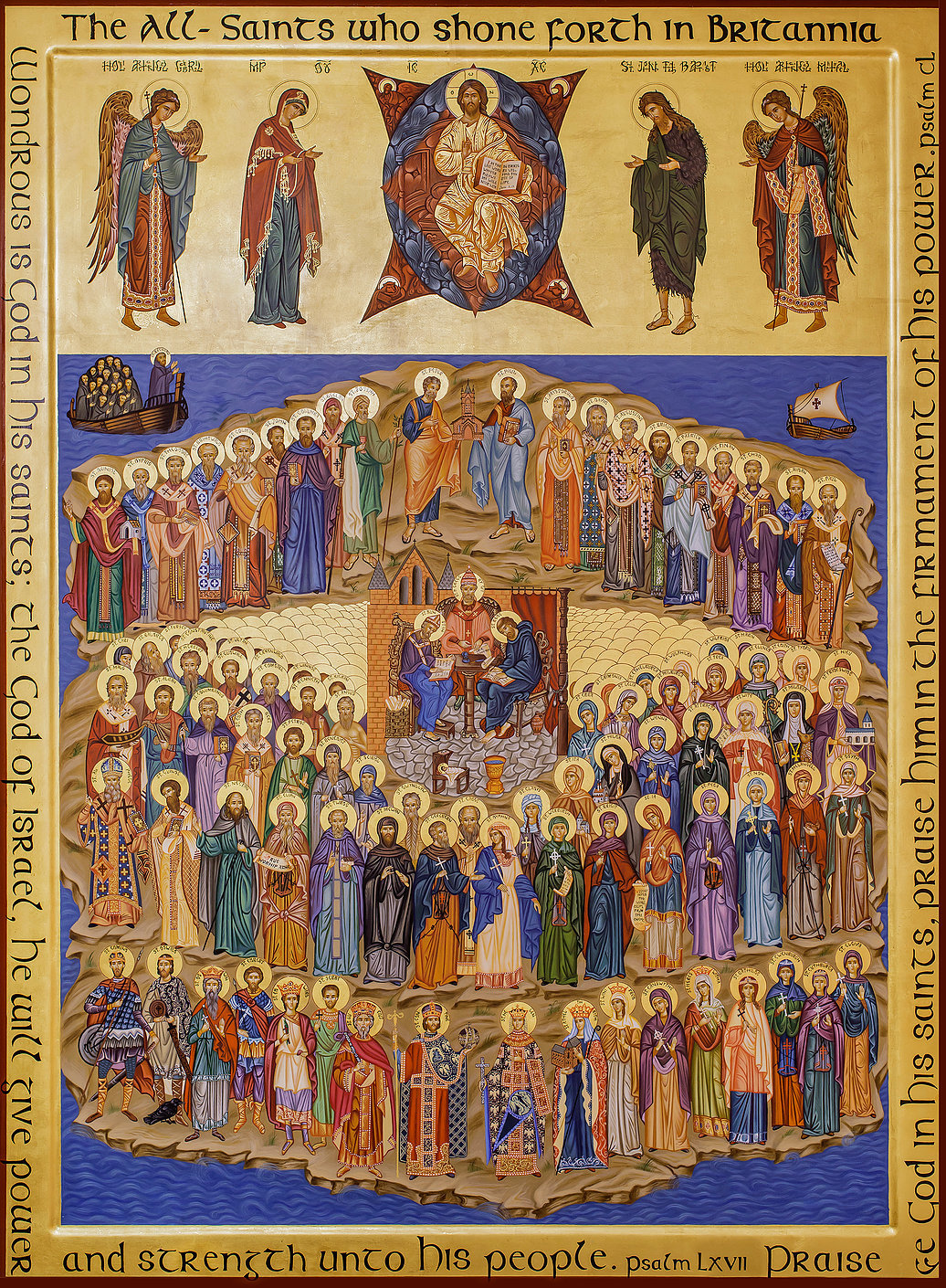
A calendar of the Pre-Schismatic Saints of Britain


THE MOST HOLY THEOTOKOS AND EVER-VIRGIN MARY
☩ Our Lady of Walsingham ☩ (15 Oct)

THE HOLY, GLORIOUS AND ALL-LAUDABLE LEADERS OF THE APOSTLES
☩ Apostle Peter (29 Jun)
☩ Apostle Paul (29 Jun)

THE FOUR PATRONS OF BRITAIN
☩ Holy and All-Laudable First-Called Apostle Andrew (30 Nov)
☩ Holy Hierarch Dewi of Mynyw, Bishop of Wales (1 Mar)
☩ Holy Hierarch Padrig of Armagh, Enlightener of Ireland (17 Mar)
☩ Greatmartyr, Victory-Bearer and Wonderworker George of Lydda (23 Apr)

THE FIRST MARTYRS AND ENLIGHTENERS OF BRITAIN
☩ Holy Apostle Aristobulus of the Seventy, Bishop of Britain (16 Mar)
☩ Alban, Protomartyr of Britain (22 Jun)
☩ Holy Priestmartyr Amphibalus of Verulamium (25 Jun)
☩ Martyrs Aaron and Julius of Caerleon (1 Jul)
☩ Righteous Joseph of Arimathæa (31 Jul)

THE HOLY SAINTS OF BRITAIN
☩ Dryhthelm of Melrose (1 Sep)
☩ Heiu of Tadcaster (2 Sep)
☩ Ealhmund of Hexham (7 Sep)
☩ Wulfþrýð of Wilton (9 Sep)
☩ Wulfhild of Barking (9 Sep)
☩ Ciarán ‘the Younger’ of Clonmacnoise (9 Sep)
☩ Deiniol of Bangor (11 Sep)
☩ Ailbe of Emly (12 Sep)
☩ Éanswíþ of Folkestone (12 Sep)
☩ Éadgýð of Wilton (16 Sep)
☩ Theodore of Tarsos (19 Sep)
☩ Adamnán of Iona (23 Sep)
☩ Ceolfrið of Jarrow (25 Sep)
☩ Barrwg of Ynys Barri (27 Sep)
☩ Leoba of Schornsheim (28 Sep)
☩ Tetta of Wimbourne (28 Sep)
☩ Sadwrn ‘the Knight’ of Llansadwrn (29 Sep)
☩ Honorius of Canterbury (30 Sep)
☩ Máel Dub of Malmesbury (2 Oct)
☩ Fragan of Armorica (3 Oct)
☩ Ósg‎ýð of Chich (7 Oct)
☩ Cynog of Powys (7 Oct)
☩ Tanwg of Harlech (10 Oct)
☩ Iestyn of Anglesey (10 Oct)
☩ Paulinus of York (10 Oct)
☩ James the Deacon (11 Oct)
☩ Æþelburg of Barking (11 Oct)
☩ Éadwine of Northumbria (12 Oct)
☩ Wilfrið of Ripon (12 Oct)
☩ Harold of England (14 Oct)
☩ Nóðhelm of Canterbury (17 Oct)
☩ Gwen of Talgarth (18 Oct)
☩ Friðuswíþ of Oxford (19 Oct)
☩ Acca of Hexham (20 Oct)
☩ Mellon of Rouen (22 Oct)
☩ Maelor of Sark (24 Oct)
☩ Gwynnog of Llanwonno (26 Oct)
☩ Eata of Hexham (26 Oct)
☩ Ælfrǽd ‘the Great’ of Wessex (26 Oct)
☩ Éadsige of Canterbury (28 Oct)
☩ Sigeberht of East Anglia (29 Oct)
☩ Æþelnóð of Canterbury (30 Oct)
☩ Cadfan of Bardsey (1 Nov)
☩ Erc of Slane (2 Nov)
☩ Gwyddfarch of Meifod (3 Nov)
☩ Gwenffrewi of Gwytherin (3 Nov)
☩ Byrnstán of Winchester (4 Nov)
☩ Kea of Devon and Cornwall (5 Nov)
☩ Fili of Cornwall (5 Nov)
☩ Illtud ‘the Knight’ of Llanilltud Fawr (6 Nov)
☩ Cyngar of Congresbury (7 Nov)
☩ Gwyddnog of Padstow (7 Nov)
☩ Cybi ‘the Tawny’ of Caer Gybi (8 Nov)
☩ Tysilio of Brittany (8 Nov)
☩ Pabo the ‘Pillar of Britain’ (9 Nov)
☩ Justus of Canterbury (10 Nov)
☩ Elaeth of Anglesey (11 Nov)
☩ Lebuin of Deventer (12 Nov)
☩ Dyfrig of Wales (14 Nov)
☩ Malo of Aleth (15 Nov)
☩ Hild of Whitby (17 Nov)
☩ Juðwara of Dorset (18 Nov)
☩ Maodez of Brittany (18 Nov)
☩ Æbbe of Minster (19 Nov)
☩ Bernward of Hildesheim (20 Nov)
☩ Éadmund of East Anglia (20 Nov)
☩ Columbán of Luxeuil (21 Nov)
☩ Éanflæd of Whitby (24 Nov)
☩ Cyngar of Congresbury (27 Nov)
☩ Ælfríc of Abingdon (28 Nov)
☩ Tudwal of Tréguier (30 Nov)
☩ Berin of Dorchester (3 Dec)
☩ Stinan of Ramsey Island (5 Dec)
☩ Beuzeg of Dol (8 Dec)
☩ Éadburg of Thanet (12 Dec)
☩ Fionnán of Clonard (12 Dec)
☩ Corentin of Quimper (12 Dec)
☩ Hygebald of Hibaldstow (14 Dec)
☩ Drostan of Deer (15 Dec)
☩ Judicaël of Brittany (17 Dec)
☩ Sturm of Fulda (17 Dec)
☩ Wynnebald of Heidenheim (18 Dec)
☩ Hildalíþ of Barking (22 Dec)
☩ Ecgwine of Worcester (30 Dec)
☩ Mael Rhys of Bardsey (1 Jan)
☩ Tyfrydog of Anglesey (1 Jan)
☩ Peter of Canterbury (6 Jan)
☩ Cedd of Lastingham (7 Jan)
☩ Cwyllog of Anglesey (7 Jan)
☩ Hadrian of Canterbury (9 Jan)
☩ Beorhtwald of Canterbury (9 Jan)
☩ Sǽþrýð of Faremoutiers (10 Jan)
☩ Benedict Biscop of Wearmouth (12 Jan)
☩ Eilian of Cornwall (13 Jan)
☩ Cyndeyrn ‘Mungo’ of Glasgow (14 Jan)
☩ Íte of Killeedy (15 Jan)
☩ Ceolwulf of Lindisfarne (15 Jan)
☩ Fursa of Burgh (16 Jan)
☩ Mildgýð of Minster (17 Jan)
☩ Theodosius ‘the Great’ of Rome (17 Jan)
☩ Ninnidh ‘the One-Eyed’ of Inishmacsaint (18 Jan)
☩ Cadog ‘the Wise’ of Llancarfan (24 Jan)
☩ Dwynwen of Llanddwyn (25 Jan)
☩ Torhtgýð of Barking (26 Jan)
☩ Gildas ‘the Historian’ of Rhuys (29 Jan)
☩ Bealdhild of Ascania (30 Jan)
☩ Brigid of Kildare (1 Feb)
☩ Seiriol ‘the Fair’ of Penmon (1 Feb)
☩ Euny of Lelant (2 Feb)
☩ Ia of St Ives (3 Feb)
☩ Laurence of Canterbury (3 Feb)
☩ Wærburg of Ely (3 Feb)
☩ Ansgar of Bremen (3 Feb)
☩ Rimbert of Bremen (4 Feb)
☩ Eborius of York (6 Feb)
☩ Restitutus of London (6 Feb)
☩ Adelphius the Bishop (6 Feb)
☩ Richard of Wessex (7 Feb)
☩ Iago of Saint-Jacut (8 Feb)
☩ Ælfflæd of Whitby (8 Feb)
☩ Teilo of Llandeilo Fawr and Llandaff (9 Feb)
☩ Cædmon of Whitby (11 Feb)
☩ Æþelwold of Lindisfarne (12 Feb)
☩ Eormenhild of Ely (13 Feb)
☩ Æþelgár of Canterbury (13 Feb)
☩ Sigefrið of Växjö (15 Feb)
☩ Finan of Lindisfarne (17 Feb)
☩ Colmán of Lindisfarne (18 Feb)
☩ Mildburg of Much Wenlock (23 Feb)
☩ Boisil of Melrose (23 Feb)
☩ Æþelberht of Kent (24 Feb)
☩ Wealdburg of Heidenheim (25 Feb)
☩ Ósweald of Worcester (28 Feb)
☩ Swiðberht of Kaiserswerth (1 Mar)
☩ Ceadda of Lichfield (2 Mar)
☩ Non of Dirinon (2 Mar)
☩ Gwenolau of Landévennec (3 Mar)
☩ Piran of Perranzabuloe (5 Mar)
☩ Billfrið of Lindisfarne (6 Mar)
☩ Balthere of Lindisfarne (6 Mar)
☩ Cyneburg of Peterborough (6 Mar)
☩ Cyneswíþ of Peterborough (6 Mar)
☩ Tibba of Peterborough (6 Mar)
☩ Eosterwine of Wearmouth (7 Mar)
☩ Felix of Dunwich (8 Mar)
☩ Bosa of York (9 Mar)
☩ Custennin of Cornwall (9 Mar)
☩ Óswine of Deira (11 Mar)
☩ Custennin of Strathclyde (11 Mar)
☩ Óengus ‘the Culdee’ of Tallaght (11 Mar)
☩ Gregory ‘the Dialogist’, Pope of Rome (12 Mar)
☩ Peulin ‘the Old’ of Léon (12 Mar)
☩ Ælfhéah ‘the Bald’ of Winchester (12 Mar)
☩ Benedict of Nursia (14 Mar)
☩ Éadweard of England (18 Mar)
☩ Cuðberht of Lindisfarne (20 Mar)
☩ Hereberht of Derwentwater (20 Mar)
☩ Liudgar of Billerbeck (26 Mar)
☩ Hǽlcelde of Middleham (28 Mar)
☩ Gwynllyw of Newport (29 Mar)
☩ Gwladys of Newport (29 Mar)
☩ Æþelburg of Lyminge (5 Apr)
☩ Brychan Brycheiniog (6 Apr)
☩ Ælfstán of Abingdon (6 Apr)
☩ Brynach of Nevern (7 Apr)
☩ Madryn of Boscastle (9 Apr)
☩ Beocca of Chertsey (10 Apr)
☩ Eðor of Chertsey (10 Apr)
☩ Gúðlác of Crowland (11 Apr)
☩ Padern of Vannes (15 Apr)
☩ Donnán of Eigg (17 Apr)
☩ Ælfhéah of Canterbury (19 Apr)
☩ Cædwalla of Wessex (20 Apr)
☩ Beuno of Clynnog (21 Apr)
☩ Máel Ruba of Applecross (21 Apr)
☩ Mellitus of Canterbury (24 Apr)
☩ Endelyn of Trentinney (29 Apr)
☩ Eorcenwald of London (30 Apr)
☩ Berhte of Kent (1 May)
☩ Asaph of Llanelwy (1 May)
☩ Brieg of Saint-Brieuc (1 May)
☩ Æþelræd of Bardney (4 May)
☩ Ósþrýð of Bardney (4 May)
☩ Éadberht of Lindisfarne (6 May)
☩ John of Beverley (7 May)
☩ Comgall of Bangor (10 May)
☩ Æþelheard of Canterbury (12 May)
☩ Damhnait of Geel (15 May)
☩ Breandán ‘the Navigator’ of Clonfert (16 May)
☩ Dúnstán of Canterbury (19 May)
☩ Helena of Constantinople (21 May)
☩ Elen ‘of the Hosts’ of Caernarfon (22 May)
☩ Aldhelm of Sherborne (25 May)
☩ Augustine of Canterbury (26 May)
☩ Bede of Jarrow (27 May)
☩ Melangell of Llangynog (27 May)
☩ Walstan of Bawburgh (30 May)
☩ Lul of Hersfeld (1 Jun)
☩ Oda of Canterbury (2 Jun)
☩ Cóemgen of Glendalough (3 Jun)
☩ Éadfrið of Lindisfarne (4 Jun)
☩ Pedrog of Padstow (4 Jun)
☩ Boniface of Crediton (5 Jun)
☩ Branwaladr of Milton Abbas (6 Jun)
☩ Willibald of Eichstätt (7 Jun)
☩ Willibrord of Frisia (7 Jun)
☩ Colum Cille of Iona (9 Jun)
☩ Iþamar of Rochester (10 Jun)
☩ Eskil of Tuna (11 Jun)
☩ Ternan of Culross (12 Jun)
☩ Eleri of Gwytherin (13 Jun)
☩ Éadburg of Winchester (15 Jun)
☩ Botwulf of Icanho (17 Jun)
☩ Nectan of Hartland (17 Jun)
☩ Hildegrim of Châlons (19 Jun)
☩ Mewan of Brittany (21 Jun)
☩ Æþelþrýð of Ely (23 Jun)
☩ Twrog of Maentwrog (26 Jun)
☩ Austell of Brittany (28 Jun)
☩ Euddogwy of Llandaff (2 Jul)
☩ Cenydd of Gower (5 Jul)
☩ Seaxburg of Ely (6 Jul)
☩ Erfyl of Llanerfyl (6 Jul)
☩ Modwen of Burton (6 Jul)
☩ Palladius of Ireland and Scotland (6 Jul)
☩ Hædde of Winchester (7 Jul)
☩ Æþelburg of Faremoutiers (7 Jul)
☩ Éadgár of England (8 Jul)
☩ Sunngifu of Selja (8 Jul)
☩ Iwerydd of Chittlehampton (8 Jul)
☩ Mwynen of Morwenstow (8 Jul)
☩ Wihtburg of Dereham (8 Jul)
☩ Eoforhild of Everingham (9 Jul)
☩ Mildþrýð of Thanet (13 Jul)
☩ Willehad of Bremen (13 Jul)
☩ Deusdedit of Canterbury (14 Jul)
☩ Swíþhún of Winchester (15 Jul)
☩ Helier of Jersey (16 Jul)
☩ Cynehelm of Winchcombe (17 Jul)
☩ Gwen ‘the Three-Breasted’ of Dorset (18 Jul)
☩ Frideric of Utrecht (18 Jul)
☩ Teneu of Glasgow (18 Jul)
☩ Samson of Dol (28 Jul)
☩ Óláfr of Norway (29 Jul)
☩ Germain of Auxerre (31 Jul)
☩ Neot of Cornwall (31 Jul)
☩ Sidwell of Exeter (1 Aug)
☩ Óswald of Northumbria (5 Aug)
☩ Beorhthelm of Ilam (10 Aug)
☩ Athracht of Lough Gara (11 Aug)
☩ Jænberht of Canterbury (12 Aug)
☩ Wihtberht of Fritzlar (13 Aug)
☩ Tydfil of Penydarren (23 Aug)
☩ Æbbe ‘the Elder’ of Coldingham (25 Aug)
☩ Gregory of Utrecht (25 Aug)
☩ Bregowine of Canterbury (26 Aug)
☩ Ninian of Whithorn (26 Aug)
☩ Degymen of Watchet (27 Aug)
☩ Aidan of Lindisfarne (31 Aug)