Showing posts with label architecture. Show all posts

31 December 2023

Yinxu on the Mississippi——密西西比河边殷墟

As mentioned in my blog post about Ulysses S Grant yesterday, I got to visit Cahokia Mounds State Historic Site together with my in-laws. Cahokia. Immense, monumental ancient step-pyramids and earthen mounds that date back a thousand years… right at the southern tip of the American Midwest.

Cahokia, located just on the other side of the Mississippi River from St Louis, in Illinois, is a thousand-year-old archaeological site consisting of a number of large raised earthen structures, as well as the remnants of a wooden stockade and a ‘Woodhenge’—a now-reconstructed ring of 49 wooden posts which archaeologists believe to have functioned as an immense solar calendar, used to calculate the equinoxes. Monks Mound is the largest pyramid north of the Mexican border, with a base measuring 13 acres in area (equal to the Great Pyramid at Giza), 955 feet across and 775 feet wide, and currently reaching a height of 100 feet.
The Cahokia Mounds were the site of a massive urban settlement between the years 900 and 1350 AD. From the archaeological evidence it can clearly be seen to have been a thriving centre of trade, with a distinct social hierarchy, metalworking and sophisticated astronomical and agricultural methods. (Woodhenge attests to the astronomical sophistication, as does the fact that the mounds and the plaza are constructed in an ‘hourglass’ shape bounded by two strict east-west lines of construction.) It could thus be said with ease, that the middle Mississippian polity which built and lived among the mounds was a civilisation in the true sense of the word.

It was a fascinating experience to walk in the shadows of the mounds… and then to climb Monks Mound with its sweeping vistas. There is something truly numinous about standing in Cahokia, a kind of awe that I have only twice or thrice felt before in my life: at the Yinxu Archaeological Site in Anyang; at Tianzi Jia Liu in Luoyang; and standing inside the old city walls in Luoyang and Xi’an. This is not the same as religious awe, the sense of standing in the presence of the Divine. For that, I go to Divine Liturgy, or pray before icons of Christ and His Mother. It is a very different, very human and this-worldly sort of awe—the sense of standing on a spot that you knew (not just felt, or fancied, but knew) that others had stood, three, five, ten thousand years before you. Call it civilisational awe.
It is standing in just such places—yea, even in places where mass human sacrifice was conducted—that one begins to understand what Konstantin Leont’ev understood in between the lines of his philosophical and medical writings. Cultures are alive; they have life-cycles. And even when they pass out of earthly existence and memory, they leave traces behind them that one can’t help but feel. However much our modern sensibilities, our religious and humanitarian scruples (which have been not so much earned on our own merits as entailed upon us by bitter experience of past ages), might turn back upon us at the contemplation of a civilisation perpetuating itself through the infliction of violent ritual death upon its own… there is nonetheless something truly splendid and grandiose about it, a kind of stoic and sanguine beauty which pervades the remains.

It was fascinating to walk amid this ancient monument, this millennium-old testament left by a pre-contact Indigenous civilisation, together with three Chinese people who are very near and dear to me. What was interesting in particular to me was how close the ancient sites of their own intimate knowledge were to the fore of their minds as we walked together.
Their first thought, also, was to liken the place to Yinxu, and also to the Bingmayong. The cruelty—the picturesque cruelty, the cruelty of fell beauty—of a Shang state perpetuated by mass human sacrifice, or of the First Qin Emperor who built a great Wall partly with the blood and bones of the men that he ruled, posed a ready parallel to what one might see at Mound 72. Hundreds of virgin maidens, exquisitely arrayed in marine shells, and then slain and arrayed at the southernmost point of the complex, their remains aligned in perfect reverence with the cardinal directions, the eternal tracks of sun and moon and season, giving life and death in their turn…

And what right have we, we shallow and arrogant children, we neonates in the grand scheme, to pass judgement upon this civilisation or those who inherited it? What do we know of what is sacred, or of what is true or what is correct? What price have we paid for that knowledge? Let’s give Nietzsche his due and acknowledge it: nowhere close to a price high enough, assuredly. Today we palefaces wax sentimental and lachrymose over the fate of the idealised Native American, with his fading ethic of spiritual and environmental harmony… yet we have no deep understanding by what route, by what autochthonous root in fact, the Indigenous peoples of this continent have come to such an ethic.
The stately, bloody grandeur of the Cahokia Mounds, even in its ruined current state, speaks still in resounding echoes of its former colossal resplendence, followed by its equally titanic collapse… this was the price, these were the conditions under which the Dakota and their cousin-nations learned what wisdom they still hold about the necessity of humility in the face of nature, about the need to honour one’s connectedness to others before the Creator. And the ancestors of the Lakota and Dakota, of the Kansa and Ponca, of the Ho-Chunk, the Choctaw and the Creek—they earned that wisdom, and carefully tended it down the generations, easily over 150 years before the white man ever laid eyes on the silver banks of the Mississippi.

The posited prehistoric connexions between the Han Chinese and the Indigenous peoples of this continent may be vastly overstated. But what is true, is that the Chinese civilisation and the heirs to the Cahokian civilisation (let’s not be coy and pretend that we don’t know who they are, or that they aren’t still with us today), share a great deal in common, when it comes to having dealt with the life-cycle of their civilisations. Let’s not whitewash those similarities, and still less downplay them or sentimentalise them or moralise them. Let us face them as they are.

If these ruminations on Cahokia strike one as too pre-Christian, too radical-reactionary, too culturally-maximalist, too elegiac of premodern brutality—in short, too Leont’evian—good. I want people to feel at least a glimmer of the mingled discomfort and awe that I felt as I led my feet and legs carefully along the tended paths, between and among the mortuary grounds and the hallowed heights of those ancient mounds.

06 November 2020

Learning from the restorers of Moldova


In the West we seem to be sliding down a slippery slope towards a diabolical post-humanism. There exists a certain project, something along the lines of what CS Lewis imagined in That Hideous Strength, which the highest-profile global élites – the likes of Elon Musk and Jeff Bezos and Mark Zuckerberg – want to put into action. I am convinced that they already believe themselves to be something not-quite-human, more-than-human, and are attempting to implement measures that will reduce those who are not in their clique to a realm of the less-than-human. I think Elon Musk tends to be the one who has the least verbal filter when it comes to things like a post-Earth society for the one-percenters or man-machine interfaces. But these are priorities which are shared across at least the Western billionaire caste.

Personally I am not sure that they can be stopped by conventional means. It may end up taking a full-scale civilisational collapse to bring about their downfall: a collapse we seem to be in the middle of already. Then: there was also a wealthy élite class that thought they were going to rule forever. Then: there was also a protracted state of political crisis that the élite class could not and did not care to address. Then: when the structures of the state fell down around them, hastened by barbarian invasions, they retreated into their own private infrastructure and left the rest of humanity to fend for themselves. Then: Benedictinism and land-sharing schemes rose to fill the void, and at least some semblance of culture was preserved.

I admit, I do not have much respect for the attempts, at least in America, to throw weight behind a purely negative cultural counter-elitism which has nothing of substance to offer. There is nothing true, or good, or beautiful about the Trump brand, which was and always will be a façade, a ruse to fool the gullible. Likewise with the attempts in some corners of Europe – such as Poland and Hungary – to attempt to decree a better order, inspired by a Gothic æsthetic, back into existence from the commanding heights. (We can see how well this is working out.) These soi-disant saviours of Western civilisation only hurry its ruin.

I know, and I have been told several times by my frustrated comrades, that my outlook is fairly bleak and cynical, and that I do not seem to have a way out. It’s true. I don’t. Speaking from a local perspective: I have no love or respect for a cruel, crass status quo ante which could suffocate George Floyd without a qualm. But I have even less love or respect for the sort of blind, unfeeling rage that only wants to tear it all down – or, worse still, the cold indifference that can look on as one’s own city burns and applaud the people doing it from a vantage of safety. I am angry, and have been for a long time, at those who saw the death of a man undeserving of death, and used it as an opportunity for plunder. I still seethe at the attempt to justify looting behind words of high principle, as though the first reaction upon seeing a murder in the street is to break into your neighbour’s house and steal his tableware! George Floyd’s murder is deserving of justice. How is justice for him achieved by out-of-state agitators setting fire to our town? How is justice for him achieved by leaving the black protesters in the daylight to take the blame? How is justice for him achieved by pundits living in safety, piously folding their hands? Yes, I accuse them all: both the nihilists and the fascists. Sadly, we now have a ‘woke’ liberal centre that is fine with such nihilists in its midst. And we now have a far-right that is fine with fascists in its midst.

So where are the people who are building things of beauty – or at least doing the best to preserve what things of beauty they already have? Where are the people who genuinely feel there is something worth saving on this earth? Where are the people who can look at their past and not see only shame and brokenness? Where are the people who can look at their present and still feel some glimmer of hope? Don’t look now: I think they may be in Moldova.

Moldova was – and is – one of the poorest countries in Europe. (Long story short: it got hit hard by Western-imposed shock therapy and never recovered.) It is riven by culture war battles over whether or not it is culturally Romanian. It is riven by a political crisis in the breakaway province of Transnistria that is still unresolved. But its political leadership, under Igor Dodon and the PSRM, has been heavily investing in public infrastructure – things like parks, playgrounds and schools – and also trying to reinvigorate Moldova’s public architecture, including its distinctive mediæval religious architecture, by sending young architects to Italy to study reconstruction and restoration.

Any idiot can tear down a statue. It takes real talent, real creative ingenuity and constant effort, to conserve what is already beautiful in the public space, and then add to it. One of the things that the Moldovan architects had to learn, in the key architectural difference between reconstruction and restoration, was humility. The restoring architect has to restrain his own ego, to quiet his own judgement. If an architect wants to preserve something effectively, he first has to sit down and learn how the original was built. And once he has done that and he is ready to proceed himself, he can’t copy the original too perfectly, lest later builders coming after him who might have better techniques for restoring old buildings want to improve on his work without damaging what is left of the original.

There is wisdom in what Igor Dodon is doing in his country – quietly and almost unnoticed. It’s not glamourous, it doesn’t grab headlines. He isn’t blaming other countries for what has gone wrong in his own. He isn’t telling the Molodaya gvardiya to go out and tear down statues of Ștefan cel Mare. On the contrary, his party lays claim to the great Prince Ștefan’s material and cultural legacy! But he is sending out young Moldovans to learn how to care for what is old and beautiful. Left parties in the West desperately need to take a leaf out of the book of the Moldovan socialists. (And right parties, too, for that matter.)

03 November 2020

Venerable Pimen the Athonite of Zographou

Saint Pimen of Zographou

The third of November in the Orthodox Church is also the feast-day of the holy and venerable Athonite father, Saint Pimen of Zographou. Another of the humble and gentle spirits in the mould of Saint Ivan of Rila and Saint Dimităr of Basarbovo, he belonged to the same nation that they did: the Bulgarian nation. He is a singular light in the dark times of the Ottoman occupation of Bulgaria, who with his own hands restored and built churches throughout his old homeland, and decorated them with beautiful frescoes.

Saint Pimen [Bg. Пимен] was born in the city of Sofia. His parents were elderly, and his mother had hitherto been barren before his birth. One night in a dream, his mother received a vision from the Holy Theotokos in a white raiment, surrounded by a multitude of ascetics. The Mother of God gave the woman to know that she would lift the barrenness from her, and also that she would bear forth a son, whose occupation in the world was indicated by those around her in the apparition. Departing from her, the woman was filled with joy, and she conceived.

She bore her son on the twenty-ninth of June, 1540. Because it was the feast-day of the leaders of the Apostles, she christened her son with the name of Pavel. From when he was young, his parents sent him to study with an elderly hieromonk named Toma, who had been on Athos when he was younger but who then served in the Church of Saint George the Greatmartyr in Sofia. The venerable Toma taught young Pavel not only his Cyrillic letters, but also how to read Holy Scripture, and as well the arts of church singing and iconography.

After his parents died, so too did young Pavel’s mentor meet his repose. On the fortieth day after his death, the hieromonk Toma appeared to Pavel in glory, and bade him go to the Holy Mountain, which would be the site of his salvation. And so Pavel took all he had – everything that his parents had left him – sold it and divided it amongst the poor of Sofia, and brought himself to the Monastery of Zographou on Mount Athos. It was here that he took the tonsure, along with the monastic name of Pimen.

Zographou Monastery, Athos, Greece

Young Pimen took quite readily to the monastic life. He was humble, thinking of himself only as a sinner, and showed himself to be kindly and gentle to all. It was natural that the other monks would come to him for a word, and his brother-monks took to calling him ‘the young Abba’. He was not, however, without enemies, for the Evil One works his way in everywhere, and preys upon the hearts of the heedless and unsuspecting. One monk became bitterly jealous of Pimen’s virtues, and took his cloak and cast it into the fire. The cloth, however, did not catch light – instead, wherever it touched the fire, the fire was extinguished. And just as the cloth extinguished the fire, so too did Pimen’s humility and goodwill overcome the malice sown in the hearts of his brethren by the wiles of the ancient enemy.

On his thirtieth birthday, on the feast-day of Saint Peter and Saint Paul, the Bishop of Edessa Pamfil Vodenski visited the Zographou Monastery. Against his will, the Bishop of Edessa made the young monk Pimen into a priestmonk, to serve at Zographou. Each time the young priestmonk served the Liturgy, it was with tears in his eyes as he gave to all the Body and Blood of Christ. He also gained the gift from God of wonderworking prayer. He conducted an exorcism upon one of the brethren who was tormented by dæmons, and on another occasion one brother was bitten by a poisonous serpent and died. Saint Pimen raised the brother to life again and expelled the atter by his prayers.

So that he would not fall victim to vainglory, he implored the abbot to allow him to go into some secluded place and there live the life of an anchorite. With great reluctance the abbot assented, and so Pimen left Athos for the woodlands nearby. He built a simple hut of sticks for himself, and ate only chestnuts and wild weeds for his food. He only ventured into Athos to partake of the Holy Elements. On one occasion he was visited by two brother-monks, when a wildfire broke out and threatened to engulf the enclave. But Saint Pimen made the Sign of the Cross and prayed to heaven, and at once a stormcloud blew up and a torrential downpour began, extinguishing the fire before it could reach the saint’s hut.

Thus he spent twenty-five years in his little hut near Athos. One day as he knelt in prayer he was visited in a vision by Saint George of Lydda, who was the patron both of his home church in Sofia and of the Zographou Monastery. The mighty soldier and meek martyr told Pimen that it was God’s will that he sojourn again among his own people and blood kin, who were like a flock of lost sheep without a shepherd to guard them from the beasts.

Saint Pimen – good Orthodox monk that he was – at once suspected himself of vainglory and did not believe the vision, thinking it to be possibly dæmonic in origin. And so he went to one of the elders of Athos and asked him his advice. Only when the elder perceived Saint Pimen’s vision to be genuine did he accept a blessing from the abbot, and departed into Bulgaria. He took with him a monastic disciple who was also named Pamfil, who would later commit Saint Pimen’s Life to writing. It was with sad joy and with many tears that the brothers came forth to bid farewell to Pimen, and they went with him to the borders of the lands of Zographou.

Over many years Saint Pimen travelled throughout Bulgaria. He went first to Sofia and into the villages around there, then spent some time in the Petritsoni Monastery of the Holy Dormition in Bachkovo, in southern Bulgaria. He sojourned in the north as well: in Vidin, in Silistra, in other towns. Everywhere he went, he preached the Word of God and strengthened the Bulgarian people in their faith, and worked many wonders of healing with his prayers. One man of Silistra, born blind and given his sight by the saint, asked to be tonsured a monk. Though reluctant at first, seeking to be assured that it was the man’s own will, he at last granted the man’s wish.

Saint Pimen also built churches wherever he went, or else renovated old ones which had fallen out of use under Turkish persecution, harassment and harsh taxes. He is credited with having built up or repaired as many as three hundred parish churches and fifteen monasteries with his own hands, as well as decorating them in beautiful frescoes and icons. His buildings were inspired by the Balkan Tărnovo School of architecture that characterised both Zographou and Petritsoni: compact rectangular floor plans and arched reliefs in the high stone walls. Two examples of his work are the Assumption Monastery in Cherepish, which became an important centre for calligraphy and illumination in early modern Bulgaria, and also the Suhodol Monastery of the Holy Trinity. Toward the end of his life he returned to Cherepish; it was there that the venerable saint reposed at the age of eighty years, in the year 1620. Holy venerable Pimen, builder of churches and upbuilder of the faith among the Bulgarian people, pray unto Christ our God that our souls may be saved!

Cherepish Monastery, Stara Planina, Bulgaria

20 June 2020

Holy architecture in Orthodoxy and Chinese religion


The Temple of Heaven, Beijing

At present I’m reading Fr Thomas Hopko’s The Orthodox Faith: an Elementary Handbook on the Orthodox Church series, and I’m currently on the second volume, on Worship. As I was reading Fr Thomas’s exposition on the structure of Orthodox temples, I was at once struck by a fascinating similarity, both in outward appearance and in design principles, between the outlay of an Orthodox church built according to the traditional architectural schematics, and the outlay of a Chinese temple in the Rujia or Daojia traditions.

In traditional Chinese cosmology there is the principle of tian yuan di fang 天圓地方 (literally: ‘Heaven is round; Earth is square’). We should be clear that this understanding of the outlay of the cosmos is mystical and ceremonial; we might even say, by analogy, liturgical. Postclassical Chinese observers such as Zhang Heng 張衡, just like ancient Greek ones, understood perfectly well from their naturalistic observations, that the physical earth has a spherical shape and is situated in the midst of the atmosphere like the round yolk inside the white and shell of an oval egg. However, the classical view of tian yuan di fang was meant to articulate, in an intuitive spiritual sense, the orientation of the human being to both the heavens and the earth.

This classical view is set forward in a Han Dynasty text, Dai the Elder’s Book of Rites (Da Dai Liji 《大戴禮記》), which was compiled around the same time as his nephew Dai the Younger compiled the canonical pre-Qin Ru classic, the Book of Rites. Dai the Elder’s name was affixed to the former text in later commentaries in order to distinguish the two. In any event, here Dai the Elder recounts a conversation between the disciple of Confucius Zengzi 曾子 and one of his students, Dan Juli 單居離, on the subject of the orientation of the human being to earth and heaven. This saying, which Zengzi contributes to Confucius himself, forms the basis of the principle tian yuan di fang. One can see from this that the ‘squareness’ of the earth and the ‘roundness’ of heaven are to be taken in a symbolic way rather than a naturalistic one. Note the mystical language and its relation to yin-yang cosmology and the classical elements, or wu xing:
「且來!吾語汝。參嘗聞之夫子曰:『天道曰圓,地道曰方,方曰幽而圓曰明;明者吐氣者也,是故外景;幽者含氣者也,是故內景,故火日外景,而金水內景,吐氣者施而含氣者化,是以陽施而陰化也。陽之精氣曰神,陰之精氣曰靈;神靈者,品物之本也,而禮樂仁義之祖也,而善否治亂所由興作也。』」

Come! I’ll explain it to you. I’ll refer to the discourse of the Master [Confucius]: ‘The Way of Heaven is round; the Way of earth is square. Squareness is called “deep” and roundness is called “bright”. Bright things give off energy [or breath], and throw shadows on the exterior. Deep things conceal energy, and they make shadows inside. Fire and sun[light] throw external shadows; metal and water make internal shadows. That which gives off energy generates, and that which conceals energy receives – in the same way that yang generates and yin receives. Yang’s essential breath is called “spirit”; and yin’s essential breath is called “numinousness”. Spirit and numinousness: these are the foundations of things; they beget rites and music, benevolence and justice; they tell us if good or evil, [social] order or chaos, are being produced.’
A quick note: the translations of ‘spirit’ for shen 神 and ‘numinousness’ for ling 靈 are not mine; these are suggested by Mark Csikszentmihalyi in his compilation of Readings in Han Chinese Thought. In modern Chinese, shen refers to any god – including the God of the Abrahamic religions – while ling refers to the human soul. It is perhaps a bit fanciful to relate these three terms qi, shen and ling to the Greek philosophical terms πνεῦμα, λόγος and νοῦς, respectively. However, one can see from the suggestion of this text – with shen referring an active-generative capacity and ling having a sensate-receptive one, and the breath being both an inward and an outward spiration – that the general contours of these analogical correspondences could be considered valid. For the classical Chinese mind, as well, the human being is literally a microcosm. In traditional Chinese medicine, human beings are intimately connected with their surroundings, and the internal workings of the human body are a functional mirror of the cosmic order.

But now we’re getting way into the weeds, and perilously so, particularly if we consider the following tale from the Daoist classic Zhuangzi. The tian yuan di fang principle is also referred to – albeit in a playfully pejorative way – in one of this text’s memorable vignettes. In this case, when talking with Duke Ai of Lu, the philosopher Zhuang Zhou makes reference to the ‘round caps’ and the ‘square shoes’ of the Ru literati, who in dressing this way signal that they try to follow the ways of heaven and earth:
莊子見魯哀公。哀公曰:「魯多儒士,少為先生方者。」莊子曰:「魯少儒。」哀公曰:「舉魯國而儒服,何謂少乎?」莊子曰:「周聞之:儒者冠圜冠者,知天時;履句屨者,知地形;緩佩玦者,事至而斷。君子有其道者,未必為其服也;為其服者,未必知其道也。公固以為不然,何不號於國中曰『無此道而為此服者,其罪死』?」於是哀公號之五日,而魯國無敢儒服者。獨有一丈夫儒服而立乎公門,公即召而問以國事,千轉萬變而不窮。莊子曰:「以魯國而儒者一人耳,可謂多乎?」

At an interview of Zhuangzi with Duke Ai of Lu, the duke said, ‘There are many of the Learned class in Lu; but few of them can be compared with you, Sir.’

Zhuangzi replied, ‘There are few Learned men in Lu.’

‘Everywhere in Lu,’ rejoined the duke, ‘you see men wearing the dress of the Learned - how can you say that they are few?’

‘I have heard,’ said Zhuangzi, ‘that those of them who wear round caps know the times of heaven; that those who wear square shoes know the contour of the ground; and that those who saunter about with semicircular stones at their girdle-pendants settle matters in dispute as they come before them. But superior men who are possessed of such knowledge will not be found wearing the dress, and it does not follow that those who wear the dress possess the knowledge. If Your Grace think otherwise, why not issue a notification through the state, that it shall be a capital offence to wear the dress without possessing the knowledge?’

At this the duke issued such a notification, and in five days, throughout all Lu, there was no one who dared to wear the dress of the Learned. There was only one old man who came and stood in it at the duke’s gate. The duke instantly called him in, and questioned him about the affairs of the state, when he talked about a thousand points and ten thousand divergences from them. Zhuangzi said, ‘When the state of Lu can thus produce but one man of the Learned class, can he be said to be many?’
The architectural idea of tian yuan di fang in Chinese traditional buildings, and particularly those consecrated to holy purposes, determines how a traditional Chinese temple is archetypically laid out. Despite Zhuangzi’s dismissive attitude towards the principle, which he associated with the learned (ru 儒) followers of Confucius, the Daoists themselves also adopted tian yuan di fang in laying out and constructing their temples, when Daojia became an organised religion during the transitional period between the Han and Sui Dynasties. Daoist temples, or daoguan, were traditionally constructed on the southern slopes of mountains, making it easy to reflect the relation of heaven to earth. To the left is the stylised floor plan of a daoguan, from the Judge Dee mystery The Haunted Monastery by Dutch sinologist RH van Gulik.

The traditional Chinese temple is usually situated in the centre of an oval ground with its foci and long axis oriented north-south. The temple itself usually has a rectangular base structure oriented in the same way. In the northern rear of the temple, in the main altar or sanctum, the floor structure is (semi-)circular and elevated. This is meant to represent the heavens. The main altar is separated from the rest of the temple by a wall or a shrine. The southern front courtyard of the temple always has a rectangular floor plan, and is situated level with the surrounding landscape. This is meant to represent the earth. Here is a brief explanation of the way the Temple of Heaven in Beijing (which is not just one temple but in fact a whole complex of them) is laid out:
The overall planning of the Temple of Heaven met with basic ancient Chinese architectural ideas. A double ring of walls enclose the compound of temple structures. The ‘north circular’ and ‘south square’ meet with the Chinese traditional understanding of the cosmos as a ‘hemispherical dome’, situated over a ‘flat earth’. Similarly, the north wall was constructed higher than the south wall, signifying that Heaven is higher than Earth. As the temple was where the emperor would pray to the heavens, the temple’s design needed to reflect this relationship. In accordance with the theory of Hemispherical Dome, the north wall of the temple was designed to be circular, a symbol of Heaven’s shape; the south wall was to be square, representing the Earth’s appearance. The main temple buildings line up from north to south along the central axis of the compound. All the temple structures have a square or circular design, again representing the shapes of Heaven and Earth.
There is a directly analogous principle to tian yuan di fang, with regard to how the Orthodox church building is traditionally founded and built. Fr Thomas Hopko explains:
The interior of the Orthodox Church building is
particularly styled to give the experience of the unity of all things in God. It is not constructed to reproduce the upper room of the Last Supper, nor to be simply a meeting hall for men whose life exists solely within the bounds of this earth. The church building is patterned after the image of God’s Kingdom in the Book of Revelation. Before us is the altar table on which Christ is enthroned, both as the Word of God in the Gospels and as the Lamb of God in the Eucharistic sacrifice. Around the table are the angels and saints, the servants of the Word and the Lamb who glorify Him—and through Him, God the Father, in the perpetual adoration inspired by the Holy Spirit. The faithful Christians on earth who already belong to that holy assembly—‘…fellow citizens with the saints and members of the household of God…’ (Ephesians 2:19)—enter into the eternal worship of God’s Kingdom in the Church. Thus, in Orthodox practice the vestibule symbolises this world. The nave is the place of the Church understood as the assembly and people of God. The altar area, called the sanctuary or the holy place, stands for the Kingdom of God.
In an Orthodox church, the sanctuary is elevated and is set under a high dome on a semicircular floor plan: specifically to reflect heaven. This sanctuary is separated from the nave by the ikonostasis in a manner similar to the way in which the main courtyard of a Chinese temple is separated from the altar by the shrine. The vestibule represents the world while the nave (similar to the courtyard of a Chinese temple), where the people stand during the Divine Liturgy, is where the people of God are called out from the world to stand in the presence of God Who is in the altar as the elements of the Eucharist.

Unlike a traditional Chinese temple, which is built between two foci on a north-south axis with the altar on the northern side, an Orthodox church must be built between two foci on an east-west axis with the altar on the eastern side. However, here too, after a certain sense, the principle of tian yuan di fang is followed. The west, representing death, sin and the fallen state of the world, is where the vestibule is situated; the progression towards the altar in the east is a progression towards the Kingdom of Heaven, towards life and its æternal source in Christ. This is in keeping with the mindset common to the classical cultures of Ægypt, Sumer and Greece, in which one determines direction – that is, literally orients oneself – by facing the rising sun.

Even in the principles of architecture, there are obvious and natural consonances between the worldview of the righteous philosophers who lived and strove after the truth, and that Truth which was revealed in its fullness from among the people of Israel in the person of Christ. Daojia and Rujia both contain incredible profundities of wisdom and truth in their own right, which are born from the careful and methodical study of nature, the desire for harmony, the quest for loving-kindness, the exploration in stillness of the heart ‘which is deep beyond all things’, the anticipation of a perfect Sage who will rightly order the cosmos to its proper ends. Orthodox Christianity is in full agreement with all of this. Again, as Fr Thomas Hopko puts it:
At this point it must be mentioned that although God’s self-revelation in history through the chosen people of Israel--the revelation which culminates in the coming of Christ the Messiah--is of primary importance, it is also the doctrine of the [Orthodox] Christian Church that all genuine strivings of men after the truth are fulfilled in Christ. Every genuine insight into the meaning of life finds its perfection in the Christian Gospel. Thus, the holy fathers of the Church taught that the yearnings of the pagan religions and the wisdom of many philosophers are also capable of serving to prepare men for the doctrines of Jesus and are indeed valid and genuine ways to the one Truth of God.

Saint Sophia Cathedral, Harbin

06 February 2020

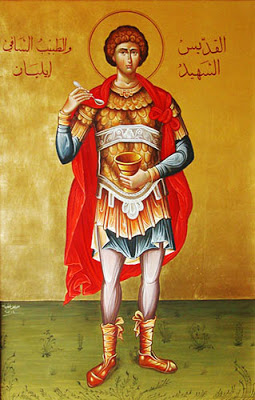
Holy Unmercenary and Righteous Martyr ’Iliyân of Homs


Saint ’Iliyân of Homs

Today in the Holy Orthodox Church we venerate Mâr ’Iliyân, a third-century martyr for Christ who died under the persecution of Roman Emperor Maximian. Mâr ’Iliyân was a Phœnician, and a native of the city of Emesa – modern-day Homs.

’Iliyân [also Julian, Elian or Ellien] was born to pagan parents. Emesa was at that time a centre of pagan worship on account of the Temple of El-Gabal which stood in the Citadel. Christianity was not a noteworthy presence there, which makes Saint ’Iliyân’s conversion the more notable. Even so, when he converted to Christendom, he sought out the best way of using the talents given to him for the glory of God. ’Iliyân took up the study of medicine, and became a physician:
Having set his hopes in Jesus Christ, he was not tempted by the glory of this ephemeral world. He prayed day and night, practiced fasting, visited prisoners and comforted them. He gave out large alms of what remained in excess in his father’s house. Ellien studied and practiced medicine skillfully. He strived to cure the diseases of both the body and soul. He cured sick people by Christ’s grace and the faith of the Apostles, while preaching God’s Word and urging them to follow the path of virtue. ‘It is not’, he says, ‘with medicines that you will be cured of your illness nor thanks to your idols which drive to perdition all those who kneel before them, but by the power of Jesus Christ’s name who has been crucified by the Jews under Pontius Pilate in Jerusalem, who has been buried and resuscitated on the third day.’
Saint ’Iliyân was notably not motivated by monetary gain. He is commemorated among the Anárguroi or Unmercenaries, saints – mostly healers and physicians – who refused to accept money for doing good works. In contradistinction to the medical practice of the day (and, for that matter, medical practice now), the Anárguroi would not turn away anyone who couldn’t pay for healing and medical care – or who had a ‘præ-existing condition’! – and they looked after the sick free of charge. As mentioned above, Saint ’Iliyân used his intelligence and skill to heal the bodies of the ill, and also proclaimed the Gospel of Christ through his actions and his way of life. If he lived in modern-day America, I’m sure Saint ’Iliyân would be condemned as a dangerous radical – as in early fourth-century Rome under the persecutions of Maximian he actually was.

The pagan doctors of Emesa grew both jealous of his skill and afraid of the popularity of his cures which were given out gratis. They first complained of him to his father, who was a Roman magistrate in Emesa. His father threatened him and appealed to his self-preservation in an attempt to get him to give up his medical practice, and also to stop preaching Christ. Saint ’Iliyân would do neither. He feared no earthly judge, not even his father, but instead only the heavenly Judge who would judge according to how he had used his talents and how he had treated the least of his brothers. As he continued his practice of healing and preaching the Gospel, his enemies went over his father’s head and appealed to the Roman governor of Emesa. The governor had Saint ’Iliyân thrown into prison alongside Bishop Silas, Deacon Luke and Reader Mocius.

Saint ’Iliyân, feeling himself unworthy of their company and yet overjoyed of it, prostrated himself at the feet of his fellow Syrian martyrs, and kissed the iron shackles which bound them. Saints Silas, Luke and Mocius were put to death in the arena soon thereafter, to be mauled by wild beasts. Saint ’Iliyân, left alone in the cell, prayed to God for courage, and he was sent a messenger who strengthened his spirit and prepared him for his own martyrdom.

Many grievous tortures were visited on Saint ’Iliyân, and yet he did not renounce his faith. All the time he continued to confess Christ who had died and was risen. Indeed, even after being tortured, he still went to his fellow-prisoners and healed their wounds and illnesses, refusing to cease his calling even as near as he was to his own end, which came on the sixth of February, 312 – though some authorities say 284. Saint ’Iliyân’s own father had him executed, by driving twelve long nails through his head on the killing ground. He was left for dead, but he did not die there. He managed to crawl his way into a cave near the Gate of Palmyra which belonged to a Christian potter, who discovered his body there the following day. Waiting for the cover of darkness, the potter had the body conveyed to a church for burial. Saint ’Iliyân was buried on the east side of the altar.


Church of Saint Elian, Homs, Syria

Later he would be honoured with his own church in Homs, which was built over the potter’s cave in the year 432. The relics of Saint ’Iliyân were translated into a marble coffin and interred in a fitting shrine in the church’s crypt. They became the site of many more healings of the sick and distressed; as ’Iliyân had done in life, so he continued to do from his place in the heavenly kingdom. The Church of Saint Elian was deliberately damaged during several persecutions of the Church – under the Sunnî Muslim ‘Abbâsid caliph al-Mutawakkil most notably. At one point, only one small damaged corner of the church still stood, measuring nine by six metres. It was expanded in 1843 thanks to the heroic efforts of Fr Yûsuf (al-Rahabiya), being then too small to accommodate the number of worshippers and pilgrims who came there. Astoundingly, some of the wall and ceiling frescoes survived, having been discovered during a renovation of the church in 1969 under Bishop Alexios of Homs. These frescoes depict episodes from the life of Christ, the Holy Theotokos, the Prophets and the Holy Apostles. Dating back to the 500s AD, these are considered to be some of the oldest surviving examples of Orthodox iconography in Syria.


Interior frescoes, Church of Saint Elian

During the Syrian Civil War, His Holiness Patriarch John X (Yazigi) has officiated at the Divine Liturgy offered in remembrance of Saint ’Iliyân’s feast on the sixth of February. Prayers are offered to God, and the intercessions of His martyr are asked, for peace in Syria, for the healing of the country, and for the æternal remembrance of the heroic soldiers of the Syrian Arab Army and the people of Homs who have suffered and been killed in the war. Holy great-martyr and unmercenary ’Iliyân, pray unto Christ our God for the healing of us sinners!
Your holy martyr ’Iliyân, O Lord,
Through his suffering has received an incorruptible crown from You, our God.
For having Your strength, he laid low his adversaries,
And shattered the powerless boldness of demons.
Through his intercessions, save our souls!


HH Patriarch John X of Antioch
at the Church of Saint Elian in Homs, Syria, 2015

02 January 2020

Allan Carlson’s worthy pæan to the Midwest


I own it as a fault of mine that patriotic feeling for the United States is something that doesn’t come to me with particular ease. I’ve never been a particular fan of the American founding mythology or the Whig historiography that comes with it, and that’s something that long predates my conversion. Indeed, if anything, my loyalties go strongly in the other direction. What’s more: I fully own that there are both familial and psychosexual grounds for this. Such loyalties as I have tend to be regional, familial and local.

I say all the foregoing so you may imagine, gentle reader, the gratitude with which I read Dr Allan Carlson’s most recent article on Midwestern cultural history at Front Porch Republic! I think I may have noted before how influential his book Third Ways was on my own political development, both towards and away from the legacy of Christian democracy. But here: his polyphonic weaving together of influences across the fields of visual arts, poetry, prosody, music, history, sports and political activism across the Midwest is nothing short of stunning.

The focal point of the essay is a triumvirate of Midwestern cultural figures and their reactions to the Chicago World Fair of 1893. Radical novelist Hannibal Hamlin Garland, architect Frank Lloyd Wright and historian Frederick Jackson Turner are presented as the chief shapers of the ‘classic Midwestern identity’; even though these three men had dramatically divergent views of both the Fair, they all came to embody in their respective works the regionalism that Carlson celebrates.

The celebration of Iowa girls’ basketball is also worthy of note – the ‘six-on-six’ half-court games that were unique enough to attract a considerable regional following. Carlson tantalisingly quotes sports historian Max McElwain that these Iowa girls’ basketball leagues represented a ‘simultaneously conservative and progressive’ sensibility reflected in the broader state culture. He also notes a certain sense of loss, that occurred with the homogenisation of the sport. After girls’ basketball went full-court, with the pursuit of a levelling gender equality desired by ‘big-city reformers and columnists’, their popularity quickly faded.

I have often felt, and struggled to articulate for myself, the idea that this mixture of conservatism and progressivism highlighted by Carlson (and McElwain, Lauck, Leary, Butler, Allen and the other contributors to the edited volume he reviews here) was somehow related to a Midwestern heritage. I have occasionally done that by reference to the migration of the Tories and the rise of the Populists in a partial pushback against the Woodard thesis (which I still find to be thought-provoking, albeit crude and incomplete). The latent radicalism of the Great Plains states continues to be something of a lodestar for my own thinking, and here Carlson manages to articulate several dimensions of that, which are not expressly political but which are still intriguingly suggestive.

If there’s one thing I wish he had dwelt a little bit more on – and this really is a bit of a parochial hobby-horse for yours truly, so it’s best taken with a grain of salt – it’s the influx of immigration from the less-genteel parts of Europe that marked so much of the Midwest in the late 1800s and early 1900s. A good deal of Midwestern popular culture, not to mention a good chunk of the labour activism, derives from the Poles, Serbs, Croats, Hungarians, Bulgarians and Carpatho-Rusins who arrived here around the turn of the century. Part – a small but significant part – of the fabric of that peculiarly-Midwestern ‘religious Tower of Babel’ Carlson mentions, belongs also to the Catholic and Orthodox spirituality which these folks brought over. Still, this essay promotes works which look to be worthy deep dives, and I’m always grateful for further reading materials with which to explore local and regional history. As I said above, it’s not often I get patriotic thrills down my jaded millennial spine, but this piece certainly gave me those. It may well be worth picking up the books mentioned herein, by Burns, Gjerde and Lauck et al.

28 September 2019

Our mothers among the saints, Venerable Leoba Abbess of Schornsheim, and Venerable Tetta Abbess of Wimbourne


Saint Leoba of Tauberbischofsheim

It did not take me long to figure out, after starting this hagiographical series on Old English saints of the Orthodox Church, that the holy mothers of the English Church are equal in importance to the holy fathers. We may have more male saints commemorated in the calendar, but the women who are here seem to shine far more brightly in their virtues, leave spiritual legacies which are every bit as lasting, and earn comparatively greater popular veneration than the men here. The saintly English mothers are truly and fully feminine and do not show any need to become counterfeit men. They do not show the tendencies of modern feminism either to desex themselves or to make an idol out of their femininity. But, as they reflect in various ways the ikon of the Theotokos, we see that they occupy a place of honour that is no whit less than the fathers.

This much is true, very much so, of the holy mother we venerate today, Holy Mother Leoba [also Lioba], who founded the abbey at Tauferbischofsheim. I have mentioned her before. She was one of the three literate women (the others being Holy Mother Éadburg of Thanet and Venerable Wealdburg of Heidenheim) with whom Saint Boniface held regular correspondence – and, indeed, she was a close relative and dear friend of this Apostle to the Germans.

Saint Leoba was born to well-to-do and pious English parents, Dynne and Æbbe, who very much like Saints Joachim and Anna were barren well into their old age. They had lost all hope of having children of their own, but Æbbe dreamt one night that she drew a great church bell from out of her bosom, and as she drew it out it pealed merrily in her hand. She asked her elderly maidservant what it meant; and the old woman told her that it meant she would yet conceive a child in holiness, that once it was born she must offer and consecrate as Hannah did Samuel to the service of God. Æbbe thereafter conceived and bore a daughter, whom she at first named either Leobgýð (‘love-battle’) or Þrýðgifu (‘strength-gift’), but who went by the comelier cognomen of Leoba, which means ‘beloved’.

As Æbbe’s elderly confidant had advised her, Leoba was given at a young age into the care of Abbess Saint Tetta of Wimbourne (whose feast also falls on the twenty-eighth of September), who had a reputation for strict discipline in her abbey which she was able to keep by way of personal example. The hagiographer Rudolf of Fulda recounts a tale which shows the power of Venerable Tetta’s prayers for the dead. She had at her convent a particularly zealous prioress who enforced the rule of the abbey with such severity and harshness that the younger nuns began to complain bitterly of her. This prioress, rigorous and inflexible in her habits, died without having offered the kiss of peace to her sisters, and without having asked their pardon for her sins. The younger nuns cursed her memory after she died; and they went to her grave and trampled the earth over her body.

When this came to Abbess Tetta’s attention, she grew alarmed and went to inspect the grave of her erstwhile prioress, finding the earth there to have been trampled down a full six inches. Knowing full well the cause, she was stricken with fear at the punishment that God had laid upon the prioress for her hardness of heart. She then gathered all her sisters around her and began to reproach them for their own cruelty toward the dead woman, and asked them to forgive her now that she was dead as Christ commanded us to forgive all our enemies – and also to offer prayers for the salvation of her soul. For Abbess Tetta feared as much for the souls of these young nuns who remembered their grudge with such bitterness, as she did for that of the prioress who lay cold in the ground. She enjoined the sisters to a strict fast and vigil for three days, which they undertook together.

At the end of this fast, to which Abbess Tetta enjoined her own tearful prayers, she led a procession before the trodden grave and knelt before it, asking God’s forgiveness for her sins and theirs, and praying for the soul of the deceased prioress. As she rose to her feet, Saint Tetta beheld the ground above the grave rise until it was level and loose as though it had been freshly turned. By this she was given to understand that God had heard her prayer, and had mercy upon the soul of the prioress and forgiven the wrongs she had done in life.

On another occasion, one of the nuns who was in charge of keeping the chapel safe and locked, lost the ring of keys in the dark after Compline. No matter how she looked, the poor girl could not find the keys anywhere – not by daylight and not by candlelight in the dark. Sick with fear, she went and threw herself at the feet of the Abbess, asking pardon for her oversight. Abbess Tetta did not punish the girl, but instead saw that it was a trick of the devil; and so she led her nuns – then about fifty of them – into another building where they sang Matins and Lauds. When this was done, they left the building and found before the door of the first the body of a dead fox with the ring of keys in its mouth. Taking these, Abbess Tetta unlocked the church and gave thanks to God that He had seen fit to answer the nuns’ prayers and unmask the devil’s deceit.

It was to this virtuous Abbess Tetta that young Leoba was entrusted, and Tetta ensured that the girl was given the very best education she could offer. Leoba learned to read, and exercised her capacious intellect by listening raptly at the reading of the Law, the Prophets and the Gospels. She committed to memory much of Holy Writ, the better to love Him Who is the Word of God. She fasted according to her strength and according to the Rule; and she prayed without cease. When she was not at rest in prayer, she committed herself to the work of her hands and did not stay idle. And not only did she listen to Scripture, but she listened to every single one of her sisters as though she was Christ Himself, and did her best to learn from them those spiritual gifts at which they excelled. And, of course, as was common to the holy mothers of the English Church and especially those in the Benedictine Order, she gave herself to the care and love of the poor, needy and sick.

Rudolf of Fulda recounts a hagiographical story wherein Leoba was given a dream. In this dream, a purple thread emerged from her mouth; she drew it out from thence, and there appeared to be no end of it. More of it kept coming out, as though it were issuing from her bowels. As she drew it out and it began to fill her hand, she began to wind it around and around, over and under, again and again until it formed a great ball. She awoke from the sheer exertion. Saint Leoba knew that in Wimbourne there lived an elderly nun who had the gift of reading dreams. However, in her modesty, she wished not to make a show of herself. Instead she related her dream to a sister-nun, who went and told it exactly to the elderly soothsayer, except that in place of Leoba she related it as though it had appeared to herself. When she had finished, the old nun became angry, and spoke thus: ‘This is indeed a true vision and presages that good will come. But why do you lie to me in saying that such things happened to you? These matters are no concern of yours: they apply to the beloved chosen by God!’ In this way the old nun referred to Leoba by name, for she knew who truly had the vision.

The old nun explained the dream thus. The purple thread signifies the wisdom of the heart, which is given to a nun who loves God with her whole heart. The fact that she wound it around her hand, shows that she is able to take that wisdom and put it into action. The repetition of her winding the thread around her hand, both around from side to side and over and under, signifies the twofold mystery of the Cross: ascending along the vertical in contemplation and love of God; and spanning the horizontal in the broad and all-giving love toward all people. ‘By these signs,’ the old nun said, ‘God shows that your mistress will profit many by her words and example, and the effect of them will be felt in other lands afar off whither she will go.’

And it so happened as the old nun said. For Saint Boniface, with the blessing of Pope Gregory, had begun his missionary work among the continental Saxons and Frisians – the still-heathen German kinsmen of the insular Saxons who had been enlightened by the True Faith. The Germans were ready to receive the Word, but few were Boniface’s helpers in reaping the harvest. To better serve and pray for the German people, he set up monasteries, and sent his Bavarian disciple Saint Sturm to the Abbazia di Montecassino to study the Rule of Saint Benedict from those who had practised it longest. He also sent back many letters to England to call for learned and zealous helpers to aid him, and of Abbess Tetta he requested Leoba by name.

Saint Sturm and Saint Leoba were chosen by Saint Boniface to have rule over the respective monastic communities. To his Bavarian spiritual son, Holy Boniface entrusted the monks of Fulda in what is now Hesse. To his English spiritual daughter, he entrusted the nuns of Tauberbischofsheim in what is now Baden-Württemberg. Rudolf of Fulda relates that she was dear and loving to all – although she had many nuns as her disciples and they all awed her, she was never proud nor high-handed. Anything she taught others to do, she first did herself. She was ever meek, ever sweet, ever cheerful (though never given to immodest laughter), and treated all who came to her with the same patient ear. She read with her every spare moment; the Scriptures were never seen out of her hands. To her knowledge of Scripture she also added the writings of the Church Fathers, much of canon law and especially the wise judgements of all Six Orthodox Œcumenical Councils that had then been held. (The Seventh, which confirmed the validity of the veneration of icons, would not be held until five years after Saint Leoba’s blessed repose.)

And yet Saint Leoba, though strict on herself, was quite lenient with her sister-nuns. She enjoined them to take as much sleep as they needed, for she wanted to keep their minds sharp and attentive whether at prayer or work. When she went to sleep, she even asked a younger nun to read aloud to her the words of the Lord, a duty which they were glad to do. And yet – Rudolf relates – if one of these nuns made an error in her reading (which some of them did deliberately to test her), even if Saint Leoba was fast asleep, Leoba would at once correct her!

The Klosterhof Tauberbischofsheim under Saint Leoba always kept its doors wide open to any and all who would visit, without exception. She practised diligently the radical hospitality of the early Benedictines, in repudiation of hard-hearted late Rome with its walled villas and brutal latifundium œconomy. Indeed, she would personally give lavish banquets for her poor guests even though she herself was fasting, and would with her own hands wash the feet of her guests.

Saint Leoba was, by the power of her prayers, able to preserve the good name and demonstrate the innocence of the Kloster. At one time the body of a newborn infant, dead from exposure, was found along the bank of the Tauber downstream of the Kloster. The woman who found it raised a great hue and cry against the nuns of the abbey, whom she accused of fornication, of abandoning the child and of befouling the river water with its dead flesh. The whole of the town came out in force to revile the nuns for this wicked deed. It turned out that all of the nuns save one – Agatha – could be vouched for; and Agatha had been given leave to visit her mother. Agatha was sent for, and the crime was laid at her feet. But weeping, Agatha fell at Saint Leoba’s feet, protesting her virginity and innocence of this child’s life.

Saint Leoba believed her, but understood that Agatha (and the whole of the Benedictine community) would be blamed unless the true culprit could be brought out. Therefore she had the nuns pray in constant vigil and make three processions daily around the cloister. As she prayed in the third procession, one woman – an unfortunate with a club foot who lived in the cloister foregate, came forward and confessed to the saint that it had been she who, ashamed of her own fornication, had birthed and then abandoned her child. Thus the good name of the nuns and of Saint Leoba in particular was preserved among the German people as well as the English.

On another occasion a fire broke out outside Tauberbischofsheim. The houses in the hamlet were of the thatch-roofed wattle-and-daub type common to the Teutonic peoples of late antiquity, and they stood close together, so that if the fire so much as licked at one, a disaster was likely to fall upon all – including humans and animals. With the conflagration approaching, the men and women of the hamlet ran in a great mob before Saint Leoba, begging her by the power of her prayers to stop the flames. The saint, unruffled, asked for one to fetch a pail of water upstream from the Tauber. She sprinkled into this some salt that had been blessed by Saint Boniface. Then she bade the water be thrown back into the river, and that water be drawn downstream and used to douse the fire. All the water having been made holy, when the Germans did as the English nun had bade them to do, the fire was extinguished ‘just as if a flood had fallen from the skies’. The crowd, at first dumbstruck by this, afterward broke out in great shouts of praise for God. Saint Leoba’s prayers to God and the blessed water of the Tauber had saved the whole hamlet from sure destruction.

On another occasion, a wild thunderstorm arose, blackening the skies and blowing so hard that the villagers were sure that the world was coming to an end. Again they formed a crowd and huddled in a great mass – men, women, children – in the church, thinking that the Last Judgement had come. Leoba bade them all have patience and join her in prayer, for no man knows the hour. Still, the crowd was sick with fear, and the nun Thekla begged Saint Leoba on their behalf to pray to the Theotokos for deliverance from the storm. Then Saint Leoba leapt up from her prostration as though roused to battle, flung away her cloak and strode toward the door with her eyes ablaze – earning the name she had been given at birth. She stood on the threshold and made the sign of the Cross before her, as though she were holding a shield alone against a host of foes. She invoked the name of Christ and of the Theotokos thrice amidst the peals of thunder. At once, by God’s grace, the wind shifted, the storm clouds blew off, and the air grew still. Armageddon having passed them by, the town again calmed.

Another miracle related by Rudolf of Fulda concerns one of her sister-nuns, named Williswíþ. She suffered, as did the woman in the Gospel, from an effusion of blood which grew so dire that she could not turn herself over, rise from her bed by herself, or so much as walk without leaning on someone else for support. Poor Williswíþ could no longer be kept in the dortoir on account of the smell; and her eldern had to fetch her home over the river on a litter. Her lameness waxed, her body grew numb, and the breath very nearly left her body, so that even her kinfolk thought she was dead. They wrapped her in linens and came weeping to Saint Leoba, asking her prayers for Williswíþ’s soul. Saint Leoba came near her bedside and ordered that the linens be taken off her. Leoba lay her hand on Williswíþ’s breast and spoke: ‘Stop your weeping; her soul is still in her.’ Leoba sent for the little spoon she used at the common table, brought milk and blessed it, and poured it drop by drop down Williswíþ’s throat. The girl gained enough strength that she could sit up and speak. Leoba kept up this treatment, and by the end of the week her issue of blood had stopped and she could stand and walk again on her own two feet. The ailment never returned. Williswíþ lived healthily to the end of her days, outliving her beloved Saint Leoba who had cured her.

As he went toward his martyrdom at Dokkum, Holy Boniface entrusted Leoba to the care of Saint Lul, whom he appointed bishop in his stead. He also went to Leoba personally, gave her his cowl, and begged her not to leave the Germans throughout her life, whose souls had been placed in her charge. It was his dear wish that Leoba’s relics and his be interred together. Thereafter, when Saint Boniface’s remains had been translated to Fulda following his martyrdom among the Frisians, Leoba became the only woman ever to be allowed to enter the men’s monastery and offer prayers there.

Saint Leoba became much trusted and revered among the Frankish nobility and court – particularly Hildegard Queen of the Franks, who loved her like a sister. She received such noble visitors with her wonted impartial hospitality, but Rudolf tells us that she ‘detested court life like poison’ and would not suffer herself to remain there for any length of time. Even so, as she reached the end of her earthly life, one of her last visits was to the young queen Hildegard.

She was taken ill not long after and was bedridden. She sent for a trusted English priest named Torhtat, who was mentioned in one of Saint Boniface’s epistles to her; and he administered to her the Gifts. She offered her soul into the Creator’s hands, and passed peacefully from this life to the heavenly one. Her earthly relics were translated in a great procession to Fulda, where – the monks showing a certain degree of circumspection about opening Boniface’s crypt – she was interred on the north side of the monastery chapel. There her relics worked many wonders for those who came to visit her.

According to Rudolf of Fulda, she had four disciples – Agatha, Thekla, Nana and Eoleoba – a couple of whom, interestingly enough, bore the names of Greek saints. These four holy women and their witness to their mistress’s life were Rudolf’s primary hagiographical source, as mediated through priests and other men of good character who knew them.

Holy Mother Leoba, sweet and gentle bearer of God’s Word among the Germans, tamer of storms and quencher of the fires of hell, and Venerable Abbess Tetta of Wimbourne her faithful tutor and mentor, pray unto Christ our God that our souls might be saved!
English by birth, you were related
To the Holy Hierarch Boniface of Mainz.
On his entreaty you went with several companions
Into his monastery of Tauberbischofsheim
Which you directed with love and wisdom.
Holy Leoba, pray to God that He have mercy on us!

27 September 2019

Venerable Barrwg, Hermit of Ynys Barri


St Barrwg’s, Bedwas, Gwent, Wales

The twenty-seventh of September is the feast-day of the præ-Schismatic Welsh holy man, Saint Barrwg of Ynys Barri. A somewhat hapless disciple and follower of Saint Cadog, few historical or hagiographical resources exist on Saint Barrwg’s life. He is chiefly commemorated in the village of Bedwas near Caerphilly north of Cardiff, and on the Isle of Barry off of Gŵyr on the southern coast of Wales.

What little we know of the saint comes from later hagiographies. He was one of two disciples of Saint Cadog – the other was named Gwalches – who accompanied him to the Isle of Barry. When Abbot Cadog made land on the Isle of Barry he asked for his little prayer-book. However, neither Barrwg nor Gwalches could produce it, for it had been forgotten and left behind on the mainland. When the two disciples confessed to this, Saint Cadog flew into a rage and bade his disciples get back into the boat and recover it. Still in a fury and not minding his tongue, Cadog also pronounced upon them a curse that they should never return. Barrwg and Gwalches did as their spiritual father bade them, crossed over to the mainland and found the prayer-book. They got back into the boat to return it to Saint Cadog, but their boat capsized in a sudden surge, and the two of them drowned. Saint Cadog, mourning over his disciple, dragged the body of Barrwg ashore and buried him. The body of Saint Gwalches was carried off to Flat Holm Island. Saint Cadog’s prayer-book was later found safe and undamaged, having been swallowed by a salmon that he caught.

There is a slightly-deprecating comment at the end of his hagiography, to this effect: ‘For what particular reason Barrwg was esteemed a saint does not transpire.’ However, Saint Barrwg is honoured with one of the single oldest continuously-standing churches in Wales, St Barrwg’s in Bedwas. This church dates back to 1102, and was unfortunately commandeered as a stable for the horses of Oliver Cromwell’s army as he was besieging Caerphilly during the Civil War. It is now a Grade II-listed structure and protected in the historical interest. Holy ascetic Barrwg, obedient disciple of Cadog, pray unto Christ our God that our souls may be saved!
Light of the West, inspirer of monastics and boast of ascetics,
Thy radiant life was pleasing to God, O Father Barrwg.
Do not reject us in our pitiable state but pray, O Saint,
That repenting and weeping we may be found worthy
Of a place in Christ's holy Kingdom.

Ynys Barri, Gŵyr, Wales

16 August 2019

Platform: a ground-eye view of uneven development


Recently I watched Platform 《站台》, the third of Jia Zhangke’s 贾樟柯 full-length films. Following a group of young musicians from the death of Mao through the era of ‘reform and opening up’ and into the reign of Jiang Zemin, it offers us an unvarnished, unfiltered and unapologetic view from ground-level of how China’s new reforms impacted one rural performance troupe in their everyday lives, as they confront vast Faustian new social forces of birth control and boom-boxes, privatisation and pop music.

The film follows the personal and professional lives of four members of a song-and-dance group in rural Shanxi Province, Cui Mingliang (Wang Hongwei 王宏伟), Yin Ruijian (Zhao Tao 赵涛), Zhang Jun (Liang Jingdong 梁景东) and Zhong Ping (Yang Tianyi 杨天乙) – during China’s transition to a market œconomy and greater degrees of sexual licence. In the beginning, their troupe plays mostly ‘official’ songs, glorifying Mao Zedong and the Communist Party, and they wear the traditional uniforms; however, as the 1980’s go on they start performing covers of pop songs and calling themselves the ‘All-Stars Rock, Breakdance and Electronica Band’ from Shenzhen. The young men grow out their hair and start wearing denim and leather jackets; the young women turn in their Mao suits for spandex. The relationships between the characters are also ambiguous. Mingliang has a painful romantic interest in Ruijian from the start, but Ruijian rejects him – in significant part because her father disapproves of any relationship they might have. On the other hand, Jun and Ping are thoroughly in love, suited to each other – but because they’re not married, their relationship is disapproved by their work group and by the authorities.

First off, let me get this out of the way first: I watched the abridged version of Platform (a 155 minute runtime instead of 195 minutes) and I still found the pacing of the movie to be downright glacial. Long stretches of the movie pass in street scenes or road scenes without any dialogue. In many cases this adds to the emotional tension, as though Jia is trying to press home to us the powerlessness of his main characters before the forces of the age. Cinematographically, Jia Zhangke has a decided liking – very similar to Sergei Dvortsevoi, for instance – for long still takes where the scenery, the architecture or the social surroundings of the main characters are the focus rather than the characters themselves. The actors, who are usually placed off-centre and dwarfed by the masonry and scalloped roofs or the dry dusty hills behind them, drift in and out of view of the camera while we the audience remain sedentary. Much of the decisive action takes place – in a Chekhov-like way – off-camera, and what we are left seeing is the build-up or the aftermath of that action.

Of course, I can understand why Jia made these directorial decisions – both for thematic and for æsthetic reasons. Speaking from experience here – rural Shanxi may be dry and rocky, but it is gorgeous. But the film is not interested solely in the rugged beauty of China’s rural locales; equal if not greater attention is lavished on the elder architecture and the newly wire-lined streets of rural Shanxi towns, as well as on the rickety tarp-covered trucks, paper lamps, dusty-windowed storefronts and other realia of rural Chinese life, which still seems stuck despite the upheavals brought by Western clothes, Cantopop, colour TV, birth control, discotheques, sex education and private markets. The one innovation that the film unambiguously celebrates is infrastructure development, specifically rail: in one scene the singers and dancers run along the new rail line after catching a glimpse of a freight train, laughing and exhilarated.

The other thing is that Jia Zhangke seems to have his finger firmly on the pulse of the time. The attitude of the film and the filmmaker to the entire period of ‘reform and opening up’ is profoundly ambivalent to negative – and that’s in part because we get to see it from a ground-eye view. We have the ‘Red’ songs and slogans get replaced by rainbow flags and praises of the one child policy. The troupe starts listening to Dschinghis Khan and Teresa Teng. The ladies experiment with perms and cigarettes. But we also see Zhong Ping, pregnant and distraught, being hounded by three men (including her boyfriend) to get an abortion while the fate of the Gang of Four and praises to Deng Xiaoping blare over the clinic radio. We see the leader of the troupe sell out his stake and strike out on his own. The band struggles to stay relevant in painful ways – with the two girls at one point doing a modern dance routine on the back of a truck on the side of the road as an uninterested public drives by. Nor are the struggles relegated merely to the youth. Cui Mingliang’s mother and father have a strained marriage – tormented by money problems and poor communication – that neither of them feel they can leave. By the end of Platform, Jun is jaded and miserable, and Ping has dropped out for good without a word to anyone. Ruijian, too, has left the troupe and gone home to Fenyang, taking up a new job in local government – though she gets a slightly happier ending: she kindles up a romance with the still-interested Mingliang.

Zhong Ping – who by the end of the film is MIA – is the one most viscerally affected by these changes. She gets a perm, starts smoking, strikes up a relationship without the approval of her danwei 单位. She tells Zhang Jun she just wants to be his wife. But Jun – who worries about his parents’ disapprobation and simply doesn’t want to commit – breaks down and confesses their still-illicit relationship to the authorities. Ping is the one who suffers the consequences. And yet, when it comes to expressing their grief and anger, Jun and Ping – heart-wrenchingly and awkwardly – find themselves unable to do so in any other language but that of the pop music that they’ve been imbibing all this time. And the two of them drift apart without resolving anything. ‘She’s impossible,’ Ruijian later says of Ping as she lights up a cigarette with Mingliang.

Jia Zhangke seems to have a bit of a reputation as a leftist, but his movies – at least the two that I’ve seen so far, The Pickpocket 《小武》 and Platform – are deeply conservative in their political sensibilities, insofar as they give voice to Grantian intimations of loss. (Of course, the perpendicularity of Chinese politics renders such a position sensible.) Jia romanticises neither the Maoist period nor ‘reform and opening’. But his attention is primarily on the wreckage wrought on human relationships and psychology produced by the unloosed and uneven forces of free markets and sexual ‘liberation’ – which arrive in rural China, it seems, as a package deal. Even though Ruijian and Mingliang are free to marry without her father’s approval and have their state-approved one kid by the end of the film, the collateral damage wrought on the relationships of their friends and family along the way is considerable. The film is a bit too interminable for me to recommend without qualification. But there are flashes of deep and valuable insight into how modern China was shaped over the course of the eighties.