07 October 2017

Sanity and stability


TL: Saint Alexis (Tovt); TR: Saint John (Pommers);
BL: Saint John (Kronstadt); BR: Saint Tikhon (Bellavin)

For my one-thousandth blog post, I still feel it’s somewhat important, in an age where the liberal consensus (long my bête noire) is busy not so much eroding as blowing itself apart (with the nouvelle nouvelle-droite taking the place of the postwar liberal-conservatives, and the identitarian regressive left taking the place of the postwar social-liberals), to clarify that I still adhere – paradoxical as it may sound – to both the broad ideals of the Old Left, and to the suspicions of the Old Right that these ideals cannot be achieved in defiance of human nature.

Insofar as I’m a socialist – a label which is still arguable, though perhaps not as arguable now as it once was – I would like to think myself a socialist in the same broad and non-dogmatic sense that Patriarch Saint Tikhon (Bellavin) of Moscow, Father Saint John (Sergiev) of Kronstadt, Father Saint Alexis (Tovt) of Wilkes-Barre and Archbishop Saint John (Pommers) of Riga all were. All of these holy men were forthright, vocal and unapologetic in their support for the rights of labour against the depredations of capital. All four spoke to this support with their deeds in life, and not just their words. All four understood the need for concerted, collective political action in support of the poor, the infirm and the dispossessed – not merely private ‘charity’. All four publicly decried inequality and poverty, racism and bigotry, exploitation, usury and greed precisely as systemic social evils, as well as personal ones. These positions are consistent, in full, with the witness of the Holy Orthodox Church, and require no alteration. However, these same positions do preclude an embrace of materialism. All four of these modern saints would likely be described by modern commentators (such as Nadia Kizenko) as Christian socialists, but none of them can be justly described as Marxists.

Which is why I think it necessary also to look at the other side of their thinking. Apart from Archbishop Saint John of Riga, of whom I know only that the Marxists suspected him of monarchism whether he held to it or not, all of these Russian saints were also indeed committed monarchists and defended even the ‘Asian’ institution of the Tsarist autocracy. And this, in spite of – or, indeed, even because of – their service and connexion with the Church in the Americas. Both Saint Tikhon and Saint Alexis publicly prayed for the Russian Tsar, defended both him and his office to their flocks, and asked them to do the same. They did so, not naïvely, but after having known and experienced the deep republican sentiments and temperament of the American people, and the instinctive distrust they displayed to any sign of royalism. They saw in the Tsar and in the institution of monarchy one of the surest ways of restraining the greed of the wealthy and the pride of the powerful, provided the Tsar himself understood himself as a servant of Christ and a younger brother to the Church. Saint John Kronstadt, too, mourned the 1905 revolution against the Tsar, though he did not cease his political activism in its wake.

And even though these men were themselves much of the time on the move, the bishops in particular being transferred from one eparchy to the next, they encouraged their flocks to root themselves, to maintain their old traditions and resist assimilation (even while, if possible, learning the tongue most commonly used in their community), and to love their immediate neighbours. Saint Alexis of Wilkes-Barre and Archbishop Saint John of Riga both also preached sobriety, patience, modesty and stability in marriage to flocks in which discipline was lax.

I hope and pray these great and gracious saints of the Church will not be too offended by what I say, when I claim their memories and witnesses as relevant to a Western, Anglocentric political concept like Tory socialism or Tory radicalism. But they do offer, and offer strongly, a perspective which is deeply, even implacably, critical of liberal individualism and the capitalist ethos; a perspective which takes opportunities to show both material and moral support for the working class. At the same time, these saints have little patience or tolerance for the totalitarian presence which was making itself felt in the late nineteenth and early twentieth centuries, on either side of the political spectrum.

In memory of these saints and of others, I still think it’s necessary to call for a ‘third way’, a ‘personalist’ way and even (yes) a ‘socialist’ way – only if, however, we understand the snarl of ‘socialism’ in the mouths of our accusers in the same way Father Paisiy of The Brothers Karamazov did and, then, if we try to live in the way that Father Paisiy and Father Zosima (or these real-life saints!) did. When both sides of the liberal consensus are unravelling into madness in peculiarly illiberal ways, holding to sanity and stability becomes all the more pressing.

Holy Fathers Tikhon, Alexis, John and John, pray to God for us!

06 October 2017

Zhao the Orphan, reimagined as Tory jeremiad


I have recently been reading popular Yuan Dynasty zaju 雜劇. As my gentle readers will know, I was overcome by a slight bout of nostalgia about a month back, and began watching Maison Ikkoku again. (I was always more of a Ranma ½ fan, but I did occasionally pick up Maison also.) It struck me on this watch-through that it was a slightly-satirical modernisation of the caizi jiaren 才子佳人 tradition of Chinese literature, with a particular resemblance to the Yuan zaju, The Romance of the Western Bower 《西廂記》. In the same volume that I’ve been reading, there is a retelling of another, very different, Yuan zaju, Zhao the Orphan 《趙氏孤兒》. And I came across an interesting little historical tidbit related to the story that was certainly of interest to me, and I hope would also be of interest to my gentle readers.

In short, Zhao the Orphan is a grand tale of revenge. It begins with the descriptions of two ministers in the State of Jin 晉國, Zhao Dun 趙盾 and Tu’an Gu 屠岸賈, who were courtiers of the Duke of Jin, who was given to drunkenness, vapid entertainments and an opulent and lascivious lifestyle. He had a resentful and cruel personality, and thought nothing of torturing and killing servants and ladies who displeased him. Zhao Dun, the prime minister of Jin, missed no opportunity to remonstrate with the Duke on his cruelties and excesses; on the other hand, Tu’an Gu did everything to encourage the Duke in his dissolute habits, with the aim of taking the State of Jin for himself. Zhao Dun was righteous, but lacked caution – Tu’an Gu succeeded in framing him for an attempt on the Duke’s life, and ordered the extermination of the entire Zhao clan. Tu’an Gu oversaw a bloodbath which murdered 300 innocent Zhaos, and then moved against Zhao Dun’s son Zhao Shuo 趙朔, who was the brother-in-law of the Duke. He forged a letter ordering Zhao Shuo to commit suicide, leaving only his pregnant wife, the Duke’s older sister Zhuang Ji 莊姬. Tu’an Gu then made plans to murder the infant as soon as it was born; however, Zhuang Ji managed to smuggle her son out of the palace with the help of a maid, her family doctor Cheng Ying 程嬰 and a righteous general named Han Jue 韓厥. Han Jue, Zhuang Ji and her maid thereupon killed themselves to escape Tu’an Gu’s wrath.

Cheng Ying fled into the countryside, but Tu’an Gu published notices to the effect that if the Zhao orphan was not handed over to him within five days, he would send soldiers to kill all children under half a year old. Cheng Ying then drew up a ruse with Zhao Dun’s old friend from the court, the righteous official Gongsun Chujiu 公孫杵臼, to pass off his own infant son Bo, in place of the Zhao orphan. Gongsun Chujiu was taken and killed by Tu’an Gu, along with Cheng Bo, and the Zhao orphan – thought to be Cheng Bo – was taken into the Jin palace to be raised by Tu’an Gu jointly with Cheng Ying.

Cheng Ying taught the Zhao orphan letters and manners, while Tu’an Gu taught him the military arts. When the last of the Zhaos reached the age of twenty, Cheng Ying – omitting all of the names so that he would be believed – began to tell him about the tragedy of the Zhao family and the deaths of the righteous people who had fallen to save the orphan. Zhao, roused to indignation and fury by so grievous an injustice, asked where the last of the Zhaos could be found – and then at last it dawned on him that his ‘father’ was the doctor in the story, and that his ‘adopted father’ was the villain who had murdered his entire family. As the lecherous and cruel old Duke had died, Zhao the Orphan went to the new Duke Dao of Jin 晉悼公 (a better man than his predecessor), told his tale as he’d learnt it, and begged the right to take vengeance upon Tu’an Gu.

That’s the story, as scripted by Ji Junxiang, in the rough strokes. As can likely already be noticed, it explores, in a high tragic tone, the dialectic between the Confucian duties of family loyalty and justice absolute, with Cheng Ying and Han Jue being subjected to the greatest degree of tragic choice, left with no options but those which can bring disgrace, pain and death upon them. But the interesting historical tidbit is this: a full score years before Voltaire butchered the story with his adaptation, a more faithful French translation of Ji Junxiang’s opera had been made by a Jesuit priest named Joseph Henri Marie de Prémare.

Prémare’s French version, in turn, was adapted into English by William Hatchett – a Yorkshire actor, pamphleteer and possible lover of actress Eliza Haywood – who also happened to be a Jacobite sympathiser and a ‘violent Tory of the old school’. Hatchett’s The Chinese Orphan was written primarily as a scathing attack on the Whiggish prime minister Sir Robert Walpole, particularly for his high-handed treatment of Field-Marshal John Campbell, Second Duke of Argyll, who opposed the Walpole government’s increasing authority over the king, and was sacked for it. Hatchett’s royalist tweaking of Zhao the Orphan makes the Duke of Jin a much more sympathetic character, and attributes all of the wrongdoing to Tu’an Gu (who is renamed ‘Siako’ and clearly made to stand in for Walpole), whereas Zhao Dun and possibly Han Jue are meant to stand in for the Duke of Argyll. The Chinese Orphan was never performed, and indeed was not even published until 1741 – the year Walpole was to be dismissed.

Even though Hatchett makes a deliberate (and polemical) reversal of the ‘literary’ and ‘military’ noble roles in the play from Ji Junxiang’s original in order to drive home his domestic political point, it’s still an interesting early use of the ‘orientalist’ motif in Western European literature. (And – I will be blunt – one I’m much more sympathetic to than Voltaire’s, for blatantly partizan and political-philosophical reasons.) Perhaps once I’m done with my current reading, I’ll have to make a foray into Hatchett’s adaptation!

05 October 2017

Synaxis of the Holy Hierarchs of Moscow


The fifth of October is the feast on which we commemorate the holy hierarchs of Moscow, the foremost among whom are: Holy Father Pyotr, Aleksiy the Wonderworker and Holy Father Iona. It is worth considering on this day the manner by which Moscow came to be, through the caritative and social labours of these three saintly hierarchs, the ecclesiastical centre – confirmed over and over again in the history of the universal and conciliar Orthodox Church – of the Russkiy Mir, the world of the Rus’. To give an example that will illustrate the point herein, let us take an example from one of the great hierarchs commemorated today: the first Patriarch of Moscow, Saint Iov, who himself established this feast for the remembrance of his saintly predecessors Pyotr, Aleksiy and Iona.

Upon being elevated to the exalted status of Patriarch – the first time a Patriarch of the Orthodox Church was recognised on Russian lands – one of the first things Saint Iov did in his new office was to recognise officially two of Moscow’s ‘social justice’ saints: Blessed Basil, Fool-for-Christ, and Saint Iosif the Abbot. The subtext here is that Saint Iov, in spite of having been an official for much of his life, understood the essence of Muscovite spirituality as caritative. Both Saints Basil and Iosif represented an ideal of spirituality as care for the poor, sick and dispossessed – Basil to the point of absolute renunciation even of all social standing and claim to honour.

To her enemies and detractors, Moscow is a Jezebel – an ecclesiastical usurper, drunk on imperial power and mad with delusions of grandeur, an ‘Orwellian’ embellisher of history who paints herself up to ‘look more exotic, more like a great prize to be wooed at all costs’. But the first acts of the first Patriarch – who is attacked by the schismatic priest in First Things for his late arrival – show that characterisation to be a lie. Moscow became the centre of the Russian world – the Russkiy mir – through several twists of irony and tragedy, and the messiness of politics under the Mongol yoke. But she could not have stayed as the centre of that world if not for the kenotic holiness of the men who lived and worked there, despite being part of the chaos.

As long as we are speaking of timelines, here is a good one to remember. Moscow is an ancient city of Kievan Rus’ which predates the Mongol invasion. The city herself first appears in 1142, a small border outpost for Knyaz Yuri Long-Arm of Kiev and his son, Knyaz Saint Andrei of Vladimir. She was sacked when the Mongols invaded, and her inhabitants put to the sword. For a long time she was poor and rustic – a river fort in the lonely backwoods.

The political changes preceded the ecclesiastical ones, though the two of them were wrapped up in each other in typically-ironic ways. Kiev’s abdication of her own kenotic ethics for the ethics of pride and revenge became apparent when her Metropolitan Konstantin II, who had been insulted by the Bishop Fedor of Vladimir, had Fedor thrown in prison, and cruelly tortured, mutilated and killed. The half-Qypchaq Knyaz of Vladimir, no stranger to revenge himself, visited his wrath upon Kiev with fire, burning the town and not even leaving the churches intact. (Later chroniclers in Kiev would even call this episode a just punishment for the hubristic pride of their Metropolitan.) The ecclesiastical and sæcular power of Kiev had been irrevocably broken, and the ecclesiastical title of the Metropolitan of Kiev thereafter existed in name only.

How Moscow became the ecclesiastical centre of the Rus’ is a different story. The Patriarch of Constantinople, Athanasios I, whose predecessors had supervised all of the Metropolitans of Kiev to this point, was basically blackmailed into appointing a Galician to the post, as the princes of Galich were threatening to break off and form their own church. The Galician he chose, in the end, was a meek, gentle and generous monk named Pyotr.

Saint Pyotr’s ascension to the Metropolitanate of Kiev (located in Vladimir) was opposed by the Knyaz Mikhail of Tver, such that his life was endangered. Unsurprisingly, he asked for protection from the court of Ivan Kalita, then the Knyaz of Moscow, who was in good odour with the Mongol khaghans. Ivan, who could very well understand the benefits of sheltering the Metropolitan of Kiev, assented. On Saint Pyotr’s part, to be sure, this was very much a realist act of self-preservation in the face of princely persecution. But Saint Pyotr’s entire ministry thereafter was one of self-renunciation and peacemaking. In spite of his quarrels with Knyaz Mikhail, he worked relentlessly for the conciliation of the princes. He made a dangerous journey alone into the heart of the Mongol Horde to beg the khaghan to leave the Rus’ in peace and to allow the clergy of the Rus’ to attend to the people unmolested. His self-giving holiness was uncontested during his life, and after his repose his relics continued to work miracles. But the most important thing he did in terms of ecclesiastical politics, was to move the see of Kiev permanently into Moscow. Even though the Metropolitans of Kiev all still bore that title-of-honour, they lived, worked and died in Moscow from Saint Pyotr’s time forward.

Metropolitan Saint Aleksiy the Wonderworker was the third Metropolitan of Kiev to reside in Moscow, after Metropolitan Saint Pyotr and his successor Metropolitan Saint Theognostos, an ethnic Greek who also distinguished himself as a peacemaker with the Mongols and as a ‘social justice’ saint who worked to restore the city of Moscow after a devastating fire. Saint Aleksiy, a pupil and protégé of Saint Theognostos, continued very much in this tradition as a good student ought, healing the sick, calling for the princes to cast aside their petty quarrels, and making dangerous journeys – more than one – into Mongol territory to beseech them for lenience on behalf of the Church and on behalf of the people. The first three Muscovite Metropolitans all stand as models – not of political wheeling-and-dealing or of ideological wrangling or of the imperialistic hubris of which she now stands, along with her entire history, wrongly accused – but instead of meekness, true peacemaking and self-giving love. Such is the essence of Muscovite spirituality that Saint Iov pointed to, when he glorified Blessed Basil and Saint Iosif the Abbot.

But we come to the crux of the argument of the schismatic priest in First Things: that issue of the Metropolitan Isidore of Thessaloniki, that issue of the vacant seat, that issue of the kinda-sorta-maybe-canonical election of the saintly Metropolitan Iona to fill the vacancy of the Metropolitanate of Kiev and All Rus’. Metropolitan Isidore, who had attended the Council of Florence and there joined the Latin Church, perjured himself before the Church of the Rus’, attempted to impose an outward uniformity on them, and was promptly deposed by the bishops of the Church in Moscow. There was no Metropolitan of Kiev from 1441 to 1448, and it was only under the extremity of need that Saint Iona was selected – unanimously, and with the blessing in absentia of the Patriarch of Constantinople (whose office was at that time also contested). Saint Iona faced the same problems with the Mongols that his predecessors had, and like them, he used, not the weapons of empire, but the prayers of peace. He led a procession around the walls of Moscow, entreating the Most Holy Theotokos to protect the city and its people. Although the Mongols shot to death one holy monk, named Antonii, the city was spared when the Mongol ranks were miraculously thrown into confusion, and they left Moscow unmolested.

When Abbot Filofei of the Eleazarov Monastery in Pskov first floated the idea of the ‘Third Rome’ in reference to Moscow in 1510, he was not propounding a political theory. As Robert Crummey states, ‘[The Third Rome theory] contains no concrete political or diplomatic programme and no recommendations on the form which their government should take’. It was, indeed, a warning to the Tsars in Moscow that if they failed to uphold the caritative duties of Christians and their responsibilities as rulers to uphold social justice, an age of apostasy and apocalypse would follow: there will be no fourth. (Remember that Pskov is, along with Novgorod, considered one of the two centres of proto-democratic thought in Russia. Also, remember that Constantinople had fallen less than three generations before.) The later intentional misreading of the Third Rome theory, both by Moscow’s supporters and her enemies, as some sort of call to imperial power, is thoroughly off-base. The idea of the Third Rome carries a wholly moral dimension – the obligations of care and hospitality.

Despite what its sæcular leaders have done – and several conscientious historians, including Crummey and Fedotov, have upbraided those leaders thoroughly for their veniality and machiavellian cynicism – the Muscovite Church has always held forth this kenotic, caritative and peacemaking witness to the world. A dutiful and humble younger sister, the crown of the Church of All Rus’ was placed on her head precisely for her irenicism, through the Saints Pyotr, Aleksiy and Iona. And despite the lies and artfully-worded doubts that are thrown with monstrous injustice upon the entirety of the Muscovite legacy today, this kenosis and peaceable witness still shines forth. Today on the celebration of the Synaxis of the Hierarchs of Moscow, we ought to remember and embrace that witness.

Holy Saints, Fathers and Hierarchs Pyotr, Aleksiy, Iona, Filipp, Makariy, Iov, Germogen, Innokentiy, Filaret, Pyotr Krutitskiy, Tikhon and Makariy, pray to God for us sinners!
O Russian Hierarchs,
Guardians of the Apostolic tradition,
Firm pillars, guides of Orthodoxy,
Peter, Alexis, Jonah, and Philip,
Pray to the Lord of all,
To grant peace to the world and great mercy to our souls.

04 October 2017

幸福圓滿


Chang’e 嫦娥

A happy Mid-Autumn Festival to all! 中秋節快樂!

One of the most popular Chinese observances, which (at least this year) falls in a ‘golden week’ along with National Day on the mainland, it’s a lunar holiday which is accompanied by the folk tale of the beauty Chang’e and her husband, the archer-hero Hou Yi.

There are many versions of the tale, but they follow the same basic story. In a Chinese farming village, a young girl named Chang’e 嫦娥 (or Heng’e 姮娥) caught the eye of Hou Yi 后羿, a boy from a neighbouring village who was skilled in archery. The two soon became sweethearts; later husband and wife. One day, instead of a single sun rising in the sky, ten suns rose, scorching the earth and threatening all life. Hou Yi volunteered to shoot down the suns, which he did – nine of them fell to his arrows, leaving only one sun in the sky. Later (possibly as a reward for saving the earth), Xiwangmu 西王母, the Queen Mother of the West, gave Hou Yi a pill that would make him immortal. Not wanting to spend an eternity without his beloved wife, he kept it at home in a box, and told Chang’e not to open it. He went out one day, and Chang’e got curious and opened the box, finding the pill inside just as Hou Yi got home. Startled, Chang’e swallowed the pill by accident, and began to float out the window. Hou Yi saw this and took out his bow to shoot her down, but he couldn’t bear to point an arrow directly at the woman he loved – so all of the arrows missed their mark. She floated straight up to the moon, where she stayed. Each year thereafter, the heartbroken Hou Yi would offer fruits and cakes – Chang’e’s favourite foods – as sacrifice to his wife’s memory.

The other versions of the tale that I’ve seen and heard differ in subtle ways. In some tellings, Hou Yi and Chang’e are already immortals, attendants of the Jade Emperor who are made mortal and sent down to earth as punishment for Hou Yi’s killing of the nine suns. In others, Chang’e swallows the pill of immortality to keep Hou Yi’s evil archery student, Peng Meng 逢蒙, from stealing it. In still others, Chang’e deliberately swallows the pill out of defiance of her husband. But the basic contours are the same. The story as a whole, in fact, reminds me strongly of Chesterton, and the ‘logic of Elfhame’ and the ‘doctrine of conditional joy’ which he explored. The story of Chang’e and Hou Yi appears to me to follow the same truly human kind of logic, West or East.
Touchstone talked of much virtue in an ‘if’; according to elfin ethics all virtue is in an ‘if’. The note of the fairy utterance always is, ‘You may live in a palace of gold and sapphire, if you do not say the word “cow”’; or ‘You may live happily with the King’s daughter, if you do not show her an onion.’ The vision always hangs upon a veto. All the dizzy and colossal things conceded depend upon one small thing withheld. All the wild and whirling things that are let loose depend upon one thing that is forbidden.
The ‘conditional joy’ in the story of Chang’e and Hou Yi, the doctrines of Elfhame and the days of myth, highlight the very real, tangible and (seemingly) unconditional joys which the Mid-Autumn Festival itself celebrates. On any one day it might be that ten suns come up in the sky; thus, folk nowadays are grateful for the good weather they’ve had from the one. Hou Yi and his wife were mortal; folk take the opportunity to pray for long life and happiness. In swallowing the forbidden pill and becoming immortal, Chang’e found herself exiled from her husband and her hearth; folk are thankful for family and home. The bitter separation that Chang’e undergoes from her lover sweetens the moon cakes that folk now enjoy.

The enduring importance of the Mid-Autumn Festival, and the ubiquity of the lunar symbolism surrounding it, shows that China (in spite of all her Sisyphean efforts in that direction) never truly rid herself of ‘feudal superstition’. So much the better. If you ask me, a little healthy superstition (and, for that matter, a little healthy feudalism) is just what we need to keep us sane and rooted. Once again, a very happy mid-autumn to one and all!

02 October 2017

Kingdom and commonwealth


The Greek word basileía βασιλεία can be correctly translated as ‘kingdom’, ‘sovereign realm’, ‘empire’ or (as we Americans tend to prefer, blasted republicans that we are) as ‘commonwealth’. Rather than griping too much about it, it’s worthy to dwell on the breadth of the meaning of the Greek word itself, because there is actually a good reason for the last translation. As our father among the Saints, Archbishop John the Golden-Tongued of Constantinople, put it:
The possessions of the Emperor, the city, the squares, and the streets, belong to all men, and we all use them in an equal degree. Look at the economy that God has arranged. He has created some things that are for everyone, including the air, sun, water, earth, heaven, sea, light, and stars, and He has divided them equally among all men, as if they were brothers. This, if nothing else, should shame the human race. The Emperor has made other things common to all, including the baths, cities, squares, and streets. There is not the slightest disagreement over this common property but everything is accomplished peacefully. If someone tries to take something and claim it as his own personal possession, then quarrels arise. It is as if the very forces of natures were complaining, and as if at that time when God was gathering them from everywhere they were trying with all their might to separate among themselves, to isolate themselves from each other, and to distinguish their own individual property by coldly saying that ‘this is yours but that is mine’. If this were true, quarrels and bitterness would arise, but where there is nothing of this sort neither quarrels nor disagreements occur. In this way we see that for us as well a common and not an individual ownership of things has been ordained, and that this is according to nature itself. Is not the reason that no one ever goes to court about the ownership of a public square the fact that this square belongs to all?
Saint John Chrysostom’s reading of the Imperial inheritance as public property of all people in the basileía, as common wealth, to be used for the common good, is actually taken from prior sources. It is a Christian radicalisation, in fact, of Seneca. It critically reorganises the Roman, pagan understanding of property in light of the rights and duties of the Emperor – by way of analogy to the providence of God. Byzantine autocracy (that is to say, the Christianised autocracy that took root after Emperor Saint Constantine) is, in fact, one of the main wellsprings of modern Christian social thought on the progressive income tax and the welfare state.

Modern leftists, ‘progressives’ and socialists borrow shamelessly from this inheritance – as well they ought to do. Quotes from Saint Basil, Saint Gregory and Saint John Chrysostom are rightly common among ‘progressive’ Orthodox and Latin Christians. There is much worth borrowing from them. Far less admirable, though, is the failure to acknowledge that the radically-Christianised aristocratic principle, the idea of noblesse oblige found in the Gospel of Saint Luke (but hardly limited to that!), is in fact the source of this Patristic thinking that they claim to value. The insistence on retaining the old equity-inspiring values and norms of the early Christian world would ring a lot more true, if they actually respected that early Christian world and its political thought, rather than writing it off as so much oppressive ‘despotism’.

In doing that, such leftists and ‘progressives’ retread the conscious rejection of Byzantine political thought in Whiggish classical-liberal and proto-libertarian quarters in the nineteenth century. They ignore the history of leftist ideas in modernity, as rooted in royal initiatives against a rising bourgeoisie. And they rob their own side of a critical dimension of historical awareness, a dimension that could still be useful in actually promoting ‘progressive’ policies.

I’ve pointed out before that the polities that generally take the best care of their people – that assure the great bulk of them of a decent and civilised existence, at least in œconomic terms – are either constitutional monarchies of the northern European variety, or else ‘illiberal’ post-communist ‘hybrid’ states. Archbishop Saint John Chrysostom was not being naïve or haphazard when he appealed to the property of the Emperor to make his case for the common weal. Concrete expressions of everyday social solidarity actually do matter a great deal more than slogans (or elections, or partizan invective). Keeping in mind that all of the Three Holy Hierarchs were, on some level, educated Christian Platonists, it’s necessary for leftists to begin to adapt at least some of the Socratic-Platonic scepticism of democracy for themselves, if they want to preserve the egalitarian goals they claim to stand for.

Righteous Admiral Feodor (Ushakov) of Sanaksar


Admiral Saint Feodor (Ushakov)

EDIT (5 Oct): Troparion below is given in original Russian rather than English translation. Thank you, JJ Kotalik!

Feodor Ushakov is one of the most celebrated naval heroes of Russian history, elder contemporary and equivalent (if not superior) in honour to his one-time ally, Britain’s Lord Nelson. Commander of the Russian Black Sea Fleet. Hero of the Russo-Turkish Wars. Liberator of Krym and Novorossiya, and of the Ionian Islands. Founder of the naval base at Sevastopol. Brilliant tactical innovator. Generous patron of naval veterans and their families, as well as of the homeless. Saint.

Born near the town of Rybinsk on the Volga in the Yaroslavl Oblast’, Feodor Ushakov enlisted in the Russian navy at the age of 15, and serving as a midshipman in the Russian fleet in the Baltic. His first battle experience was during the Russo-Turkish War in 1768 as the captain of a small vessel in the fleet of the Azov. After the first of the Russo-Turkish Wars of the eighteenth century ended, he took command of the battleship Viktor, which toured the Mediterranean and defended merchant ships from piracy by the English Navy. His experiences in the Azov and in the Mediterranean helped to shape his tactical character as an innovator and improviser.

The line tactics which were then favoured by the nations of Western Europe served, for Saint Feodor, as a template to be improved upon (or abandoned, as the situation warranted) rather than as a dogma to be blindly followed. Saint Feodor’s unmatched success in naval battles – his career was distinguished by never having suffered a defeat in battle against the French or against the Turks – was owing to his flexibility and adaptation to the demands of the moment. He came up with dynamic battle tactics for situations involving anchored ships, battles on open water, enemy formations involving columns and so forth, and depended as much on manoeuvre and reformation as on line tactics.

For this, the young naval commander roused significant opposition among the conservative members of the nobility who were wont to adopt Western naval doctrines wholesale. But his adoption of these tactics was as much owing to the closeness to the men under his charge as it was to any abstract doctrine. As any good watcher of Star Trek knows, the heaviest responsibility of a ship’s captain is for the souls that he carries aboard the craft he commands, and Ushakov carried this responsibility deeply and in a heartfelt way. He was a strict father to his men: he forbade drunkenness, fighting and idle chatter aboard his timber. And more so than any other commander in the Russian fleet, he was attentive to his sailors’ diet, physical and emotional health – and even funded their board (along with the local hospitals) out of his own pocket when military funding grew scarce in 1792. The reason he studied tactics so intensely was because he loved his sailors like brothers, and did all he could do to ensure a swift victory with few casualties.

His next term of service was in the second war between the Turks and the Russians, starting in 1787. During that time, Ushakov had taken charge of the port of Sevastopol from its founder and his predecessor, Rear Admiral Thomas MacKenzie, who had taken ill and died there the previous year. Ushakov turned Sevastopol from a mere winter warm-water port for Russian ships, into an actual city: he oversaw the construction of the fort, the barracks, hospitals, roads, a market district. And he defended Sevastopol during his command of the Black Sea Fleet in spite of the Turks and Tatars attempting to take back the entire Peninsula of Krym. Ushakov, tenacious as always, won a string of brilliant naval victories over the Turks, and protected the fledgling naval port he had helped to found, as well as of the entirety of the New Russian Territories it gated, free from harm during that war.

Ushakov thereafter fought against Revolutionary France, and in particular oversaw the liberation of the Greek Orthodox Ionian Islands from tyrannical misrule by the French regicides – a liberation in which the Greeks themselves took part. Ushakov was welcomed at Corfu, and indeed celebrated Holy Pascha with the islanders, taking part in a procession with the relics of Saint Spyrídōn the Wonderworker of Cyprus. He invited an Orthodox bishop to the island – which the islanders had not seen in over two hundred years. He aided in the establishment of the Eptansos Polity, the first time any of the Greeks had governed themselves since the fall of Constantinople to the Turks. When he had to leave Corfu, the Ionian Greeks, sorry to see him leave, saw him off with tears in their eyes. Saint Feodor is still remembered with particular fondness on Corfu for his actions against the French.

Sadly, in 1800 he was all but forced to retire from the naval service by Tsar Aleksandr I, who did not understand the importance of the Navy to Russia’s grand strategy and did not know how to make use of Ushakov’s formidable talents. He devoted the rest of his life to prayer and works of mercy at his estate in Mordoviya and at the nearby Monastery of the Nativity of the Holy Theotokos at Sanaksar, where his uncle – an immensely holy man in his own right – was the abbot. He was notable here for his generosity to the poor, and to naval veterans of the war against Napoleon in particular, to the point where his adjutant complained that if they continued giving so much away they’d have nothing left for themselves. When he died, the papers in Mordoviya paid the saintly admiral this tribute: ‘You knew him as a great naval commander. We knew him for his outstanding charity to others.’

Saint Feodor was ultimately glorified by the Church of Russia, not for his feats in battle, but precisely for this generosity of spirit, his brotherly affection for even the least of his fellows. Military saints like Saint Feodor are glorified, not for any acts of violence, but for those Christian habits and virtue that a life of discipline and self-restraint seems apt to encourage, for the protection of the weak and for the propensity to ‘lay one’s life down for one’s brothers’. And – for all his zeal for tactical innovation and lack of respect for precedent in other areas of his career – Saint Feodor’s life seems entirely given to these humane and Christ-like habits. He was glorified not only for his protection of the Russians of Krym and Novorossiya; not only for his help to the Greeks of Corfu; not only for his devotion to the well-being of the sailors under his command; but also for his later deeds of selfless gift and mercy.

Holy and Righteous Admiral Feodor of Sanaksar, please offer your prayers to Our Lord Jesus Christ for us sinners!
Державе Российстей архистратиг непобедимый явился еси,
Агаринскую злобу нивочтоже вменив и разорив:
Не славы мирския, ниже в богатства взыскуя, но Богу и ближнему послужил еси,
Моли, святе Феодоре, воинству нашему даровати на враги одоление,
Отечеству во благочестии непоколебиму пребыти,
И сыновом Российским спастися.

Bust of Admiral Saint Feodor, Sevastopol, Republic of Krym, Russia

01 October 2017

Pokrov, to the Slav (and to the Chinese)


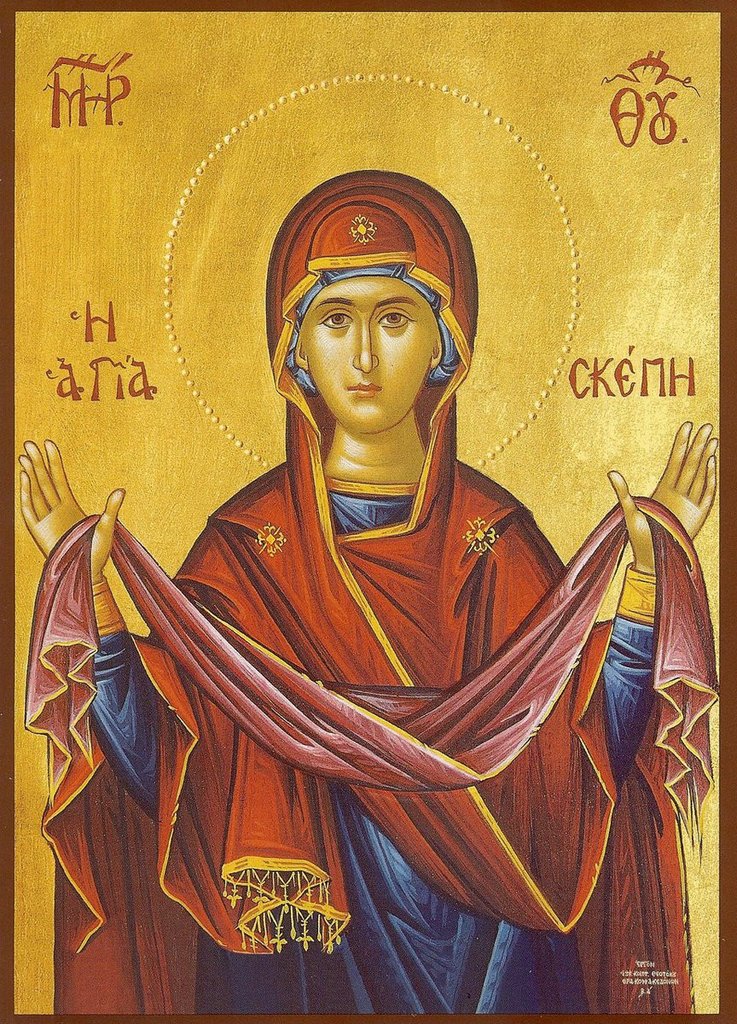
Protection of the Mother of God

Today, on the New Calendar, was the celebration of the Feast of the Protection of Our Most Holy Lady Theotokos and Ever-Virgin Mary, which is remembered with the greatest observance by the Slavic peoples of Eastern Europe. (My little two-year-old’s partly-Yugoslav descent was ably proven today. He knocked over the vase of flowers in front of the ikon of Father Saint Herman of Alaska, spilling water everywhere to the great embarrassment of his father. I was later assured that this is something of a rite-of-passage for kids at Saint Herman’s OCA – they’re not really members until they’ve knocked something over.) It also happens to be China’s National Day (Guoqingjie 国庆节), which means that my in-laws in the Central States were busy celebrating also.

It’s possible to draw some specious parallels between the two observances, of course. The veil (Pokrov means both ‘veil’ and ‘protection’) of the Holy Theotokos is dyed deep red, and marked with golden stars; and this bears something a resemblance to the flag of China which was adopted on this day sixty-eight years ago. The veil of the Theotokos is red to demonstrate the divine presence that overshadowed her, and marked with three golden stars to signify her perpetual virginity. However, the flag of Mao’s China is red to signify revolution, and the stars represent the Party and the four social classes, arranged in the pattern of a begonia flower. Yes, there are five stars, not three. And yes, the stars each have five points, not eight. The likeness of the communist flag to the veil of the Theotokos is still there. I wouldn’t go so far as to say the likeness is purely accidental. It’s not; Marxism is a Christian heresy and resemblances between Marxism and Christianity are seldom accidental. But it is trivial.

The more important parallel to be drawn is that in each case, the commemoration is that of an end of a war. The Chinese Civil War ended in September of 1949, and the People’s Republic was proclaimed on the first of October of that year. Eleven centuries before that, a massive fleet of Rus’ ships was preparing to attack Constantinople. A former slave and holy fool, Saint Andrew, who belonged to one tribe of the Slavs, had a vision of the Theotokos kneeling before the altar at the church at Blachernæ and praying to her Son for the protection of all the Christians of the world. When her prayer was ended, she took her veil and spread it over the common people gathered in the church, a promise of her protection. Saint Andrew turned to his disciple Saint Epiphanios and asked him: ‘Do you see, brother, the Holy Theotokos, praying for all the world?’, to which the disciple replied: ‘I do see, Holy Father, and am in awe!’

The heathen Rus’ fleet which threatened Constantinople, so says the Primary Chronicle, was destroyed in a storm; this destruction was attributed to the intercession of the Theotokos after the veil of the Theotokos was dipped into the sea waters at Blachernæ. Constantinople was spared. Interestingly, the Rus’ began to celebrate this feast with greater attention than the Greeks themselves do – the OCA’s description of the feast notes this fact as ‘ironic’, which it is. (Far be it from me to gainsay a good ironic twist!) But I’m not so certain that the irony is the whole story.

It is a healthy and normal impulse (though still a pagan one) to do as the mainland Chinese do today: to celebrate a victory in war. But Orthodoxy overturns that normal logic, and radicalises it – and no group of people has managed to submit so fully to that logic as the Rus’. It is in keeping with the unique character of the Christianised Slavs to celebrate even a defeat when that defeat was justified. I will get into this more in a later post, but even the Kievan chroniclers acknowledged that the terrible retribution visited upon them by Knyaz Saint Andrei was justified on account of the grievous sins of their Metropolitan, and it is not unknown for Russian localities to venerate even ‘enemy’ saints. It is not out-of-character for the descendants of the Rus’, that they began to celebrate the destruction of their forefathers’ fleet through the prayers of the people of Constantinople and the intercession of the Holy Theotokos. In this sense, the original Christian impulse has been far more radical, on the psychological level, than the Marxism that took hold in place of that impulse.

Interestingly enough, there is another connexion. One of the few active, surviving Orthodox churches in China is located in Harbin, and is dedicated to the Pokrov of the Holy Theotokos. I am not surprised that a mission which began among a people – the Albazinian Cossacks – defeated in a border skirmish with the Manchus, a people who survived wholly through the protection of the Theotokos themselves, would so dedicate their mission and submit themselves to her prayers.

In any event: enough of my tenuous ramblings. A joyous feast of the Protection of the Holy Theotokos, and a happy National Day for those who observe each!