21 August 2018

China, Syria, Uighurs and the Silk Road

Given the recent hints (now back-pedalled somewhat) that China may be stepping up its presence in the Syrian conflict, there has been a fair amount of speculation on the relationship between China and the Arab world generally. Oftentimes in Anglophone media the relationship between China and the Arab world is considered an ancillary one to the ‘special relationship’ between China and Russia, but there are multiple good reasons to consider the China-Arab relationship on its own merits.

Anyone who is familiar with the Judge Dee murder mysteries will recall that there was an Arabic (or Dashi 大食) maritime trading and diplomatic presence in Guangzhou as early as the Tang Dynasty, and also that the relationship was not always a particularly friendly one. However, during the An Lushan Rebellion 安史之亂, the Arab Caliph Al-Mansur sent four thousand soldiers to aid the Tang Emperor Minghuang 唐明皇 and Chinese Christian general Guo Ziyi 郭子儀 in putting down the revolt. These Arab soldiers, called ‘Black-Robed Dashi’ 黑衣大食, were integrated into the Tang military after the rebellion was quelled, and the Tang established good diplomatic relations with several of the Arab Caliphs in subsequent generations, even occasionally returning the favour to the Caliphs.


Tang cavalry, ca. 800 AD

The Silk Road – the original one, the overland trade route – originated in Luoyang (my wife’s hometown and former residence) and ended in the Syrian cities of Antioch, Damascus and Tyre. Guo Ziyi himself was a product of Syrian-Arab and Persian cultural exchange with China. The Nestorian Church of the East to which he belonged has an East Syrian Rite, and had its heartland in the Fertile Crescent. Its first missionaries to China came from Assyria and Mesopotamia along the routes used by traders on the Silk Road.


Chinese Nestorian Christian stele, 781 AD

In more modern times, the Chinese Hui Muslim minority was instrumental in establishing good diplomatic relations with the Arab nationalist states in the wake of World War I. The Hui Muslims (Huizu 回族) themselves are the descendants of the Persian, Arab and Turkic Silk Road traders who arrived during the Tang Dynasty and thereafter intermarried, adopted the Chinese language and assimilated to Han Chinese culture, similar to the Orthodox Christian Albazinians of Beijing. Traditionally, they belong to the Hanafî school of Sunnî Islamic jurisprudence, though there are also Ismâ‘îli Shî‘a and Sûfî minorities.

During the Second Sino-Japanese War, Hui Muslim leaders petitioned the kings of Saudi Arabia and Ægypt for aid against the Japanese, who had been committing atrocities against the Muslims in Asia, leading the Muslims of China to declare a jihâd against the Japanese idolaters. The Muslim community itself split due to the Chinese Civil War into pro-Communist and pro-Nationalist factions – a split which carried over into its gæopolitics. This split is drenched with irony on multiple levels. The Hui Muslims who sided with Mao – particularly the conservative but heavily-Sinicised followers of the Qadim school – were deeply sympathetic to the Arab nationalist cause despite having adopted Chinese language, architecture and manners. On the other hand, the Guomindang-loyalist Xibei San Ma, patrons of the Ikhwâni school (not to be confused with the Muslim Brotherhood in the Middle East), tended to be more sympathetic to the puritanical Salafism of the Saudis, but (to a point) intolerant of the newer successive waves of Arabic Salafism into China. This pattern has continued to modern times.


Qadim-school Hui Chinese mosque in Xi’an; note the Chinese-style architecture

When Jamâl ‘Abd an-Nâsr came to power in Ægypt, he chose to recognise the People’s Republic in Beijing rather than the Republic in Taibei; most other Arab nationalist polities, including Syria – which would be politically united with Ægypt two years later – followed his lead. Beijing’s relationship with Syria under Hâfiz al-’Asad, therefore, ranged between cordial and overtly friendly. They supported the Ba’ath Party in Syria in 1963 with a generous $16 million aid package; and the Chinese Communist Party later welcomed Mustafa Abd al Qadir Tlâs to negotiate an arms agreement – and Tlâs himself was seen waving Mao’s Little Red Book in a move calculated to provoke the chagrin of the Stalinist Soviet Union in the wake of the Sino-Soviet split. It is not an accident that Syria was accepted into the Non-Aligned Movement the following year.

The relationship between Beijing and Damascus remained friendly, if a bit distant, throughout the 1970’s and 1980’s, primarily because they had common interests in Third-World and Non-Aligned Movement ventures. That changed in the 1990’s when Russia began to unravel at the seams under American-administered ‘shock therapy’, and Syrian support from Russia began drying up. At that time, the al-’Asad family began looking to China for support, and they got it in spades, particularly after President Baššâr al-’Asad’s visit in 2004. China is now Syria’s third-largest trading partner in terms of import volume – largely because of Baššâr’s efforts to keep the 1200-year-old relationship between China and Syria alive and happy.
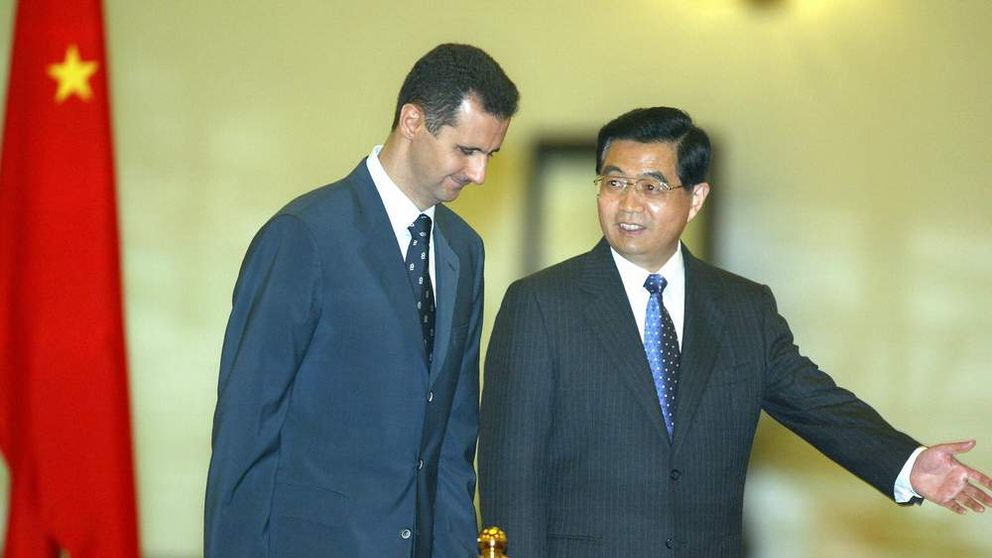

Baššâr al-’Asad and Hu Jintao, 2004

So why does all this gæopolitics and history matter now? Well, two seemingly-unrelated current events seem to render the history of relations between China and the Arabic world particularly relevant. The first is the offer from China, now partially-rescinded, in light of Syrian military action in Idlib, to support the government of Syria with military muscle rather than just diplomatic and financial measures. The second is the astoundingly-hypocritical hand-wringing in the United States and Western Europe over the Chinese government’s treatment and hypothesised internment of Uighurs in Xinjiang.

Thus far, China has not been particularly eager to get involved in a Middle Eastern conflict in any capacity. However, the Chinese government has already helped the Syrian people in other ways, and the use of the imagery of Belt and Road has not been accidental.

And here’s where we get back to the significance of the sectarian-ethnic-gæopolitical ‘split’ in the Hui Muslim community. The following is a simplification, but in the broad strokes: the culturally-conservative majority in the Qadim school of Hanafî jurisprudence generally get along fairly well with the Chinese government, as do the various Sûfî groups. The ‘reformist’ Ikhwâni minority have a little tenser relations with the Chinese government, but this is as much on account of their previous pro-Guomindang political leanings as on account of their previous association with Salafism. Successive influxes of Salafist money, material and converts from the Gulf monarchies, from the 1970s onward, have been associated with more violent and radical tendencies, they’ve focussed their conversion efforts on the Uighur minority, and this is what the Chinese government primarily objects to. This is broadly interpreted in the Western press as ethnic favouritism (the story being that Hui Muslims get a pass and Uighurs don’t, because of Han cultural chauvinism) – but really what is at stake is when they were exposed to Salafi ideology. As puritan Saudi legalism has gotten more blatant and more strident, the converts they made, Hui and Uighur, have become twice the children of hell. The fact that Uighur Salafis have been recruited into Dâ‘iš and into other extremist groups operating in Syria has given the Chinese government an additional interest in the conflict.

Conversely, it seems naïve to assume that the recent Syrian military operation in Idlib and the Chinese Uighur question are unrelated from the Atlanticist point of view. The Anglo-Franco-American alliance still hasn’t forgiven Baššâr al-’Asad for surviving this long; it’s doubtful our governments have quite forgiven the Syrians for having thrown off the French in the first place. And the sudden outpouring of sympathy for the Uighurs from a notoriously Islamophobic administration is more than a little convenient. Robbing the Syrian people of Chinese development aid and military assistance may be postulated as a motive for this ‘sympathy’, particularly considering the timing.

Again, the relationship between China and the Arab world is long and involved; it goes deeper than the Non-Aligned Movement; and it’s necessary for us Christians – Orthodox, Catholic and otherwise – to pay careful attention, particularly since we happen to be involved in this conflict. Muslims are our brothers in more ways than one; even if the relationship seems to be analogous to that between Cain and Abel. It behoves us not to be naïve about our long history together (and apart). It also behoves us, particularly those of us Christians in the West who still value our apostolic ties, not to be so dismissive or ungrateful toward China, which, even if its motives are grounded in realpolitik, is here acting in defence of our brothers and sisters, the living stones of the Middle East.

18 August 2018

Red Ruthenia

First, gentle readers, allow me to share a handful of maps. (I like maps. My favourite class in grad school was GIS.) Here is the first one, showing the ethnic make-up of Slovakia. The yellow municipalities are majority-Hungarian; the blue majority-Slovak; the brown majority-Roma and the bright red majority-Rusin. Rusins form significant majorities or pluralities in certain municipalities stretching from the district of Stará Ĺubovňa, to parts of the three districts of Svidník, Medzilaborce and Snina in the east, in a stretch across Slovakia’s northeast.


The second map shows the religious demographics of Slovakia. Here the colour schema is reversed somewhat, sadly. The red is for Latin Rite Roman Catholics; the yellow is for Byzantine Rite Catholics; the purple is for Lutherans; the green is for Calvinists; the blue is for Orthodox Christians. Again – outside little Orthodox municipal enclaves in Brezno, Michalovce and Sobrance – the major areas in which Orthodox believers form a majority are: Stará Ĺubovňa, Svidník, Medzilaborce and Snina.


Now, let’s look at this map, which shows how well the post-communist left Direction Party in Slovakia, led by the controversial and now somewhat-disgraced Róbert Fico, did in each district. As we can see, Direction turned out the heaviest majorities in the districts of – you guessed it! – Stará Ĺubovňa, Svidník, Medzilaborce and Snina. (Also Sobrance in the southeast, Čadca in the far north, and Topoľčany in the centre-west of the country.)


As Michal Pink, writing for the Central European Political Studies Review, puts it: ‘In three elections in a row, SMER [Direction] has found its greatest voter support outside of urban areas in the eastern Slovakia periphery. There is also pronounced voter support for the party in Central Slovakia, particularly in non-urban areas once again.’ It’s uncanny how closely these three – religious, ethnic and political preferences – coincide. Though Fico is a left-wing Slovak civic nationalist, his true blue – uh, make that red – political base lies in the areas of the country which have significant Rusin, Orthodox minorities. (They didn’t call it ‘Chervonnaya Rus’’ – Red Ruthenia – fer nuttin’, I guess.)

This trend has been noted in the Slovak press with some degree of irony – take, for example, this piece in Týždeň magazine. In it, Jozef Majchrák notes that the Rusins in Slovakia consistently turn out to vote for Direction, despite the party’s leader complaining a bit about ‘minorities’ in Slovakia. The author makes due note of the Stalinist resettlement of the Rusins into Ukraine, and the subsequent violent attempts to change their culture, language and religion – a campaign, by the way, which is still ongoing in Slovakia’s eastern neighbour. The Rusins certainly have reason to be worried about the loss of their cultural and linguistic distinction; and this has been the cause of the rise of a local ethnic party, Our Region or Náš Kraj, which is dedicated to preserving precisely these cultural and linguistic distinctions. Majchrák speculates, slightly disparagingly, on the reasons why the Rusins continue to flock to the ‘red’ team despite this other option being available to them: ‘vysoká nezamesnanosť, nostalgia za rokmi socialistického rozvoja a istôt či migrácia mladých do iných kútov Slovenska a do zahraničia’ – ‘high indifference, nostalgia for the years of socialist development and security, and migration of the youth to other parts of Slovakia and abroad’.

There probably is significant ‘nostalgia’ for an era in which most Rusins did well (or at least better than they did under the Austrians). The Pink study further says, in agreement with Majchrák: ‘SMER [Direction] voters were repeatedly located primarily in areas with higher unemployment and lower incomes, along with a lower proportion of Catholic adherents’, and further: ‘SMER voters are very likely recruited from socially excluded areas characterized by a higher level of unemployment and lower incomes in smaller municipalities and towns.’ But again, I feel like this only gets at part of the picture.

The Rusin people, whether on these shores or back in the ‘old country’, have long flocked to the left for various historical reasons, which are more genuine – not merely ‘nostalgic’ – than I believe Majchrák will allow. Œconomic marginalisation and direct oppression by landlords (including clerical ones) was one such reason. Their deliberate exclusion by right-wing ‘national democrats’ and fascists on all sides would be another such reason. Many of them – particularly the Lemko branch – became Soviet or Czechoslovak partizans against Nazi domination, and the Rusin civic organisations of the diaspora long supported anti-fascist action on both sides of the Atlantic. And still another reason would be a certain solidarity with unionising mine workers in the diaspora. It is particularly worthy of note that Thomas Bell, a Rusin-American immigrant author of realist novels depicting the lives of the working class, has enjoyed greater popularity in Slovakia than here in his adoptive country, despite one of his books being adapted into a classic Hollywood film starring Joan Fontaine and Mark Stevens. One of these days I’m going to have to elaborate further on the effect reading All Brides Are Beautiful had on me when I was unemployed. But Thomas Bell’s literary support for localist Jewish political activism lends further credence to my suspicion that the civic ‘doyikayt’ of the Jewish diaspora is in some measure equivalent to and sympathetic with the ‘tutešni’ self-awareness of the Rusins.

That same self-awareness may be part of why Rusins do not flock easily to the politics of ethno-nationalism in the same way as their oppressors over the centuries have; why, in the words of Majchrák, they appear to be so ‘modest’ and ‘uncaring’ in their cultural demands. Their national awareness is civic and realist, not racial or linguistic. The Rusins of Slovakia do not shy away from Fico’s expressions of Slovak patriotism even if it isn’t pandering to them; on the other hand, they are still possessed of a remarkable sense of œconomic fairness and solidarity. Red Ruthenia is alive and well; long may it endure.


And: for lately-departed harbingers of truth and beauty Aretha and Samîr, večná pamäť; may God make their memories to be eternal!

16 August 2018

A prayer for justice long due


The following began as a post on Facebook; it has since been slightly expanded.

Most all of my gentle readers are surely aware by now of the clerical sex abuse scandal in the Catholic Church which has been going on for decades and which has implicated 300 priests, victimised over 1000 children, and brought grief to thousands more Pennsylvanians. This horrific pattern of behaviour, moreover, was deliberately and systematically covered up by the Catholic bishops, and even the Vatican has not escaped criticism in this regard.

It has been grievous, shocking, sickening and outrageous to read. It ought to be so for anyone, Catholic or not, and yet - after a warranted fashion or not - I feel rather ‘close’ to this as an Orthodox Christian. However, I have thus far avoided discussing it here for two reasons; you may judge them as you will, be they noble and appropriate or not.

Firstly, I am convinced that there is a right way for us ‘Easterners’ to discuss these abuses, and a wrong way. The wrong way, in my own view, would be anything that even remotely smacks of gloating, of triumphalism, of pharisaical pride, of ‘I thank thee, Lord, that I am not like this Papist’. We Orthodox Christians do have plenty of beams in our eyes, both personally and collectively, and we do no one any good by reaching for motes. We may lack the institutional structure that allows for a cover-up the size and scale of what was seen in Pennsylvania, but that says nothing about the state of our own parishes. The clerical celibacy question is probably more relevant, but we of all people should be able to understand that temptation visits celibates and monks more strongly than it does laypeople, whether Catholic or Orthodox.

Second, this simply isn’t the time to argue the superiority or inferiority of one or the other church’s praxis or ecclesiology. However ‘justified’ such argument may seem, it’s profoundly insensitive and unjust to the victims of clerical abuse and cover-up, to use them as props in a sectional battle.

Make no mistake. This scandal will be a stumbling block to the faith of many Americans. If Ivan Karamazov would turn in his ticket to the Kingdom of God over the unavenged tears of only one small innocent child, how many more will hurl back their tickets in spite at God, spitting curses, as they behold the unavenged tears of a thousand small innocent children, the victims of those same depraved men whose job it is to divide the word of truth and proclaim the Kingdom of God, to proclaim Christ? You murderer-priests, you vipers, you wicked tenants! Not one, but many more Ivan Karamazovs will come of this scandal. A great nihilism will be the bitter fruit reaped by the church, and the harvest will be entirely deserved.

What is asked for now? Fr Steve Clark puts it simply: ‘We need to stand with the victims. That's all we need to do.’ I couldn’t agree more. We must not turn our faces away from the innocents. We need to demand justice – a justice that will be to their good first and foremost, but also to the good, ultimately, of our Latin brothers and sisters generally. Let justice be done for the victims first, and let us hope and pray and demand that the Vatican start doing the right thing by them now.

All the foregoing is really just a long-winded way of saying that all I pray now is that the victims receive closure and recompense both from the ecclesiastic and from secular authorities, sooner rather than later. May such a prayer fall from my lips without malice; may no malice befall by this prayer, but let justice be done.

15 August 2018

Dormition of the Theotokos

The angels, as they looked upon the dormition of the Virgin,
Were struck with wonder, seeing how the Virgin went up from earth to Heaven.
The limits of nature are overcome in you, o pure Virgin,
For birthgiving remains virginal and life is united to death.
A Virgin after childbirth and alive after death;
You ever save your inheritance, O Theotokos!

12 August 2018

Wise up to the anti-China campaign


Clearly the greatest national security threat we face. Gentlemen, DEFCON 2.
Chinese-Americans think of themselves as American, not as Chinese. That’s a problem. That’s why they support Trump. They think they’ll get the same treatment as white people. But [white] Americans don’t see Chinese-Americans as American. The Muslims—the Arabs—they all voted Republican before 11 September, didn’t they? And now where are they? And why do you think that is?
Pretty much verbatim, this is what my wife said to me yesterday, in what started out as a conversation about Crazy Rich Asians. She’s more than a bit concerned about the recent news coming out of the Beltway’s wherever, so to speak. The trade war’s not ending anytime soon. Trump’s latest anti-Chinese comments to a group of CEOs in New Jersey, for example. Or the crackdown – apparently a long time in the making – on immigrants who come here legally, but suffer financial difficulties. Or Joe Wilson’s (yes, that guy’s) initiative to defund public universities which host Confucius Institutes. Or the recent wave of crocodile tears over mainland Chinese Uighurs, which appears to be based on State Department priorities – but since when does the State Department, under whatever administration, care about Muslim civil rights anywhere?

I’m troubled by all these recent political manoeuvres against China, Chinese nationals and Chinese-Americans. As I’ve already shown, I stand to be directly and intimately affected. My immediate family are either CRBA citizens or recent legal immigrants, and we certainly aren’t rich or well-connected, to say the least. (But yeah, my five-year-old daughter is definitely a Chinese spy. Have you seen just how cute she is, gentle readers? Only spies could possibly be that cute. And she does traditional Chinese dance now as a hobby, which is clearly just an insidious plot to undermine the American cultural bedrock.)

In my experience, Confucius Institutes in academia mostly do innocuous, humanities-related things like – well, support my daughter’s dance troupe and other events associated with Chinese culture. The Confucius Institutes do propagate teaching materials from the government of mainland China, but honestly this sort of thing is to be expected. And if American universities are doing their jobs properly, then honestly the best defence against such materials is not to shut down cultural events and groups, but instead to train students to be able to spot propaganda when they hear it or read it.

The animus against mainland Chinese students, moreover, is not quite entirely scare-mongering, but it’s damn close. Having taught, advised, fought with, motivated and congratulated hundreds of aspiring Chinese college-goers for several years both here and in China proper, I feel I’m in a good position to attest to this personally. The reasons Chinese students come over here to study are manifold. Many do so simply to get a degree with prestige enough to get them a better-paying job back home, and that utility is diminishing. Others come here with more idealistic expectations of Western education which don’t always live up to the reality. There might be a handful of Simon Shady types – but in the main, the reality is much more mundane. They’re not here to spy for their government. They’re not here to steal industrial secrets. They’re here so they can go home and get good jobs.

But the emanations of anti-Chinese sentiment from both the executive and legislative branches of the government—cannot be incidental. They are being officially encouraged. My suspicion is that the recent encouragement through the organs of the national security apparatus and through the corporate media of racist orientalist sentiment against Russians was something of a test case. Unfortunately, American liberals have just proven themselves most of all susceptible to this toxic mixture of race-baiting and Cold War nostalgia. However, despite a handful of reports of low-key ‘street-level’ discrimination, Russian-Americans are simply not ‘visible’ enough as a minority to be useful in a classic jingo campaign: only about three million people are reported as ‘Russian-American’, and even this is an over-estimate given that it used to be an umbrella term for all immigrants from former Soviet countries. When push comes to shove, it’s simply the case that despite this immense top-down propaganda campaign that we’ve seen, not many people actually care about l’affaire russe de deux mille seize. May God bless them.

China, though? That’s way juicier for politicians and pundits. Collective defamation and anti-China sentiment aimed at immigrants is nothing at all new for the United States. Chinese-Americans are both more numerous (at five million) and far more visible a target than Russian-Americans. And there are ready-made constituencies for an anti-China campaign both among élite liberals and among the more blue-collar working-class vote. Sadly, it is remarkably simple to misdirect white working-class anger at China; American politicians and union leaders have been doing that for three decades now. And we already know what a test case for inculcating anti-China sentiment among liberals would look like, thanks to Australia’s Clive Hamilton, a ‘green’ activist who by his own self-description is absolutely, definitely, completely not a racist – but who still bullies Asian students who criticise him and accuses them of being fifth-columnists. Little wonder the executive branch here can say the same thing now and mostly gets away with it. At this point, I’m realistic (or cynical) enough to believe we can expect more Hamiltons on the left, and more Caffertys and Carlsons on the right, to begin appearing and craftily nudging American public opinion toward a jingo campaign against the Chinese mainland in the near future, with Chinese-Americans as the proximate target.

On the larger scale of international relations, I do understand that realist concerns apply in spades. China is safeguarding and securing its national interests, and the United States does need to do the same in response. Cybersecurity, intellectual property security and maritime security in the Pacific are all relevant and necessary concerns for the American government. However, American policy-makers are notoriously bad at distinguishing between vital national interests, and ideological or special-interest based hobby-horses. Attacking the Confucius Institutes and Chinese students is easy and popular domestically: being visible and easily-connected to the Chinese government, they’re a handy target for a jingo campaign. But, to put it bluntly, academia isn’t the vector of Chinese espionage and cyber-warfare campaigns. And the Chinese government doesn’t suffer except marginally through these symbolic measures aimed at academia; Chinese-Americans, however, will suffer much more.

I stand with Asian-Americans here because I am their brother: almost (but not quite) their nüxu. As to Chinese-Americans themselves: my suggestion to them, as I believe my wife’s would be, is to wise up. Before the advent of the term or the concept of ‘Asian-American’, the tendency of Asian immigrant advocacy was to disaggregate into cliques. That was politically counter-productive at the time – Japanese-American assimilationism and disaggregation from their fellow Asian-Americans didn’t save them from the camps. And the same disaggregation is happening again today, though now the ‘wedge’ issue seems to be affirmative action. Disaggregation is happening; it’s being driven from the top, and it’s being encouraged by the executive branch of the federal government. There’s strength in solidarity.

10 August 2018

Is cyberspace public space?


One doesn’t have to be a fan of Alex Jones and InfoWars (I certainly am not, for multiple reasons) to be somewhat disturbed by his treatment at the hands of major social media platforms like Facebook, Spotify and YouTube. Figures on both sides of the spectrum of American political thought, from Glenn Greenwald and Jimmy Dore on the left to Matt Drudge and Ted Cruz on the right, have criticised the platforms for their selective, opaque and seemingly politically-motivated uses of community-standards policies.

Personally, I will cop to some misgivings here, too, but it isn’t because I’m a free-speech absolutist: I am no such thing. I have been saying for a long time that there are dangerous and harmful forms of speech and that some of these forms should be curtailed, whether by law or by a reinvigorated honour culture. But it strikes me that censorship per se isn’t even the most interesting or salient point of l’affaire Jones. We really ought to be asking ourselves the question: what is the nature of our social media ‘reality’, of our online ‘space’? Who polices it, and to which ends? Looking into my own vexation and misgivings at the corporate no-platforming of InfoWars carefully, I find I can unfold it in this way.

The first is that the Internet is a utility which has been monopolised at several points by for-profit rentiers. This isn’t simply a matter of net neutrality – a policy which has been supported by several of the same corporations now booting InfoWars. No, this is a much more involved problem. Large portions of the Internet – a significant percentage of the content – is controlled by these corporations. The Internet, and social media platforms in particular, are popularly understood to be public space; indeed, the Internet essentially started as a public works project. However, we have seen that the process for deciding what community standards should be upheld and how, is not directly accountable to public authorities but instead to corporate ones. Much of the Internet space we frequent is, essentially, privatised. (Ironically, if Jones and InfoWars were being ideologically-consistent, they would welcome this state-of-affairs – after all, this is the free market at work.) This brings me to my second point.

This comparison will likely offend some people, but you know what? Good! This corporate shucking of InfoWars reminds me a great deal of the NFL’s shucking of their own players’ anthem protests. To be clear, I’m not positing any kind of moral equivalence between Kaepernick and Jones. Kaepernick, unlike Jones, gives back to the community and also, unlike Jones, does not target and endanger specific people with his exercised right of free speech. What is comparable between the two is that both men understood themselves to be exercising their legally-protected right of political speech in a public forum, whereas that wasn’t really the case.

I can understand why people were offended by Kaepernick’s protests – football games are public, civic events, and the anthem plays a significant rôle there. However, those who objected to Kaepernick’s protests, I feel actually misunderstood the venue as much as he did. What’s really galling about Kaepernick’s and other protesters’ treatment by the NFL, is that they were in essence scolded for a lack of civic feeling, by an organisation which makes massive amounts of profit by extorting taxpayers in various cities to subsidise infrastructure which is essentially private property. It’s morally grotesque. And I think a similar feeling applies to the corporations which operate spaces which look and function as public, but which legally aren’t.

Getting back to the question of Facebook censorship, I think what we are looking at is the partial deflation of the utopian expectations of the corporate masters themselves. Facebook was founded on a utopian belief (as, indeed, was Google) that greater flows and exchanges of information would bring us closer together as people, would unite us in solidarity in ways hitherto unheard of, would ignite passions for social activism as yet unseen. Call it the ‘Arab Spring thesis’. As we have seen, however, and should have expected, these utopian expectations went unmet. Being saturated with information, freely exchangeable, has not brought us closer together or deepened our understanding of each other across cultural, social or political lines; if anything, it has driven us further apart. What we are seeing from Facebook, YouTube and Spotify now with regards to InfoWars may be thought of as an acknowledgement of a Thermidorian reaction to Internet utopianism. Not all information is good; not all information deserves to be spread to as broad an audience as possible. The problem, however, is and always will be this: whom do we let decide what information is ‘good’ and which is ‘bad’? (That chuckling you’re hearing right now? It’s coming from Fang Binxing’s laptop.)

Ultimately, I feel that both the ‘left’ and the ‘right’ look at this issue the wrong way. Personally, I believe the left is right that the corporate takeover of the Internet ought to disturb us – and not just the issue of net neutrality, which is really addressing only a part of the problem. What is more to the point is that we treat the Internet as though it really has become a public space, but it is one dominated by interests that keep themselves opaque to us while at the same time harvesting our personal information to keep up their advertisement-driven profit margins. There’s a fundamental asymmetry between the users and gatekeepers that renders these popular discussions about ‘free speech’ on the Internet somewhat moot.

On the other hand, though, the free-speech absolutists on both left and right are wrong. Public space does not and should not automatically mean ‘anything-goes’. What few public spaces we have left have – and always have had – strict rules and less-formal norms to enforce or encourage good behaviour: after all, we don’t like our parks littered with trash and dog turds. If even the current masters and utopian ‘thought-leaders’ have decided that not all information is good and deserves to be spread, then we (and that is a democratic and inclusive ‘we’) have some deep and serious thinking to do about how we decide which information is fit to see, and which isn’t.

08 August 2018

Against all utopias


Nikolai Aleksandrovich Berdyaev

Nikolai Berdyaev’s The Philosophy of Inequality, sent to me most kindly by his translator Fr Stephen (Janos), has been a rather guilty pleasure to read – almost an indulgence, really. It is an angry jeremiad, written at the very fever pitch of the Russian Revolution – and a wholly, unabashedly and self-consciously reactionary document, which is what gives it its peculiar power and persuasiveness. Berdyaev, who is not satisfied with anything less than a politics of the Resurrection, sorties forth and does savage intellectual battle with every possible manner of sæcular political utopianism. It is no accident, I think, that Aldous Huxley credits Berdyaev and honours him with the epigraphical quote on the inner cover of Brave New World, and chooses a quote of his (not from Philosophy of Inequality but instead from The End of Our Time, which came out a year later) that directly challenges the very nature and self-understanding of such utopianisms:
Les utopies apparaissent bien plus réalisables qu’on ne le croyait autrefois. Et nous nous trouvons actuellement devant une question bien autrement angoissante: comment éviter leur réalisation définitive … Les utopies sont réalisables. La vie marche vers les utopies. Et peut-être un siècle nouveau commence-t-il, un siècle où les intellectuels et la classe cultivée rêveront aux moyens d’éviter les utopies et de retourner à une société non utopique moins parfaite et plus libre.

Utopias seem to be much more realisable than we formerly believed them to be. Now we find ourselves presented with another alarming question: how do we prevent their definitive realisation? …Utopias are realisable. Life marches toward utopias. Perhaps a new century will begin, a century in which intellectuals and the cultivated class will dream of ways to evict utopias and return to a non-utopian society, less perfect and more free.
I’ve already written a little bit about how Berdyaev – often associated, including by myself, with anarchism – in fact rejected anarchism in a way similar and in several ways parallel to that offered by William Morris. But he ranges much further in his jeremiad. He rejects not only anarchism, but also liberalism, democracy and particularly socialism – again, one must remember that this is in response to the Russian Revolution – and indeed descends to the very roots of utopian thinking, opposing an artificially-unlimited horizon of politics (fictionalised and abstracted) with the growth patterns of history:
Your sociological worldview was always detached from genuine historical activity. And therefore it was merely rationalistic and utopian. Ye isolated your societal aspect not only from the worldly cosmos, but also from the historical cosmos. In your theories ye abstractly subordinated man to the natural and social medium, ye rejected his spiritual freedom and transformed him into a passive reflection of the natural and social cycle. Yet you however have declared, that man of himself arbitrarily and in a break with the past can begin a history, in accord with your adjusted intents. Ye have loved to speak about “leaping from the realm of necessity into the realm of freedom”, which is made by this slave of the social medium, a reflection of natural necessity… By you everything has been rendered abstract—abstracted, rationalised is your necessity, and abstracted, rationalised is your freedom, whereby the living man and living history have all vanished into abstractions.
A few of the themes I’ve been thinking on, and indeed fumbling toward, in this blog, are presented in bold print here in The Philosophy of Inequality. His meditation on the question of nation – neither an endorsement of nationalism as an ideology and still far less a condemnation of it – manages to encapsulate and elucidate some of my own doubts and struggles to grasp the concept. For Berdyaev, nations are not artificial tracts of territory, not arbitrary agglomerations of people, but living organisms that span multiple generations and grasp at immortality. Berdyaev does indeed condemn those nationalisms that go ‘false at the roots’, that lose their grounding in creative religious impulses or that abstract themselves into anti-personal identity politics. But he asserts a sacral mystery of blood and the love of child for parent as the kernel of national feeling, and boldly asserts that nations, invested as they are with personal character, indeed have some creative purpose to reveal within history. Likewise Berdyaev defends the state as having both a creative and a caritative purpose – indeed, he paraphrases Solovyov to the effect that the state exists not to make of Earth a paradise, but to make it less of a hell for the less fortunate.

Berdyaev’s thoughts on war also mirror and echo Solovyov’s – both for better and for worse. Writing at the close of the First World War, he explicitly denounces the pacifism of Tolstoy as a philistine ‘lie and a deception’, a thinly-veiled disavowal of the immortality of the soul. More importantly, he takes pacifists to task for opposing war only during its commission, instead of doing spiritual battle with the malices, hatreds, prides and petty vengeances in peacetime that give rise to war. And even in 1917, he takes the democratic idealists to task for desiring the ‘end of history’, for desiring a this-worldly order of bourgeois states united in a philistine outward peace while the inner man remains untransformed. (This is Berdyaev deliberately rebelling against Kant.) Here the influence of Nietzsche is strongly felt. Berdyaev fears that in the world the pacifists want, the ‘lofty’, ‘noble’ aristocratic-martial virtues will be lost; only a smug philistine and bourgeois ethos of grasping and cheating will be left. (Sadly, he seems to have appropriated here the rather odious racist historical theorising of Solovyov. Blessedly, Berdyaev grows out of that in his later work.)

Berdyaev is still a challenging read, particularly to someone like me given to what Berdyaev’s compatriot and friend Mother Maria (Skobtsova) called wingèd visions. It’s not an accident that I mention William Morris above. Even though Berdyaev deploys a number of the standard arguments against socialism and enforced collectivism in his broadside, at the same time he seems to stand closer to the non-sectarian æstheticism of Morris, even than to previous Russian critics of socialism (like Boris Chicherin, whom he mentions by name).

Despite his appeals to freedom of conscience, to free charity in contraposition to a forced levelling, in his objections to socialism he never once makes appeal to the sorts of œconomistic arguments so beloved by the libertarians. Indeed, he scorns them, seeing in them the very roots of the levelling impulse – and blesses the struggle against capital (itself an abstraction from the proper rôle and situation of concrete productive property) when it denies the ‘sacred rights’ of labour, which does and ought to have a religious significance! Instead of the atheistic socialism of the revolution he decries, he appeals to the aristocratic socialism of Plato, and the English socialism of John Ruskin.

Berdyaev rails most vehemently against the socialists, those ‘murderers of mankind’. In this one senses the umbrage and the anger of the newly-disabused ex-Marxist, who has not abandoned the moralistic outrage which drove him to embrace Marxism in the first place. But we see hints of a thread that is common to Russian radicals and reactionaries both, of a certain stripe: Pobedonostsev, Dostoevsky, Solovyov, Fedotov, now Berdyaev. The socialists, even when they are seen as the enemy, are – in Berdyaev’s words – prodigal sons. They have spurned God, they have rejected God, they have declared themselves dead to God and demanded their share of the inheritance of His Kingdom: that inheritance being the demand for an earthly justice, the Kingdom of God come to earth. And for this they are willing to cut themselves off from God and, just as the prodigal son himself does in the parable, debase themselves to the level of pigs. And for this Berdyaev castigates them.

But in his anger Berdyaev reveals (whether intentionally or not is unclear) the psychological truth that Dostoevsky came to about the socialists, and to which the latter philosopher himself would refer in his later work. Dostoevsky was a studier of souls. And for Dostoevsky, whose Raskolnikov, protagonist of Crime and Punishment, was the very psychological ‘type’ of the socialist, there is indeed a redemptive streak, some noble and worthy aspect in the soul such that he ‘comes to himself’ and opens to salvation, even though the resentful soul of the unrepentant Raskolnikov is full of hatred and murder. Raskolnikov can and does repent, in a way that – for example – the narrator of Notes from Underground cannot.

Even in translation, this comes across clearly as a book written by a young, understandably-angry and disillusioned man. My worry about Berdyaev here – and this jeremiad is indeed very much so the cry of a ‘young man of talent’ in the face of an oppressive state – is precisely that he displays the psychological features of the untutored Glaucon in The Republic. Berdyaev puts forward a philosophical justification for inequality, in precisely the same way that Glaucon objects to the egalitarian ‘city of utmost necessity’ erected by his brother Adeimantus. Glaucon bridles, revolts, against the idea of the life of ‘pigs’ in such a city; Berdyaev likewise disdains the materialistic striving, the ‘interests’ that cannot be avoided within the utopian visions of his day. And within this young Berdyaev stands another philosophical doubt entertained by Glaucon after the denunciation of Socrates by Thrasymachus. ‘Justice’ is never a word spoken positively by Berdyaev here; in it he sees only the pretences of utopians and rationalists. Perhaps he suspects, in the revolutionary climate in which he finds himself, that an enforced ‘justice’ is never an end desired for itself, but instead a justification for tyrants to exercise their will to power. Berdyaev is breathless in his own denunciations of his ‘contemners’. He strives after an ‘aristocratic’ ideal of Christian love, is painfully aware of its tragic inability to be realised within a fallen world, and is weighed down by a sense of history and art that recalls Glaucon’s drift back to the poets, particularly Homer. But for Glaucon there is hope! And Berdyaev’s more mature work is indeed philosophical, attuned to the ironies of the socialists’ position in Russian history.

One hundred years on and from another national vantage-point, The Philosophy of Inequality is still relevant, for the same reasons that Huxley is – and not merely because Putin has it on his required reading list. We ought not to fall into the smug philistine idea that we are beyond utopian temptations – least of all those of us who think our rationality most protects us from them. We live in just such a realised utopia, with nationalism, liberalism and democracy (far less so socialism, in the sense Berdyaev meant it) still warring for relevance on terms which have been abstracted so far from our everyday lives it seems like a reality show, and has turned into one. Our hazy utopian daydreaming has turned it into one. The utopianism is crumbling around the edges, but it is far from collapsed – we have ready-made constituencies willing to shore up various corners of it, waving various flags. Our political utopianism functions as a kind of wilful daydream, one in which the past is only hazily (if at all) remembered through the electronic filter of social media. Actually-existing inequality is rampant, yet it is of a faceless, groundless, hyperrationalised kind which arises from and sweeps into the very Ungrund against which Berdyaev militates; it is the result of utopian thinking, not a standing rebuke against it or still less a remedy from it.