31 October 2011
Vengeance, forgiveness, love, patriotism and care for the common people
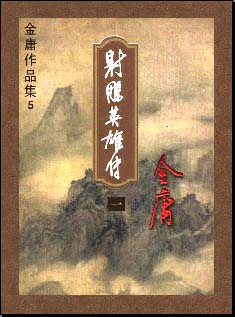
Last night I finished the fan translation of Eagle-Shooting Hero 《射鵰英雄傳》 by Sir Louis Cha (better known by his nom de plume Jin Yong 金庸, taken from the character elements of his given name 查良鏞), also on a recommendation from my significant other.
What a ride.
Never mind that the whole thing is only marginally shorter than War and Peace, and that I’ve been reading it on-and-off since July; this book is amazing, even in translation (however rough it may be). The elderly Hong Kong master of letters has a reputation both in China and among the overseas Chinese community that is apparently fully deserved. Not only is this an admirable work of historical fiction in its own right (taking place during the conquest of China by Jingghis Khan, and incorporating historical figures such as the great Khan and his Daoist advisor Qiu Chuji seamlessly with his fictional characters); it tackles philosophical and moral questions as well as an Edith Pargeter novel can.
The primary story follows two sons of renowned Song heroes: Guo Jing 郭靖, son of Guo Xiaotian, and Yang Kang 楊康, son of Yang Tiexin – named by Qiu Chuji after the Humiliation of Jingkang 靖康之恥 when Jurchen soldiers from the bordering kingdom of Jin looted and razed Kaifeng, and kidnapped the Song Emperor and his relatives. The two boys, though their fathers are close friends from the same village, grow up separately from each other and lead very different lives: Guo Jing is raised by his mother and by his martial-arts masters on the Mongolian steppe, whilst Yang Kang is adopted by a Prince of Jin, and changes his surname to Wanyan 完顏. Whilst Guo Jing is crude, unlettered, stubborn and slow-witted, and learns things only through sheer repetition and force of will, Yang Kang is erudite and clever. More importantly, though, Guo Jing, being raised by his mother and by six martial artists of lower-class upbringing (the Six Freaks of Jiangnan), is honest to a fault and brave bordering on foolhardy. Yang Kang, though, with his court upbringing, becomes something of a pathological liar.
Guo Jing is introduced to the world of ‘rivers and lakes’ (the martial-arts world) by his teachers, and sent on a quest by his mother to avenge the death of his father at the hands of the Jin. On this quest he not only has repeated run-ins with his sworn brother Yang Kang, but also meets his star-crossed lover Huang Rong, the overpoweringly-intelligent daughter of one of the most powerful (and cruel) martial artists in the world.
I won’t give away too much of the story here; suffice it to say that this epic explores a number of ethical questions in detail – and in ways which are surprising. Though the book as a whole upholds the virtues of filial piety and loyalty to one’s country, the reader is sometimes left to cheer when Guo Jing is aided by someone acting against the wishes of a parent or of a king – only to be left scratching his head (as Guo Jing eventually does) at the contradiction. Though Guo Jing himself is presented as the Confucian paragon and the ethical centre of the story’s universe (in a rather ironic way, given how he is also presented as half-barbarian on account of his Mongolian upbringing), Huang Rong is a much more accessible character, whose conscience is more readily conflicted by the tension between filiality, upright behaviour and her practically all-consuming love for Guo Jing.
War itself is an ever-present force which is often brought to the foreground – the Jin attack on Ox Village (separating Guo Jing from Yang Kang) and the bloody Mongolian conquests of Jin and the (supposedly Jin-aligned) eastern Iranian kingdom of Horezm bookend the novel. The suffering of common people in war, and at the hands of military leaders and bandits, is likewise emphasised, as is the duty (ever-present in wuxia novels of this kind) of the world of rivers and lakes to come to the defence and aid of the innocent.
Even across the combined language and cultural gaps of the translator and the reader, the book lost none of its emotional potency or its ability to engage. The demands of honour and virtue, pitted against the personal desires of the protagonists, were so well-balanced that one had to feel empathy for Guo Jing even as his sense of honour led him to repeatedly thwart his own and Huang Rong’s desire for a peaceful life together. Sir Louis Cha manages quite adroitly to keep his characters sympathetic without turning them into saints or martyrs… the one possible exception being Hong Qigong, one of the five best martial artists in the world, and the leader of the Beggar Clan.
It is certain, once my workload becomes a little more manageable, that I’ll pick up the two sequels in the trilogy: Divine Eagle, Gallant Knights 《神鵰俠侶》 and Heaven-Reliant and Dragon-Slayer 《倚天屠龍記》 (which are equal in length). But I have a sneaking suspicion that Eagle-Shooting Hero will continue to be my favourite in the trilogy.
Labels:
Anglophilia,
books,
Confucianism,
Eranshahr,
history,
Huaxia,
nerdiness
29 October 2011
Highly recommended reading
It seems both John at Economics is for Donkeys and California Constantian have been in top form this past week.
John has linked to a great article over at Naked Capitalism, which does an excellent job of cutting past the layers of mendacity surrounding Greece’s fiscal crisis as in, say, the Financial Times: hardly the outcome of an overactive welfare state, the problem in Greece is that a significant portion of its populace (the top earners, to be precise) pays next to nothing in taxes, and (long story short) the current institutional setup is such that the government is powerless to do anything about its own monetary policy.
California Constantian, on the other hand, has touched on matters somewhat closer to home geographically, and in a way which I highly appreciate. The former part, which reduces to absurdity Ron Paul’s claims to anti-corporatism by noting that the policies he favours all have a disturbing tendency in the pro-corporate direction, concludes that measuring one’s own public morality by adherence to the Constitution is ultimately unsatisfactory. He then makes the more radical (or reactionary) suggestion that a written Constitution under the hermeneutic control of a political elite is not going to guarantee for us a just society, and follows up said suggestion with an alternative: a public figure who is exempt not from public life, but rather from the political class itself – in other words, a monarch. I do very much agree with him thus far – indeed, his argument carries valuable echoes of a Metternichesque ‘socialisme conservateur’: constitutions are the work of generations, and have only the authority given to them by tradition and by the people under them – and the American Constitution does not have even the first advantage! However, his argument to this point rests upon the good behaviour and philanthropic spirit of the monarch herself – historically, as monarchs have generally been drawn from the warrior castes of their respective societies (even in such intellectually-inclined societies as China, the imperial families all started off as warlords), I’m not sure this assumption naturally holds. If I may take his argument further; what is needed is a non-political head of state, informed by a religious establishment which emphasises economic justice and the common good.
Actually, my third recommendation for the week is the civic republicanism of Jim Sleeper . This strikes me as a very tempting correction to the ills of a fragmented body politic, but it also seems to me that if it relies over-much on the way American political institutions are currently structured, into an over-reliance on the high interpretive powers of the Supreme Court or an over-reliance on top-down reforms vested in the executive apparatus under the Presidency, such a republicanism may be doomed to distort itself ultimately into the heresies of neoconservatism, ultra-liberalism or identity politics.
Currently reading 1587 by Ray Huang (黃仁宇), on a recommendation from Jessie Zong. So far, it looks to be a very interesting historical work on the beginning-of-the-end for the Ming Dynasty. Hope to do a post on it later.
John has linked to a great article over at Naked Capitalism, which does an excellent job of cutting past the layers of mendacity surrounding Greece’s fiscal crisis as in, say, the Financial Times: hardly the outcome of an overactive welfare state, the problem in Greece is that a significant portion of its populace (the top earners, to be precise) pays next to nothing in taxes, and (long story short) the current institutional setup is such that the government is powerless to do anything about its own monetary policy.
California Constantian, on the other hand, has touched on matters somewhat closer to home geographically, and in a way which I highly appreciate. The former part, which reduces to absurdity Ron Paul’s claims to anti-corporatism by noting that the policies he favours all have a disturbing tendency in the pro-corporate direction, concludes that measuring one’s own public morality by adherence to the Constitution is ultimately unsatisfactory. He then makes the more radical (or reactionary) suggestion that a written Constitution under the hermeneutic control of a political elite is not going to guarantee for us a just society, and follows up said suggestion with an alternative: a public figure who is exempt not from public life, but rather from the political class itself – in other words, a monarch. I do very much agree with him thus far – indeed, his argument carries valuable echoes of a Metternichesque ‘socialisme conservateur’: constitutions are the work of generations, and have only the authority given to them by tradition and by the people under them – and the American Constitution does not have even the first advantage! However, his argument to this point rests upon the good behaviour and philanthropic spirit of the monarch herself – historically, as monarchs have generally been drawn from the warrior castes of their respective societies (even in such intellectually-inclined societies as China, the imperial families all started off as warlords), I’m not sure this assumption naturally holds. If I may take his argument further; what is needed is a non-political head of state, informed by a religious establishment which emphasises economic justice and the common good.
Actually, my third recommendation for the week is the civic republicanism of Jim Sleeper . This strikes me as a very tempting correction to the ills of a fragmented body politic, but it also seems to me that if it relies over-much on the way American political institutions are currently structured, into an over-reliance on the high interpretive powers of the Supreme Court or an over-reliance on top-down reforms vested in the executive apparatus under the Presidency, such a republicanism may be doomed to distort itself ultimately into the heresies of neoconservatism, ultra-liberalism or identity politics.
Currently reading 1587 by Ray Huang (黃仁宇), on a recommendation from Jessie Zong. So far, it looks to be a very interesting historical work on the beginning-of-the-end for the Ming Dynasty. Hope to do a post on it later.
28 October 2011
25 October 2011
The real defenders of human rights (not who you’d think!)
Lin Zexu 林則徐
The Qing Dynasty – the last of China’s Imperial states – was founded by a Tungusic tribe descended from the Jurchens 女真 calling themselves ‘Manju’ 滿族. Their first king, Aisin Gioro hala-i Nurhaci 努爾哈赤, broke away from the ailing Ming Dynasty and proclaimed himself the king of the Later Jin 後金, claiming continuation with the mediaeval Jurchen Jin Dynasty headed by the Wanggiyan 完顏 family (and made infamous by the Condor trilogy by Jin Yong). It was not long, however, before the nobility of this kingdom, which came to rule all of China under Kangxi 康熙, adopted Chinese culture almost wholesale, as many foreigners who came to rule China had before them. A number of their leaders, nobles, intellectuals and civil servants carried on even more drastic reforms than those of the early Ming rulers: although they could be very the Yongzheng 雍正 and Qianlong 乾隆 Emperors were both highly talented administrators and implacable enemies of corruption, and even put into place a number of prohibitions on the sale and ownership of slaves, far more effective and wide-reaching than even the Ming-era reforms had been.
Particularly during their peak, the Qing emperors were masterful politicians who ruled over a cosmopolitan state rivalling that of the Xianbei Tang Dynasty, and used many different means to legitimate themselves. To the Tibetan government and to the Mongols, the Qing Emperors were devout Buddhists who derived their ruling legitimacy from their adherence to that religion. However, to the Chinese people, the Aisin Gioro kings showed a distinctly more Confucian face… though in the case of Yongzheng and Qianlong, this was more than just a façade. They depended on and rigorously upheld a Confucian standard of integrity for their civil servants. This rigour outlasted their reigns, however, among these officials. One particularly (and justly) famous civil servant, Commissioner Lin Zexu 林則徐, would become famous for upholding his nation’s honour and for advocating the same human dignity in China that people in the West enjoyed: particularly life, health, self-determination and freedom from the degradations of opiate addiction at the hands of the drug-pedlars of the British East India Company.
In his famous 1839 letter to Queen Victoria (which the much-esteemed monarch never herself read), the good Confucian Commissioner Lin expressed himself with outrage and eloquence at his people’s ill-treatment at the hands of British traders:
The kings of your honourable country by a tradition handed down from generation to generation have always been noted for their politeness and submissiveness. We have read your successive tributary memorials saying, ‘In general our countrymen who go to trade in China have always received His Majesty the Emperor's gracious treatment and equal justice’, and so on. Privately we are delighted with the way in which the honorable rulers of your country deeply understand the grand principles and are grateful for this Heavenly grace. For this reason the Heavenly Court in soothing those from afar has redoubled its polite and kind treatment. The profit from trade has been enjoyed by them continuously for two hundred years. This is the source from which your country has become known for its wealth.
But after a long period of commercial intercourse, there appear among the crowd of barbarians both good persons and bad, unevenly. Consequently there are those who smuggle opium to seduce the Chinese people and so cause the spread of the poison to all provinces. Such persons who only care to profit themselves, and disregard their harm to others, are not tolerated by the laws of Heaven and are unanimously hated by human beings. His Majesty the Emperor, upon hearing of this, is in a towering rage. He has especially sent me, his commissioner, to come to Guangdong, and together with the governor-general and governor jointly to investigate and settle this matter.
[…]
Let us ask, where is your conscience? I have heard that the smoking of opium is very strictly forbidden by your country; that is because the harm caused by opium is clearly understood. Since it is not permitted to do harm to your own country, then even less should you let it be passed on to the harm of other countries -- how much less to China! Of all that China exports to foreign countries, there is not a single thing which is not beneficial to people: they are of benefit when eaten, or of benefit when used, or of benefit when resold: all are beneficial. Is there a single article from China which has done any harm to foreign countries?
[…]
As for the barbarian merchants who come to China, their food and drink and habitation, are all received by the gracious favor of our Heavenly Court. Their accumulated wealth is all benefit given with pleasure by our Heavenly Court. They spend rather few days in their own country but more time in Guangzhou. To digest clearly the legal penalties as an aid to instruction has been a valid principle in all ages. Suppose a man of another country comes to England to trade, he still has to obey the English laws; how much more should he obey in China the laws of the Heavenly Dynasty?
This communication, and the destruction of Indian opium with which the courageous Commissioner Lin followed it up, was met with gunships, which opened fire on civilian ports and looted all livestock from townspeople and villagers who could not pay for ‘protection’. China was subjected, ultimately, to a humiliating defeat and the cession of Xianggang to placate the British East India Company’s desire for ‘free trade’ (meaning, naturally, ‘free trade’ in a dangerous and often-deadly drug).
It is an oft-repeated Big Lie on the part of liberals and neoliberals that human rights and free trade go hand-in-hand; but this Big Lie requires, in China’s case, not only the acceptance of a blatant insult to their experience and cultural history, but also the acceptance on the part of everyone else an incredibly gruesome fiction. The defenders of human rights, in China, were neither the ‘free trade’-supporting Western nations who greeted the British victory against China with their own gunship delegations demanding extraterritoriality and other concessions from China, nor the nations which made blatant use of low-skilled, low-paid labour when the Qing Dynasty was in such a weakened state. Rather, in China’s case, the defenders of a transcendental ideal of human dignity were the very same Confucian officials and ideology that all later Western and Western-influenced thinkers would make the focus of their sustained attacks.
23 October 2011
Pointless video post - ‘Missä Miehet Ratsastaa’ by Teräsbetoni
This band was introduced to me by Andreas - an old friend of mine from grade school days - and his family, who recently visited the United States. Teräsbetoni (lit. reinforced concrete), a recent Finnish power metal act, entered this song, ‘Missä Miehet Ratsastaa’ (‘Where the Men Ride’) in the Eurovision contest in 2008. Their style has been frequently compared with Manowar, but thankfully they do not take themselves too seriously (as the video very clearly shows!). They’ve managed to get a great deal of attention in Finland, and I can see quite clearly why; it sucks, though, that their albums are so difficult to locate in the United States… Anyway, my gentle readers, please enjoy the reinforced concrete (there’s a phrase I never thought I’d see myself typing)!
22 October 2011
One country, many nations?
Colin Woodard, via Dave Brockington. I’m pretty much in full agreement with Mr Brockington on this one; this is an immensely interesting map and a thesis which looks, on its face, to be intuitively convincing. I share Mr Brockington’s concerns, however, that the division of the United States into its cultural regions rather discounts the impact of successive waves of immigrants, and furthermore appears slightly deterministic (which seems to be somewhat the wrong attitude to take, particularly when speaking of phenomena like the Tea Party).
Being fully cognisant of the fact that the plural of ‘anecdote’ is not ‘data’, my own family’s cultural affiliation appears notoriously difficult to pin down. The Coopers were originally Pennsylvania Quakers (authentic Midlanders), before the War of American Independence forced my own branch of the family to migrate into the Deep South, where they stayed until two generations ago, when my grandfather relocated first to Providence, Rhode Island (deepest, darkest Yankeedom) and then to Arlington, Virginia (Tidewater), where my aunt and my father were born and raised. The Doanes, on the other hand, are Yankees through and through – but they don’t fit Mr Woodard’s Weberian ‘ideal type’ at all. Rather than being patrician, Puritan social engineers, they have been and are much more similar in temperament to the Midland ideal type: Methodist and broad-church to a fault with a very strong sense of family and place, my grandfather is a dairy farmer who distrusts big government and big religion as much as he distrusts big business. Somewhat oddly, my own ‘red Tory’ political, religious and cultural attitudes appear vaguely to be those of a High-Church or Catholic Tidewaterman (though I was raised in Madison, Wisconsin – which, according to Mr Woodard’s reckoning, is a Yankee stronghold).
Which brings me to another point. The religious culture of the Midwest is indeed heavily Protestant, but the Calvinist legacy, if it ever existed there, has long since faded to the faintest echo (except possibly in Western Michigan, but there it survived due to Dutch Reformed immigrants, not Puritans of Scotch or English extraction). The culture of the Great Lakes states has been far more closely shaped by immigrants from Central, Eastern and Northern Europe (note the preponderance of German, Swiss and Finnish culture still lingering around places like Stoughton, New Glarus and the mining towns of northern Wisconsin, or the Norwegian culture stretching all across Minnesota), who share in the anarchistic and egalitarian tendencies of their forebears, who fled from their home countries largely during the mid-1800’s (a tumultuous time in Europe). Also (applying Mr Woodard’s implicit assumptions regarding the formation and character of these cultural blocs), if Upper Canada resembles the Midlands at all, it is more likely than not an accidental resemblance, due to the constitutionally-moderate, anti-slavery and communitarian leanings of the United Empire Loyalists who settled there in the wake of the War of American Independence.
I’m not particularly sanguine, either, on a.) the intractability of the Tidewater region in its historical alliance with the Deep South, or on b.) the ease with which El Norte can be comfortably brought into the modern American progressive fold alongside, say, the New Netherlanders. During the Civil War, the High Church Episcopalians and the Catholics of the Coastal border states were heavily divided on the issue of slavery, which really was dying out, particularly in the large cities (which had begun to resemble the economy of the North). Maryland was home to one of the largest populations of freedmen in the entire country, although the vestiges of slavery lingered through the Civil War. Since then, in spite of occasional bouts of Confederate nostalgia, Northern Virginia and the Research Triangle in North Carolina have made them key swing states in recent elections (both having gone to President Obama in 2008). Since the party realignment in the wake of Civil Rights, also, both Delaware and Maryland have been Democratic strongholds.
Regarding El Norte, Catholicism runs very deep within the Hispanic and Southwest American Indian cultural template (although said Catholicism is also quite often very Low-Church, even Charismatic in flavour), and although Democratic candidates have found common ground with them on issues of immigration, they remain very culturally conservative, overwhelmingly pro-life and opposed to same-sex marriage. The faith of the average norteno is still a faith which is (in the words of Mr Lindsay) characterised by ‘compassion for the poor, disgust at wars of aggression, revulsion at the lying of countries into such wars and at gargantuan personal profiteering from them, hostility to drugs and to sexual promiscuity’.
Still, the central thesis is immensely thought-provoking, and I agree with Mr Brockington that the quibbles with Mr Woodard’s thesis do not overshadow his ability to tell an intuitively-convincing tale; and that what remains is to test his model empirically.
Labels:
Britannia,
Chicomoztoc,
culture,
Helvetia,
history,
Norðrlǫnd,
politics,
Teutonia,
the Dominion,
Viri Romæ
19 October 2011
Perverse (dis)incentives and theology in Guangdong hit-and-run
The news is already nearly a week old, but it is still extremely outrageous. A little toddler named Yueyue 月月 wanders down a narrow street of Foshan, Guangdong, alone, and is hit by an oncoming white van which showed no hint of slowing down, until it has already hit her; at which point it stops, goes into reverse and runs over her again before driving away. What is even worse is that eighteen people, one of whom in all likelihood saw the accident, passed by the poor little girl without lifting a finger, and a second van ran her over as she lay prone on the street. In the end, only an elderly scrap pedlar named Chen Xianmei 陳賢妹 bothered to move her out of harm’s way and inquire as to where the girl’s parents were. This story has been covered at Hidden Harmonies, Shanghai Scrap, chinaSMACK and Shanghaiist. The entire incident is intensely depressing.
I realise there is a very strong tendency to want to blame the society for this, particularly given the perverse disincentives currently in place because of the Peng Yu Case (彭宇案), in which a man who helped an elderly lady (who had suffered a fall after colliding with someone whilst waiting for a bus) was promptly sued by said person for having collided with her in the first place. The suit was (astoundingly) successful, and the ‘reasoning’ the judge used (insofar as I can understand it) was that, since he was the first one on the scene to help, he must have felt guilty about having injured her in the first place. On the one hand, I understand quite clearly that this case had a profound and negative impact on the society; seemingly reinforcing the idea that ‘no good deed goes unpunished’. I’m very unwilling to chalk it all up to that, however, since this happened in a broadly public setting and (as has been argued very broadly elsewhere) the ‘bystander effect’ is a very universal phenomenon. The only reason one can possibly have for trusting myself not to pass a young girl by on the side of the road is when one has actually done so (I say this as much of myself as of anyone else).
One thing I would like to comment briefly on (another kind of perverse disincentive at work) is the way in which Ms Chen was treated both while she was attempting to rescue the injured girl and in the aftermath when she ended up a heroine, both lauded and reviled out of proportion. Lauded because she did what no one else would; and reviled at first because she was seen as a busybody who couldn’t mind her own business (if she had been a young up-and-coming businesswoman rather than a working-class elderly pedlar and recycler, would she have met the same reception?), and later because of envious people suspecting her of being a fame- and fortune-seeker rather than a woman who managed to do the right thing and save a little girl’s life. In our current economic and social climate, as I believe the reaction has shown, another Lei Feng 雷鋒 (a popular hero of the PRC era, who was famed for his selfless service to his community and country) is probably not going to be well-received. Somewhere along the line (Cultural Revolution, anyone?), China has become a country where people who do not keep their heads down will be punished.
I really don’t want to make it sound as if it is cultural – or if it is, it is a culture which is common between East and West. In American society as well as Chinese society there is a definite pressure to ‘fit in’, to keep one’s head down, to mind one’s own private business, to not get involved. I think one of my friends, Yu Dong (also from Guangdong), has it pretty much right. He cites Lu Xun – one of whose themes is the idea that modern China has become a society of jaded, anaesthetised spectators. Lu Xun is very evocative, and there’s a lot in his writings to admire. But at the same time, his attachment to the existentialism of Nietzsche proves his undoing: his need to get under the skin of his readers, to write out of the spectator’s shoes in a position of detachment to provoke the reader, he takes so seriously that he winds up in a self-made hell of madness, bitterness and disenchantment.
The tale of Yueyue and of Chen Xianmei proved just how right he was, and just how wrong. Lu Xun justly wielded his pen against the crowds who stood by whilst atrocities were committed before their eyes. He had enough of a sense of irony that he could step into the follies of the crowds, but he did not have enough of a sense of humour to forgive them. If one really wants to get around the ‘bystander effect’, one has to have a sense of humour about it; not only irony. But once we get into this discussion (which naturally attributes meaning wherever one notes irony or humour), the next logical step must be a religious one.
Sinostand’s attitude (and the one the CCP has) toward religion in the wake of this tragedy – as a means of retaining power over people, using Heaven and Hell as a Machiavellian carrot-and-stick to influence good behaviour – I find to be fundamentally facile and unhelpful. The studies cited by Sinostand take assume only a functionalist, consequentialist morality (a sad product of our soulless system of economics) in which personal utility is the only consideration; this only matters because, to a certain extent, the testers (and the broader capitalist society) say it matters. The true irony is that it is in the interests of the high-powered and moneyed controllers of capital and technocratic managerial class to see religion as a tool to keep the rabble in line. But if the Nanjing Judge side of the equation has any meaning at all in this instance, people who fear punishment, divine or otherwise, will not be the ones to move themselves to undertake good actions – Confucius was ultimately right that harsh punishments do not give people a sense of shame in order to distinguish right from wrong. Further (and more to the point theologically), Jesus never spoke of Hell to the poor, to the common people or to the ‘sinners’; he only spoke of Hell to those who were already ‘righteous’: the religious authorities and the wealthy. If Jesus truly embodied this theology, the Sanhedrin and Pilate would have seen him as a useful tool rather than a threat!
This really is pure and utter tragedy; I truly cannot blame people for reacting the way that they have. One ray of hope, though, is the outpouring of generosity which the Chinese people have shown to Yueyue’s family in the wake of the event. It appears that, when it comes to a sense of morality in the Chinese people, all is not (as somewhat feared) lost.
Thank you, Rob Klugerman and Yu Dong, for the links!
I realise there is a very strong tendency to want to blame the society for this, particularly given the perverse disincentives currently in place because of the Peng Yu Case (彭宇案), in which a man who helped an elderly lady (who had suffered a fall after colliding with someone whilst waiting for a bus) was promptly sued by said person for having collided with her in the first place. The suit was (astoundingly) successful, and the ‘reasoning’ the judge used (insofar as I can understand it) was that, since he was the first one on the scene to help, he must have felt guilty about having injured her in the first place. On the one hand, I understand quite clearly that this case had a profound and negative impact on the society; seemingly reinforcing the idea that ‘no good deed goes unpunished’. I’m very unwilling to chalk it all up to that, however, since this happened in a broadly public setting and (as has been argued very broadly elsewhere) the ‘bystander effect’ is a very universal phenomenon. The only reason one can possibly have for trusting myself not to pass a young girl by on the side of the road is when one has actually done so (I say this as much of myself as of anyone else).
One thing I would like to comment briefly on (another kind of perverse disincentive at work) is the way in which Ms Chen was treated both while she was attempting to rescue the injured girl and in the aftermath when she ended up a heroine, both lauded and reviled out of proportion. Lauded because she did what no one else would; and reviled at first because she was seen as a busybody who couldn’t mind her own business (if she had been a young up-and-coming businesswoman rather than a working-class elderly pedlar and recycler, would she have met the same reception?), and later because of envious people suspecting her of being a fame- and fortune-seeker rather than a woman who managed to do the right thing and save a little girl’s life. In our current economic and social climate, as I believe the reaction has shown, another Lei Feng 雷鋒 (a popular hero of the PRC era, who was famed for his selfless service to his community and country) is probably not going to be well-received. Somewhere along the line (Cultural Revolution, anyone?), China has become a country where people who do not keep their heads down will be punished.
I really don’t want to make it sound as if it is cultural – or if it is, it is a culture which is common between East and West. In American society as well as Chinese society there is a definite pressure to ‘fit in’, to keep one’s head down, to mind one’s own private business, to not get involved. I think one of my friends, Yu Dong (also from Guangdong), has it pretty much right. He cites Lu Xun – one of whose themes is the idea that modern China has become a society of jaded, anaesthetised spectators. Lu Xun is very evocative, and there’s a lot in his writings to admire. But at the same time, his attachment to the existentialism of Nietzsche proves his undoing: his need to get under the skin of his readers, to write out of the spectator’s shoes in a position of detachment to provoke the reader, he takes so seriously that he winds up in a self-made hell of madness, bitterness and disenchantment.
The tale of Yueyue and of Chen Xianmei proved just how right he was, and just how wrong. Lu Xun justly wielded his pen against the crowds who stood by whilst atrocities were committed before their eyes. He had enough of a sense of irony that he could step into the follies of the crowds, but he did not have enough of a sense of humour to forgive them. If one really wants to get around the ‘bystander effect’, one has to have a sense of humour about it; not only irony. But once we get into this discussion (which naturally attributes meaning wherever one notes irony or humour), the next logical step must be a religious one.
Sinostand’s attitude (and the one the CCP has) toward religion in the wake of this tragedy – as a means of retaining power over people, using Heaven and Hell as a Machiavellian carrot-and-stick to influence good behaviour – I find to be fundamentally facile and unhelpful. The studies cited by Sinostand take assume only a functionalist, consequentialist morality (a sad product of our soulless system of economics) in which personal utility is the only consideration; this only matters because, to a certain extent, the testers (and the broader capitalist society) say it matters. The true irony is that it is in the interests of the high-powered and moneyed controllers of capital and technocratic managerial class to see religion as a tool to keep the rabble in line. But if the Nanjing Judge side of the equation has any meaning at all in this instance, people who fear punishment, divine or otherwise, will not be the ones to move themselves to undertake good actions – Confucius was ultimately right that harsh punishments do not give people a sense of shame in order to distinguish right from wrong. Further (and more to the point theologically), Jesus never spoke of Hell to the poor, to the common people or to the ‘sinners’; he only spoke of Hell to those who were already ‘righteous’: the religious authorities and the wealthy. If Jesus truly embodied this theology, the Sanhedrin and Pilate would have seen him as a useful tool rather than a threat!
This really is pure and utter tragedy; I truly cannot blame people for reacting the way that they have. One ray of hope, though, is the outpouring of generosity which the Chinese people have shown to Yueyue’s family in the wake of the event. It appears that, when it comes to a sense of morality in the Chinese people, all is not (as somewhat feared) lost.
Thank you, Rob Klugerman and Yu Dong, for the links!
Subscribe to:
Posts (Atom)


